En Passant in Chess
The pawn capture most players learn last: the four conditions, when it is not allowed, how to write it, and nine positions to solve.


The pawn capture most players learn last: the four conditions, when it is not allowed, how to write it, and nine positions to solve.
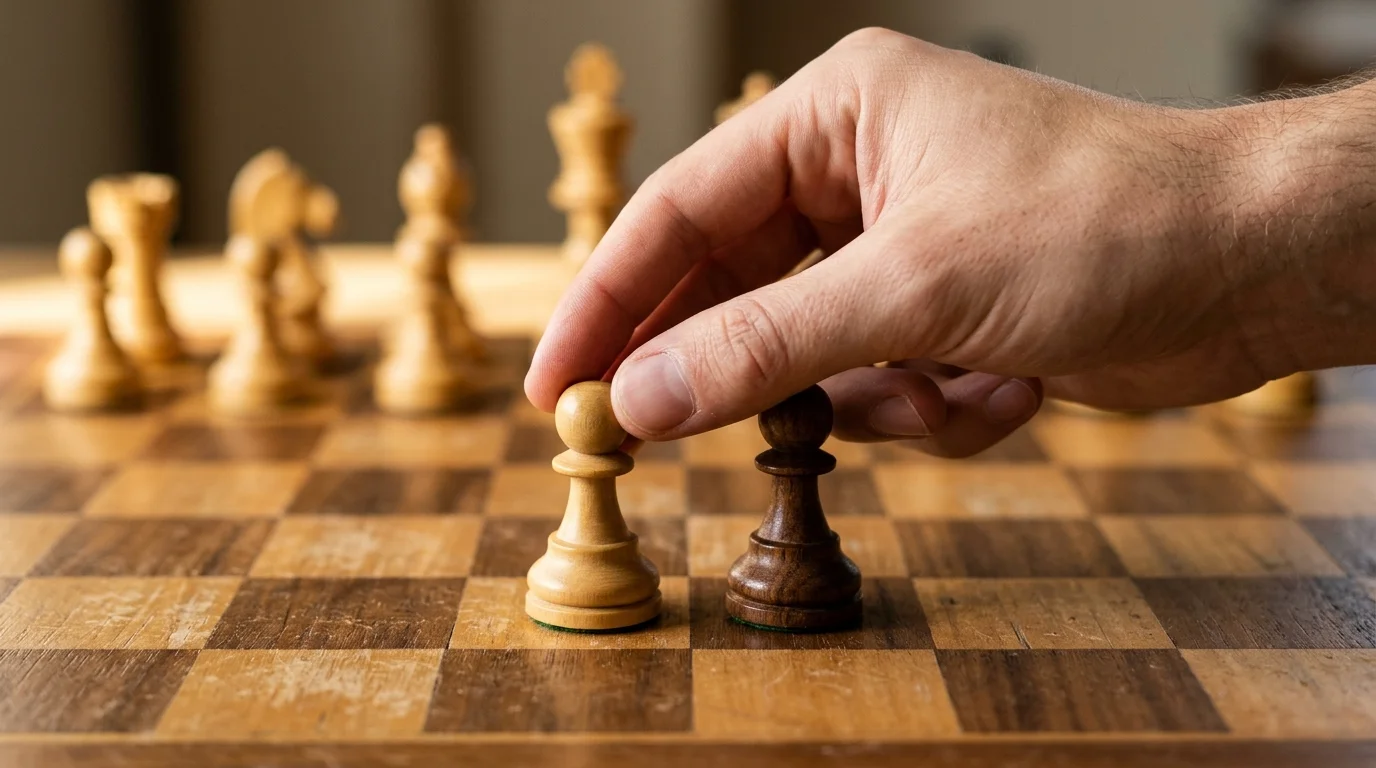
En passant (French for “in passing”) is a special pawn capture in chess. When a pawn moves two squares forward from its starting square and lands right beside an enemy pawn, that enemy pawn may capture it as if it had moved only one square. The capturing pawn moves diagonally onto the square that was skipped, and the pawn that moved two squares is taken off the board. It must be done on the very next move, or the chance is gone. This page explains the en passant rule with examples, when you can and cannot use it, how to write it down, and why it exists, and it has a free en passant trainer with nine positions to solve.
For the full rules of the game, see how to play chess, where you can also play a complete game against the computer.
Test yourself on nine positions, from the basic capture to the cases where en passant is not allowed and two famous checkmates. In some you have to find the move: tap the pawn, then the square. In others you decide whether en passant is possible. Every position was reached by real moves and checked against the official rules, and the last move played is highlighted.
You can capture en passant only when all four of these are true:
Your pawn then moves diagonally forward onto the square the enemy pawn passed over, and the enemy pawn is removed from the square where it stands. It is the only capture in chess where the capturing piece does not land on the square of the piece it takes.
| White captures | Black captures | |
|---|---|---|
| Capturing pawn stands on | Rank 5 | Rank 4 |
| The enemy pawn moved | From rank 7 to rank 5 | From rank 2 to rank 4 |
| Capturing pawn lands on | Rank 6, the square skipped | Rank 3, the square skipped |
| Example | Pawn on e5; Black plays …d7-d5; White plays exd6 | Pawn on b4; White plays a2-a4; Black plays …bxa3 |
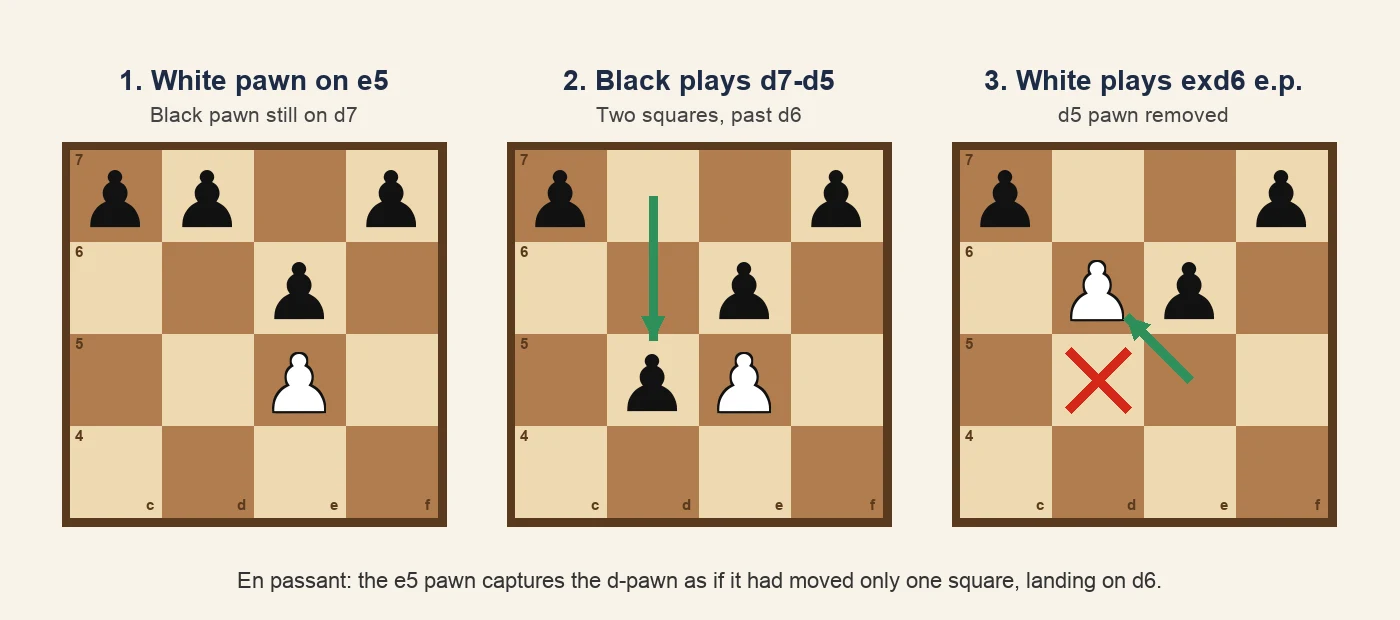
The classic example comes from the French Defence. After 1.e4 e6 2.e5, White’s pawn stands on e5. If Black now plays 2…d5, moving the d-pawn two squares, it skips d6, the square White’s pawn attacks. White can reply 3.exd6: the e5 pawn moves diagonally to d6 and the black pawn on d5 is removed. This exact capture was played by Wilhelm Steinitz against Bernhard Fleissig in Vienna in 1882.
Over the board, make the capture in one go: move your pawn to the empty square diagonally ahead, then take the enemy pawn off the board from beside it.
No. Like any capture in chess, en passant is optional: you can play a different move instead. The only time you must capture en passant is when it is your only legal move, for example when it is the only way out of check. Puzzle 8 in the trainer above is such a position: the en passant capture is White’s one legal reply, and it turns out to be checkmate.
In algebraic notation an en passant capture is written like any pawn capture: the file the pawn comes from, an x, and the square it lands on. The FIDE Laws of Chess allow “e.p.” to be added, so exd6 and exd6 e.p. mean the same move. The landing square is the empty square the enemy pawn skipped, not the square where the captured pawn stood.
In early forms of chess a pawn could only ever move one square. The two-square first move was added between the 13th and 16th centuries to speed games up. That created a problem: a pawn could now slip past an enemy pawn on the fifth rank without ever passing through the square it attacked. En passant restores the balance by letting the enemy pawn capture it exactly as if it had moved one square. The capture is described in the books of the 16th-century Spanish player Ruy López de Segura.
It was not used everywhere at first. In parts of Europe, particularly Italy, players followed a rule called passar battaglia, under which a pawn could pass freely. Italy only adopted en passant in 1880, in preparation for the 1881 Milan tournament.
| Game | What happened |
|---|---|
| Steinitz v Fleissig, Vienna 1882 | An en passant capture as early as move 3: 1.e4 e6 2.e5 d5 3.exd6 e.p. |
| Gundersen v Faul, Melbourne 1928 | White ended the game with an en passant capture that gave double check and checkmate: 15.hxg6 e.p.# (puzzle 9 in the trainer). |
| Segal v Podzielny, 1980 | The earliest of three known games with three en passant captures, the most ever recorded in one game. In none of the three did one player make all three captures. |
The Gundersen–Faul finish shows something only en passant can do. Removing the g5 pawn reopened the bishop’s diagonal, while the capturing pawn left the h-file open for the rook, so two pieces gave check without either of them moving. It is the only way to give a double check without moving one of the checking pieces.
En passant also matters for draws. Under the FIDE Laws, two positions only count as the same for threefold repetition if the same moves are possible in both. So a position in which an en passant capture was possible is not the same as the identical-looking position a move later, when the right has gone.
En passant is one of the three special moves in chess, with castling and pawn promotion. All three are explained in the chess rules guide, which also covers how to set up the board, how every piece moves, and check, checkmate and stalemate. For the names and moves of all six pieces, see chess pieces explained. For more board games, try checkers or Nine Men’s Morris.

After going through several successful experiences with several industry pioneers, Fadi Hayek has managed to excel in the world of content for online gaming by providing unique content for several projects that allowed him to obtain the necessary experience to launch his career. Last but not least, Fadi also holds several certificates, including but not limited to content marketing and iGaming.


