How to Play Checkers
Twelve pieces each, diagonal moves, compulsory jumps and kings: the rules of checkers (draughts), how to set up the board, and how to win.


Twelve pieces each, diagonal moves, compulsory jumps and kings: the rules of checkers (draughts), how to set up the board, and how to win.
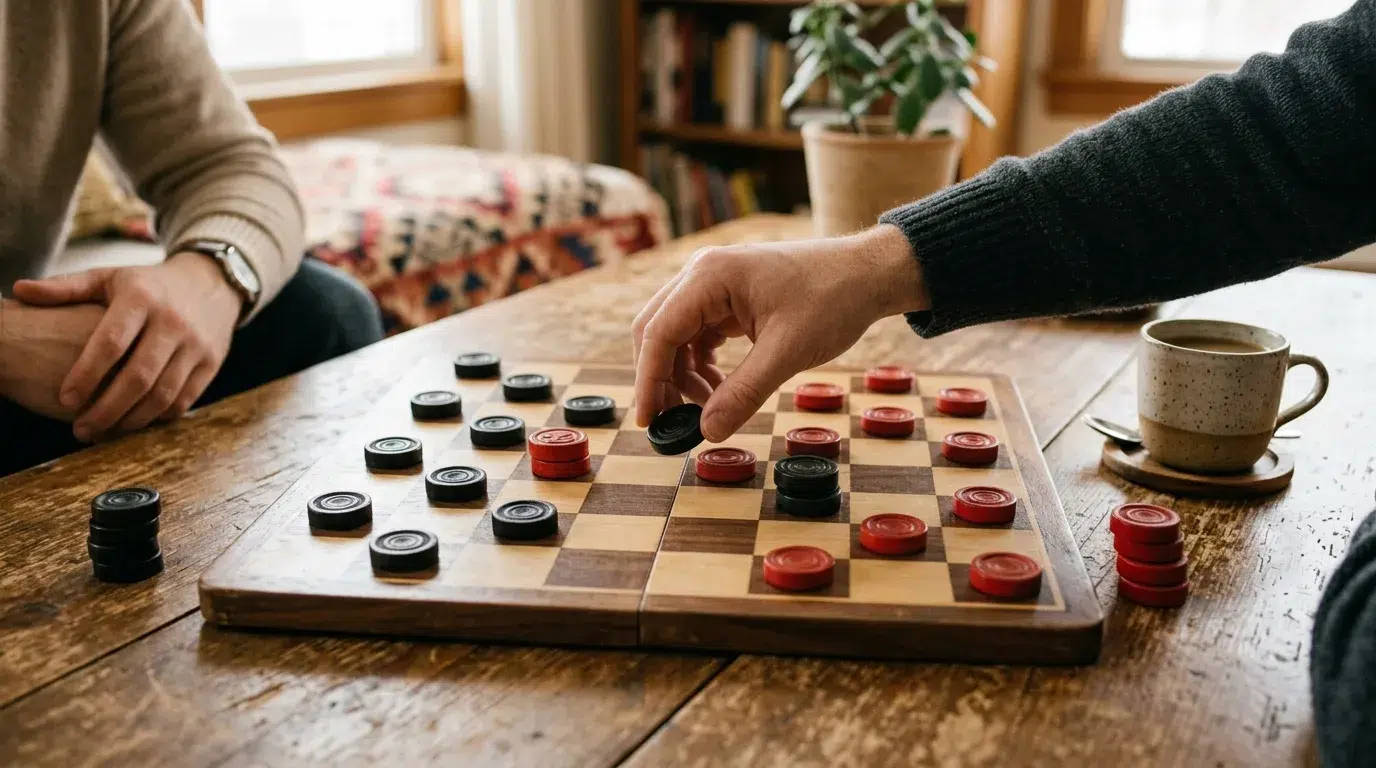
Checkers, called draughts in the UK, is a two-player strategy game played on an 8×8 board. Each player has 12 pieces that move diagonally forward, jump over the other side’s pieces to capture them, and become kings when they reach the far side. You win by capturing all your opponent’s pieces or leaving them with no legal move. There is no luck involved, and the rules fit on one page. This guide covers how to play checkers under the standard American and English rules, how to set up the board, the king rules, the most common questions, and the strategy that wins games.
| Checkers (English draughts) | |
|---|---|
| Players | Two. |
| Board | 8×8, 64 squares. Only the 32 dark squares are used. |
| Pieces | 24: 12 dark (black) and 12 light (red or white) per side. |
| First move | Black (the darker pieces) moves first. |
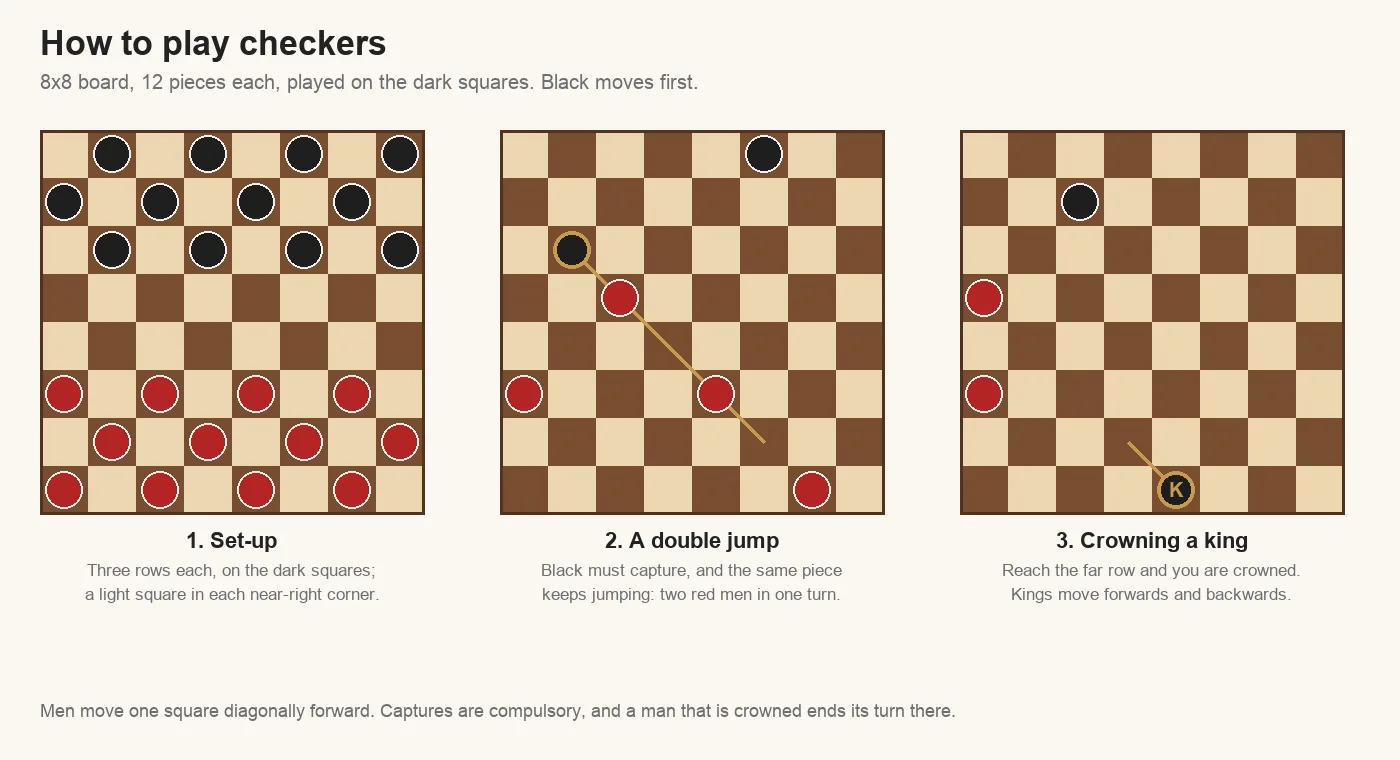
| Moves | One square diagonally forward onto an empty dark square. |
| Captures | Jump diagonally over an opponent’s piece onto the empty square beyond. Captures are compulsory, and one piece can make several jumps in a turn. |
| Kings | A piece that reaches the far row is crowned and can then move and capture backwards as well. |
| Winning | Capture all your opponent’s pieces or leave them with no legal move. If neither side can win, the game is a draw. |
| Question | Answer |
|---|---|
| Can you jump backwards in checkers? | Only with a king. Ordinary pieces move and jump forwards only. |
| Is jumping mandatory? | Yes, in the official rules. If you can jump, you must. |
| Can you choose which jump to make? | Yes. With two or more captures available, you pick one, even if another would take more pieces, but you must complete it. |
| What is “huffing”? | An old rule where a missed jump is punished by the opponent removing the piece that should have jumped. Official play dropped it in favour of making the jump compulsory, but some home sets still mention it. |
| How many pieces are in checkers? | 24 in all: 12 per player. |
| What if nobody can win? | The game is a draw, either by agreement or when neither player can force a win. |
Checkers is one member of a large family of draughts games. The main ones differ in board size and in what kings can do:
| Game | Board | How it differs |
|---|---|---|
| Checkers / English draughts | 8×8, 12 each | The rules on this page. Kings move one square; men capture forwards only. |
| International draughts | 10×10, 20 each | Men capture backwards too, kings “fly” any distance along a diagonal, and you must take the most pieces possible. Played across Europe and parts of Africa. |
| Russian draughts | 8×8, 12 each | Flying kings and backwards captures, and a man crowned in the middle of a jump keeps jumping as a king. |
| Brazilian draughts | 8×8, 12 each | International rules on the smaller board. |
| Pool checkers | 8×8, 12 each | Flying kings and backwards captures; played mainly in the south-eastern United States. |
| Dama (Filipino checkers) | 8×8, 12 each | Played in the Philippines, often on a board of crossed diagonal lines; close to Brazilian draughts, with the most-pieces capture rule. |
| Turkish draughts | 8×8, 16 each | Pieces move straight forwards and sideways rather than diagonally. |
Checkers was solved in 2007. A team led by Jonathan Schaeffer at the University of Alberta, whose program Chinook was first written in 1989, proved that with perfect play by both sides the game is always a draw. There are about 500 billion billion possible positions (500,995,484,682,338,672,639).
The number of possible games grows quickly. Black has 7 possible first moves; counting single moves by either player, the totals are:
| Moves played | Possible games |
|---|---|
| 1 | 7 |
| 2 | 49 |
| 3 | 302 |
| 4 | 1,469 |
| 6 | 36,768 |
| 8 | 845,931 |
| 10 | 18,391,564 |
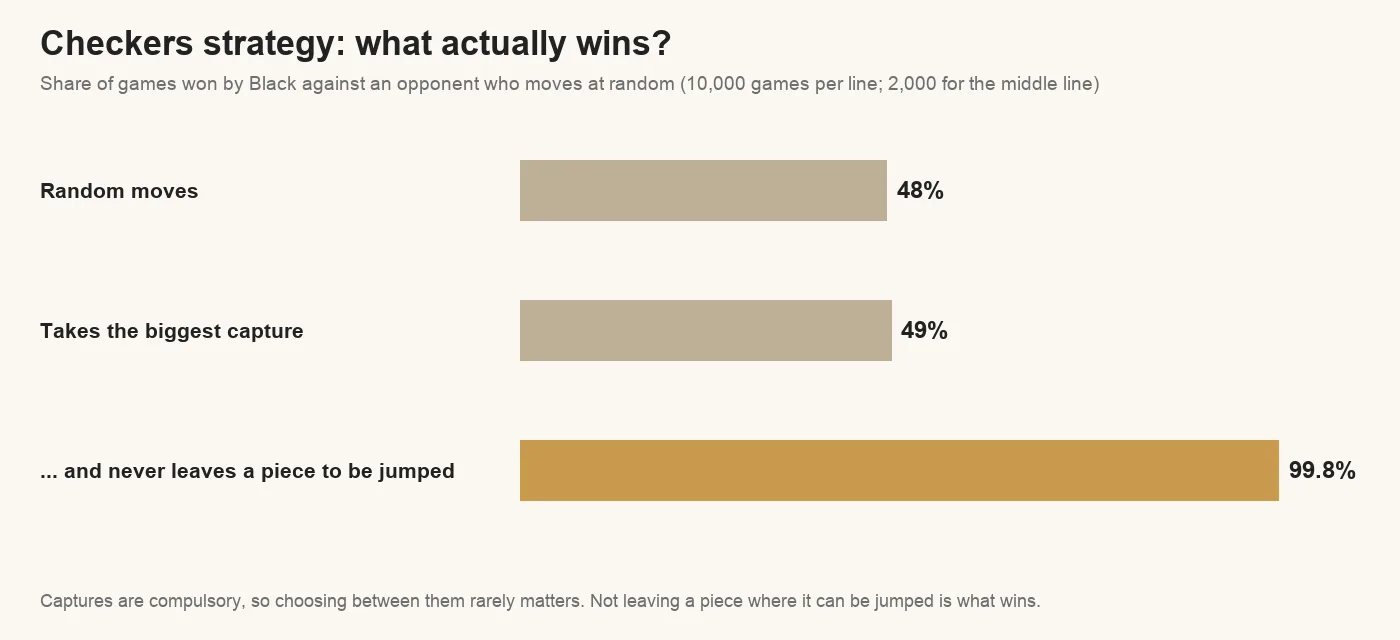
Between ordinary players, two simple habits make the difference. In 10,000 simulated games between two players moving at random, Black won 48% and Red 52%, and a typical game lasted 28 moves each. A player who always took the biggest available capture did no better, winning 49%, because captures are compulsory anyway. But a player who also never left a piece where it could be jumped won 99.8% of games.
The shortest possible game of checkers lasts 20 moves: Martin Bryant’s exhaustive analysis in 2003 found 247 such games.
Checkers most likely grew out of alquerque, a game played on a 5×5 grid of lines that the 10th-century Arabic Book of Songs mentions as al-qirkat and that the Moors brought to Spain. Moved onto a chessboard, it was probably being played in southern France by around 1100. The rule that captures are compulsory comes from France, where the game was called jeu forcé. The first book on the game in English, by the mathematician William Payne, appeared in 1756, and the world championship of English draughts dates back to the 1840s. Marion Tinsley, world champion from 1955 to 1962 and from 1975 to 1991, is widely considered the greatest checkers player ever; he beat Chinook in a match in 1992.
For another strategy game for two, try mancala or backgammon. For tiles, see the dominoes guide, and for a race game with marbles for up to six players, Chinese checkers.
A board game with dice: Trouble, the race-and-chase game with the Pop-O-Matic die.
A strategy game with hidden pieces: Game of the Generals, the Filipino war game.

After going through several successful experiences with several industry pioneers, Fadi Hayek has managed to excel in the world of content for online gaming by providing unique content for several projects that allowed him to obtain the necessary experience to launch his career. Last but not least, Fadi also holds several certificates, including but not limited to content marketing and iGaming.


