How to Play Rummy
The rules of rummy step by step: how many cards to deal, how sets and runs work, laying off, going out and scoring, then the house rules, a few tips and the best-known variants, from gin rummy to Indian 13-card rummy.


The rules of rummy step by step: how many cards to deal, how sets and runs work, laying off, going out and scoring, then the house rules, a few tips and the best-known variants, from gin rummy to Indian 13-card rummy.
If you're searching for the best rummy gaming experience, there are plenty of things to consider. Players need a good quality online rummy platform, security, game integrity, generous cash prizes and fantastic promotions. Unfortunately, finding a casino that fits all the criteria is not always easy. Still, the casinos on the list below are each set out with the licence they hold and what their lobby offers. So feel free to browse the list below to find a trusted casino.
Casino availability varies by country. Pick yours below to filter this list, or read each review for the operator's own terms.


18+ | Gamble responsibly | GambleAware.org T&C’s apply
18+ | Gamble responsibly | GambleAware.org T&C’s apply
18+ | Gamble responsibly | GambleAware.org T&C’s apply
18+ | Gamble responsibly | GambleAware.org T&C’s apply
18+ | Gamble responsibly | GambleAware.org T&C’s apply
18+ | Gamble responsibly | GambleAware.org T&C’s apply
18+ | Gamble responsibly | GambleAware.org T&C’s apply
21+ | Gamble responsibly | GambleAware.org T&C’s apply
There are plenty of casinos offering a variety of rummy games in the industry; however, finding casinos that offer the full secure experience takes some time and effort. Those who would prefer to save time and skip this process are free to look at the comprehensive list of pre-checked casinos here. Although, there are some steps that players can take to ensure they find the best online rummy casinos themselves. So, here is what to look out for when searching to play rummy online.

When playing at a new online casino, the first thing to check is the casino site's security. This includes checking when the casino is licensed by a relevant gambling authority and ensuring that they provide a safe gaming environment for their players. Safe platforms will also use the most up-to-date security technology on their website, usually 127-bit or 256-bit security encryption. You will be able to see this demonstrated on their website.

Next, a good indicator of whether a casino offers a quality gaming experience is its reputation. Players can find online and independent reviews for many casinos. A significant number of casino reviews are also available on this site. Look for customer satisfaction and reliability of payouts too. Payment options are also important; look at whether your preferred choice is available and if the transaction times fit your expectations.

A solid bonus or promotion is another tell-tale sign of a good casino. That doesn't mean promotions that only offer huge matchups or extra instant cash. Those who want to win big cash rewards should look for casinos that provide lucrative promotions with viable terms and conditions. Players should check that playing rummy online at the casino is valid for a particular bonus and what the wagering or playthrough conditions are for it too.

Lastly, there are so many different varieties of online rummy games that players need to check that their favourite type is available. Alternatively, you can review the casinos listed here, as the majority offer a massive selection of the best rummy varieties. However, the basic rules for the variants are the same, so it's often worth picking a casino with a good selection of different types for when you feel like a change!
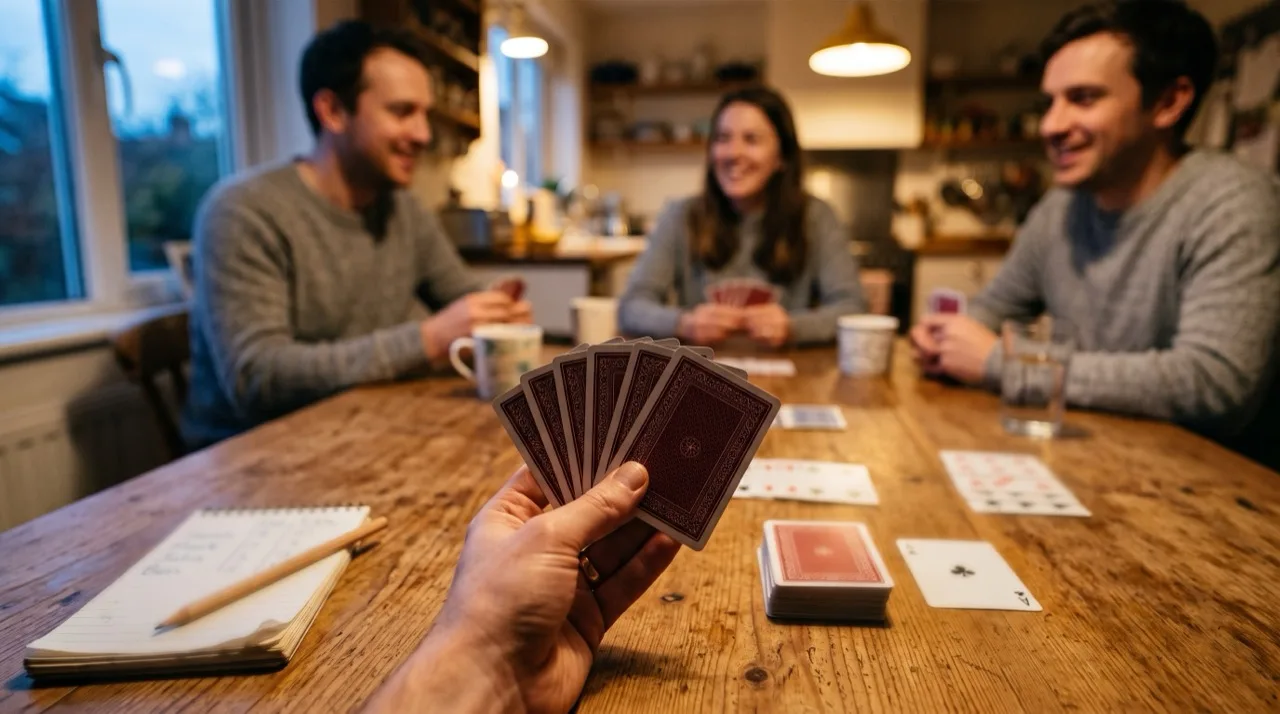
Rummy is the family of card games where you collect cards into sets and runs and try to be the first to empty your hand. The basic game, sometimes called straight rummy or Rum, takes five minutes to learn and works for two to six players with one ordinary deck. This guide explains how to play rummy step by step: the deal, the turn, melding and laying off, going out and scoring. After that come the house rules people argue about, some tips, and the variants you are most likely to meet: gin rummy, Indian 13-card rummy, Tongits and more.
You need one standard 52-card deck, no jokers, and something to keep score with. Cards rank from low to high: Ace, 2, 3, 4, 5, 6, 7, 8, 9, 10, Jack, Queen, King. In the basic game the ace is always low.
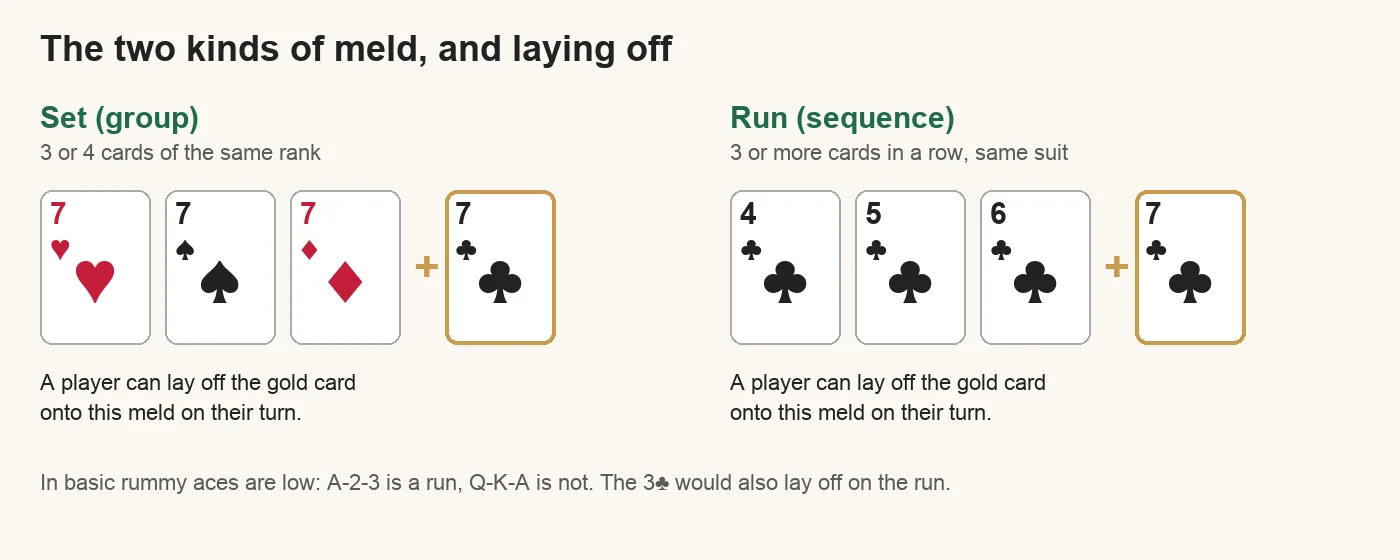
The aim is to get rid of all your cards. You do that in three ways: melding (laying a combination face up in front of you), laying off (adding cards to a combination already on the table) and discarding one card at the end of each turn. There are two kinds of combination, or meld:
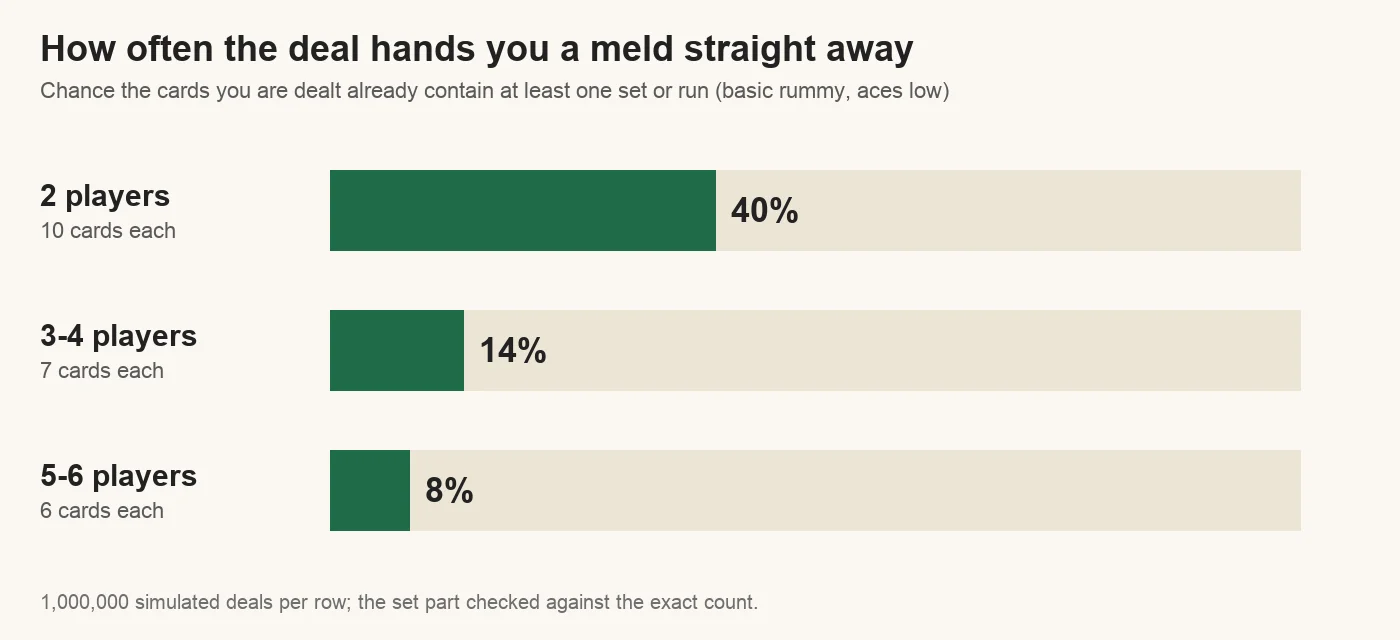
| Players | Cards each | Chance the deal already holds a meld |
|---|---|---|
| 2 | 10 | 40% |
| 3 or 4 | 7 | 14% |
| 5 or 6 | 6 | 8% |
Deal the cards one at a time, face down. Turn the next card face up to start the discard pile and put the rest face down beside it as the stock. With two players the deal alternates; with more, it passes to the left.
The player to the dealer’s left goes first and play continues clockwise. Every turn has the same three parts.
Laying off means the card must still make a valid meld. If 4♣ 5♣ 6♣ is on the table you can add the 3♣ or the 7♣; if three sevens are down you can add the fourth. You cannot rearrange melds already on the table.
Going out. The hand ends the moment someone gets rid of their last card, whether by melding, laying off or discarding it. Nobody else gets a final turn, even if they are holding complete melds.
If the stock runs out and the next player does not want the top discard, turn the discard pile over to make a new stock and carry on. Many players shuffle it first, which is the version most rule books now give.
When someone goes out, the other players count the cards still in their hands, whether or not those cards would have made melds:
| Card | Points |
|---|---|
| King, Queen, Jack | 10 each |
| 10 down to 2 | Face value |
| Ace | 1 |
The winner adds the total of everyone else’s cards to their score. The game is played to an agreed target, often 100 or 500, or for a fixed number of deals.
| Example (three players) | Cards left | Points |
|---|---|---|
| You go out | None | You score 43 |
| Player B | K, 9, 4 | 23 |
| Player C | A, 2, 7, Q | 20 |
Going rummy. If you go out in a single turn, laying down your whole hand without having melded or laid off anything before, that is called going rummy and most people double the score. In the example above you would score 86 instead of 43.
Rummy is played at home far more than in clubs, so rules vary. Agree these before the first deal:
The deal itself rarely does the work for you. With seven cards, only 14% of hands start with a ready-made set or run, so most of the game is about building them:
More tactics are in our rummy tips guide.
Rummy itself is mostly played on dedicated card-game apps and sites. The casinos below carry card and live-dealer tables; each review covers the welcome offer, the games and the payment methods.

Wagering: 40x

Wagering: 35x

Wagering: 35x
The popularity of rummy stems from the simplicity of the game. Yet, the multiplayer game still requires some skill and logical thinking, so it is a fantastic game to play tactically and use decision-making skills. There are plenty of advantages to playing rummy, apart from improving your mental agility. So let’s break down the pros and cons of playing online rummy.

Once you know basic rummy, every other version is a change to the deal, the melds or the scoring. These are the ones you are most likely to be asked to play.
The best-known two-player version. Each player gets 10 cards and nobody melds during play. Instead, when the unmatched cards in your hand (your deadwood) total 10 points or less, you can knock: discard face down and show your hand. Your opponent then lays off what they can on your melds, and the player with the lower deadwood scores the difference. Knocking with no deadwood at all is going gin and earns a 20-point bonus; if your opponent’s count is equal to or lower than yours, you have been undercut and they score the difference plus 10. A game goes to 100 points (full rules and scoring in our gin rummy rules guide). In Oklahoma Gin the first upcard sets the knocking limit, and a spade upcard doubles the scores for that deal.
Played with two decks plus printed jokers for up to six players, each dealt 13 cards. A card is turned up at the start and every card of that rank becomes a wild joker. Nothing is melded during play: you build your 13 cards in hand and declare when they are complete. To declare you need at least two runs, one of them pure (made without any joker); the rest can be sets or runs with jokers. Online it comes in three formats: points rummy, a single deal where a losing hand is capped at 80 points; pool rummy, where players drop out on reaching 101 or 201 points and the last one left wins; and deals rummy, a fixed number of deals with chips passing to each winner.
Tongits is the Philippines’ three-player rummy variant, and it differs from the international versions in ways that matter: the player count is fixed at three, you may lay cards onto your opponents’ combinations as well as your own, and a player who never exposes a meld loses the hand automatically however few points they hold. The Tongits rules guide covers the deal, the scoring and the points on which the published rulebooks contradict each other.
Seven rounds, each with a required combination (the contract) you must lay down before you can meld anything else, starting with two sets of three and ending with three runs of four. Players get 10 cards in the first three rounds and 12 in the last four, and the lowest total of penalty points after seven rounds wins. Shanghai rummy and May I? are close relatives, and the card game Phase 10 is built on the same idea.
Here the cards you meld score points for you, and you may take more than one card from the discard pile as long as you use the deepest one straight away. The first player to reach 500 wins. Many people simply call this game “rummy”. See the full Rummy 500 rules.
A partnership game with two decks and four jokers, in which jokers and twos are wild and the aim is to build canastas: melds of seven cards of the same rank. It is said to have started in Montevideo, Uruguay, in 1939 and was a craze across the Americas in the 1950s.
Rummy with 106 numbered tiles instead of cards (numbers 1 to 13 in four colours, twice over, plus two jokers). Players can rearrange everything on the table to fit their tiles in. It was brought to the West by the Israeli games inventor Ephraim Hertzano.
The real bonus of rummy’s popularity is that the online version is available globally for players, both free games and real cash rummy. Everyone can benefit from playing this fantastic card game. The online rummy experience is spectacular. Casinos don’t drop their standards for free rummy games either; apart from being available for everyone, they are also a great place to practice games and strategies.
Although playing rummy is traditionally a social game, it might sometimes be challenging to find others who are motivated to play it in the same way. That’s where online rummy games come in and provide the opportunity to play with others anytime, anywhere. However, there are some differences between playing rummy online for real cash prizes and playing free rummy games. Let’s take a look at the benefits and disadvantages of both here.
 Cash rummy games offer players the chance to win real money
 There's no option to practice during real money games Playing rummy online is exciting and mentally stimulating Bonuses and promotions can be used to play online rummy There are lots of different variations to play Rummy tournaments are available for very attractive cash prizes There are no cash prizes when you play rummy for free You can have practice games to test your rummy skills Playing for free can also be exciting Free rummy doesn't offer any bonuses There are also different kinds of free rummy, just not as many may be provided as cash rummy Free rummy games are just for fun
With two players, gin rummy is the more popular choice: hands are short, and the knock-or-wait decision adds a layer of strategy. With three to six players, basic rummy works better, because everyone melds in the open and there is always a meld to lay off on. Indian 13-card rummy suits players who like building a whole hand in secret, and it is the version most rummy apps are built around.
If rummy is India’s game of skill, Teen Patti is its game of nerve — three cards each, and three hands in four are nothing at all. Our guide counts every one of the 22,100 possible hands, shows why the ranking is inverted at the top, and explains what India’s 2025 online-gaming law changed for both games at once.
Whatever you play, set a budget before you play for real money and stick to it. Free, confidential support is available at BeGambleAware.org. 18+ only.
Also worth a look: the full rules of Canasta — melds, canastas, red threes and scoring to 5,000.
Another family card game: Switch, the British version of Crazy Eights, with power cards that make the next player pick up.
Rummy with a new wild card every round: Five Crowns, played over 11 rounds from 3 cards up to 13.
Rummy with tiles: Mahjong, the four-player Chinese game of drawing, discarding and building sets.
Rummy with tiles: Rummikub, where every set on the table can be split and rearranged.

After going through several successful experiences with several industry pioneers, Fadi Hayek has managed to excel in the world of content for online gaming by providing unique content for several projects that allowed him to obtain the necessary experience to launch his career. Last but not least, Fadi also holds several certificates, including but not limited to content marketing and iGaming.


