Chicken Foot Dominoes Rules
Fill the four sides of the double, grow a three-toed foot from every double and keep your score low: how to play Chicken Foot dominoes.


Fill the four sides of the double, grow a three-toed foot from every double and keep your score low: how to play Chicken Foot dominoes.
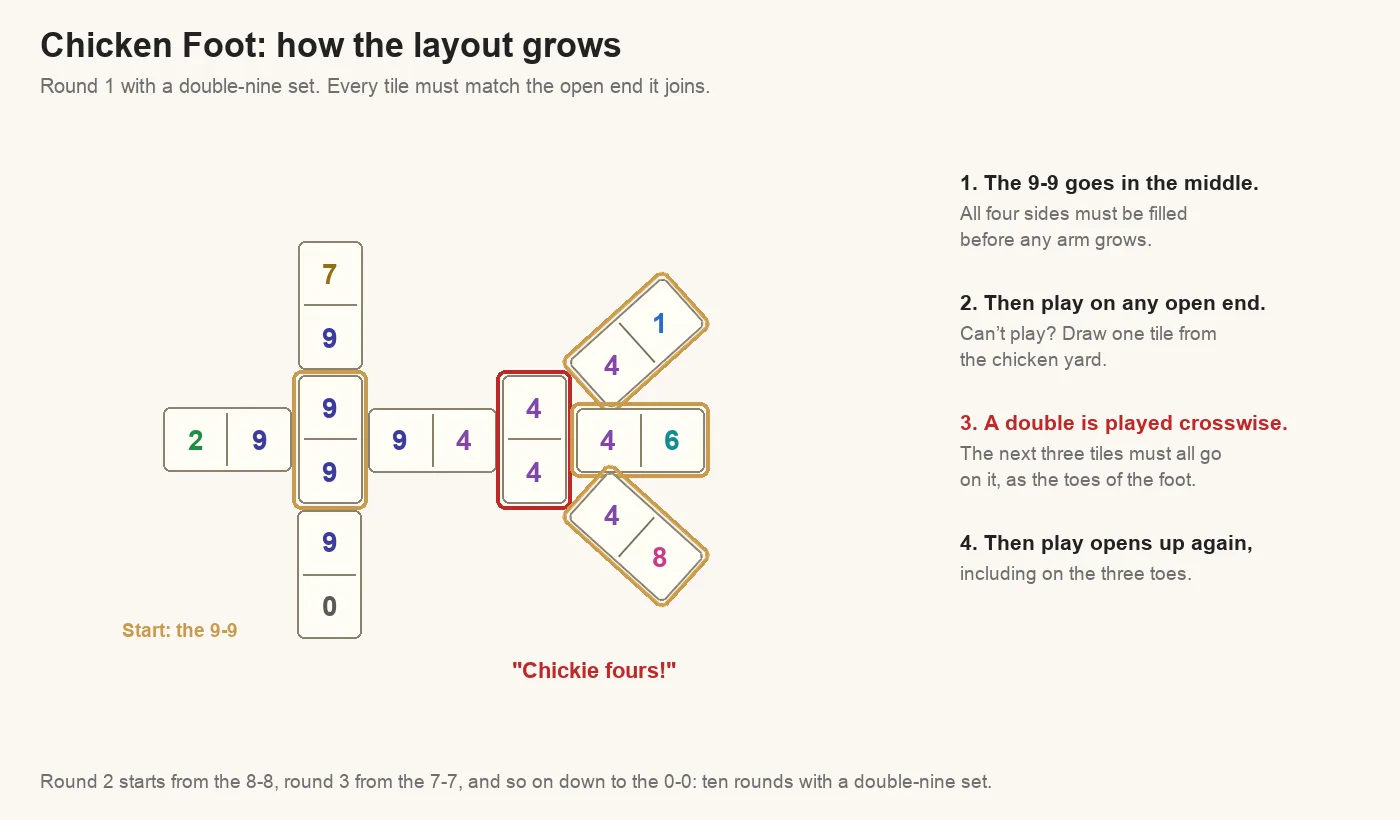
Chicken Foot is a dominoes game for two or more players, best with four to eight. Play starts from a double in the middle of the table and spreads out in every direction, and whenever someone plays a double, the next three tiles must branch off it like the toes of a chicken’s foot. Each round, the aim is to empty your hand; the pips left in everyone else’s hand are their score, and after the last round the lowest total wins. It is also called Chickenfoot, Chickie Dominoes and Chicken Dominoes. House rules vary, so this guide gives the most common Chicken Foot dominoes rules and the main variations.
| Chicken Foot | |
|---|---|
| Players | Two or more, best with four to eight. |
| Tiles | A double-nine set of 55 dominoes. Larger groups use a double-twelve set or bigger. |
| Tiles each | Depends on the set and the number of players: 11 each for four players with a double-nine set. |
| Rounds | One for each double: ten with a double-nine set, from the 9-9 down to the 0-0. |
| Each turn | Play one matching tile on an open end. Can’t play? Draw one tile from the chicken yard. |
| Doubles | Played crosswise. The next three tiles must go on the double, making the chicken foot. |
| Scoring | Pips left in your hand count against you. The 0-0 usually counts 50. |
| Winning | The lowest total after the last round. |
A double-nine set is standard: every pair of numbers from 0 to 9, doubles included, which makes 55 tiles carrying 495 pips. Each number appears on ten tiles. With a large group, a double-twelve set (91 tiles) or a double-fifteen or double-eighteen set gives everyone enough tiles, and two or three players can make do with an ordinary double-six set. You also need pencil and paper for the score.
The number of tiles each player draws depends on the set and the number of players. This is the table published by the domino maker Puremco:
| Players | Double-nine | Double-twelve | Double-fifteen |
|---|---|---|---|
| 2 | 20 | ||
| 3 | 14 | ||
| 4 | 11 | 18 | |
| 5 | 9 | 14 | |
| 6 | 7 | 12 | 18 |
| 7 | 10 | 15 | |
| 8 | 9 | 14 |
Many groups start with fewer tiles, for example seven each, and some sets come with their own chart.
Any double you play goes crosswise across the end of the line, and you announce it: for a 4-4, “Chickie fours!”. From that moment, the next three tiles played by anyone must go on the far side of the double, each with a 4 against it. They are angled away from each other so the double and its three branches look like a chicken’s foot; the three branches are the toes.
Until the foot is complete, nothing can be played anywhere else on the table. A player with no matching tile draws one from the chicken yard, plays it on the foot if it fits, and otherwise passes. Once the third toe is down, play opens up again on every open end, including the three new toes. The starting double works the same way, except that it needs four tiles, one on each side.
A round ends when one player plays their last tile, or when the chicken yard is empty and nobody can play. That can happen when someone plays a double late in the round and not enough tiles with its number are left to finish the foot. Each player then adds up the pips on the tiles left in their hand, and that is their score for the round. A player who went out scores 0. The 0-0 is the exception: in the usual rules, getting stuck with it costs 50 points.
The next round starts from the next double down, the 8-8, then the 7-7, and so on. With a double-nine set, the tenth and last round starts from the 0-0. After the last round, the player with the lowest total wins. If two players tie, the one with more rounds at 0 wins.
| Variation | How it differs |
|---|---|
| Sides on the starting double | Some groups fill only three sides of the starting double, so the opening looks like a Y. Others allow six or even eight tiles around it, which gives everyone more places to play. |
| Double chicken foot | The first double played gets three toes on each side instead of one side only. |
| Chicken Little rule | You must announce your last tile. Forget, and if another player points it out first, you draw a tile; if the chicken yard is empty, you miss your next turn. |
| Going out on a double | Some groups don’t allow a round to end on a double: a player whose last tile is a double scores 50. |
| Value of the 0-0 | 25 points instead of 50, or just 0 in some groups. |
| Playing to a target | Instead of one round per double, keep playing until someone reaches an agreed total. That player loses, and the lowest score wins. |
Both games belong to the same family of domino games, and both start each round from a central double that drops by one every round. The difference is in how the table grows:
| Chicken Foot | Mexican Train | |
|---|---|---|
| Usual set | Double-nine (55 tiles) | Double-twelve (91 tiles) |
| Layout | One shared layout that branches out in every direction | Each player builds their own train, plus the shared Mexican Train |
| Playing a double | Needs three tiles on it, the toes | Needs one tile to cover it |
| Opening | All four sides of the starting double are filled first | Players start their own trains from the engine |
| Markers | None | A marker opens your train to everyone |
For the full rules of the other game, see Mexican Train dominoes.
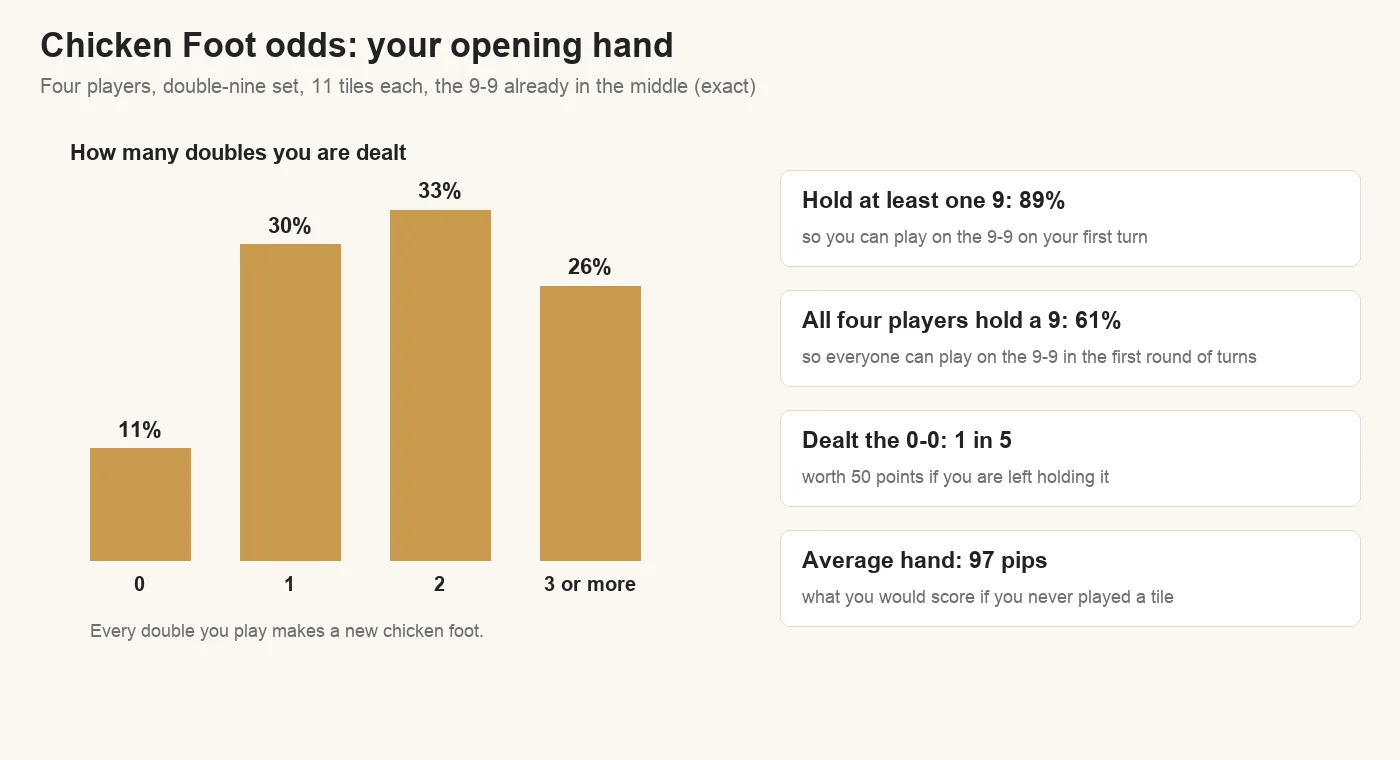
With four players and a double-nine set, the 9-9 in the middle and 11 tiles each, these are the exact chances for your opening hand in round 1:
Chicken Foot is a version of the older domino game Maltese Cross and seems to have started in Texas or Mexico. Jennifer A. Kelley’s Great Book of Domino Games (1999) credits Louis and Betty Howsley with inventing it in 1986. It belongs to the same family of domino games as Mexican Train.
Chicken Foot is one of many games you can play with a set of dominoes. The dominoes rules guide covers the basic block and draw games and how scoring works, and Mexican Train is the other favourite for a big group.

After going through several successful experiences with several industry pioneers, Fadi Hayek has managed to excel in the world of content for online gaming by providing unique content for several projects that allowed him to obtain the necessary experience to launch his career. Last but not least, Fadi also holds several certificates, including but not limited to content marketing and iGaming.


