Mexican Train Rules
Build your train from the 12-12, cover your doubles and keep your score low: how to play Mexican Train dominoes.


Build your train from the 12-12, cover your doubles and keep your score low: how to play Mexican Train dominoes.
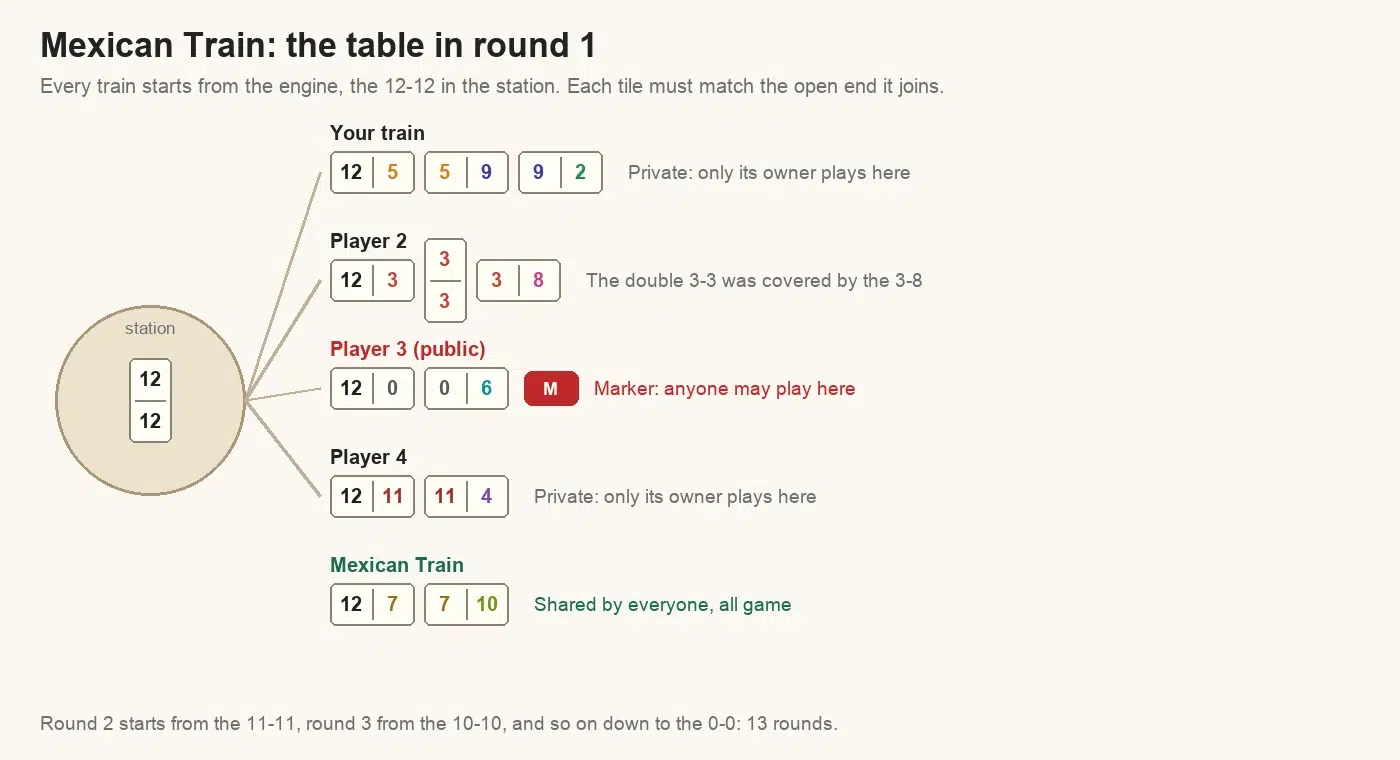
Mexican Train is a dominoes game for two to eight players. Each player builds their own line of tiles, a train, out from a central double, and there is also a shared train, the Mexican Train, that anyone can play on. The first player to get rid of all their tiles ends the round, the others score the pips left in their hands, and after 13 rounds the lowest total wins. There is no single official rulebook, so groups play slightly different versions; this guide gives the most widely used Mexican Train rules and points out where they vary.
| Mexican Train | |
|---|---|
| Players | Two to eight. |
| Tiles | A double-twelve set of 91 dominoes, plus one marker per player (coins or small trains). |
| Tiles each | 15 with two to four players, 12 with five or six, 11 with seven or eight (some rules say 10). |
| Rounds | 13: the first starts from the 12-12, the last from the 0-0. |
| Each turn | Play one tile on your train, the Mexican Train or any marked train. Can’t play? Draw one tile. |
| Scoring | Pips left in your hand count against you. The player who goes out scores 0. |
| Winning | The lowest total after 13 rounds. |
The game is played with a double-twelve set: every pair of numbers from 0 to 12, doubles included, which makes 91 tiles carrying 1,092 pips. You also need one marker per player, and pencil and paper for the score. Many sets come with a plastic station or hub that holds the starting double and spaces the trains evenly, plus small train-shaped markers, but neither is essential. Smaller groups can play with a double-nine set of 55 tiles.
A double is laid crosswise and must be covered: the player who played it immediately plays a second tile on it, so a double is the one way to play two tiles in a turn. If you can’t cover your double, draw one tile and play it if it fits; if it still doesn’t, put your marker out. The next player must then cover the double before anything else can be played anywhere, and anyone who fails puts their own marker out too. A double does not need covering if every other tile with that number has already been played.
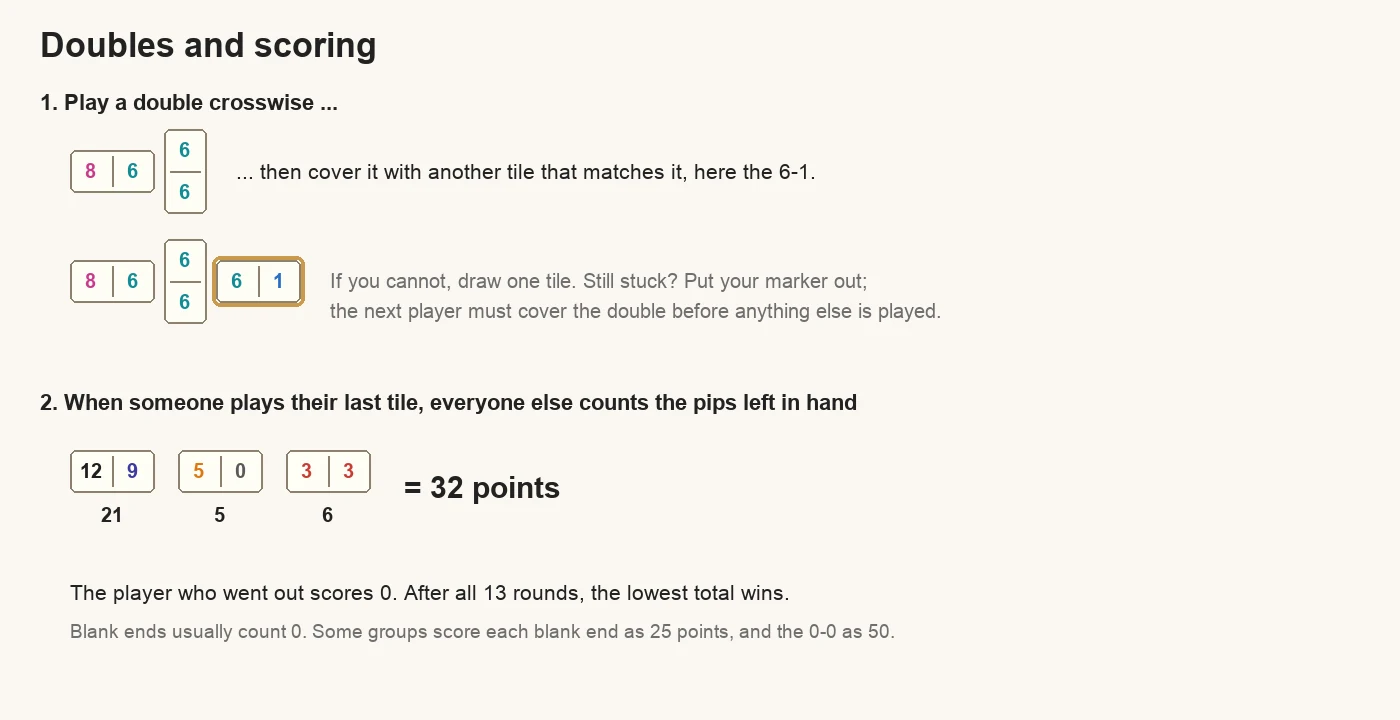
A round ends as soon as one player plays their last tile, or when the boneyard is empty and nobody can play. The player who went out scores 0; everyone else adds up the pips on the tiles left in their hand. A blank end counts 0 in the usual rules. Then the next double down becomes the engine: 11-11 in round 2, 10-10 in round 3, and so on to the 0-0 in round 13.
After 13 rounds, the player with the lowest total wins. If two players tie, the one with more rounds at 0 wins. Many groups also ask a player with one tile left to tap the table as a warning.
| Variation | What changes |
|---|---|
| Fast start | In the first turn of a round, each player lays as much of their own train as they can, then normal turns begin. |
| Shorter game | Play fewer than 13 rounds, or use a double-nine set (55 tiles) and start from the 9-9. |
| Partnerships | With four, six or eight players, partners sit opposite and share a train. A team scores together, and the player who went out counts 0 for the team. |
| Scoring blanks | Each blank end counts 25 points, and the 0-0 counts 50. |
| Tiles for seven or eight | Some rules deal 10 tiles each instead of 11. |
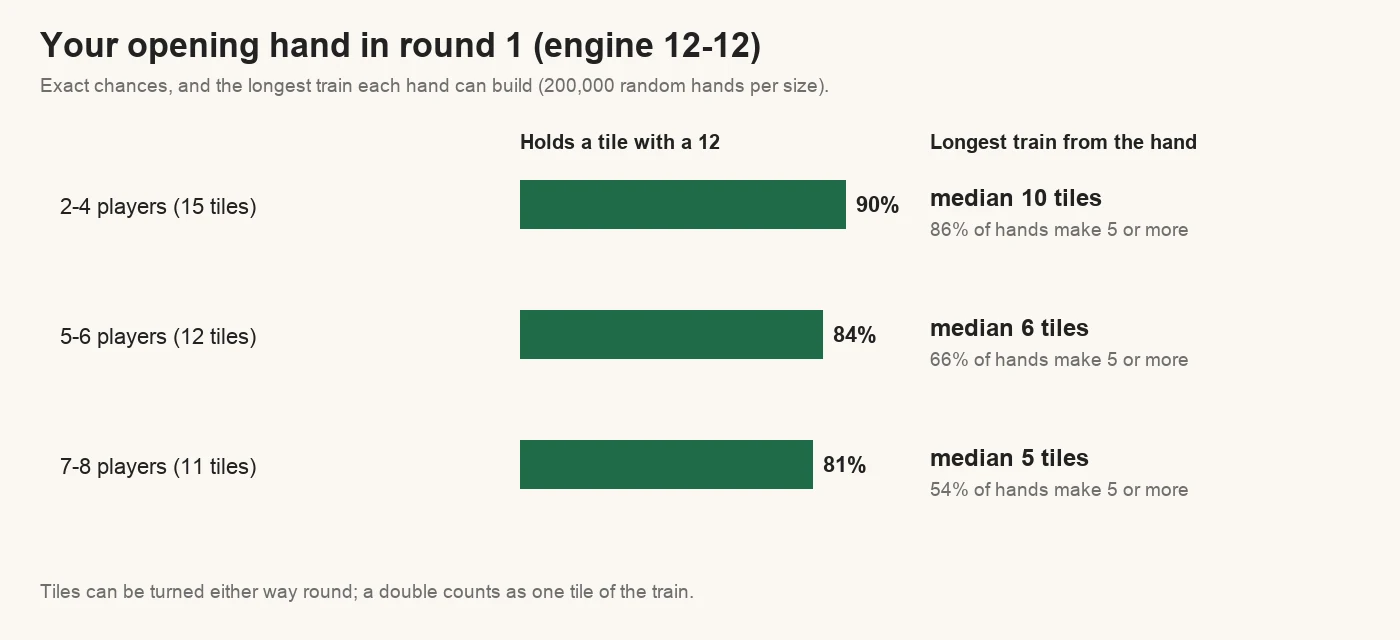
In round 1, with the 12-12 in the station, twelve other tiles carry a 12. How often your opening hand includes one of them, and how long a train your own tiles can build:
| Players | Tiles each | Hand holds a 12 | Longest train (median) |
|---|---|---|---|
| 2 to 4 | 15 | 90% | 10 tiles |
| 5 or 6 | 12 | 84% | 6 tiles |
| 7 or 8 | 11 | 81% | 5 tiles |
The average tile carries 12 pips, so a hand of 15 tiles is worth about 180 points if you are caught with all of it. The train lengths come from 200,000 random hands of each size.
Mexican Train is one of the games covered in the dominoes rules guide, which also explains the block and draw games and All Fives. For a card game built on the same idea, try Sevens, and for another game for a big group, Bunco.
A related game: Chicken Foot dominoes, where every double grows three toes and everyone plays on one layout.

After going through several successful experiences with several industry pioneers, Fadi Hayek has managed to excel in the world of content for online gaming by providing unique content for several projects that allowed him to obtain the necessary experience to launch his career. Last but not least, Fadi also holds several certificates, including but not limited to content marketing and iGaming.


