Tiger and Goat Game
Play Aadu Puli Attam (Puli Meka) and Bagh Chal free against the computer, as the tigers or the goats, and learn the rules, the boards and how to win.


Play Aadu Puli Attam (Puli Meka) and Bagh Chal free against the computer, as the tigers or the goats, and learn the rules, the boards and how to win.
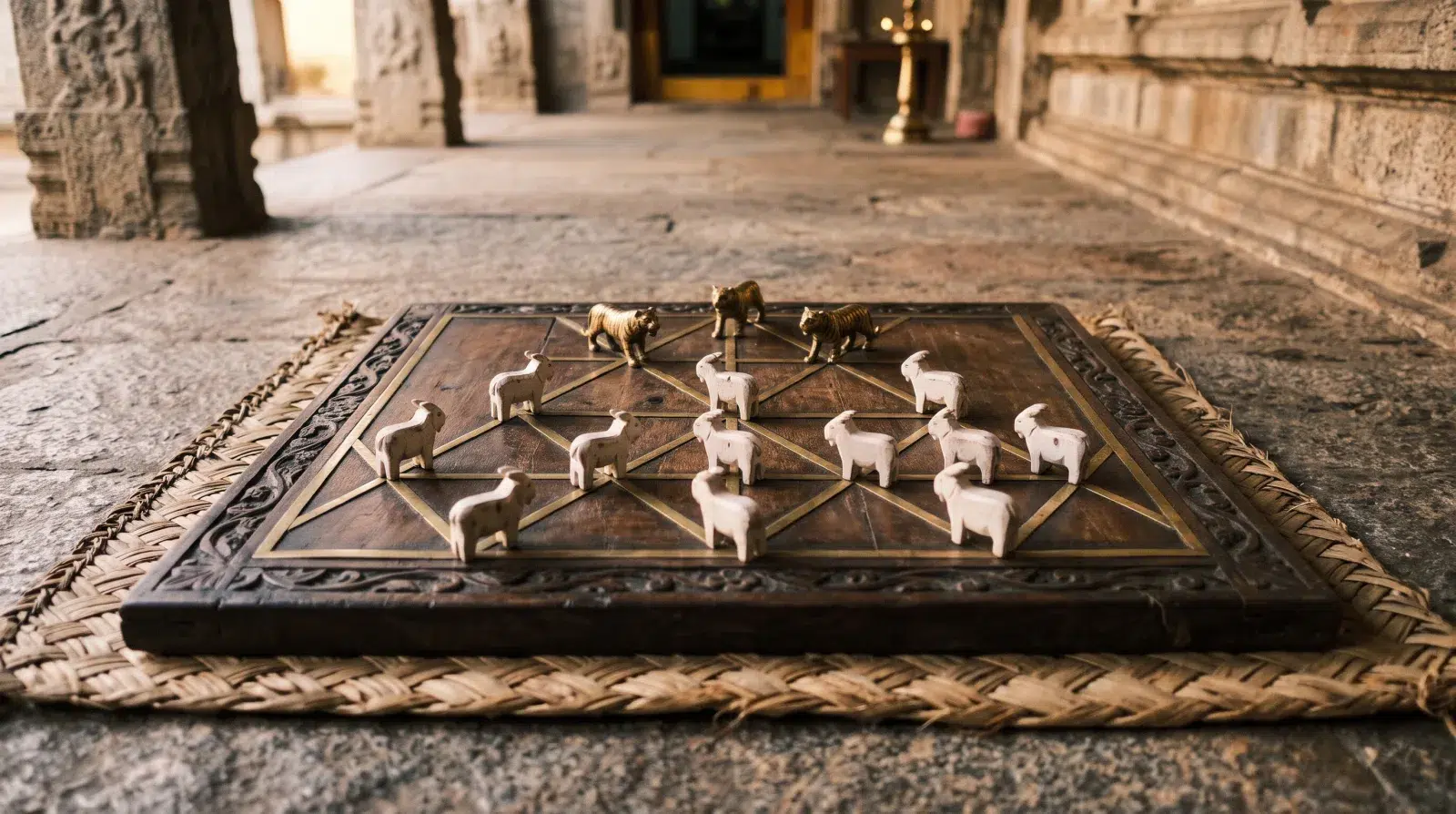
The tiger and goat game is one of the oldest board games of South Asia. One player has a few tigers, the other a herd of goats. The tigers hunt by jumping over goats and eating them; the goats win by crowding round the tigers until not one of them can move. It is called Aadu Puli Attam in Tamil, Puli Meka or Pulijudam in Telugu, Aadu Huli or Huli Katti in Kannada, and in Nepal the four-tiger version is Bagh Chal.
Below you can play both versions free against the computer, as the goats or as the tigers. Then read the rules step by step, the two boards, the names across India and Nepal, strategy for each side, and what computer analysis has found about who really has the upper hand.
Choose a board: Aadu Puli (3 tigers against 15 goats on the 23-point triangle board) or Bagh Chal (4 tigers against 20 goats on a 5 by 5 grid). Choose your side and the computer’s level. As the goats, tap an empty point to place a goat; once all your goats are on the board, tap a goat and then a lit point next to it. As the tigers, tap a tiger, then a green point to move or a red point to jump a goat and eat it. The small numbers beside the points are the ones used in the move messages.
The free game uses the common rules below: the goats go first, the tigers win when they have eaten 5 goats, and the goats win when no tiger can move. After the last goat is placed, no move may bring back a position that has already been seen, as in Bagh Chal. Two house rules keep every game finite: a side whose only moves would repeat a position, or the goats with no move at all, lose, and a game is a draw after 50 moves each with no goat eaten.
| Aadu Puli / Puli Meka | Bagh Chal | |
|---|---|---|
| Where | South India: Tamil Nadu, Karnataka, Andhra Pradesh and Telangana | Nepal |
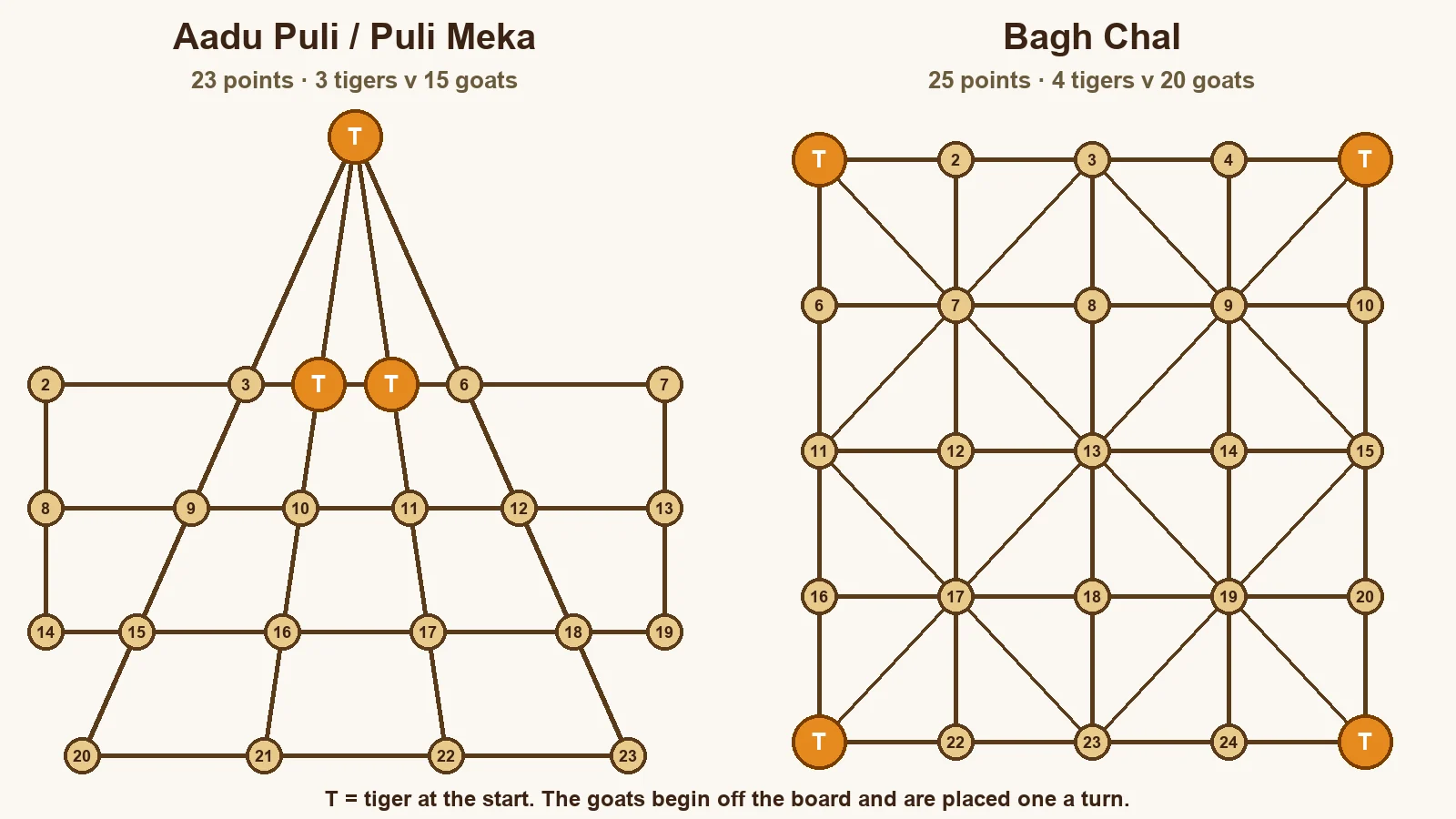
| Board | 23 points: a triangle from one top point, crossed by three rows, with a base of 4 | 25 points on a 5 by 5 grid with diagonals |
| Tigers | 3, starting on the top point and the two middle points of the first row | 4, starting on the four corners |
| Goats | 15, placed one a turn | 20, placed one a turn |
| Goes first | Goats | Goats |
| Tigers win | Usually after eating 5 goats (some families play until every goat is eaten) | After eating 5 goats |
| Goats win | When no tiger can move | When no tiger can move |
| Luck | None | None |
The South Indian board is a triangle. Four lines fan out from the top point down to a base of four points, and three rows cross them; each row also reaches out to a short side line on the left and right. That makes 23 points joined by 38 short lines. The top point is the tigers’ den, and it has four neighbours; the corner points of the side lines and the two ends of the base have only two, which makes them the safest places for goats.
The Bagh Chal board is a 5 by 5 grid of 25 points, the same pattern as the old alquerque board. Every point joins its neighbours across and down, and every other point, starting from the corners, also joins its diagonal neighbours, giving 56 lines in all. The centre and the four points diagonally next to the corners have eight neighbours each, so a tiger there is hard to pin down.
| Question | What people play |
|---|---|
| How many goats must the tigers eat? | Five is the usual target, and the one used in Bagh Chal. A primary-school rules sheet from Durham University has the tigers play on until all 15 goats are eaten, which makes the game much harder for the goats. |
| Can a position repeat? | In Bagh Chal, once all the goats are placed no move may bring back a position seen earlier in the game. A Karnataka version allows the same move back and forth only three times in a row. |
| Is eating compulsory? | No, in both games. A tiger may ignore a goat it could jump. |
| Smaller games | For beginners, one Karnataka set plays 1 tiger against 5 goats (the tiger needs 3 goats), or 3 tigers against 12 goats. |
| Where do the tigers start? | On the triangle board, the top point and the two middle points of the first row. |
| Name | Language or region | Meaning |
|---|---|---|
| Aadu Puli Attam (Aadu Puli Aattam) | Tamil | The goat and tiger game |
| Puli Meka, Puli Meka Aata (Meka Puli) | Telugu | The tiger and goat game |
| Pulijudam | Telugu | Tiger gambling |
| Aadu Huli, Huli Gatta, Huli Katti | Kannada | Goat and tiger; tiger game; encage the tiger |
| Bagh Chal (Bagh Chaal) | Nepali | The tiger game, or tiger moves |
| Bagh aur Bakri | Hindi | Tiger and goat |
| Bagh Bandi | Bengali (Lower Bengal) | A related game on the Bagh Chal grid with 2 tigers, where the goats start stacked in four piles |
| Fact | Figure |
|---|---|
| Bagh Chal positions | The computer scientists Lim Yew Jin and Jürg Nievergelt (2004) built a database of all 88,260,972 positions after the placing phase (with symmetries removed). |
| Placing phase | In Bagh Chal it lasts 39 turns in all (20 goat placements and 19 tiger moves). With perfect play the tigers can force the capture of 2 goats during it. |
| Who wins with perfect play? | Not yet proved. Lim and Nievergelt conjectured that the goats have the upper hand and can at least force a draw. |
| Aadu Puli, Hard v Hard | In 100 games between two Hard computer players (with a few random moves mixed in), the tigers won 47, the goats 26 and 27 were drawn. A game lasted about 148 moves in all. |
| Bagh Chal, Hard v Hard | In 100 games the tigers won 71 and the goats 29, in about 75 moves. The tigers ate 1.4 goats on average while the goats were still being placed (0.5 on the triangle board). |
| What that means | Good goat play is hard: one gap is enough for the tigers. The computer goats lose more often than perfect goats would, which is why the game rewards practice on the goats’ side. |
Hunt games, where one side has a few strong pieces and the other many weak ones, are played all over South and Southeast Asia. The tiger and goat game has long been played in Karnataka, Tamil Nadu and the Telugu states; a board is drawn on the parapet inside the great gate of the Chamundeshwari temple on Chamundi Hill in Mysore. The game is often told as a lesson that the weak, if they stand together, can beat the strong.
Bagh Chal comes from Nepal, where it is played in villages across the country, traditionally on a brass board with brass tigers and goats. Its 5 by 5 grid is the same as the board of alquerque, the ancestor of draughts; in Bengal the same board carries Bagh Bandi, with two tigers against goats that start in piles.
Another game born in India: Snakes and Ladders, the Moksha Patam race game. Play it free online.

After going through several successful experiences with several industry pioneers, Fadi Hayek has managed to excel in the world of content for online gaming by providing unique content for several projects that allowed him to obtain the necessary experience to launch his career. Last but not least, Fadi also holds several certificates, including but not limited to content marketing and iGaming.


