How to Play War
Turn a card, the higher card wins, and a tie means war: the full rules of the classic card game for two.


Turn a card, the higher card wins, and a tie means war: the full rules of the classic card game for two.
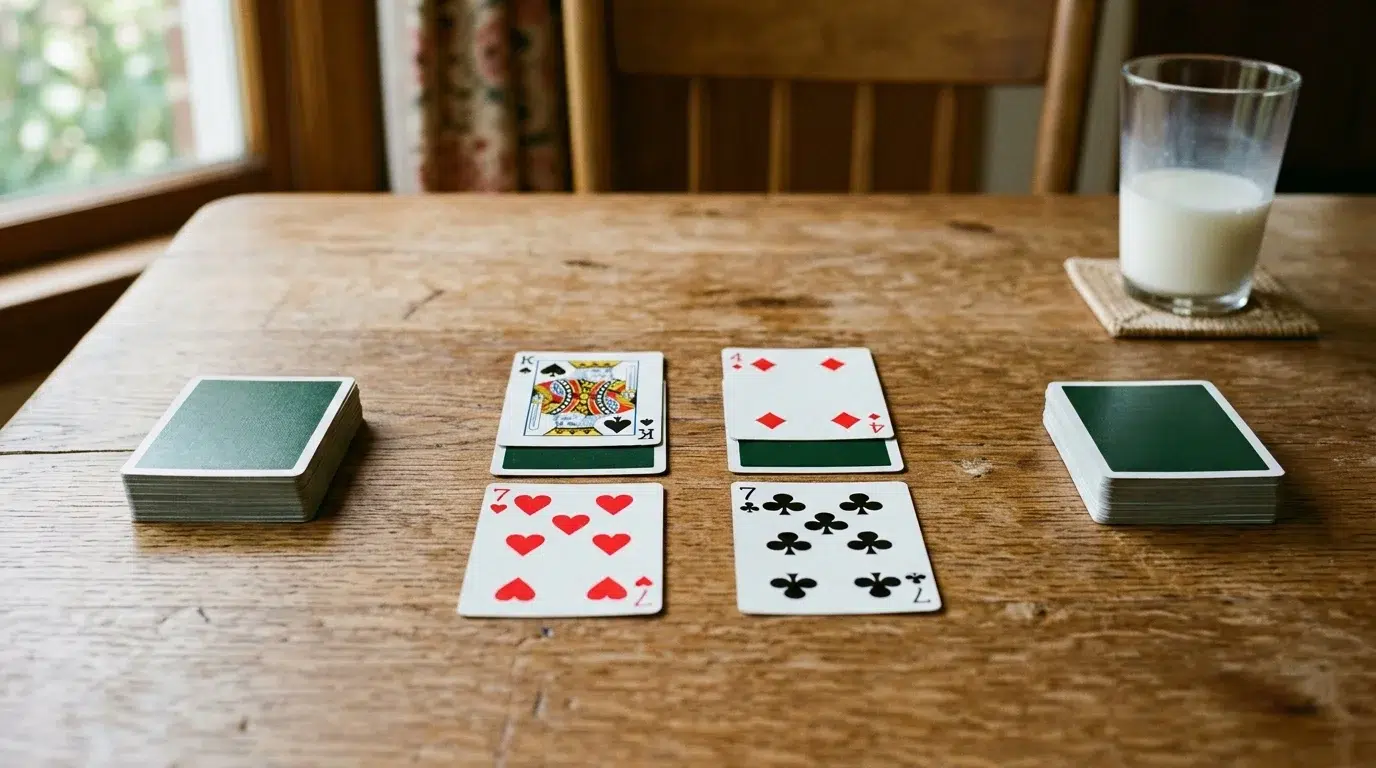
War is one of the simplest card games there is, and a favourite with young children. Two players split a deck, turn over one card each at the same time, and the higher card takes both. When the cards match, it is war: each player puts down an extra card face down and another face up, and the winner takes the whole pile. The player who ends up with all 52 cards wins. There are no decisions to make, so anyone who can tell which card is higher can play, and it is called Battle in the UK.
| War | |
|---|---|
| Players | 2 (3 or 4 also work). |
| Cards | A standard 52-card deck. |
| Card order | A (high), K, Q, J, 10, 9, 8, 7, 6, 5, 4, 3, 2. Suits don’t matter. |
| Deal | The whole deck, one at a time, face down: 26 cards each. |
| A battle | Both players turn up their top card. The higher card wins both. |
| A war | On a tie, each player plays one card face down and one face up. The higher face-up card wins everything on the table. |
| Goal | Win all the cards. |
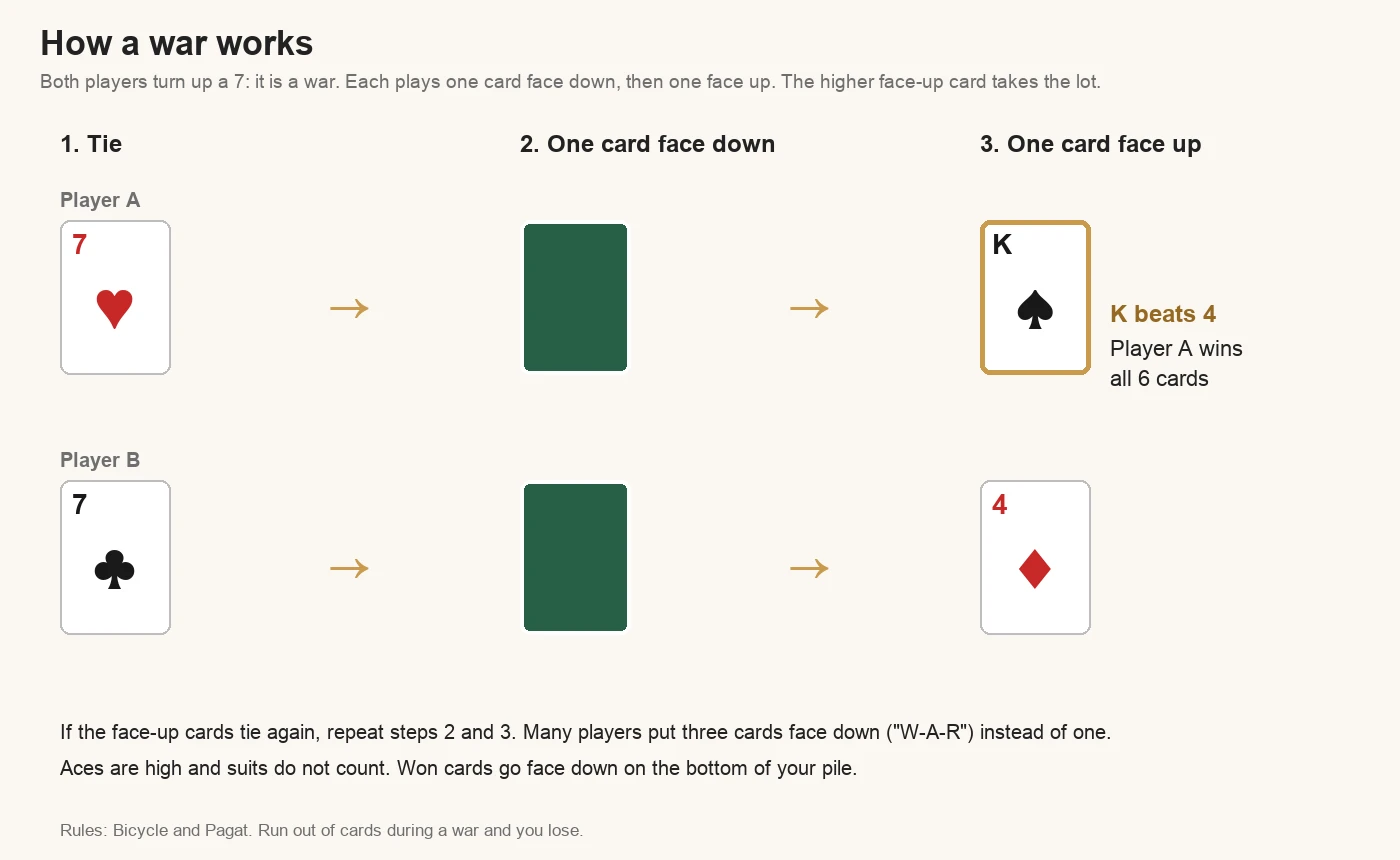
Most rule sheets don’t say, so agree before you start. The two common answers are:
| Question | Answer |
|---|---|
| How many cards do you start with in War? | 26 each with two players, 17 with three (one card left over) and 13 with four. |
| Are aces high or low? | High. The ace beats every other card. |
| Do suits matter? | No. A 7 of hearts and a 7 of spades are equal, which starts a war. |
| How many cards go face down in a war? | One in the standard rules. Many players put three down, sometimes saying “I de-clare war” as they lay them. |
| Can you look at your cards? | No. You play them from the top of your pile without looking. |
| Do you shuffle the cards you win? | The rules don’t say. Any order works, as long as both players agree. |
| How do you win War? | By collecting all 52 cards. For a shorter game, you can agree a time limit and count cards when it runs out. |
Deal the cards out evenly: 17 each for three players or 13 each for four. Everyone turns up a card at once, and the highest card takes them all. If two or more players tie for highest, there is a war, and everyone plays a card face down and a card face up, not just the players who tied. A player with no cards left drops out, and the last player with cards wins.
In the standard game, no: every card is played from the top of the pile, so the deal decides the winner. That is part of its appeal for young children, who can play on equal terms with adults and practise recognising which card is higher. The one place a player can have an effect is the order in which won cards go on the bottom of the pile, since the rules don’t fix it. If you want a version with choices, try Prisoners of War, or switch to Slapjack or Egyptian Rat Screw, where speed matters.
Often a long time. These numbers come from 100,000 simulated two-player games under the standard rules (won cards returned in random order, and a player who can’t finish a war loses), plus 100,000 with three cards face down:
| One card face down | Three cards face down | |
|---|---|---|
| Median game | 334 battles | 180 battles |
| Average game | 442 battles | 236 battles |
| Short game (1 in 10 are shorter) | 114 battles | 63 battles |
| Long game (1 in 10 are longer) | 910 battles | 486 battles |
| Games over 1,000 battles | 8% | 1% |
| Wars per game, on average | 26 | 14 |
| Longest game in the simulation | 4,240 battles | 2,566 battles |
Playing with three cards face down roughly halves the length of the game, because each war moves ten cards instead of six.
| Question | Answer |
|---|---|
| Chance the first battle is a war | 3 in 51, or 6% |
| Share of all battles that turn into a war | About 6%, or 1 in 17 |
| Chance a game includes at least one double war | 69% |
| Chance you are dealt 2 of the 4 aces | 39% |
| Chance you are dealt all 4 aces, or none | 6% each |
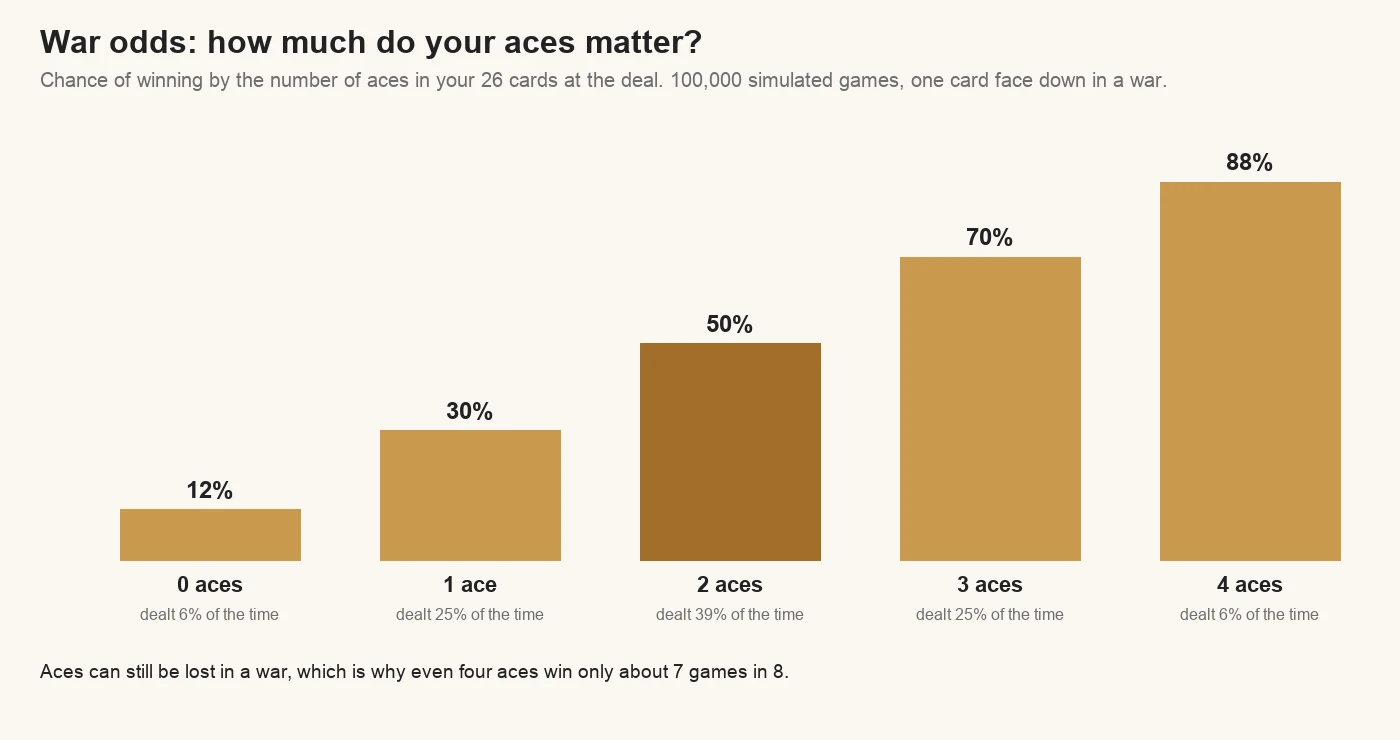
| Chance of winning with no aces | 12% |
| Chance of winning with 2 aces | 50% |
| Chance of winning with all 4 aces | 88% |
An ace never loses a battle, but it can be lost when it lands face down in a war, which is why four aces don’t guarantee a win. The figures for winning by aces come from the same 100,000 simulated games.
Nobody knows exactly when War started, and it has been played under different names around the world. Its close German relatives Bettelmann (“Beggar Man”) and Tod und Leben were described as early as 1833. In Britain the same game is called Battle, and in Russia children play a 36-card version called P’yanitsa (“Drunkard”).
For more quick games for children, try Snap, Slapjack, Go Fish and Old Maid. Egyptian Rat Screw is the fast, slapping version for older players, and Casino War is the betting game built on the same idea.

After going through several successful experiences with several industry pioneers, Fadi Hayek has managed to excel in the world of content for online gaming by providing unique content for several projects that allowed him to obtain the necessary experience to launch his career. Last but not least, Fadi also holds several certificates, including but not limited to content marketing and iGaming.


