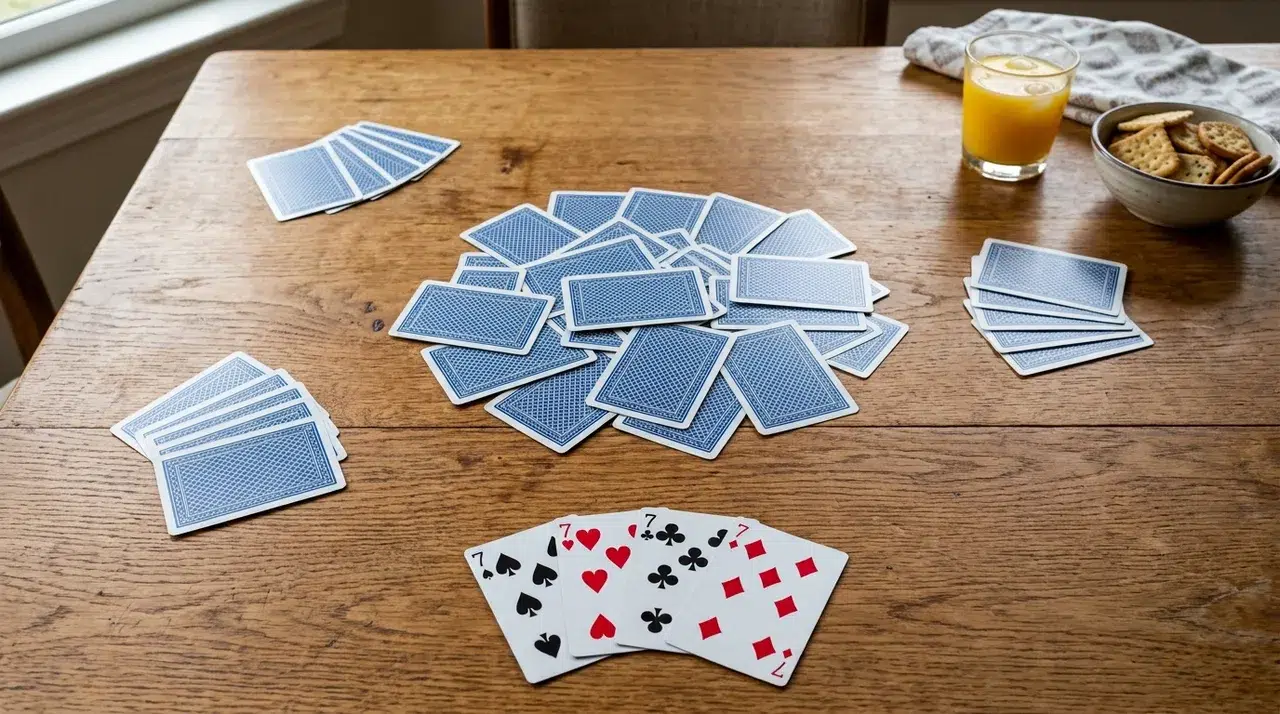
A game of Go Fish on a wooden kitchen table: a messy pond of face-down cards in the middle, three face-down hands around it and a completed book of four sevens laid face up in front
Four sevens make a book. Lay it down the moment you have it.

Go Fish is the card game most people learn first: ask another player for a card, and if they don’t have it, they tell you to “go fish” from the pile in the middle. The aim is to collect books – all four cards of one rank – and whoever has the most books at the end wins. It is quick to teach, works for two to six players and suits children from about four, but there is more to it than luck: remembering who asked for what is the difference between winning and losing. This guide covers the Go Fish rules, a worked example turn, the main variations and the real odds behind every ask.

Go Fish Rules at a Glance

Go Fish
PlayersTwo to six; three to five is best.
CardsOne standard 52-card pack, no Jokers. Suits do not matter, only ranks.
DealSeven cards each for two or three players, five each for four or more. The rest go face down in the middle as the pond (or stock).
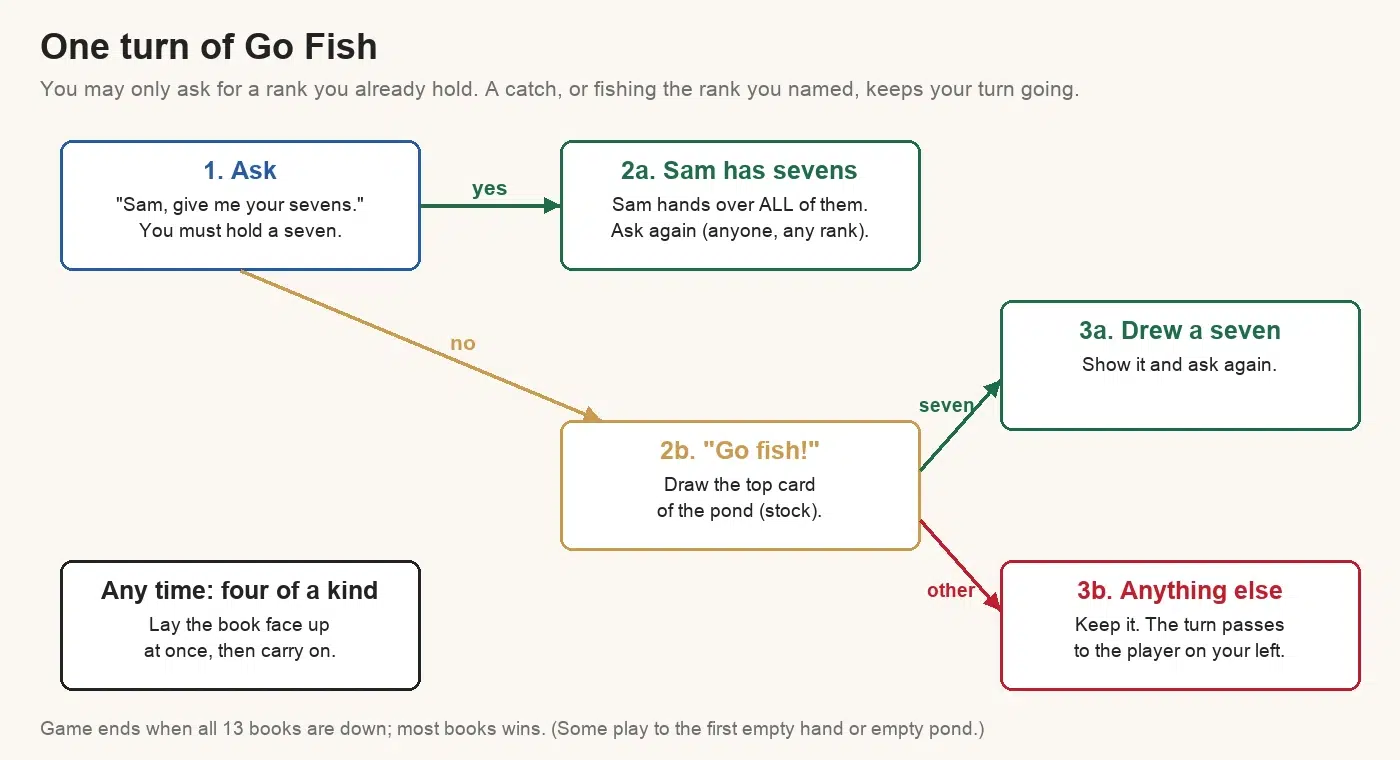
On your turnAsk one player for a rank you already hold: “Sam, give me your sevens.”
If they have itThey hand over every card of that rank and you ask again.
If they don’t“Go fish!” You draw from the pond. Draw the rank you asked for and you go again; otherwise the turn passes left.
BooksFour of a kind. Lay it face up as soon as you have it.
WinnerMost books when all 13 have been made.

How to Play Go Fish

  1. Deal. Shuffle and deal one card at a time, face down: seven each for two or three players, five each for four or more. Spread the rest face down in the middle – that is the pond.
  2. Lay down any books. If you were dealt four of a kind (rare: 0.17% of seven-card hands), put it face up in front of you.
  3. Ask. The player to the dealer’s left starts. Pick one opponent and ask for a rank: “Sam, do you have any sevens?” You must already hold at least one seven to ask for sevens.
  4. Catch. If Sam has any sevens, he must hand over all of them, not just one. You have made a catch, so you ask again – the same player or anyone else, for the same rank or another.
  5. Go fish. If Sam has no sevens, he says “Go fish!” and you draw the top card of the pond. If it is a seven, show it and ask again. If it is anything else, keep it and the turn passes to your left.
  6. Make books. As soon as you hold all four of a rank, lay them face up. That is a book.
  7. Running out. If your hand is empty on your turn, draw a card from the pond and ask for that rank. If the pond is empty too, you are out for the rest of the game.
  8. Win. When all 13 books are down, the player with the most books wins. Seven books guarantees a win, since nobody else can then reach seven.
Go Fish turn flowchart: ask a player for a rank you hold; if they have it they hand over all of it and you ask again; if not, go fish from the pond; draw the rank you named and you ask again, draw anything else and the turn passes left; lay any four of a kind face up at once
One turn, start to finish.

An example turn

Four players: you, Sam, Priya and Leo. You hold 7, 7, Q, 4, 2. You ask Sam for sevens and he hands you one: a catch, so you go again. You ask Priya for queens. “Go fish!” You draw a 4 – not the queen you named – so you keep it and your turn ends. Sam now asks you for fours. You must give him both, and everyone at the table now knows Sam holds at least three fours. You can’t ask for fours now (you have none), but if you draw the last four later, you know exactly who to ask.

How Many Cards Do You Deal in Go Fish?

PlayersCards eachLeft in the pond
2738
37 (some play 5)31 (37)
4532
5527
6522

Pagat lists seven cards for two players and five for everyone else; Bicycle deals seven to two or three players. Both work – agree before you start.

Go Fish Variations

VariationWhat changes
Ask for a card, not a rankYou name a specific card, such as the seven of diamonds. You still need a seven in hand. Slower and harder to remember.
One card onlyThe player asked hands over just one card of the rank, not all of them.
Pairs, not booksLay down pairs instead of fours. Popular with young children and in Australia, where seven cards are dealt.
Turn goes to the player askedAfter an unsuccessful fish, the turn passes to the player who said “go fish” instead of to your left.
Short gameStop when the first player runs out of cards or the pond runs dry; most books still wins.
Refill the handA player who runs out draws a fresh five cards from the pond and keeps playing.
Scoring by rankOver several hands, score books by face value (Jacks 11, Queens 12, Kings 13, Aces 15) and play to a target.
Happy FamiliesThe British version with special cards: families of four (Mr Bun the Baker, Mrs Bun and so on) collected by asking politely for one card at a time.

Go Fish Odds: Who Should You Ask?

At the start of a four-player game, with five cards each, you can see 5 of the 52 cards. The other 47 are spread between three hands and the pond, so most of the cards you need are still in the pond:
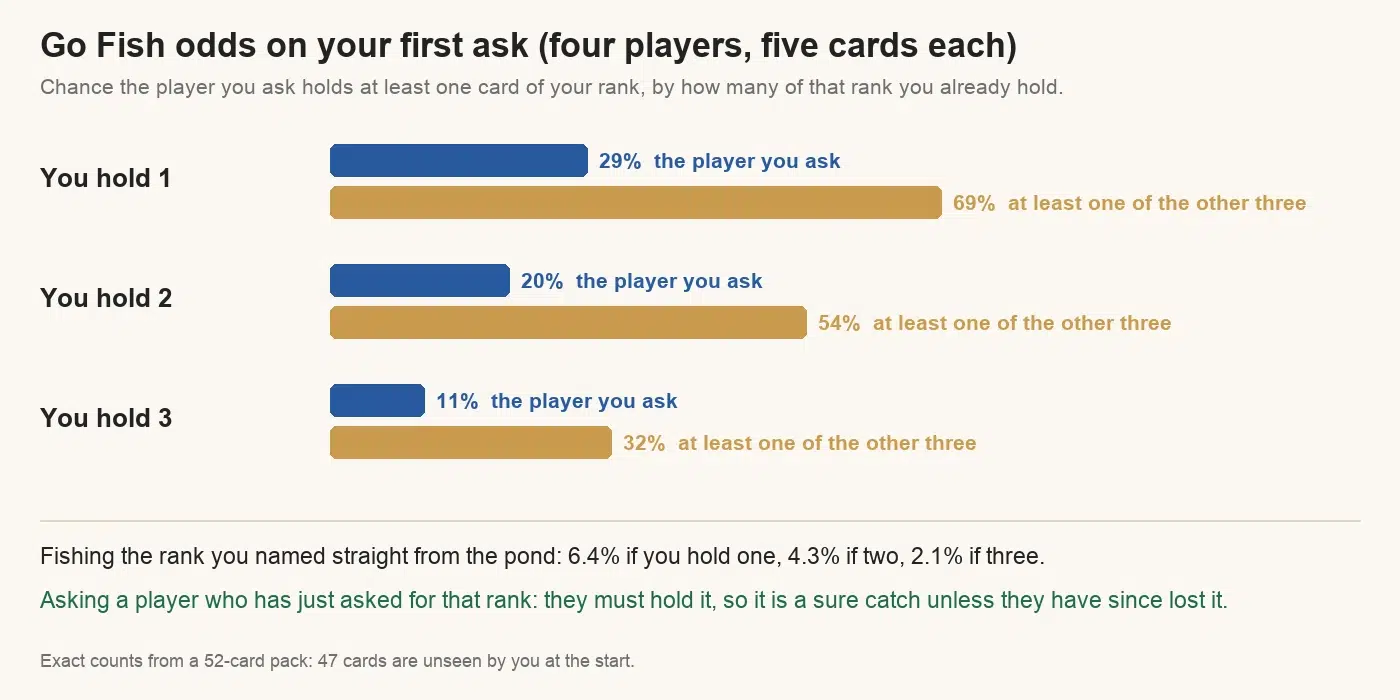
Go Fish odds chart for four players with five cards each: holding one card of a rank, the player you ask has it 29% of the time and at least one of the other three 69%; holding two, 20% and 54%; holding three, 11% and 32%; fishing the named rank from the pond 6.4%, 4.3% or 2.1%
Exact chances on a blind first ask.
  • A blind ask usually misses. Holding one seven, the player you ask has another seven only 29% of the time (41% in a two-player game with seven cards each).
  • The more you hold, the worse a blind ask gets. Hold three sevens and only one is left to find: 11% that your chosen player has it, 32% that anyone at the table does.
  • Fishing the card you named is a long shot: 6.4% when you hold one of the rank.
  • Bigger tables help. With six players, at least one opponent holds a card of your rank 91% of the time.
  • Your starting hand has at least one pair 49% of the time with five cards, and 79% with seven.

How much does a good memory matter?

Every ask gives information away: to ask for sevens you must hold one, and a player who says “go fish” has none (until they draw). In 60,000 simulated four-player games where one player remembered all of this and the other three asked at random, the player who kept track won 84% of them, against the 25% you would expect by luck, and made about six books a game to the others’ two. Even in a two-player game, memory alone won 58% of games.

Go Fish strategy tips

  • Ask for what someone else has asked for. If Leo just asked for Kings, he holds at least one. When you get a King, ask Leo – it is a sure catch unless he has since lost them.
  • Remember who said “go fish”. They have none of that rank, so don’t ask them for it again until they have drawn a few cards.
  • Ask for a card you have just fished on your next turn if you had none of that rank before: nobody knows you hold it, and it is a fresh lead.
  • Keep a catch going. After a successful ask, go for the rank where you have the best information, not the one you hold most of.
  • Don’t give your hand away. Asking the same player for the same rank again tells the table you are still collecting it; spread your asks around.

Go Fish and Its Relatives

Games built on asking for cards go back to the mid-1800s, often with special packs. In Britain, Happy Families replaced the older Spade the Gardener; in the United States, Dr Busby (1843) and Authors (1861) came first; Germany plays Quartett with 32-card packs, and Thailand has Pâi Hông. The name “Fish” is also used for Literature, a harder partnership game.

More Card Games

For more family card games, try Switch, the bluffing game Cheat, President or Chase the Ace. If you like collecting sets, rummy and Canasta take the same idea further.

Another first card game: Old Maid, where you pair up your cards and try not to get stuck with the last Queen.

Another four-of-a-kind game: Spoons, where you pass cards as fast as you can and grab a spoon when you have four of a kind.

Got only two players? Try Spit (also called Speed), a race to get rid of your cards.

Next game for the kitchen table: Kings Corner, a shared game of solitaire for two to four players.

Another easy game for young players: Trash, also known as Garbage, where you fill a layout from Ace to 10.

Another first card game: War, which only needs players to know which card is higher.

Go Fish: frequently asked questions

How many cards do you deal in Go Fish?

Seven cards each for two or three players and five each for four or more. The rest of the pack goes face down in the middle as the pond. Some groups deal five to three players as well.

Can you ask for a card you don't have in Go Fish?

No. You may only ask for a rank you already hold at least one card of. To ask for sevens, you must have a seven in your hand.

Do you have to give all your cards in Go Fish?

Yes. If someone asks for your sevens, you hand over every seven you hold, not just one. Some house rules change this to one card only.

Do you get another turn if you fish the card you asked for?

Yes. If the card you draw from the pond is the rank you just asked for, show it and ask again. Anything else ends your turn.

How do you win Go Fish?

Collect the most books. A book is all four cards of one rank. Play usually continues until all 13 books are down, so seven books always wins.

What happens when you run out of cards in Go Fish?

On your turn, draw a card from the pond and ask for that rank. If the pond is empty as well, you are out and wait for the others to finish.

How many players can play Go Fish?

Two to six. Three to five is the best range. With two players, deal seven cards each.

Is there any strategy in Go Fish?

Yes: memory. Anyone who asks for a rank must hold it, and anyone who says go fish has none of it. In simulations, a player who kept track of this won 84% of four-player games against players who asked at random.

Fadi Hayek
Author & Casino Expert

After going through several successful experiences with several industry pioneers, Fadi Hayek has managed to excel in the world of content for online gaming by providing unique content for several projects that allowed him to obtain the necessary experience to launch his career. Last but not least, Fadi also holds several certificates, including but not limited to content marketing and iGaming.

Latest News

Artificial Intelligence in Gambling – How It Is Changing the Future of the Industry

As online casinos adopt machine learning models and artificial intelligence in gambling becomes the next disruption, you don’t want to be left behind. Read on to learn about the impact AI will have on the future of the gambling industry.

Arabian Football Betting Trends – Stay Current on Betting Preferences in the Middle East!

Keep abreast of the latest Arabian football betting trends with the Arabian sports betting insights below. This guide covers the most popular bet types with Arab bettors and the top bookmakers for Arabian and global football competitions.

Al-Nassr vs PSG | Cristiano Ronaldo vs Lionel Messi

The biggest event in world football is scheduled to take place later this month as Al Nassr vs PSG is on the cards.

Yggdrasil Collaborate with Reflex to Release Dublin Up DoubleMax

Yggdrasil and Reflex are set to launch Dublin Up DoubleMax, an Irish-style video, as one of their latest releases. The slot game is designed by incorporating Yggdrasil’s proprietary Game Engagement Mechanic (GEM) DoubleMax coupled with unique features like free spins bonus and fairy magic.