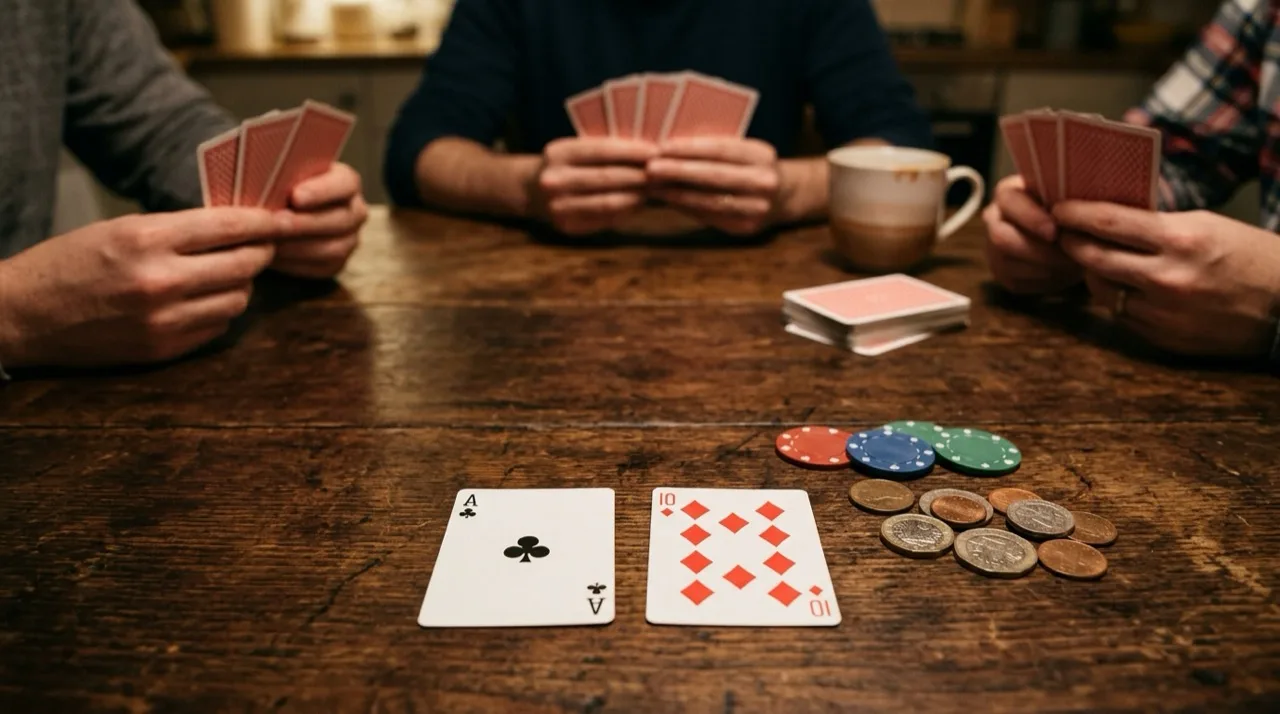
A pontoon on a wooden kitchen table: the ace of clubs and the ten of diamonds face up next to coins and chips, with other players holding their cards

Pontoon is the British cousin of blackjack and one of the best-known card games in the UK. The aim is the same, to get closer to 21 than the banker without going over. The words are different (twist, stick, buy, bust), the best hand is called a pontoon, and five cards that stay under 22 make a Five Card Trick. The name comes from the French game vingt-et-un, “twenty-one”. This guide covers the pontoon card game rules as played at home, the casino and online version, and how Pontoon differs from blackjack.

Pontoon Rules at a Glance

Pontoon (home game)
PlayersTwo or more; best with 5 to 8. One player is the banker.
CardsOne 52-card pack; two packs mixed for 8 or more players.
Card valuesAce 1 or 11; K, Q, J and 10 count 10; other cards their number.
AimBeat the banker’s hand without going over 21.
Best handPontoon: an ace plus a ten-point card in two cards.
TiesThe banker wins.
Minimum to stick15 (some house rules say 16).

Pontoon Hands, from Best to Worst

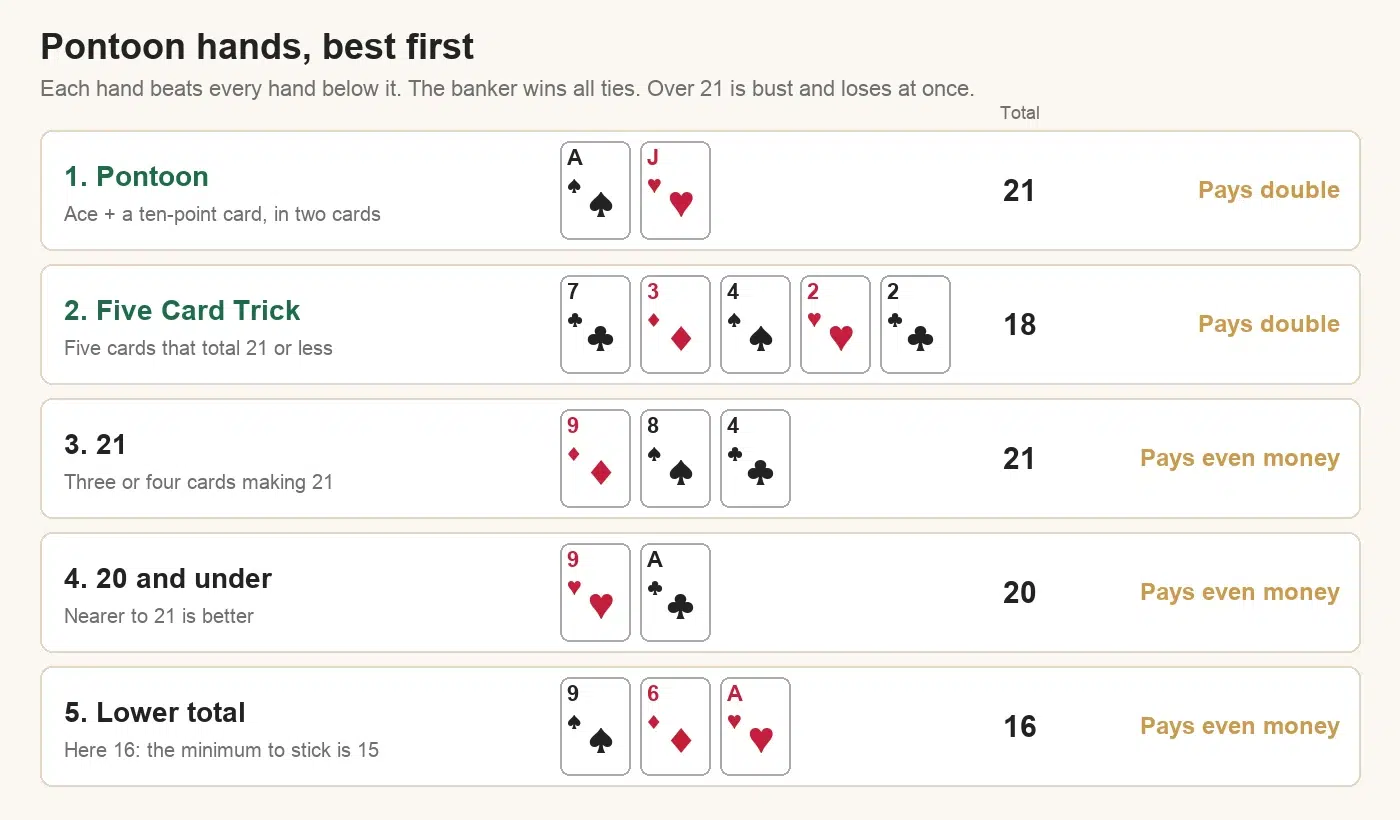
  1. Pontoon: 21 in two cards (ace + 10, J, Q or K).
  2. Five Card Trick: any five cards totalling 21 or less.
  3. 21 in three or four cards.
  4. 20 or less in up to four cards: the nearer to 21, the better. 19 in two cards is worth exactly the same as 19 in four.
  5. Bust: anything over 21 loses straight away.
Pontoon hand ranking with examples: pontoon ace and jack, five card trick 7-3-4-2-2, 21 with 9-8-4, 20 with 9 and ace, and 16 with 9-6-ace
A pontoon and a Five Card Trick are paid double; every other winning hand is paid even money.

How to Play Pontoon

  1. Choose a banker. Everyone cuts the pack and the highest card deals first. The banker has the edge, so the role moves around (see below).
  2. First card and bets. The banker deals one card face down to each player and to themself. Players look at their card and bet, between an agreed minimum and maximum.
  3. Second card. Everyone gets a second card face down. If the banker has a pontoon, it is shown at once and every player pays double their stake.
  4. Your turn. Starting on the banker’s left, each player can:
    • Declare a pontoon by laying the ten-point card face down with the ace face up on top.
    • Split a pair of equal rank into two hands, with a second stake equal to the first. A queen and a jack are not a pair.
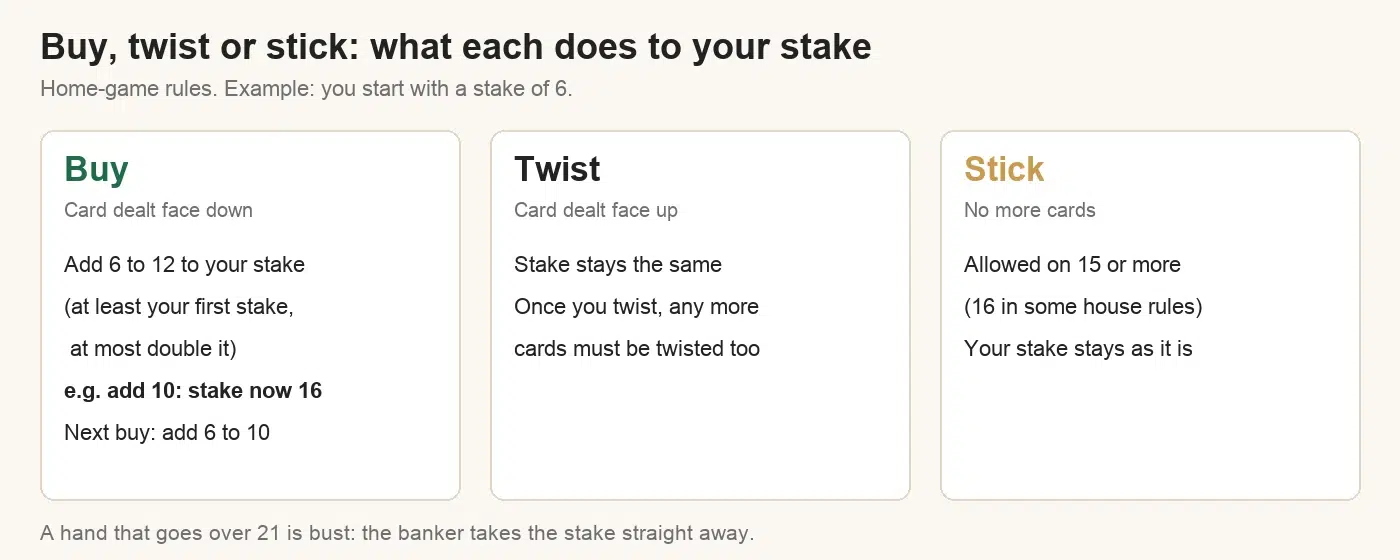
    • Buy a card face down, adding between your first stake and double it.
    • Twist a card face up, for no extra stake.
    • Stick on 15 or more and keep the hand as it is.
  5. The banker plays. The banker turns over their two cards and takes more cards one at a time until happy to stay.
  6. Settle. If the banker busts, every player still in is paid, double for a pontoon or Five Card Trick. If the banker stays on, say, 18, they announce “paying 19”: hands of 19 or more win, and the rest lose.
Pontoon buy, twist and stick explained: buying a card adds between your first stake and double it, twisting keeps the stake the same, and you can stick on 15 or more
You can buy and then twist, but once you have twisted, every further card must be twisted.

Buying and twisting: the details

With a first stake of 6, buying a third card costs between 6 and 12 more. A fourth card bought costs between your first stake and what you paid for the third: if the third cost 10, the fourth costs 6 to 10. Twisted cards are free but dealt face up, so the banker sees them. A hand reaching five cards without going bust is a Five Card Trick and takes no more cards.

When the banker makes 21 or a Five Card Trick

A banker on 21 pays only pontoons and Five Card Tricks. A banker with a Five Card Trick pays only pontoons, and everyone else, including players holding their own Five Card Trick, pays double.

Passing the bank

A player who gets a pontoon (not from a split hand), when the banker had none, becomes the next banker. The banker can also sell the bank at an agreed price. After a hand with no pontoon, the used cards go to the bottom of the pack without a shuffle, so remembering what has been played helps; after a pontoon the pack is shuffled.

Popular house rules

  • Burning: a two-card hard 13 (or 14 in some groups) can be shown, thrown in and replaced with two new cards.
  • Royal Pontoon: three sevens beat everything and are paid treble.
  • Stick on 16 instead of 15, or split aces only.
  • Pontoon payouts of single or treble stakes instead of double.

Agree the house rules before the first deal.

Pontoon vs Blackjack

PontoonBlackjack
Dealer’s cardsBoth face down until the players have finishedOne card face up
TiesBanker winsPush (stake returned)
Two-card 21Pontoon, paid 2 to 1Blackjack, usually paid 3 to 2
Five cards under 22Five Card Trick, paid 2 to 1No special payout
Take a cardTwist (face up) or buy (face down, extra stake)Hit
StayStick, only on 15 or moreStand, on any total
Double the stakeBuy (home game); online, double on two to four cardsDouble, usually on two cards only

Pontoon at the Casino and Online

Casinos turned the home game into a table game against the dealer. Online Pontoon, offered by studios including Playtech and Betsoft, usually follows these rules:

  • Eight 52-card decks; the dealer has two cards face down and checks for a pontoon first.
  • A pontoon or any five-card hand pays 2 to 1, including after a split; other wins pay even money; ties lose.
  • You can stand on 15 or more, or on any five-card hand, and hit after doubling.
  • Double on two, three or four cards, once per hand; split pairs, with one resplit (three hands).
  • The dealer hits soft 17 and stops on any five-card hand.

With correct strategy the house edge is about 0.38%, or 0.39% where split aces get one card each and the dealer stands on soft 17. Unusually, more decks lower the edge: the same game with two decks is about 0.35 points worse. Always split eights.

Australian Pontoon is a different game: it is played with Spanish 48-card decks (all four tens removed) and is close to the American Spanish 21.

Pontoon Odds

The chance of being dealt a pontoon is 4.83% with one pack, about 1 hand in 21, and 4.75% from eight decks. The banker’s advantage in the home game comes from winning every tie, so take turns at the bank.

Where to Play Pontoon Online

Search the blackjack or table-games section of the lobby; availability depends on the casino and your country. These casinos run large table-game lobbies:

CasinoWelcome offerOur rating
iWild CasinoUp to 550% + 400 free spins4.8Open iWild Casino
Amunbet450% up to €3,000 + 450 free spins4.2Open Amunbet
1Red Casino225% up to €11,500 + 225 free spins over 3 deposits4.0Open 1Red Casino

More on twenty-one: blackjack rules and strategy, free blackjack and the blackjack glossary.

Set a budget before you play for real money and stick to it. Free, confidential support is available at BeGambleAware.org. 18+ only.

Another British family favourite: Newmarket, where you stake counters on four horses and race to play out your cards.

Not to be confused with: British Black Jack, the 7-card shedding game played in UK homes.

Pontoon: frequently asked questions

How do you play pontoon?

Each player gets two cards and tries to beat the banker’s hand without going over 21. You can twist (take a card face up), buy (take a card face down and raise your stake) or stick on 15 or more. The banker then plays and wins all ties.

What is a pontoon in the card game?

An ace and a ten-point card (10, J, Q or K) in your first two cards. It is the best hand and is paid double.

What is a Five Card Trick?

Five cards that total 21 or less. It beats every hand except a pontoon and is paid double.

What is the difference between twist and buy in pontoon?

A twisted card is dealt face up and does not change your stake. A bought card is dealt face down and you add between your first stake and double it. Once you twist, you cannot buy again on that hand.

What is the minimum you can stick on in pontoon?

15 in the standard rules; some house rules make it 16.

Does a Five Card Trick beat a pontoon?

No. A pontoon is the highest hand; the Five Card Trick is second.

Is pontoon the same as blackjack?

They share the aim of 21, but in pontoon both dealer cards are hidden, the dealer wins ties, a two-card 21 pays 2 to 1, five cards under 22 also pay 2 to 1, and you cannot stick below 15.

What is the house edge in online pontoon?

About 0.38% with correct strategy under the usual online rules, or 0.39% where split aces get one card and the dealer stands on soft 17.

Fadi Hayek
Author & Casino Expert

After going through several successful experiences with several industry pioneers, Fadi Hayek has managed to excel in the world of content for online gaming by providing unique content for several projects that allowed him to obtain the necessary experience to launch his career. Last but not least, Fadi also holds several certificates, including but not limited to content marketing and iGaming.

Latest News

Artificial Intelligence in Gambling – How It Is Changing the Future of the Industry

As online casinos adopt machine learning models and artificial intelligence in gambling becomes the next disruption, you don’t want to be left behind. Read on to learn about the impact AI will have on the future of the gambling industry.

Arabian Football Betting Trends – Stay Current on Betting Preferences in the Middle East!

Keep abreast of the latest Arabian football betting trends with the Arabian sports betting insights below. This guide covers the most popular bet types with Arab bettors and the top bookmakers for Arabian and global football competitions.

Al-Nassr vs PSG | Cristiano Ronaldo vs Lionel Messi

The biggest event in world football is scheduled to take place later this month as Al Nassr vs PSG is on the cards.

Yggdrasil Collaborate with Reflex to Release Dublin Up DoubleMax

Yggdrasil and Reflex are set to launch Dublin Up DoubleMax, an Irish-style video, as one of their latest releases. The slot game is designed by incorporating Yggdrasil’s proprietary Game Engagement Mechanic (GEM) DoubleMax coupled with unique features like free spins bonus and fairy magic.