Back your horses, play your cards in sequence and be first out. How to play the classic British family card game.
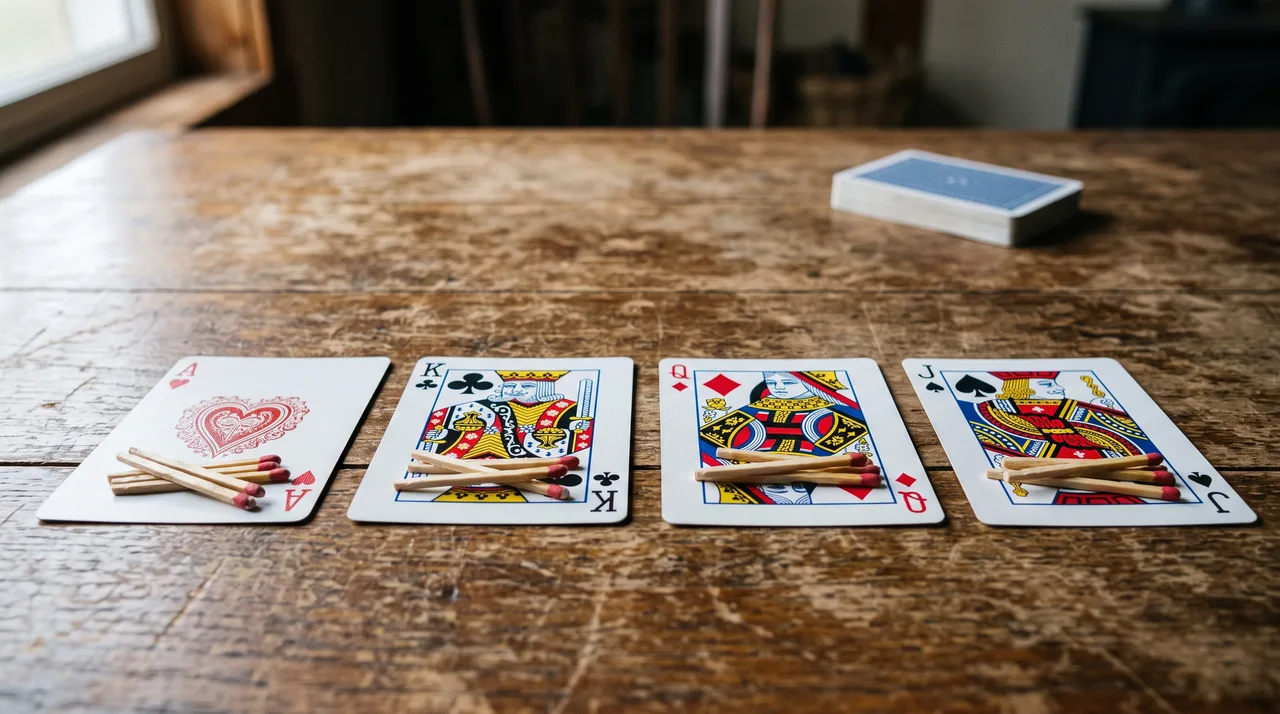
The four “horses”, each carrying its stake of matchsticks.
Newmarket is the classic British family card game with a racing theme. Before each deal, players put counters on four “horses” – an Ace, King, Queen and Jack from a second pack – and anyone who plays the matching card during the hand collects the stake on it. The first player to get rid of all their cards wins the kitty. It is a game of almost pure luck, easy enough for young children, and is usually played for matchsticks, sweets or pennies. The same game is called Boodle or Stops, and its American descendant is Michigan. This guide covers the Newmarket card game rules step by step, the many family variations, where the game comes from and the odds of each horse paying out.
Newmarket Rules at a Glance
Newmarket
Players
Three to about eight; three to five is best. Two can play.
Cards
One standard pack to play with, plus four cards from a second pack as the horses. Aces are usually high.
Horses
Usually the Ace of hearts, King of clubs, Queen of diamonds and Jack of spades – any Ace, King, Queen and Jack of different suits will do.
Stakes
Each player puts an agreed stake in the kitty and on the horses before the deal.
Deal
All the cards, one at a time, to the players and to one extra “dummy” hand that nobody plays.
Play
Cards are played in suit order, 2, 3, 4 … by whoever holds the next card. A run stops at the Ace or at a card in the dummy.
Horses pay
Play a card that matches a horse and you take its stake.
Winner
The first player to run out of cards takes the kitty. Unclaimed horse stakes stay for the next deal.
What You Need
Two packs of cards. One full pack for playing, and four cards from a second pack to be the horses (also called boodles or money cards). The most common horses today are the Ace of hearts, King of clubs, Queen of diamonds and Jack of spades.
Counters. Matchsticks, buttons, sweets or coins. Give everyone the same number to start – ten or twelve each works well; more makes a longer game.
How to Play Newmarket
Lay out the horses. Put the four horse cards face up in a row in the middle of the table, with a space for the kitty.
Place the stakes. Before the deal, each player puts one counter in the kitty and one on each horse (or an agreed number, spread however they like). In some families the dealer stakes double.
Deal. Deal the whole pack, one card at a time, to every player and to one extra hand – the dummy. It does not matter if some hands have one more card. The dummy stays face down and is not played.
Sort your hand. Arrange your cards by suit and in order. You will need to spot the next card quickly.
Open the play. Whoever holds the 2 of diamonds plays it face up in front of themselves and calls it out (many families start with the 2 of clubs instead). If nobody has it, call for the 3, and so on.
Follow in sequence. Whoever holds the next card of the same suit – the 3, then the 4 – plays it in front of themselves and calls it out. Play does not go round the table: it goes to whoever holds the next card, so you may play several in a row.
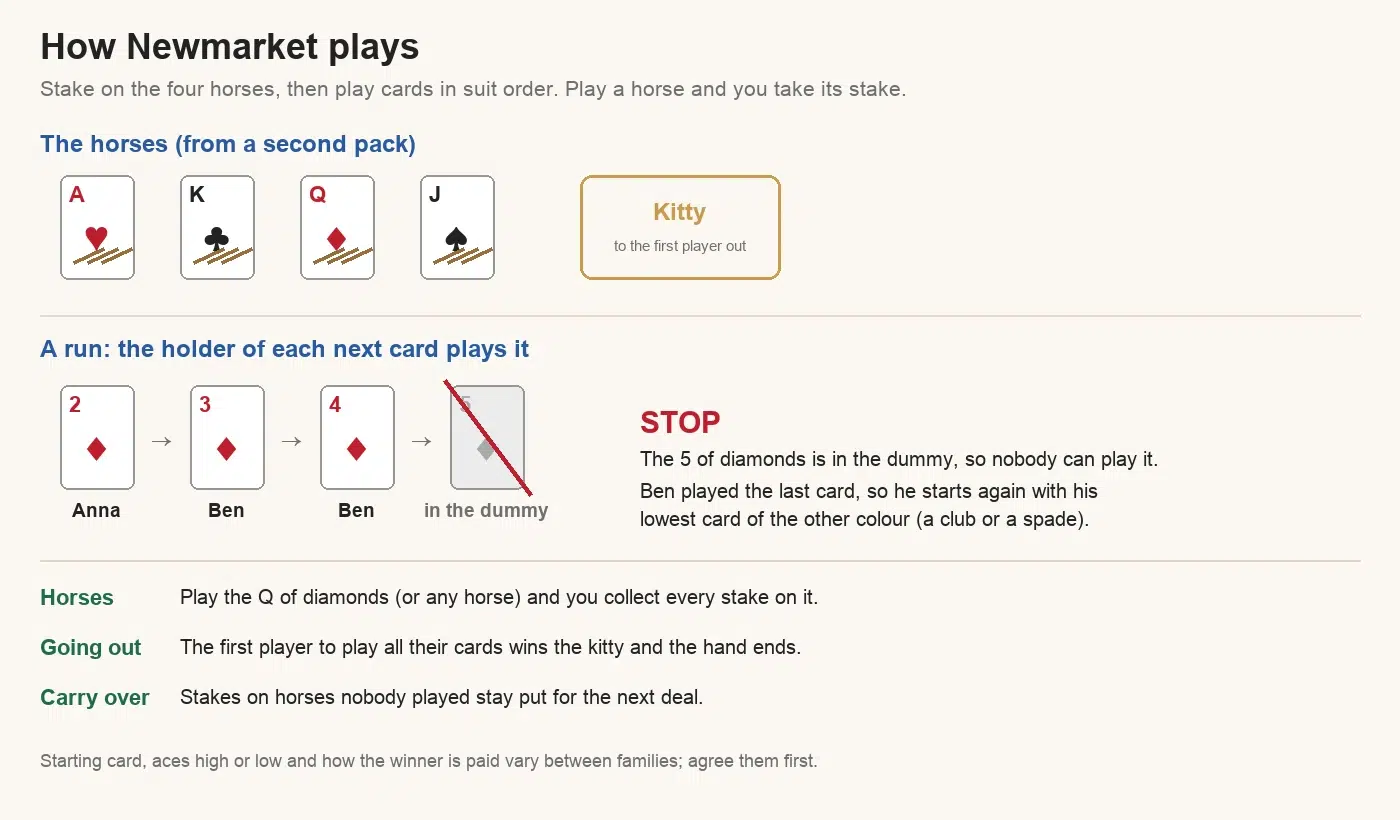
Stop. The run stops when it reaches the Ace, or when the next card is in the dummy or has already been played. The player of the last card starts a new run with their lowest card of the other colour (after a red run, a club or a spade). If they have no card of that colour, the next player to the left who does starts instead.
Collect the horses. Whenever you play a card that matches a horse, take all the counters on that horse.
Go out. The first player to play their last card wins the kitty and the hand ends. Counters left on horses that nobody played stay there for the next deal. The deal then passes to the left.
A run stops when the next card is in the dummy – and the stop card’s player leads again.
Paying the winner
Families settle the hand in one of two ways. In most British homes, the first player out simply takes the kitty. In older rules and in Michigan there is no kitty: instead, every other player pays the winner one counter for each card left in their hand, so it pays to get rid of cards even if you won’t go out first.
Newmarket Variations
Newmarket has been played in so many homes for so long that almost every family has its own version. The common ones:
Variation
What changes
Swap or buy the dummy
The dealer (or the player who receives the dummy) may swap their hand for it unseen. If they don’t, it can be offered round the table or auctioned, with the price going in the kitty.
Change suit, not colour
After a stop, the next run just has to be in a different suit, not the other colour.
Free staking
Each player places a fixed number of counters, say six, spread across the horses as they choose – all on one if they like.
Dealer pays double
The dealer puts two counters on each horse and everyone else one.
Lead any suit
The player to the dealer’s left starts with the lowest card of any suit they choose, instead of a fixed starting card.
Aces low
Aces count low, so runs go Ace, 2, 3 … up to the King.
Different horses
Some families use a King, Queen, Jack and Ten of different suits. In one south London version all four Kings are the horses, and a King’s stake is won by playing the Queen of the same suit.
Michigan Rummy (Three in One)
Before the stops game, each player picks five cards and plays a round of Poker with them.
The horses through history
Which four cards are the horses has changed from book to book:
Source
Horses
Heather, 1875
King of diamonds, Queen of spades, Jack of clubs, Ten of hearts
The American Hoyle, 1885
Ace of spades, King of hearts, Queen of clubs, Jack of diamonds
Phillips, 1957
Ace of hearts, King of diamonds, Queen of spades, Jack of clubs
Parlett, 1979
Ace of spades, King of hearts, Queen of clubs, Jack of diamonds
pagat.com, 2000 and Bicycle, 2001
Ace of hearts, King of clubs, Queen of diamonds, Jack of spades
Where Newmarket Comes From
Newmarket grew out of Pope Joan, an older English gambling game played on a round, divided staking board. A duke was reported “losing considerably at Newmarket” as early as 1820, and the first printed rules appeared in the 1850s. The staking cards are called horses in a nod to Newmarket Racecourse. In America it became known as Stops or Boodle before Michigan replaced it in the 1920s. Newmarket stayed popular in Britain: as late as 1981 it was still the sixth most popular card game in the country.
Newmarket Odds
Newmarket is mostly luck, but the numbers show which horses pay and how often the money rolls over. From 50,000 simulated hands per table size, using the rules above (aces high, 2 of diamonds starts, change colour after a stop):
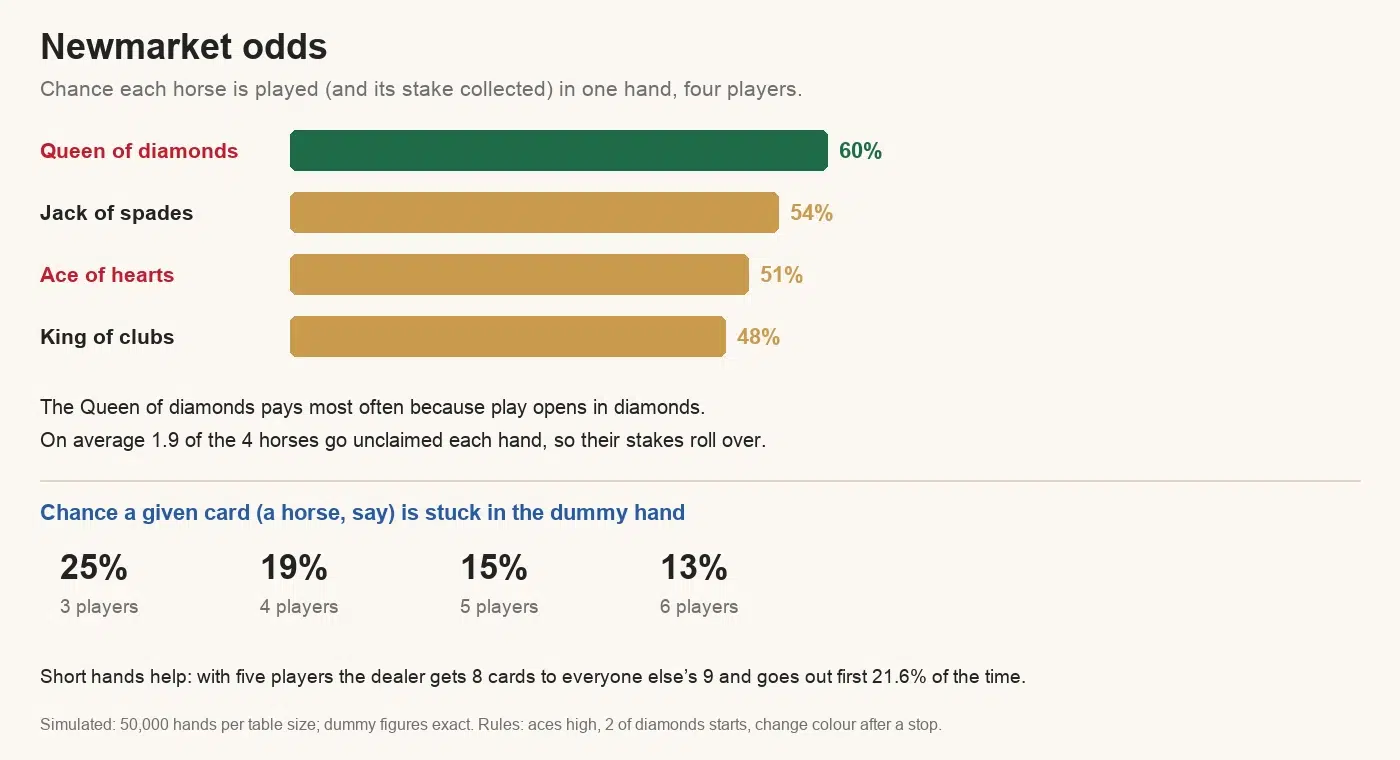
The Queen of diamonds pays most often – in 60% of four-player hands, because play always opens in diamonds. The Jack of spades pays 54%, the Ace of hearts 51% and the King of clubs 48%.
Stakes roll over a lot. On average 1.9 of the four horses go unclaimed in a hand, so their counters stay for the next deal and the piles grow.
The dummy is the spoiler. Any given card – a horse included – is in the dummy 25% of the time with three players, 19% with four, 15% with five and 13% with six. A horse in the dummy can’t be won that hand.
Fewer cards, better chances. When hands are uneven, the shorter hands go out first more often: with five players, the dealer holds 8 cards to everyone else’s 9 and wins the kitty 21.6% of the time, against about 19.5% for each of the others.
The Queen of diamonds pays most often, because play opens in diamonds.
Tips for Newmarket
Sort your cards by suit and in order before play starts, or you will miss your turn to play.
Call every card clearly. Play moves to whoever holds the next card, not round the table, so everyone needs to hear it.
Watch for the gaps. A card that never turns up is in the dummy. Once you know where a suit stops, you know which of your cards will be stuck.
Buy the dummy with a weak hand. If you hold few picture cards, few runs and lots of low cards, it can be worth buying the dummy when your family plays that rule.
Keep the stakes small. Matchsticks or sweets are traditional, and the game is just as much fun without real money.
Another game of playing cards in suit order:Sevens (Fan Tan), where every suit is built out from its 7.
Newmarket card game: frequently asked questions
How do you play Newmarket?
Put four horse cards from a second pack in the middle and stake counters on them and in the kitty. Deal the whole pack to the players and one spare dummy hand. The holder of the 2 of diamonds starts, then whoever holds the next card of that suit plays it, and so on until the run stops. Play a card matching a horse and you take its stake. The first player to get rid of all their cards wins the kitty.
What are the horses in Newmarket?
They are four cards from a second pack on which the stakes are placed, usually the Ace of hearts, King of clubs, Queen of diamonds and Jack of spades. Any Ace, King, Queen and Jack of different suits will do. They are also called boodles or money cards.
What is a stop in Newmarket?
A run stops when it reaches the Ace or when nobody can play the next card because it is in the dummy hand or has already been played. The player of the last card then starts a new run with their lowest card of the other colour.
What is the dummy hand in Newmarket?
It is an extra hand dealt as if for another player but never played. Its cards create the stops. In some families the dealer may swap their hand for it, or it can be auctioned.
How do you win Newmarket?
The first player to play all their cards wins the kitty, and anyone who plays a horse card collects its stake along the way. In some versions there is no kitty and every other player pays the winner one counter for each card left in their hand.
How many players can play Newmarket?
Three to about eight, with three to five the best number. Two can play.
Is Newmarket the same as Michigan?
Michigan is the American descendant of Newmarket. It differs in details, such as having no kitty, letting the dealer exchange their hand for the spare hand and requiring a change of suit after a stop. The game is also known as Boodle or Stops.
Which horse pays out most often in Newmarket?
With four players and play opening on the 2 of diamonds, the Queen of diamonds is played in about 60% of hands, against roughly 48% to 54% for the other three horses. On average almost two horses go unclaimed each hand and their stakes roll over.
Fadi Hayek
Author & Casino Expert
After going through several successful experiences with several industry pioneers, Fadi Hayek has managed to excel in the world of content for online gaming by providing unique content for several projects that allowed him to obtain the necessary experience to launch his career. Last but not least, Fadi also holds several certificates, including but not limited to content marketing and iGaming.
As online casinos adopt machine learning models and artificial intelligence in gambling becomes the next disruption, you don’t want to be left behind. Read on to learn about the impact AI will have on the future of the gambling industry.
Keep abreast of the latest Arabian football betting trends with the Arabian sports betting insights below. This guide covers the most popular bet types with Arab bettors and the top bookmakers for Arabian and global football competitions.
Yggdrasil and Reflex are set to launch Dublin Up DoubleMax, an Irish-style video, as one of their latest releases. The slot game is designed by incorporating Yggdrasil’s proprietary Game Engagement Mechanic (GEM) DoubleMax coupled with unique features like free spins bonus and fairy magic.