Cee-lo
Play the 4-5-6 dice game free, as a player or as the banker, and learn every roll, the rules and the odds.


Play the 4-5-6 dice game free, as a player or as the banker, and learn every roll, the rules and the odds.
Cee-lo is a fast gambling game played with three dice. Its name comes from the Chinese for “four-five-six”, the best roll in the game, and it is also known as the 4-5-6 dice game. You keep throwing until the dice show something that counts: 4-5-6 or any triple wins on the spot, 1-2-3 loses, and a pair with an odd die sets a point for the others to beat. Below you can play Cee-lo free against the computer, as a player or as the banker, followed by the full rules, the odds of every roll and the most common house rules.
Choose your bet and press Roll. As a player you bet against the computer banker, who rolls first; if the banker sets a point, you roll to beat it. Switch to You are the banker to roll first against three computer players and see the banker’s advantage from the other side. Throws that score nothing are thrown again automatically and shown faded. You start with 100 chips.
| Cee-lo | |
|---|---|
| Equipment | Three six-sided dice, and a bowl, box or patch of floor to roll on |
| Players | Two or more; one is the banker in the banking game |
| Instant wins | 4-5-6, any triple, and a pair with a 6 |
| Instant losses | 1-2-3, and a pair with a 1 |
| Points | A pair with a 2, 3, 4 or 5: the odd die is the point |
| Anything else | Scores nothing; throw again |
| Payout | Even money against the banker; a tied point is a push |
| Banker’s advantage | About 2.5% of every bet, because the banker rolls first |
| Other names | 4-5-6, See-Low, Four-Five-Six, Roll-off, Banker’s Dice, Chinchiro |
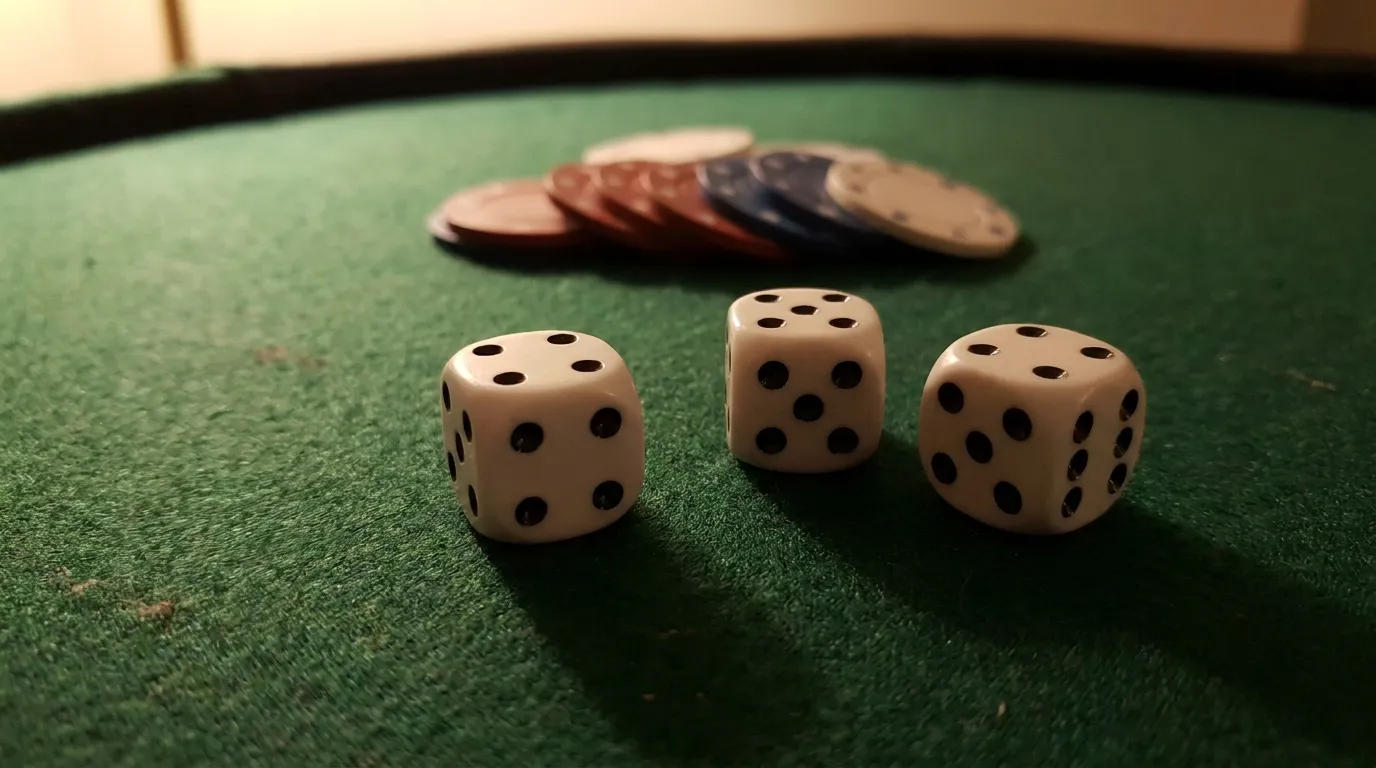
Each turn you throw all three dice together and keep throwing until you get a roll that counts. Half of all throws score nothing, so a turn takes two throws on average.
| Roll | Example | In the banking game | Chance per throw |
|---|---|---|---|
| 4-5-6 | 4, 5, 6 | Instant win | 2.78% |
| Trips (any triple) | 3, 3, 3 | Instant win | 2.78% |
| Pair and a 6 | 2, 2, 6 | Instant win | 6.94% |
| Point 5 | 3, 3, 5 | Sets a point of 5 | 6.94% |
| Point 4 | 1, 1, 4 | Sets a point of 4 | 6.94% |
| Point 3 | 6, 6, 3 | Sets a point of 3 | 6.94% |
| Point 2 | 5, 5, 2 | Sets a point of 2 | 6.94% |
| Pair and a 1 | 4, 4, 1 | Instant loss | 6.94% |
| 1-2-3 | 1, 2, 3 | Instant loss | 2.78% |
| No score | 2, 4, 5 | Throw again | 50% |
The point is always the odd die, not the pair: 2-2-5 and 1-1-5 are both a point of 5, and both beat 3-3-4. Of the 108 throws that count, 27 win outright, 21 lose outright and 60 set a point. The winning rolls are known as headcracks.
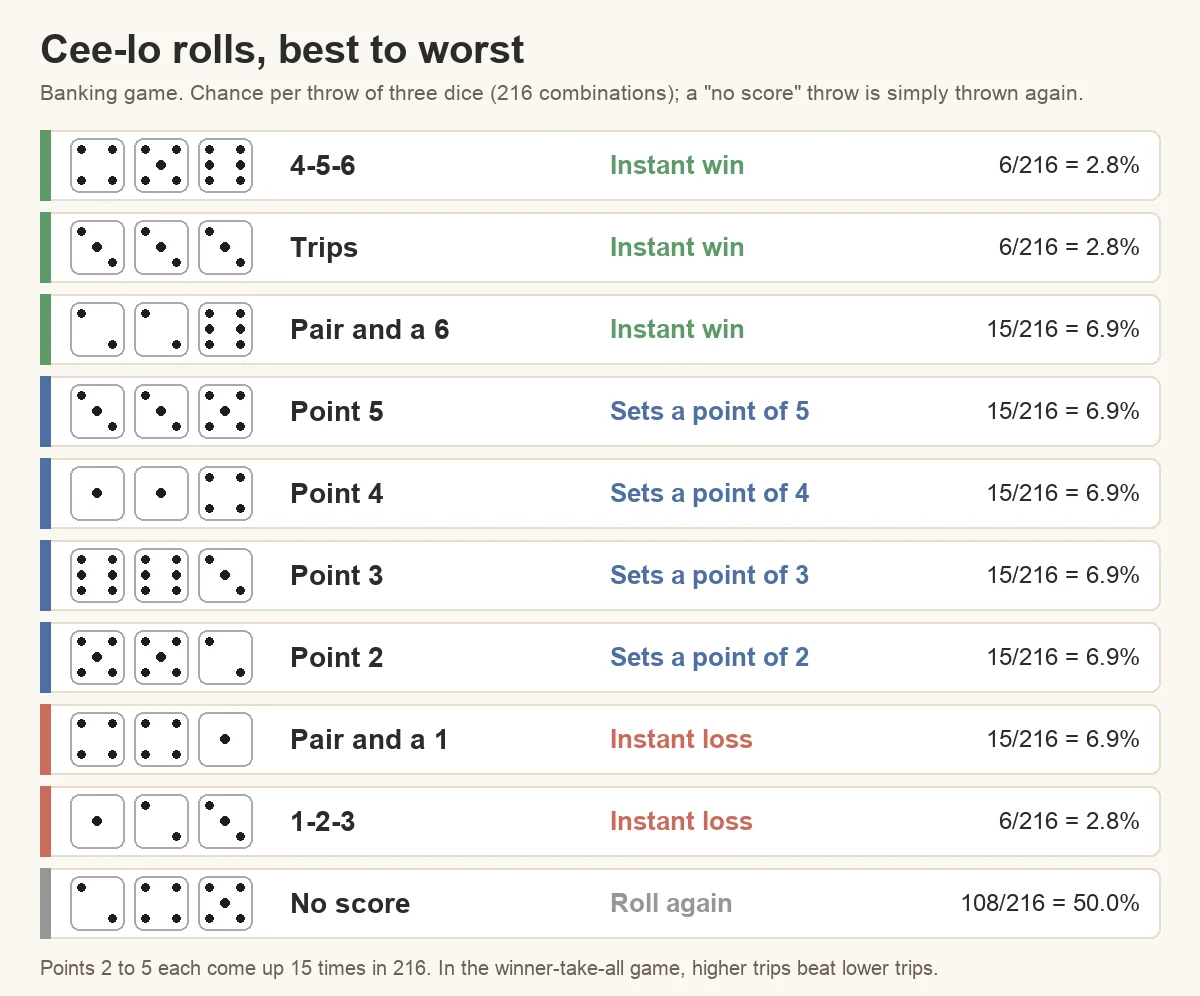
The banking game is the classic way to play. One player is the banker and everyone else bets against the bank at even money.
So a player who bets 10 and beats the banker’s point collects 10 from the bank and keeps the stake. Dice that leave the playing area are usually an automatic loss for the thrower.
Without a banker, everyone puts the same amount in the pot and rolls once each, throwing until the roll counts. The best roll takes the whole pot, and players who tie for the best roll throw again in a shoot-out. The ranking is slightly different from the banking game:
The banker’s whole advantage comes from rolling first. Of the banker’s rolls, 25% win every bet straight away, 19.4% lose every bet, and the rest set a point, each point from 2 to 5 with a chance of 13.9%. Your chances against each point:
| Banker’s point | You win | Push | You lose | Return |
|---|---|---|---|---|
| 2 | 66.7% | 13.9% | 19.4% | +47.2% |
| 3 | 52.8% | 13.9% | 33.3% | +19.4% |
| 4 | 38.9% | 13.9% | 47.2% | −8.3% |
| 5 | 25.0% | 13.9% | 61.1% | −36.1% |
Put together, a player wins 44.9% of bets, pushes 7.7% and loses 47.4%. That makes the banker’s edge exactly 2/81 of every bet, or 2.47%. Leave the pushes out and it is 2.68% of the bets that are decided, the “about 2.7%” usually quoted for the game. That is why the bank is the seat to have, and why the rules pass it round the table.
A point of 4 or 5 is good for the banker, a point of 2 or 3 is good for the players. There is no strategy in the rolling itself: the dice decide everything, and the only choices are how much to bet and whether to take the bank.
There is no single official rule book for Cee-lo, so agree the rules before the first roll. Common variations:
The name is the Cantonese sz’ ng luk, “four five six”. In 1893 the ethnographer Stewart Culin described it as the most popular dice game among Chinese-American workers, though the writer Gil Jacobs traced it to the old European game passe-dix, with betting borrowed from craps. Cee-lo flourished in Harlem in the 1970s and 1980s, remains popular in parts of New York City, and has been named in East Coast hip hop since the 1990s. In Japan the same game is Chinchiro or Chinchirorin, and in China it is also called “Three-Six Leopards” after its name for triples. In the US it also goes by See-Low, Four-Five-Six, Roll-off, Banker’s Dice, Pair and a Point, or simply Dice.
| Cee-lo | Craps | Sic Bo | |
|---|---|---|---|
| Dice | Three | Two | Three |
| Who rolls | Every player, banker first | One shooter | The dealer, in a shaker |
| Points | A pair with a 2 to 5 | 4, 5, 6, 8, 9 or 10 | None: bets on totals and combinations |
| Where | Among friends, one player banks | Casinos and the street | Casinos and live online casinos |
In craps the point is set on the come-out roll. Online casinos do not run Cee-lo, because it needs players to bank for each other, but their three-dice game, sic bo, uses the same dice and familiar combinations such as triples. Learn the bets in the sic bo guide, or the two-dice game in the craps rules and odds. More dice games to play free: Farkle, Liar’s Dice and Yahtzee.
Cee-lo is a gambling game: only play for money where it is legal, with money you can afford to lose. Free, confidential support is available at BeGambleAware.org. 18+ only.

After going through several successful experiences with several industry pioneers, Fadi Hayek has managed to excel in the world of content for online gaming by providing unique content for several projects that allowed him to obtain the necessary experience to launch his career. Last but not least, Fadi also holds several certificates, including but not limited to content marketing and iGaming.


