Roll under the cup, bid on the whole table, call the bluff: how to play liar's dice and Perudo, and how to read the odds.
Liar’s dice is a bluffing game for two or more players. Everyone rolls five dice under a cup and looks only at their own. Players then take turns bidding on how many dice of one number are on the whole table, each bid higher than the last, until someone calls “liar”. The cups come up, the loser of the challenge gives up a die, and the last player with dice left wins. It is also played as Perudo or Dudo, where ones are wild. This guide covers the liar’s dice rules, the Perudo rules, the poker-dice version, and the odds that tell you when a bid is likely to be true.
Liar’s Dice Rules at a Glance
Liar’s dice
Players
Two or more; best with four to six.
Equipment
Five standard dice and a dice cup for each player.
A bid
A quantity and a face: “seven threes” means at least seven threes among all the dice on the table.
Your turn
Make a higher bid, or call “liar” on the last one.
Wild ones
In Perudo, and in many house games, a one counts as any face being bid.
Losing a die
Whoever is wrong when a bid is challenged loses one die.
Winning
The last player with dice left wins.
Also called
Perudo, Dudo, Cacho, pirate’s dice, Call My Bluff, Bluff.
How to Play Liar’s Dice
Pick a starting player. Each player rolls; the highest roll bids first and play goes clockwise.
Everyone rolls at once. Shake your five dice in your cup, turn it over on the table, then peek at your own dice without letting anyone else see them.
Open the bidding. The first player names a quantity and a face, such as “four fives”: a claim that there are at least four fives across every cup, their own included.
Raise or call. The next player either makes a higher bid or calls “liar” (in Perudo, “dudo”, Spanish for “I doubt”).
Reveal. When a bid is called, every cup is lifted and the dice are counted. If there are at least as many as bid, the bidder wins the challenge; if not, the caller wins.
Lose a die. The loser of the challenge puts one die aside for the rest of the game.
Next round. Everyone rerolls the dice they have left, and the loser of the last challenge starts the bidding (or the next player, if they are out). The last player with dice wins.
What counts as a higher bid
Agree this before you start. The three common rules are:
bid more of any face, or the same quantity of a higher face (“five threes” can become “five fours” or “six twos”);
bid more of the same face, or any quantity of a higher face;
the strictest: more of the same face, or the same quantity of a higher face.
An example round
Four players. The first bids “three fours”, the second raises to “five fours”, and the third to “seven fours”. The fourth player calls. Under the cups there are six fours, so the bid of seven was wrong: the third player loses a die. With seven or more fours, the caller would have lost one instead.
Perudo Rules: Wild Ones and Bidding on Aces
Perudo (also called Dudo) is the South American form of liar’s dice. It plays as above, with these extra rules:
Ones (aces) are wild. A bid of “five threes” counts every three and every one on the table.
Bidding on aces halves the quantity. To switch to aces, bid at least half the current quantity, rounded up: after “five threes” the lowest aces bid is “three aces”.
Switching back doubles it. From aces to another face you must bid more than double, plus one: after “three aces”, at least “seven fours”.
No opening on aces, unless you are down to your last die.
Spot on (calza). Instead of calling, you can claim the bid is exactly right. If it is, you win back a lost die; if not, you lose one (two in some games). The bidder loses nothing either way.
Last-die round (palo fijo). In many games, when a player first drops to one die, the next round is special: ones are not wild, and only players down to one die may change the face.
Common-Hand Liar’s Dice (Poker Dice)
The other classic version passes one set of five dice around the table. You roll in secret and announce a poker-dice hand: a pair, two pair, three of a kind, a straight, a full house, four or five of a kind. It may be true or a bluff. Rule books rank straights differently, so agree the order first. The next player either calls it, or accepts the dice unseen, rerolls any of them (saying how many) and must announce a higher hand. Whoever is wrong when a call is made loses a counter; the last player with counters wins.
Liar’s Dice Odds and Strategy
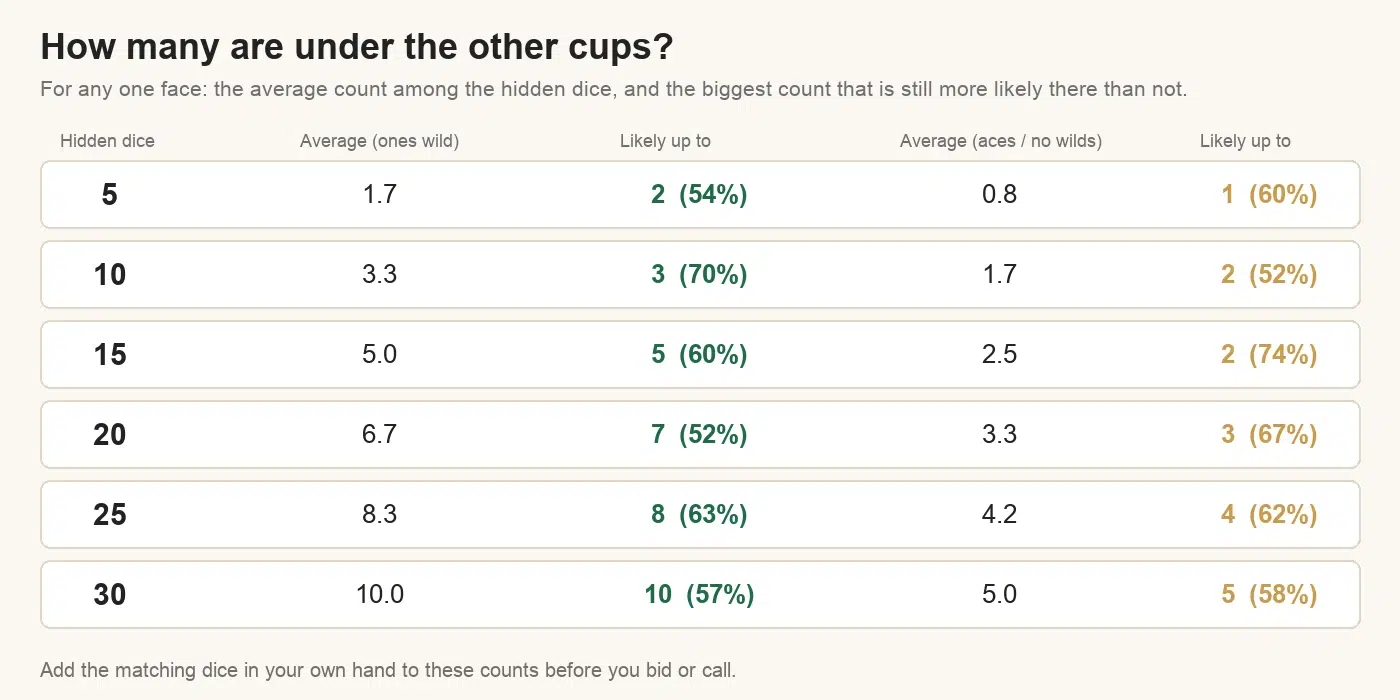
You cannot see other players’ dice, but you can work out what is likely under their cups. Each hidden die shows a given face one time in six. With ones wild, any face from two to six is matched one time in three. So:
Average count = hidden dice ÷ 3 with ones wild, or ÷ 6 for aces (or with no wild ones).
Then add your own matching dice. They are certain, so they count in full.
A bid of the average, rounded down, is true more often than not. Above that, the chance drops quickly.
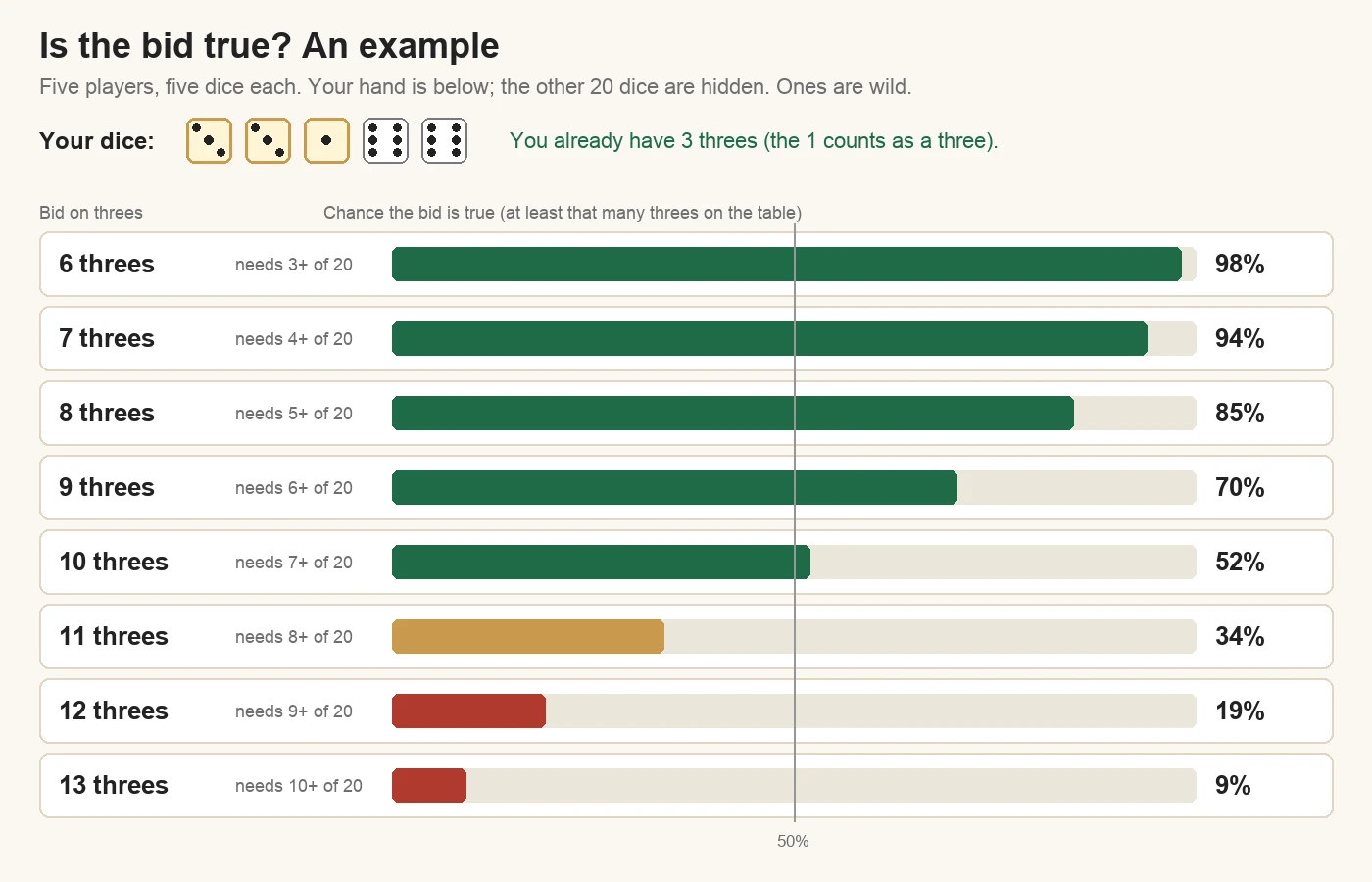
Five players, ones wild: with three threes in your hand, “ten threes” is close to a coin flip.
In the example above you hold 3, 3, 1, 6, 6, so you have three threes (and three sixes) already. The other 20 dice should hold about 6.7 more threes, making about ten in all. “Nine threes” is true 70% of the time and “ten threes” 52%; by “twelve threes” it is down to 19%, and that is the bid to call.
The counts under other players’ cups. Add the matching dice in your own hand.
Tips for bidding and calling
Bid on faces you hold. Your own dice make the bid more likely to be true, and other players cannot see them.
Read the raises. A player who keeps pushing one face may well have several of it. A sudden change of face can be a bluff to shift the bidding away from a face they lack.
Switching to aces is a high-bid escape. Looking at 20 dice you cannot see, “five threes” is true 85% of the time but the aces bid that replaces it, “three aces”, only 67%. At the top end it turns round: “eight threes” is 34%, “four aces” 43%.
Spot on is a long shot. Even the most likely exact count among 20 hidden dice with ones wild (7) comes up only 18% of the time. Keep it for small tables, where it is closer to one in three.
Fewer dice, wider swings. As players lose dice the average falls and every guess carries more risk.
Where Liar’s Dice Comes From
Liar’s dice is said to come from Dudo, a game from the Inca Empire in the 15th century, carried to Europe by Spanish conquistadors; it is still widely played across South America under names such as Cacho and Dudo. Many commercial versions followed in the 1970s and 1980s, and Call My Bluff (sold as Bluff) won Germany’s Spiel des Jahres in 1993. Film fans know it from the dice game in Pirates of the Caribbean: Dead Man’s Chest, and gamers from Red Dead Redemption.
More Dice and Bluffing Games
For more dice, try Farkle, the six-dice push-your-luck game, or the pub classic Shut the Box. If it is the bluffing you enjoy, Three Card Brag and poker are built on it.
If you play for money, agree the stakes in advance and keep them small. Free, confidential support is available at BeGambleAware.org. 18+ only.
The card version of the bluff:Cheat (also called Bullshit or I Doubt It), where you play face down and dare others to call it.
Another game played for counters:Newmarket (Boodle), the classic stops game with four horses.
For a bigger group:Bunco, the party dice game where three of the round number scores 21.
Another bar dice game:Ship, Captain and Crew, where you race to roll a 6, 5 and 4 and score the cargo.
A lighter dice game:Pass the Pigs, first to 100 points wins.
A dice game without the bluffing:Yahtzee, plus a printable score card.
Liar's dice: frequently asked questions
How do you play liar's dice?
Each player rolls five dice under a cup and looks only at their own. Players take turns bidding how many dice of one face are on the whole table, each bid higher than the last, until someone calls liar. All cups are lifted: if the bid was short, the bidder loses a die; otherwise the caller does. The last player with dice wins.
Are ones wild in liar's dice?
In Perudo (Dudo) and many house games, yes: a one counts as whatever face is being bid. Some tables play without wild ones, so agree it before you start.
Is liar's dice played with 5 or 6 dice?
Each player normally has five standard six-sided dice and a cup to hide them.
What is the difference between liar's dice and Perudo?
Perudo is a version of liar’s dice with ones wild, a rule that halves the quantity when you bid on aces, a spot-on call, and a special round when a player first drops to one die.
How do you bid on aces in Perudo?
Bid at least half the current quantity, rounded up: after five threes, the lowest aces bid is three aces. To move from aces back to another face you must bid more than double the aces, plus one.
What does spot on (calza) mean?
Instead of calling liar, you claim the last bid is exactly right. If it is, you win back a lost die; if not, you lose one, or two in some games.
How do you win at liar's dice?
Count what you can: with ones wild, about one in three hidden dice matches any face from two to six, so divide the hidden dice by three and add your own matching dice. Bid on faces you hold, and call bids that need far more than that average.
What happens when two players have one die each?
Some house rules switch to bidding on the total of the two dice instead of a count of one face. Otherwise the game carries on as normal until one player loses their last die.
Fadi Hayek
Author & Casino Expert
After going through several successful experiences with several industry pioneers, Fadi Hayek has managed to excel in the world of content for online gaming by providing unique content for several projects that allowed him to obtain the necessary experience to launch his career. Last but not least, Fadi also holds several certificates, including but not limited to content marketing and iGaming.
As online casinos adopt machine learning models and artificial intelligence in gambling becomes the next disruption, you don’t want to be left behind. Read on to learn about the impact AI will have on the future of the gambling industry.
Keep abreast of the latest Arabian football betting trends with the Arabian sports betting insights below. This guide covers the most popular bet types with Arab bettors and the top bookmakers for Arabian and global football competitions.
Yggdrasil and Reflex are set to launch Dublin Up DoubleMax, an Irish-style video, as one of their latest releases. The slot game is designed by incorporating Yggdrasil’s proprietary Game Engagement Mechanic (GEM) DoubleMax coupled with unique features like free spins bonus and fairy magic.