Farkle Rules
Roll six dice, set aside what scores, then bank or push your luck: the rules of Farkle (also called 10,000), the scoring chart and when to stop.


Roll six dice, set aside what scores, then bank or push your luck: the rules of Farkle (also called 10,000), the scoring chart and when to stop.
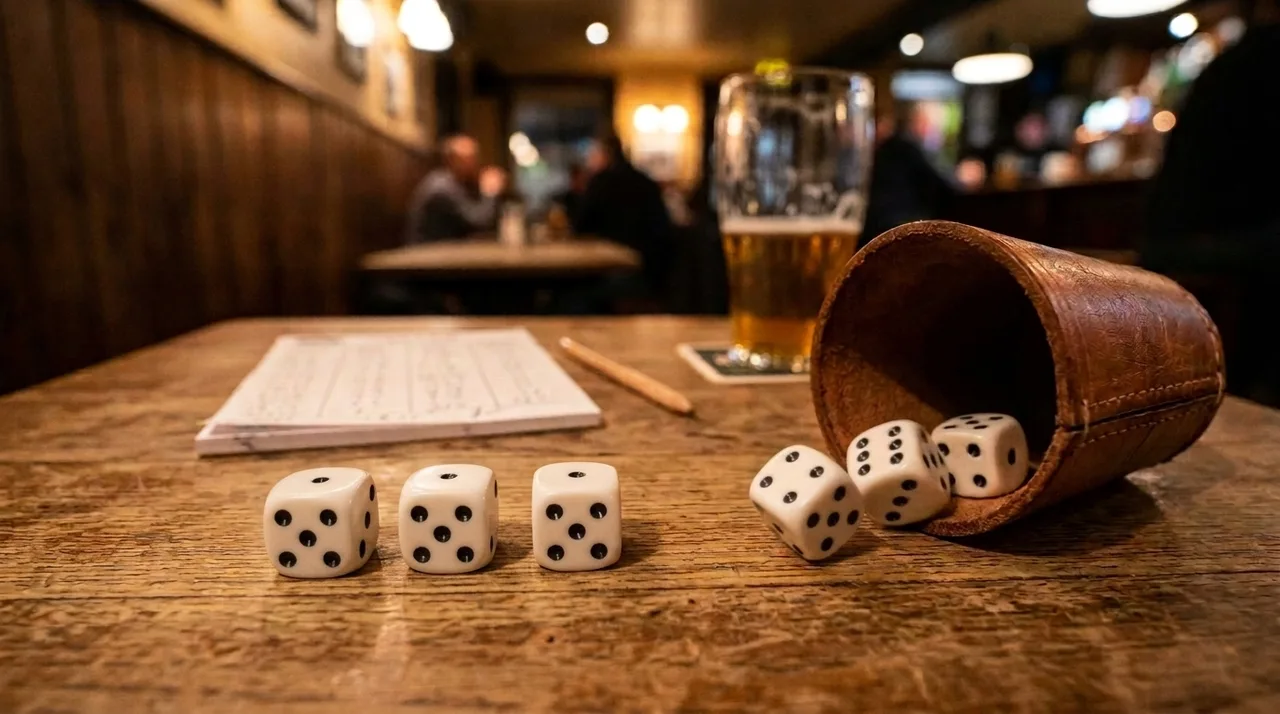
Farkle is a push-your-luck dice game for two or more players, played with six dice and a score sheet. You roll, set aside dice that score, and decide whether to bank your points or roll the rest again. Roll nothing that scores and you have “farkled”: every point from that turn is gone. The first player to reach 10,000 points sets the target for everyone else. This guide covers the Farkle rules, the full scoring chart (and where the boxed game differs), hot dice, popular house rules, and the exact odds behind the big decision: roll again or bank.
| Farkle | |
|---|---|
| Players | Two or more. |
| Equipment | Six standard dice, a pen and a score sheet. A dice cup is handy. |
| Goal | Be the first to 10,000 points; everyone else then gets one last turn to beat you. |
| On your roll | Set aside at least one scoring die or combination, then bank or roll the rest. |
| Farkle | A roll with nothing that scores. You lose the points from that turn. |
| Hot dice | Score with all six dice and you can pick them all up and roll again. |
| Also called | Ten Thousand, Dix Mille, Zilch, Greed, Hot Dice, Zonk and more. |
Each combination has to come from a single throw. Set aside one 5 on your first roll and two more on your next, and you have 150 points, not three 5s worth 500.
You roll 1, 1, 2, 3, 4, 6. You could take both 1s for 200, but setting aside just one 1 (100) and rolling five dice is the stronger play. Your five dice show 5, 5, 5, 2, 3: three 5s are worth 500, so your running total is 600 with two dice left. With two dice you farkle 44% of the time, so you bank the 600.
Hot dice work like this: with 250 in hand and two dice left, you roll 1 and 5. Both score (150), all six dice have now been set aside, and you pick up all six to roll again with 400 already in the turn.
Single 1s and 5s always score. Other numbers only count as three or more of a kind, or as part of a six-dice combination. The most widely used table is below; the boxed Farkle game sold in shops (PlayMonster) uses the same values with a few exceptions, shown in the right-hand column.
| Combination | Common rules | Boxed Farkle |
|---|---|---|
| Single 1 | 100 | 100 |
| Single 5 | 50 | 50 |
| Three 1s | 1,000 | 300 |
| Three 2s / 3s / 4s / 5s / 6s | 200 / 300 / 400 / 500 / 600 | 200 / 300 / 400 / 500 / 600 |
| Four of a kind | 1,000 | 1,000 |
| Five of a kind | 2,000 | 2,000 |
| Six of a kind | 3,000 | 3,000 |
| Straight (1-2-3-4-5-6) | 2,500 | 1,500 |
| Three pairs | 1,500 | 1,500 |
| Four of a kind + a pair | 1,500 (counts as three pairs) | 1,500 |
| Two triplets | Scored as two sets of three | 2,500 |
| To get on the score sheet | Any score | 500 in one turn |
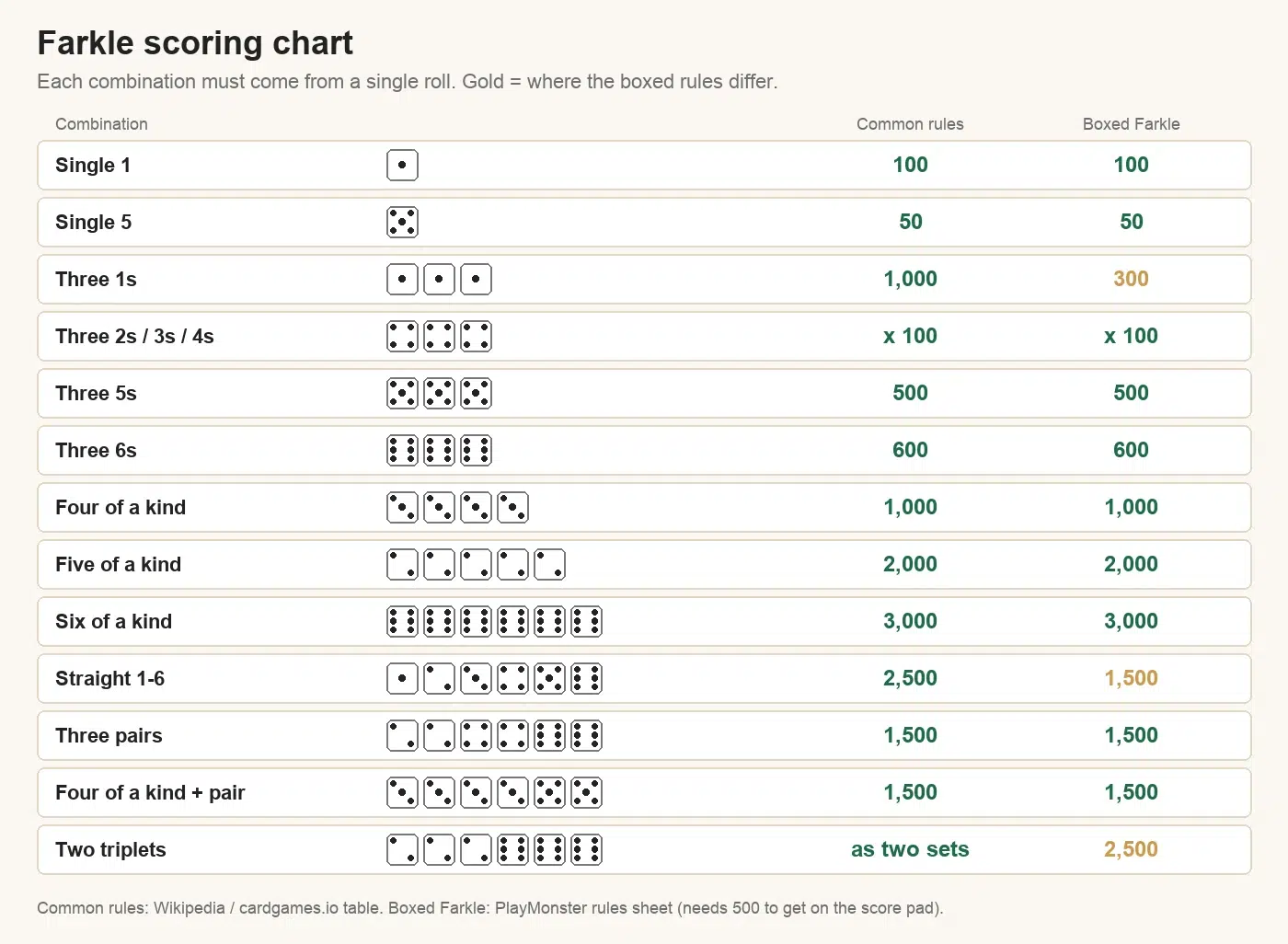
One roll can often be scored several ways. Roll 1, 2, 3, 3, 3, 5 and you could take the three 3s (300) and roll three dice, take just the 1 (100) and roll five, or take the 1, the 3s and the 5 for 450. That last choice leaves one die; at the start of a turn the best play is to take the 450 and bank it.
| House rule | How it works |
|---|---|
| Opening score | You must score 500 (sometimes 350 or 1,000) in a single turn before you can bank for the first time. |
| Three Farkles | Three farkles in a row costs you 500 or 1,000 points. |
| Toxic twos | Rolling four or more 2s at once wipes out your turn (in harsher versions, your whole score). |
| Must roll hot dice | After hot dice you have to roll all six again at least once. |
| Four, five and six of a kind | Instead of 1,000 / 2,000 / 3,000, some tables double the three-of-a-kind value for each extra die. |
| Welfare | You must finish on exactly 10,000. Go over and that turn’s points go to the player in last place. |
| High stakes (piggybacking) | You may start your turn by rolling the dice the previous player left; score with them and you collect a bonus on top (1,000 points, or the previous player’s turn total, depending on the table). |
| Five-dice Farkle | The original folk version: five dice, so there are no three pairs. |
Every Farkle turn comes down to one choice: stop now, or risk the running total for more. The answer depends on how many dice you would be rolling. Working through every possible roll exactly (common rules, aiming for the highest average score per turn) gives these points to stop:
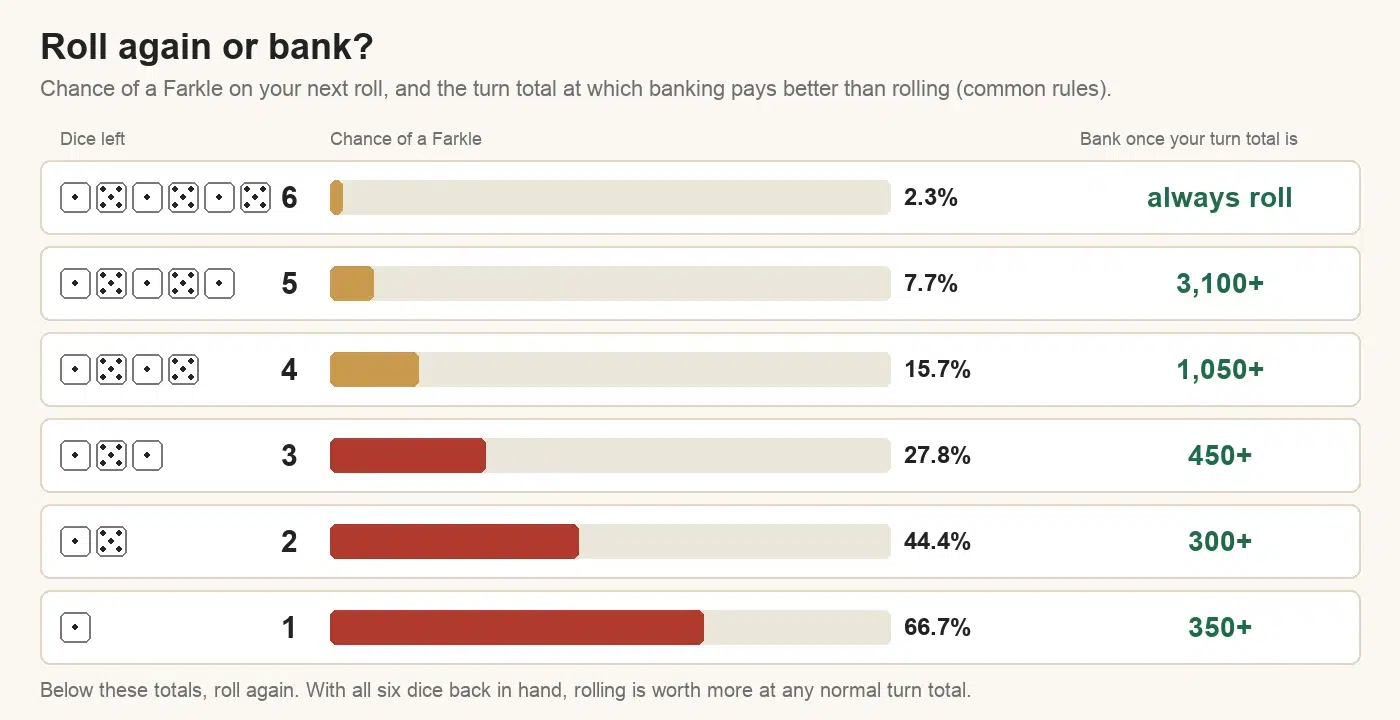
With the boxed scoring (three 1s are worth only 300), the stopping points come down a little: 300, 250, 400, 950 and 2,800 for one to five dice.
Taking every scoring die is often a mistake, because each die you keep is one fewer to roll. Roll 2, 2, 2, 4, 5, 6 at the start of a turn and the best play is to keep only the 5 and roll five dice: that is worth about 370 points on average, against 262 for keeping the three 2s. In the example turn above, keeping a single 1 rather than both 1s works the same way.
Late in a game, the score matters more than the average: if you are far behind, you need bigger turns and should roll on; if one bank wins you the game, take it.
| Dice rolled | Chance of a Farkle | About 1 in |
|---|---|---|
| 6 | 2.3% | 43.2 |
| 5 | 7.7% | 13.0 |
| 4 | 15.7% | 6.4 |
| 3 | 27.8% | 3.6 |
| 2 | 44.4% | 2.2 |
| 1 | 66.7% | 1.5 |
With one die, only a 1 or a 5 scores (2 faces out of 6). With six dice, a Farkle needs no 1, no 5, no three of a kind, no three pairs and no straight: just 1,080 of the 46,656 possible rolls.
Many families know Farkle as 10,000, Ten Thousand or, in French, Dix Mille, after the score you play to. It is the same game: six dice, 1s and 5s score on their own, three of a kind scores, you set aside scoring dice and then bank or roll on, and a roll with nothing that scores wipes out your turn. When someone reaches 10,000, everyone else gets one last turn to beat them.
What changes from one 10,000 table to the next is the fine print. Two published 10,000 rule sheets show how far apart they can be:
| Rule | Common Farkle (this page) | 10,000 sheet A | 10,000 sheet B |
|---|---|---|---|
| To get on the board | Any score | 500 in one turn | 800 in one turn |
| Four of a kind | 1,000 | Double the three of a kind (four 2s = 400) | Double the three of a kind (four 2s = 400) |
| Five of a kind | 2,000 | Triple it (five 2s = 600) | Four times it (five 2s = 800) |
| Six of a kind | 3,000 | Four times it (six 1s = 4,000) | Eight times it (six 1s = 8,000) |
| Straight 1–6 | 2,500 | Not listed | 1,000 |
| Three pairs | 1,500 | Not listed | 1,000 |
Sheet A is Bees Boards’ “How to Play 10,000”; sheet B is a widely shared “10,000 dice game directions” printable, which also spells out that a three of a kind has to come in a single roll. So before the first roll, agree three things: the opening score, how four or more of a kind count, and whether straights and three pairs score.
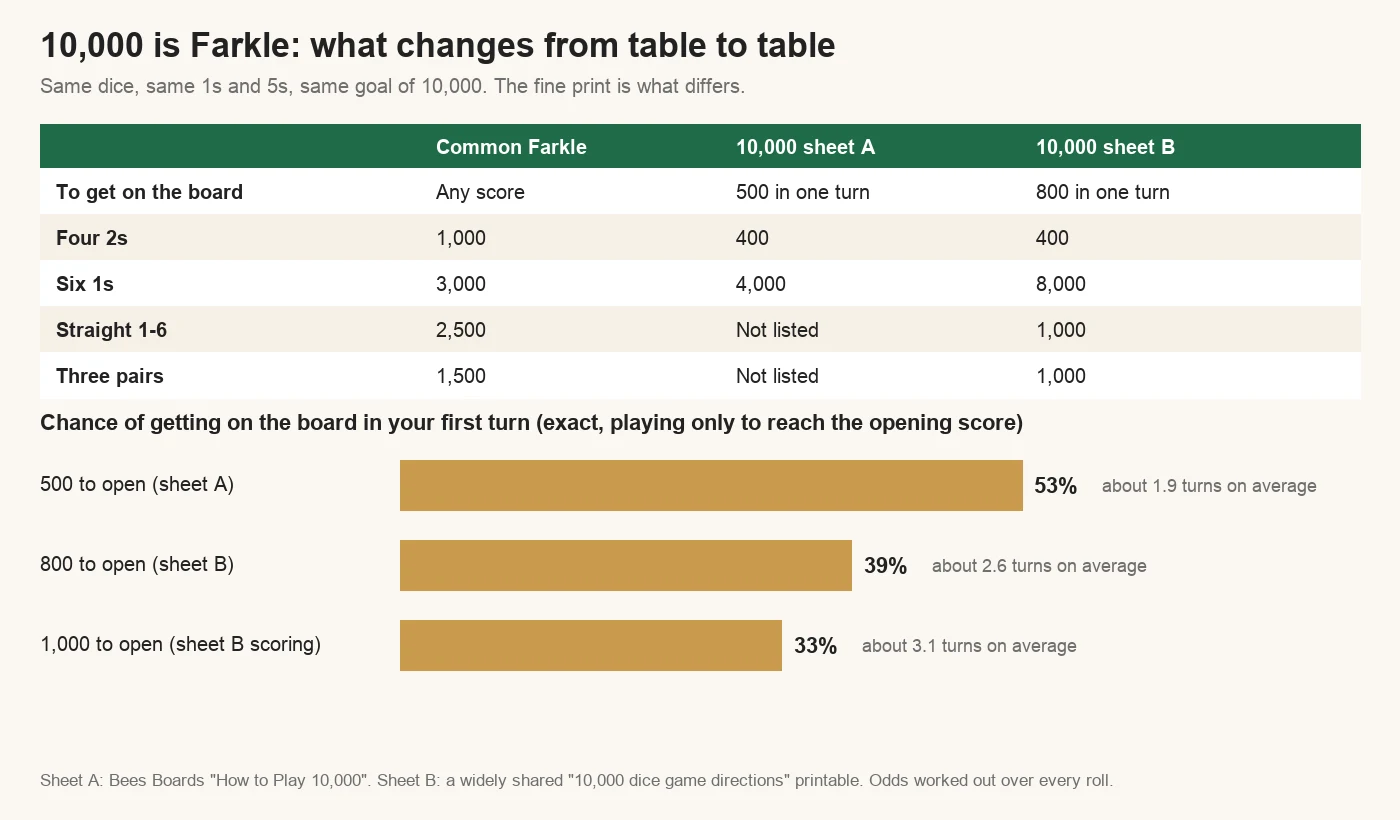
How long does it take to get on the board? Playing only to reach the opening score, you make 500 in your first turn 53% of the time, about 1.9 turns on average. With 800 to open it drops to 39% (about 2.6 turns), and with 1,000 to 33%. These figures are exact, worked out over every possible roll.
Playing 10,000 with five dice: some families use five dice instead of six. Three pairs cannot happen, and the game often comes with an instant win for rolling five of a kind on the first roll of a turn.
Farkle is a folk game, which is why so many versions exist. The makers of Pocket Farkel, sold since 1996, say it arrived in North America on French ships in the 1600s, and Farkle equipment and instructions dating to the 1700s have been found at Fort Chartres, Illinois. It goes by many names, among them Ten Thousand, Dix Mille, Zilch, Greed, Hot Dice and Zonk. Video game players know it from Kingdom Come: Deliverance, where it appears as Farkle, and its sequel, which calls it simply Dice and adds weighted dice.
If you like pushing your luck with dice, try the pub classic Shut the Box. Casinos have their own dice games too: craps, played with two dice, and sic bo, played with three.
If you play for money, agree the stakes in advance and keep them small. Free, confidential support is available at BeGambleAware.org. 18+ only.
A dice game built on bluffing: Liar’s Dice, where everyone rolls under a cup and bids on the whole table.
Another dice game for a crowd: Bunco, played in teams at several tables with three dice and a bell.
Want a dice game with no decisions at all? Try Left Right Center, a pure-luck party game played with three dice and a few chips.
Push your luck with pigs: Pass the Pigs, where two pig figures replace the dice and a Pig Out wipes the turn.

After going through several successful experiences with several industry pioneers, Fadi Hayek has managed to excel in the world of content for online gaming by providing unique content for several projects that allowed him to obtain the necessary experience to launch his career. Last but not least, Fadi also holds several certificates, including but not limited to content marketing and iGaming.


