Chess Board Setup
Light on the right, queen on her colour: how to set up a chess board in six steps, where every piece goes, the common mistakes and a free set-up trainer.


Light on the right, queen on her colour: how to set up a chess board in six steps, where every piece goes, the common mistakes and a free set-up trainer.
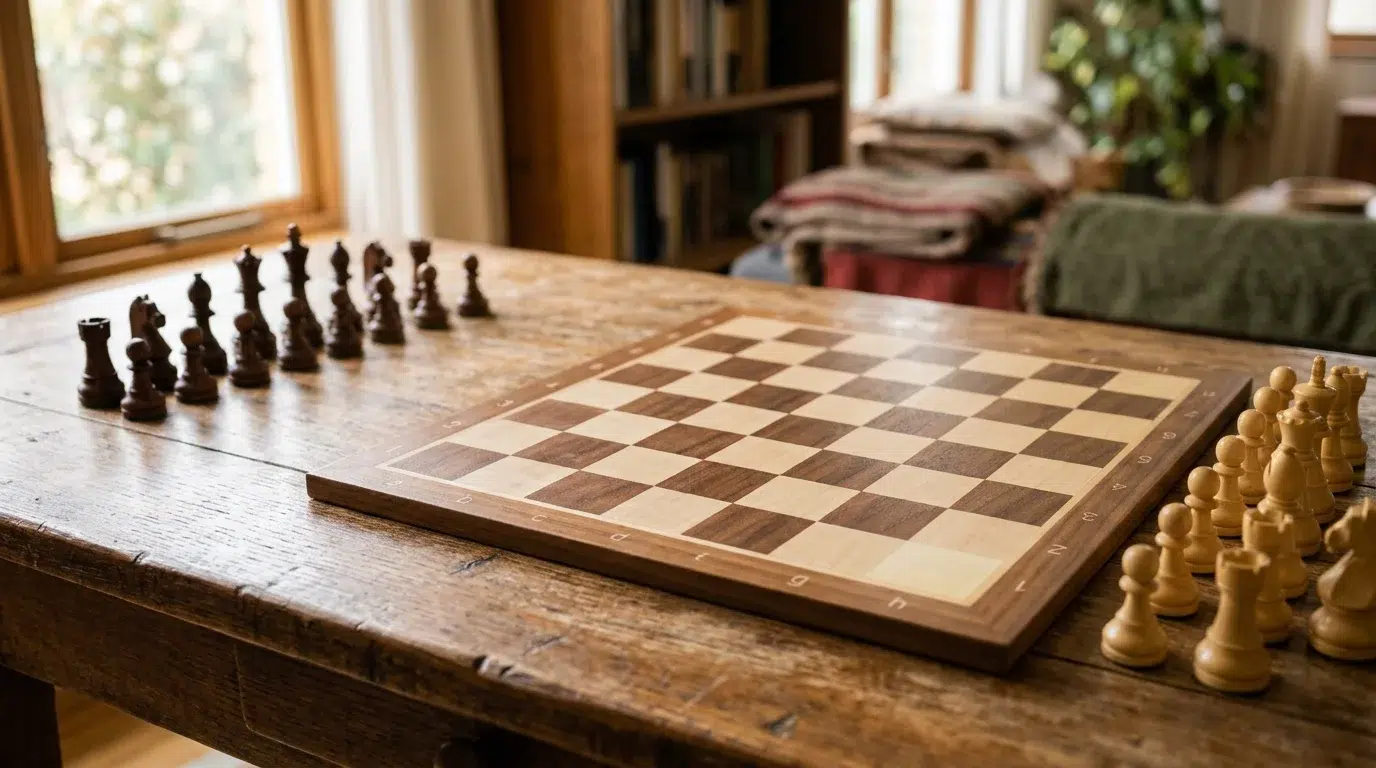
Setting up a chess board takes less than a minute once you know the pattern. Turn the board so each player has a light square in the near right-hand corner, put the rooks in the corners, the knights next to them, then the bishops, the queen on the square of her own colour, the king on the last square, and fill the second row with pawns. Both armies then mirror each other: queen facing queen, king facing king. White moves first.
This page takes you through the chess board setup step by step, with a diagram for every step, the exact starting square of every piece, the mistakes beginners make most often and what happens if a game is started from the wrong position. The free set-up trainer below lets you practise: place the pieces one step at a time, set up the whole board on your own and have it checked, or spot what is wrong with ten boards.
You play White, at the bottom of the board. In Step by step, choose a piece and tap the square where it goes: the trainer explains every wrong square, and Show me highlights the right ones. In On your own, set up all 32 pieces and press Check to see which are right (green) and which are wrong (red). Spot the mistake shows ten boards: say whether each one is set up correctly and, if not, what is wrong.
Each player starts with 16 pieces: one king, one queen, two rooks, two bishops, two knights and eight pawns. Every piece has a fixed starting square:
| Piece | Each side | White starts on | Black starts on |
|---|---|---|---|
| Rooks | 2 | a1, h1 | a8, h8 |
| Knights | 2 | b1, g1 | b8, g8 |
| Bishops | 2 | c1, f1 | c8, f8 |
| Queen | 1 | d1 | d8 |
| King | 1 | e1 | e8 |
| Pawns | 8 | a2 to h2 (the whole second rank) | a7 to h7 (the whole seventh rank) |
The four middle ranks, 3 to 6, are empty at the start.
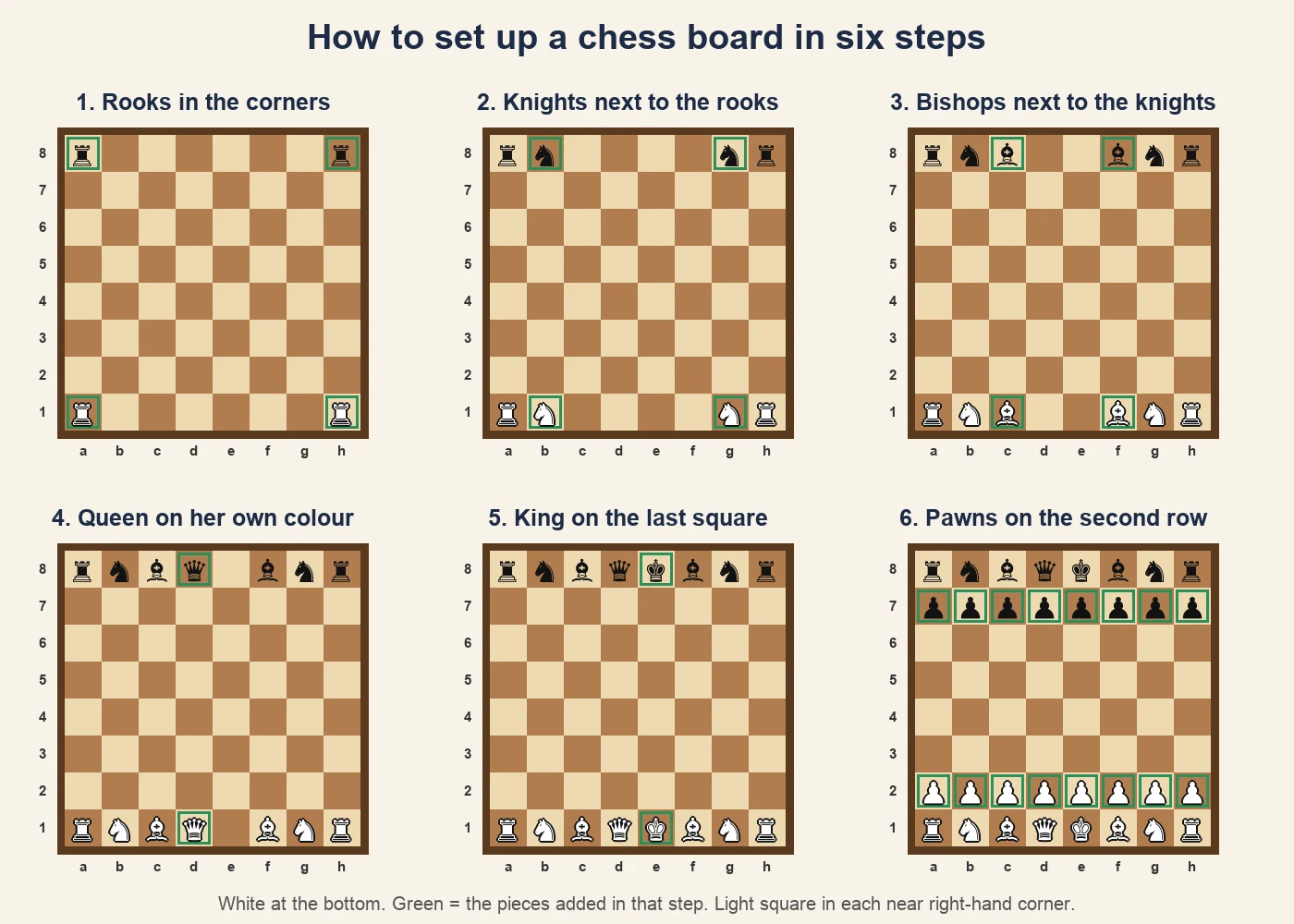
Check the result: the two sides should be exact mirror images, with each piece facing the same piece across the board, and each queen standing on a square of her own colour.
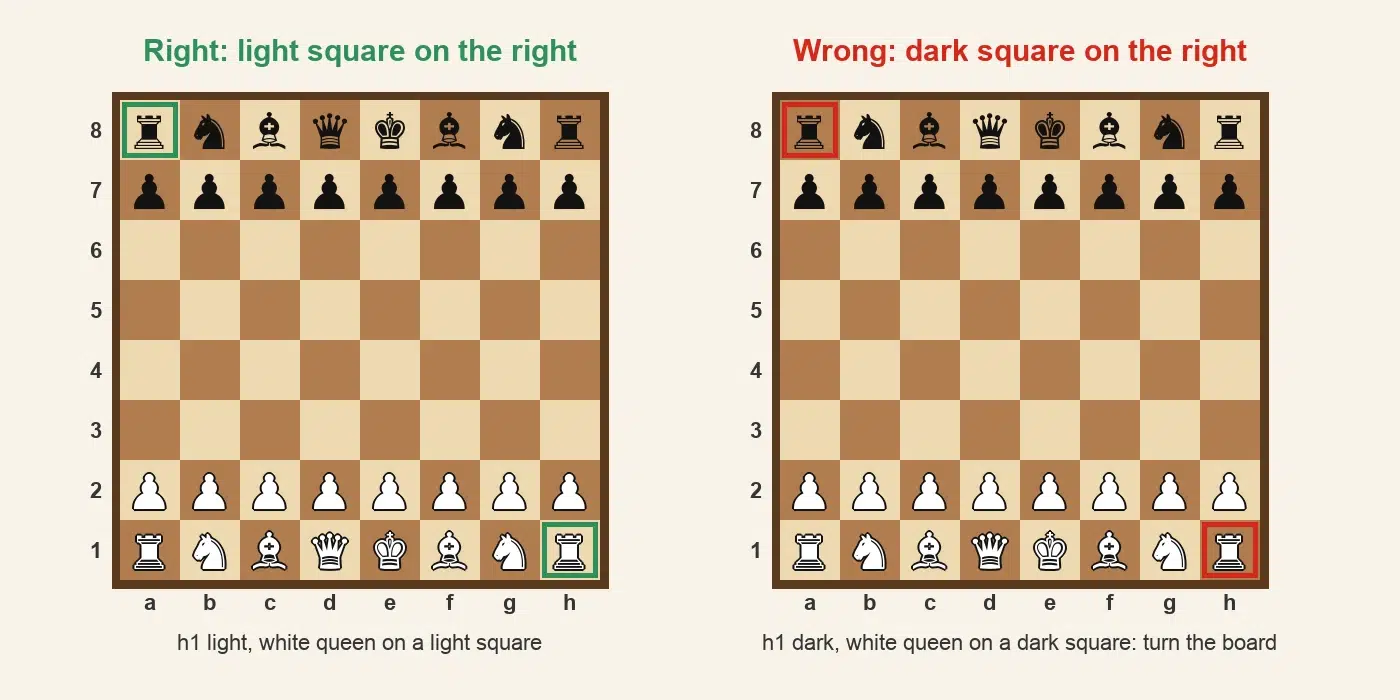
A chess board can lie on the table four ways, and only two of them are correct. The FIDE Laws of Chess say the board is placed so that the near corner square to the right of each player is light. For White that square is h1; for Black, sitting opposite, it is a8. Both are light squares, so if one player has a light square on the right, so does the other.
The quickest test is the queen: set up the back row and look at d1. If the white queen is standing on a dark square, the board is the wrong way round. Turn it a quarter turn and set it up again. Many boards also have the letters a to h along White’s side and the numbers 1 to 8 up the left-hand edge; when you sit as White, the a-file is on your left and rank 1 is nearest you.
This is the part most people get wrong. The two pieces share the two middle squares of the back row, d and e, and the rule that sorts them out is queen on her own colour:
So the queens face each other on the d-file and the kings face each other on the e-file. Seen from White’s chair the king stands to the right of the queen; from Black’s chair the king is to the left of the queen. That is why “the king always goes on the right” is not a safe rule: it is only true for White.
Every square on the board has a name, made of a letter and a number. The eight columns are called files and are lettered a to h from White’s left to right. The eight rows are called ranks and are numbered 1 to 8, starting from White’s side. The square in White’s near left-hand corner is a1 (a dark square) and the one in the near right-hand corner is h1 (light). Black’s back row is rank 8.
The square names make the starting position easy to describe: White’s pieces on ranks 1 and 2, Black’s on ranks 7 and 8, the queens on d1 and d8 and the kings on e1 and e8. The same names are used to write down the moves of a game; see how to play chess for how chess notation works.
| Mistake | How to spot it | Fix |
|---|---|---|
| Board turned the wrong way | A dark square in your near right-hand corner; the white queen ends up on a dark square | Give the board a quarter turn |
| King and queen swapped | The queen is not on her own colour (white queen on e1, or black queen on e8) | Queen on d1 / d8, king on e1 / e8 |
| Knights and bishops swapped | Bishops next to the rooks | Order from the corner: rook, knight, bishop |
| Rooks and knights swapped | Knights in the corners | Rooks always go in the corners |
| Wrong colour moves first | Black makes the first move | White always moves first |
In a friendly game, just stop and set it up again. In a tournament played under the FIDE Laws of Chess, the rules are precise:
Chess960, also called Fischer Random Chess, uses the same board and the same moves but shuffles the pieces on the back row before each game. The pawns stay on the second rank as usual, and the white pieces on the first rank are placed at random with three conditions: the king must stand somewhere between the two rooks, the two bishops must be on squares of opposite colours, and the black pieces are placed directly opposite the white ones. Those conditions allow exactly 960 different starting positions, which gives the variant its name. The normal starting position is one of them.
With the board set up, White always makes the first move, and then the players take turns. To learn what each piece can do, see chess pieces names and moves. The special moves have their own pages: castling, which only works if the king and rook are still on the squares you have just put them on, and en passant. For the full rules, including check, checkmate and stalemate, and a free game against the computer, see how to play chess. Like a different board game? Try checkers.

After going through several successful experiences with several industry pioneers, Fadi Hayek has managed to excel in the world of content for online gaming by providing unique content for several projects that allowed him to obtain the necessary experience to launch his career. Last but not least, Fadi also holds several certificates, including but not limited to content marketing and iGaming.


