The Donkey card game is a family favourite in India: everyone tries to get rid of their cards, and the last player still holding cards is the donkey. In Punjab, Pakistan and Bangladesh the same game is known as Getaway, and its key move is the thulla, a card of another suit that stops a trick and makes someone pick the whole trick up. In Kerala it is played with a trump suit and called Donkey.

Play both versions free below against three computer players, then read the full rules: the deal, the first trick with the ace of spades, following suit, the thulla, getting away, the Kerala trump rules, who ends up the donkey, house rules, odds and tips. At the end there is a short guide to the other card games that are also called Donkey.
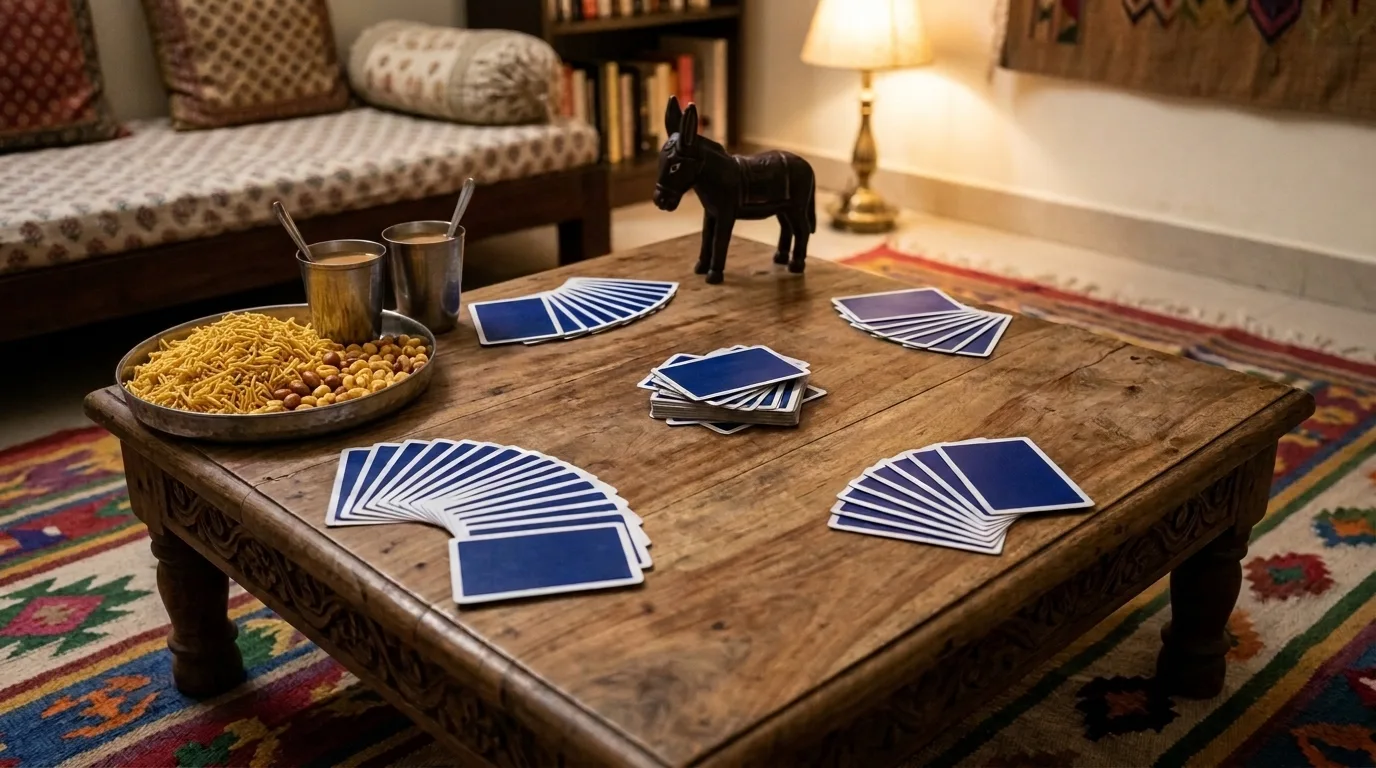
A low wooden table in an Indian living room with four face-down hands of cards of very different sizes, a discard pile in the middle, a carved wooden toy donkey, glasses of chai and a plate of namkeen
Mid-game: the hands shrink and grow as tricks are thrown away or picked up. The last player left holding cards is the donkey.

Play the Donkey Card Game Free Online

You sit at the bottom; Left, Across and Right are computer players, and play goes to the left. Pick Getaway (no trumps) or Donkey (Kerala, with trumps) at the top. Only the cards you are allowed to play are lit. The table shows how many cards each player holds, a tick once they have got away, and how many times each player has been the donkey.

Free, no sign-up, nothing to download. Four players, 13 cards each, play goes to the left (clockwise). Get rid of all your cards; the last player left holding cards is the donkey. The A♠ leads the first trick. In Getaway a card of another suit (a thulla) ends the trick and the highest card of the suit led picks it up. In Donkey the first player who cannot follow suit makes trumps. The optional rule of taking the cards of the player to your left is not used.

The free game uses the standard rules described below, with one optional rule left out: taking all the cards of the player on your left.

Donkey (Getaway) at a Glance

Getaway (Punjab)Donkey (Kerala)
Players3 to about 8 (4 is common)3 to about 8 (4 is common)
CardsStandard 52-card pack, no jokers, A highStandard 52-card pack, no jokers, A high
DealAll the cards, as evenly as possibleAll the cards, as evenly as possible
DirectionClockwiseClockwise
First leadThe ace of spadesThe ace of spades
TrumpsNoneSet by the first player who cannot follow suit
Cannot follow suitPlay any card: a thulla, which ends the trickPlay a trump if you can; otherwise any card, which ends the trick
Who picks upThe highest card of the suit ledThe winner of the trick (highest trump, or highest card of the suit led)
AimGet rid of all your cardsGet rid of all your cards
LoserThe last player holding cardsThe last player, a “donkey with x legs” (x = cards left)

Players, Cards and the Deal

Use a standard 52-card pack without jokers. Cards in each suit rank from high to low A, K, Q, J, 10, 9, 8, 7, 6, 5, 4, 3, 2. At least three players are needed for the game to be interesting, and up to about eight can play. With four players everyone gets 13 cards.

Shuffle and deal out all the cards as equally as possible; some players may get one more card than others. Deal and play go clockwise. Players pick up their cards and keep them hidden. Taking turns to deal evens out the luck of getting an extra card.

The First Trick: the Ace of Spades

The player holding the ace of spades starts by playing it face up, and every other player must also play a card. Players who have a spade must play a spade of their choice; players with no spades may play any card. In this first trick, unlike the rest of the game, a card of another suit does not stop anyone else from playing.

When everyone has played, the cards of the first trick are put face down to one side to start a discard pile (the waste pile). They are always thrown away, even if someone could not follow suit. The player of the ace of spades leads to the second trick (in the Kerala game, the player of the highest trump if one was played).
How a Trick Works: Following Suit and the Thulla

  1. The player with “the power” leads any card. That is the player who played the highest card of the suit led in the previous trick.
  2. Follow suit if you can. If you hold cards of the suit led you must play one of them, any one you like.
  3. If everyone follows suit, the trick goes face down on the discard pile, and the player of the highest card leads next.
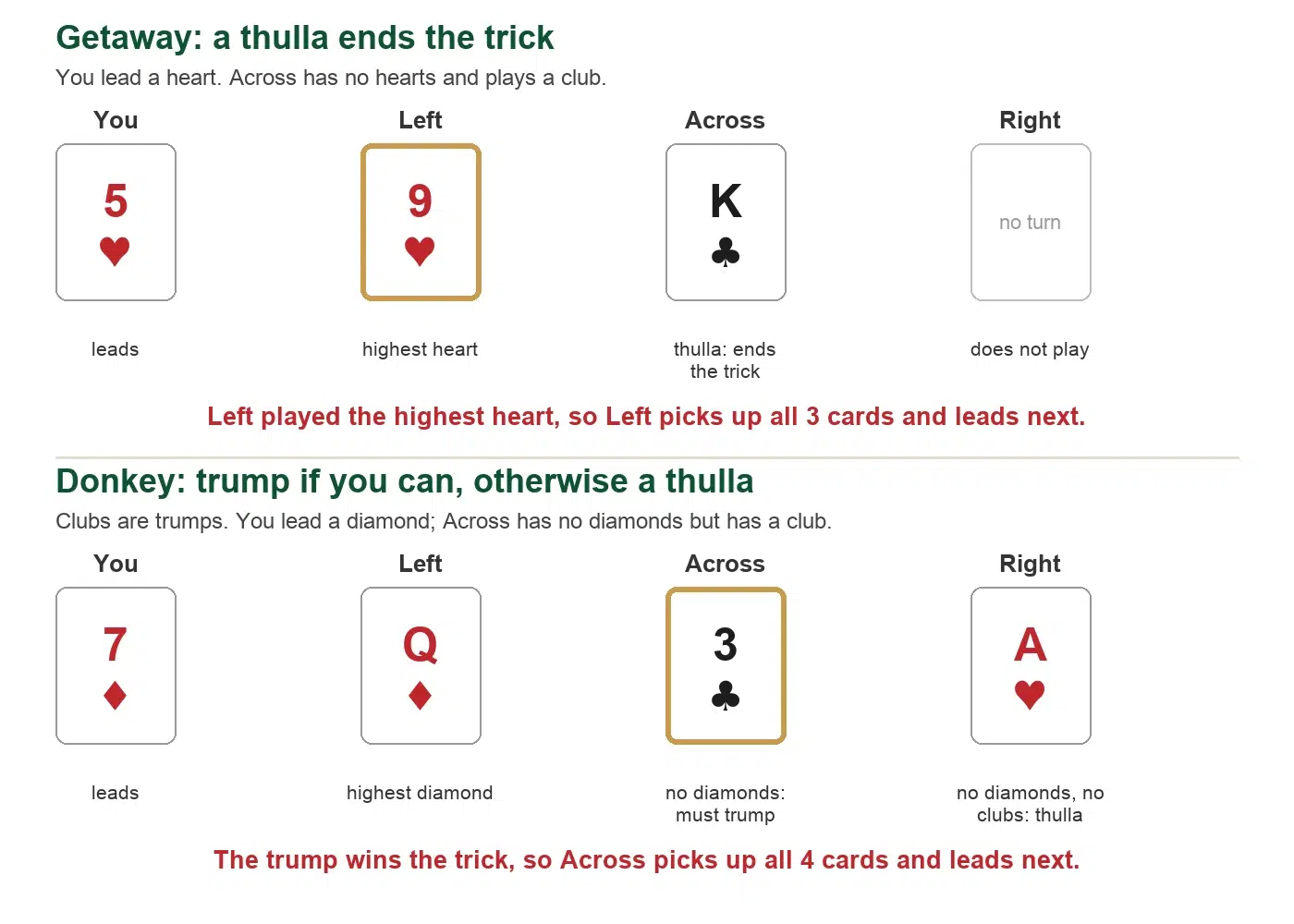
  4. If you cannot follow suit, play any card. This card of another suit is a thulla (also called a tochoo) and it ends the trick at once: the players after you do not play to it.
  5. The player of the highest card of the suit led picks up every card played to that trick and adds them to their hand. That player then leads to the next trick.
Two example tricks: in Getaway a club played on a heart lead ends the trick and the highest heart picks up; in Donkey a player without diamonds must trump, and a player with neither diamonds nor trumps ends the trick
A thulla in each version. Both tricks were played through the free game’s own rules engine.

The word thulla is Hindi slang for the police, used for the card that interrupts the trick. Mistakes have a price too: anyone who plays to a trick after the thulla, plays out of turn, or plays a thulla while holding the suit led has to pick up the trick and lead next.

Getting Away, and When You Cannot

As tricks are thrown away or picked up, players run out of cards at different times. A player who has no cards left has got away: they take no more part in the game and cannot lose.

There is one catch. You cannot get away while you have the power. If your last card is the highest card in a trick where everyone followed suit, it is your turn to lead but you have nothing to lead with. You must then draw a card at random from the shuffled discard pile, before the cards of the trick just played are added to it, and lead that card. If somebody plays higher in that suit, you are out; if not, you have to lead again.

Taking the cards of the player on your left

Before any trick, a player may take all the cards of the player on their left (or, if that player has none, the next player clockwise who still has cards) and add them to their own hand. The player who gave up their cards has got away and cannot lose. It sounds strange in a game about getting rid of cards, but it is often the best move when the player on your left does not have the suits you hold, or has the low cards you need.

Who Is the Donkey?

As players get away and drop out, the last player still holding cards is the loser, the donkey. There is no formal scoring; when you play a series of games, simply keep count of how often each player has been the donkey. In the Kerala game the loser is called a “donkey with x legs”, where x is the number of cards they are left holding.

When only two players are left

Play goes on as normal. If one of the two plays their last card as a thulla, or their last card is the same suit and lower than the other player’s card, the player still holding cards is the donkey. If you lead your last card and your opponent beats it with a higher card of the same suit, you get away and your opponent loses, even if that was their last card too.

Donkey with Trumps: the Kerala Rules

In Kasaragod, Kerala, the game called Donkey adds a trump suit. Everything else is played as in Getaway: the ace of spades leads to the first trick, you must follow suit if you can, and the last player holding cards loses.

  • The first player who cannot follow suit makes trumps. Whether it happens in the first trick or later, the suit of the card they play becomes trumps for the rest of the game, and this card does not end the trick.
  • From then on, if you cannot follow suit you must play a trump if you have one. If a trump is led, everyone must play trumps if they can.
  • A trick with a trump in it is won by the highest trump; a trick without trumps by the highest card of the suit led.
  • If everyone follows suit or trumps, the trick is thrown away and the winner leads next.
  • If you have neither the suit led nor a trump, play any card of another suit. It ends the trick, and the winner of the trick picks up all its cards and leads.

Trumping makes the Kerala game faster: in 10,000 computer-played games of each version, a game of Donkey lasted 18 tricks on average with 4.5 pick-ups, against 25 tricks and 12.5 pick-ups in Getaway. The donkey was left with 3.7 legs (cards) on average, and never more than 15.

Variations and House Rules

  • Piles instead of a deal: the dealer splits the shuffled pack into face-down piles of roughly equal height, one per player, without counting them. Traditionally the youngest player picks a pile first.
  • Anticlockwise play: some groups play the whole game the other way round; then you take cards from the player on your right.
  • Drawing from a player: instead of drawing from the discard pile, a player who must lead with no cards draws one at random from the hand of the next player on the left who still has cards.
  • Last card gets away: with more than two players left, playing your last card lets you get away even if you should have led next; the lead passes on to the left.
  • Two packs: with a large group, play with a double pack.

In Punjab many players call the game Bhabhi or Bhabhi Thulla. That name is used to mock the loser and many find it offensive, which is why this page uses Getaway and Donkey.

Odds and Numbers

With four players and 13 cards eachChance
You hold the ace of spades and lead the first trick25%
A given player is dealt no spades1.3%
At least one player has no spades, so the first trick has an off-suit card (in Donkey it makes trumps straight away)5.1%
Your 13 cards are missing at least one suit5.1%

From 10,000 computer-played games of each version:

GetawayDonkey (Kerala)
Average length25.4 tricks18.0 tricks
Average pick-ups per game12.54.5
Games where someone had to draw from the discard pile13.0%45.7%
The ace-of-spades holder ended up the donkey34.4%22.8%

With four players each would be the donkey 25% of the time if it were pure chance. In Getaway the player who starts with the ace of spades lost more often than that (34.4%).

Tips for Not Being the Donkey

  • Get rid of high cards while everyone is still following suit. Early in the game most players hold every suit, so tricks are thrown away and a high card costs you nothing. Later, a high card is the one that picks up the pile.
  • Watch for voids. When a player plays a thulla on a suit, they have none left. Avoid leading that suit, and avoid playing the highest card in it when that player is still to play.
  • Keep a low card in each suit when you can. It lets you follow without winning the trick.
  • Your thulla is a weapon. When you cannot follow, throw your most dangerous card: a high card in a suit that others are short of.
  • Do not win the trick with your last card if you can help it, or you will have to draw from the pile and lead again.
  • In the Kerala game, keep your trumps for when you cannot follow. A low trump wins a trick and keeps the cards out of your hand.

Other Card Games Called Donkey

The name is used for several quite different children’s and party games, so check which one your group means:

  • The pairs game: players match cards into pairs and draw cards from each other; the player left holding the unmatched queen of spades is the donkey and has to make a donkey noise. This is a version of Old Maid.
  • The passing game: each player has five cards and passes unwanted cards round the table, trying to collect five of a kind. The first to do it quietly puts their hand down, and the last player to notice and do the same is the donkey. In some versions the donkey earns a letter each round, D-O-N-K-E-Y. It plays like Spoons, without the spoons.

More card games from India to play free on this site: Callbreak, 3 2 5 (Teen Do Paanch), 29 (Twenty-Nine), Mendicot and Dehla Pakad and Indian Rummy.

Another favourite from Indian card nights: Bluff, the face-down shedding game where you call a rank and anyone can shout Bluff; free to play online.

Donkey card game: frequently asked questions

How do you play the Donkey card game?

Deal out a standard 52-card pack. The player with the ace of spades leads it, and everyone must follow suit if they can. If everyone follows, the trick is thrown away and the highest card leads next. A player who cannot follow plays a card of another suit, a thulla, which ends the trick, and the player of the highest card of the suit led picks the trick up. Get rid of all your cards; the last player left holding cards is the donkey.

What is a thulla in the Donkey card game?

A thulla (also called a tochoo) is a card of a different suit played by someone who cannot follow suit. It stops the trick at once, and the player of the highest card of the suit led has to pick up all the cards played to it. The word is Hindi slang for the police.

Who starts the Donkey card game?

The player holding the ace of spades. They play it to the first trick, everyone else plays a spade if they have one, and the first trick always goes on the discard pile, even if somebody could not follow suit.

How many players can play Donkey?

At least three, and up to about eight with one pack. Four is common, with 13 cards each. With a large group you can play with two packs.

What happens if you win a trick with your last card?

You cannot get away while you have the lead. If your last card is the highest in a trick where everyone followed suit, you draw a card at random from the discard pile and lead it.

What is the Kerala version of Donkey?

In Kerala the game has a trump suit: the first player who cannot follow suit makes their suit trumps. After that, a player who cannot follow must play a trump if they have one; only a card that is neither the suit led nor a trump ends the trick. The loser is a donkey with as many legs as cards left.

Is Getaway the same game as Donkey?

Yes. Getaway is the name used in Punjab, Pakistan and Bangladesh; the version with trumps is called Donkey in Kerala. The aim in both is to get rid of your cards and not be the last player holding any.

Is there a free online Donkey card game?

Yes. The game on this page lets you play Getaway or the Kerala Donkey free in your browser against three computer players, with no sign-up and nothing to download.

Fadi Hayek
Author & Casino Expert

After going through several successful experiences with several industry pioneers, Fadi Hayek has managed to excel in the world of content for online gaming by providing unique content for several projects that allowed him to obtain the necessary experience to launch his career. Last but not least, Fadi also holds several certificates, including but not limited to content marketing and iGaming.

Latest News

Artificial Intelligence in Gambling – How It Is Changing the Future of the Industry

As online casinos adopt machine learning models and artificial intelligence in gambling becomes the next disruption, you don’t want to be left behind. Read on to learn about the impact AI will have on the future of the gambling industry.

Arabian Football Betting Trends – Stay Current on Betting Preferences in the Middle East!

Keep abreast of the latest Arabian football betting trends with the Arabian sports betting insights below. This guide covers the most popular bet types with Arab bettors and the top bookmakers for Arabian and global football competitions.

Al-Nassr vs PSG | Cristiano Ronaldo vs Lionel Messi

The biggest event in world football is scheduled to take place later this month as Al Nassr vs PSG is on the cards.

Yggdrasil Collaborate with Reflex to Release Dublin Up DoubleMax

Yggdrasil and Reflex are set to launch Dublin Up DoubleMax, an Irish-style video, as one of their latest releases. The slot game is designed by incorporating Yggdrasil’s proprietary Game Engagement Mechanic (GEM) DoubleMax coupled with unique features like free spins bonus and fairy magic.