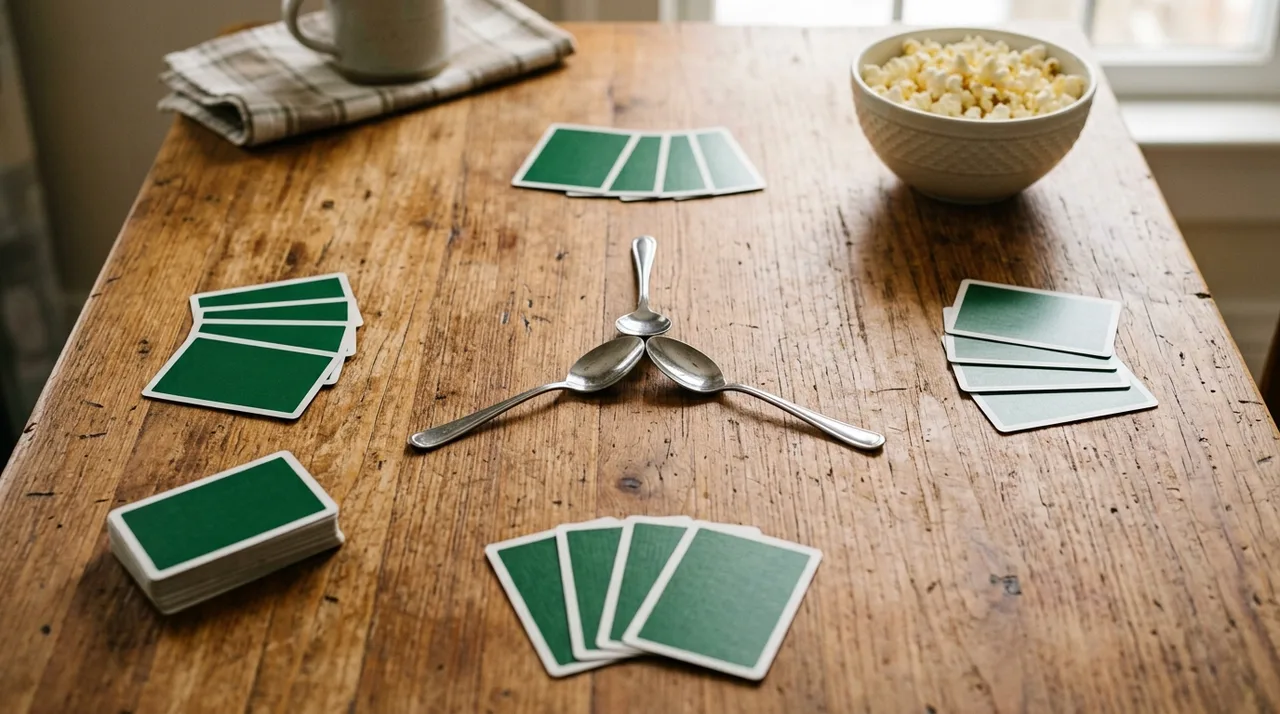
A game of Spoons ready to play on a wooden kitchen table: three teaspoons in the middle, four face-down hands of four cards around them and a small stock pile beside the dealer
Four players, three spoons: someone is going to miss out.

Spoons is a fast, noisy card game for three to thirteen players. Everyone passes cards round the table trying to collect four of a kind, and there is one spoon fewer than there are players in the middle of the table. The moment someone takes a spoon, everyone else can grab one too – and whoever is left without a spoon loses the hand. It is the same game as Pig and Donkey with a different ending, and it works for any age from about seven. This guide covers the Spoons card game rules (with and without a stock pile), scoring, the best variations and what the numbers say about how to win.

Spoons Rules at a Glance

Spoons
PlayersThree to thirteen; four to eight is best. Use two packs for more than 13.
CardsA standard 52-card pack, or one set of four equal cards per player (no-stock version).
SpoonsOne fewer than the number of players, in the middle of the table.
DealFour cards each.
PlayEveryone passes one card face down to the left and picks up the card from the right, as fast as they like. You hold five cards only for a moment, between picking up and passing on.
AimCollect four of a kind, such as four Kings.
End of a handTake a spoon when you have four of a kind; then everyone grabs. No spoon = you lose the hand.
ScoringEach lost hand earns a letter of S-P-O-O-N-S. Spell it and you are out; the last player in wins.

How to Play Spoons

  1. Set out the spoons. Put one spoon fewer than the number of players in the middle of the table, within everyone’s reach: three spoons for four players, five for six.
  2. Deal four cards each. Put the rest of the pack face down next to the dealer as the stock.
  3. Start passing. The dealer takes the top card of the stock, so they have five, and passes one card they don’t want face down to the player on their left.
  4. Keep it moving. Each player picks up the card passed to them, then passes one card on to the left, so you hold five cards only for a moment. (Some groups play that you must pass a card before you pick one up, so nobody ever holds more than four.) The last player, on the dealer’s right, discards onto a face-down trash pile.
  5. No waiting. There are no turns: pass as fast as you can. When the stock runs out, the dealer shuffles the trash pile and carries on.
  6. Four of a kind? Take a spoon. As soon as you hold four cards of the same rank, take a spoon – quietly, if you like.
  7. Grab! Once the first spoon has gone, anyone can take one, whether or not they have four of a kind.
  8. The loser. The player left without a spoon loses the hand and takes the next letter of S-P-O-O-N-S (some groups use S-P-O-O-N). Spell the whole word and you are out. Take one spoon away and deal again; the last player still in wins.
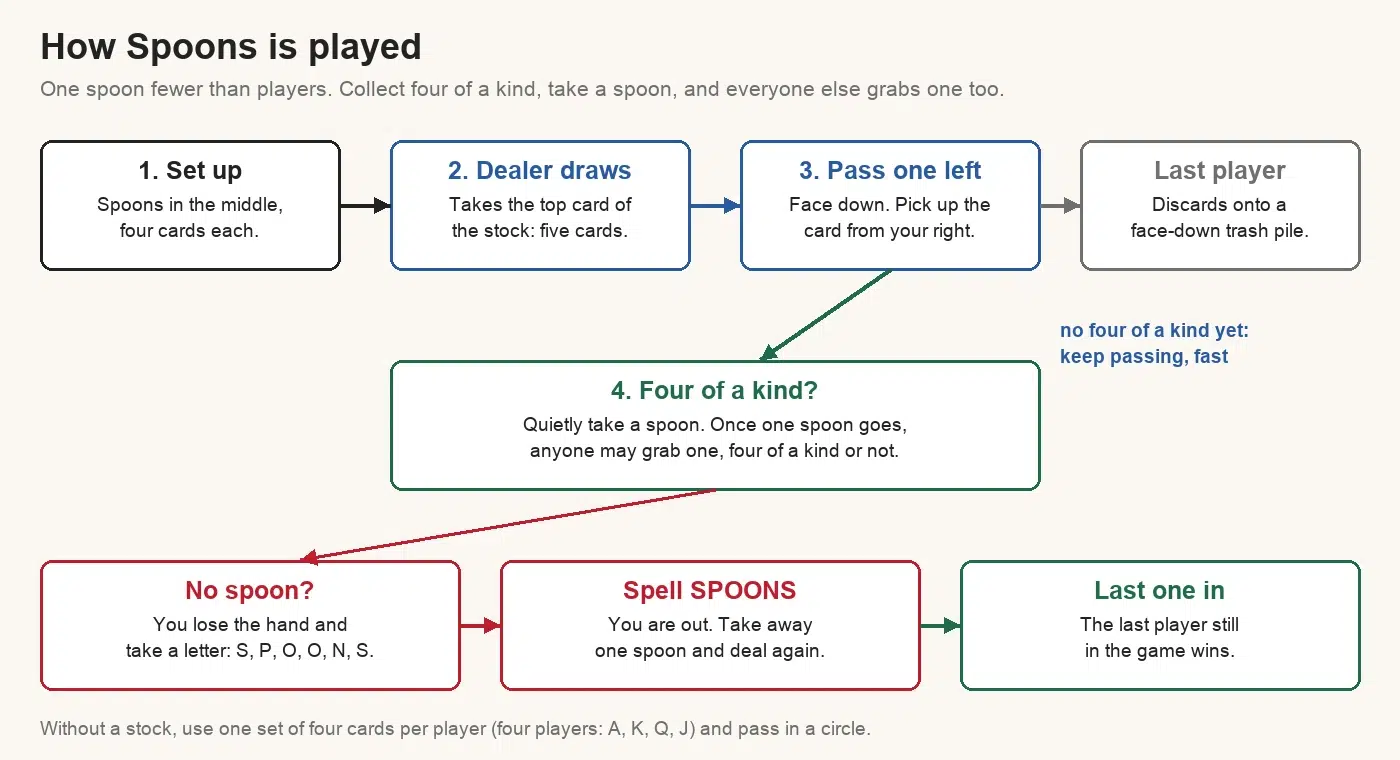
Spoons flowchart: spoons in the middle and four cards each; the dealer draws from the stock and everyone passes one card face down to the left, picking up from the right; the last player discards; four of a kind means take a spoon, then anyone may grab one; the player without a spoon takes a letter of S-P-O-O-N-S and is out after six; the last player in wins
A hand of Spoons, start to finish.

Spoons without a stock pile

The older way to play uses only as many sets of four as there are players, so every card is in someone’s hand and nothing goes to waste. Everyone passes at the same time, in a circle, and hands come round much faster:

PlayersCards in playRanks to use (for example)Spoons
33 × 4 = 12Aces, Kings, Queens2
44 × 4 = 16Aces, Kings, Queens, Jacks3
55 × 4 = 20Aces, Kings, Queens, Jacks, 10s4
66 × 4 = 24Aces, Kings, Queens, Jacks, 10s, 9s5
77 × 4 = 28Aces, Kings, Queens, Jacks, 10s, 9s, 8s6
88 × 4 = 32Aces, Kings, Queens, Jacks, 10s, 9s, 8s, 7s7

When a player is knocked out, take out one set of four cards and one spoon.

Spoons Variations

VariationWhat changes
PigNo spoons: when you have four of a kind, quietly touch your nose. Everyone copies you, and the last to touch their nose loses (letters P-I-G).
DonkeyUse chips or other small objects instead of spoons; the loser takes a letter of D-O-N-K-E-Y.
TongueSilently stick your tongue out when you have four of a kind. The last to notice loses.
Five cardsDeal five cards each; you still need four of a kind.
Hidden spoonsThe spoons go somewhere awkward nearby – another room, under a cushion – so you have to run for them.
Two winnersThe loser drops out after each hand and the last two players left both win.
1-2-3 PassThe Filipino version: when someone has four of a kind, everyone puts a hand on the middle of the table, and the last to do so loses.
BouchonFrance: played with corks, and the loser takes a letter of B-O-U-C-H-O-N.

Spoons Odds and Strategy

Spoons comes down to two things: getting four of a kind first, and noticing when somebody else has. The numbers below are for the no-stock game, from 20,000 simulated games for each line.
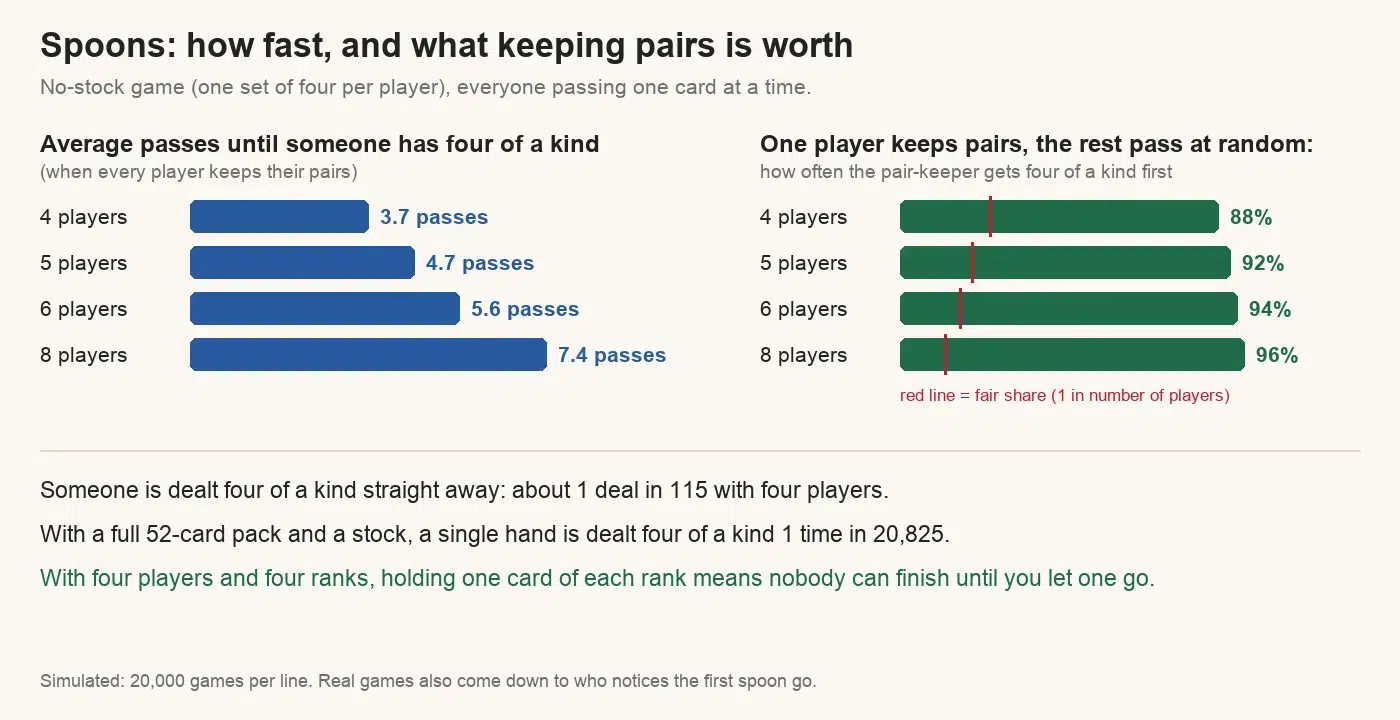
Spoons odds chart: when every player keeps their pairs, someone has four of a kind after 3.7 passes with four players, 4.7 with five, 5.6 with six and 7.4 with eight; a player who keeps pairs while everyone else passes at random gets four of a kind first 88% of the time with four players, 92% with five, 94% with six and 96% with eight
How quickly a hand ends, and what keeping pairs is worth.
  • Hands are short. With four players all keeping their pairs, someone has four of a kind after about 4 passes on average; with eight players, about 7. With a full pack and a stock it takes much longer – around 19 passes with four players – because there are 13 ranks in play instead of four.
  • Keep your pairs. A player who always passes a card from their smallest group – never breaking up a pair unless they hold three of a kind – got four of a kind first 88% of the time against three players passing at random (96% with eight).
  • A four of a kind at the deal is rare: about 1 deal in 115 with four players and no stock, and 1 hand in 20,825 from a full pack.

Tips for winning at Spoons

  • Count the spoons, not just your cards. A quiet player can take the first spoon without anyone noticing. Glance at the middle every few passes.
  • Watch your left-hand neighbour. If they keep the cards you pass and never pass that rank back, they are collecting it.
  • Block in a small game. With four players and four ranks, if you hold one card of each rank nobody can complete four of a kind until you let one go.
  • Fake it. Reaching towards the spoons is allowed as long as you don’t touch them, and it can make others grab too soon. (Check your house rules: some groups count a false grab as a lost hand.)
  • Keep passing after you take a spoon. Carry on passing and picking up as normal, keeping your four of a kind together, and others may not notice the spoon is gone.
  • Use spoons. Forks and knives versions exist, but spoons are the only safe choice when everyone grabs at once.

Where Spoons Comes From

Spoons belongs to a family of four-of-a-kind passing games. The earliest relative is Vive l’Amour, recorded in Germany in 1821, in which players swapped cards to collect a whole suit. Pig, the nose-touching version, is first recorded in the United States in 1911, and Donkey, with tokens in the middle, by the 1940s. A version called spoof, played with spools or spoons, was described in 1946, and the name Spoons first appears in print in 1990.

More Card Games

For more family card games, try Go Fish, another four-of-a-kind game, Old Maid, Cheat, Switch or President.

Another game of quick reactions: Spit (Speed), the two-player race to play one higher or one lower.

Another slap-the-pile party game: Irish Snap, where everyone counts from Ace to King and the last hand down picks up.

For quick hands: Egyptian Rat Screw, where the first hand on the pile takes it.

Another game for a big group: Screw Your Neighbor (Chase the Ace), where everyone gets one card and the lowest loses a life.

Another grab-from-the-middle game: Kemps, where teams of two collect four of a kind and pass secret signals.

Spoons card game: frequently asked questions

How do you play the card game Spoons?

Put one spoon fewer than the number of players in the middle and deal four cards each. Everyone passes one unwanted card to the left and picks up the card from the right, as fast as they can, trying to collect four of a kind. The first to do so takes a spoon, everyone else grabs one, and the player left without a spoon loses the hand.

How many spoons do you need for Spoons?

One fewer than the number of players: three spoons for four players, five for six. Take one spoon away each time a player is knocked out.

How many cards do you deal in Spoons?

Four cards each. The rest of the pack goes face down next to the dealer as the stock, and the dealer draws from it to start each pass.

Can you take a spoon without four of a kind?

Only after someone else has taken the first spoon. From then on anyone can grab one, whatever cards they hold.

How do you score Spoons?

The player left without a spoon takes a letter of S-P-O-O-N-S. Spell the whole word and you are out. The last player still in wins.

How many players can play Spoons?

Three to thirteen with one pack, and more with two. Four to eight is the most fun.

What is the difference between Spoons and Pig?

They are the same card game with a different ending. In Pig, players touch their nose when they have four of a kind instead of grabbing a spoon, and the last to touch their nose loses.

Is there any strategy in Spoons?

Yes. Keep your pairs and pass cards from your smallest group, watch what your left-hand neighbour keeps, and keep an eye on the spoons. In simulations, a player who kept their pairs got four of a kind first 88% of the time against three players passing at random.

Fadi Hayek
Author & Casino Expert

After going through several successful experiences with several industry pioneers, Fadi Hayek has managed to excel in the world of content for online gaming by providing unique content for several projects that allowed him to obtain the necessary experience to launch his career. Last but not least, Fadi also holds several certificates, including but not limited to content marketing and iGaming.

Latest News

Artificial Intelligence in Gambling – How It Is Changing the Future of the Industry

As online casinos adopt machine learning models and artificial intelligence in gambling becomes the next disruption, you don’t want to be left behind. Read on to learn about the impact AI will have on the future of the gambling industry.

Arabian Football Betting Trends – Stay Current on Betting Preferences in the Middle East!

Keep abreast of the latest Arabian football betting trends with the Arabian sports betting insights below. This guide covers the most popular bet types with Arab bettors and the top bookmakers for Arabian and global football competitions.

Al-Nassr vs PSG | Cristiano Ronaldo vs Lionel Messi

The biggest event in world football is scheduled to take place later this month as Al Nassr vs PSG is on the cards.

Yggdrasil Collaborate with Reflex to Release Dublin Up DoubleMax

Yggdrasil and Reflex are set to launch Dublin Up DoubleMax, an Irish-style video, as one of their latest releases. The slot game is designed by incorporating Yggdrasil’s proprietary Game Engagement Mechanic (GEM) DoubleMax coupled with unique features like free spins bonus and fairy magic.