3 2 5 Card Game
Play Teen Do Paanch free in your browser and learn every rule: the 30-card pack, the 5, 3 and 2 trick quotas, trumps and pulling cards.


Play Teen Do Paanch free in your browser and learn every rule: the 30-card pack, the 5, 3 and 2 trick quotas, trumps and pulling cards.
3 2 5 (also written 325, 2-3-5 or 5-3-2, and called Teen Do Paanch in Hindi) is a three-player trick-taking card game played in India, Pakistan and Nepal with a 30-card pack. Each player has a quota of tricks to win: 5, 3 or 2, depending on where they sit. Whoever beats their quota gets to pull cards out of the hand of whoever fell short in the next deal, which is what makes the game so lively at home.
Play it free below against two computer players, then read the full rules: the pack, the seats and quotas, the deal and choosing trumps, how a trick is won, the pulling of cards, scoring, the common house rules and the odds behind the first five cards.
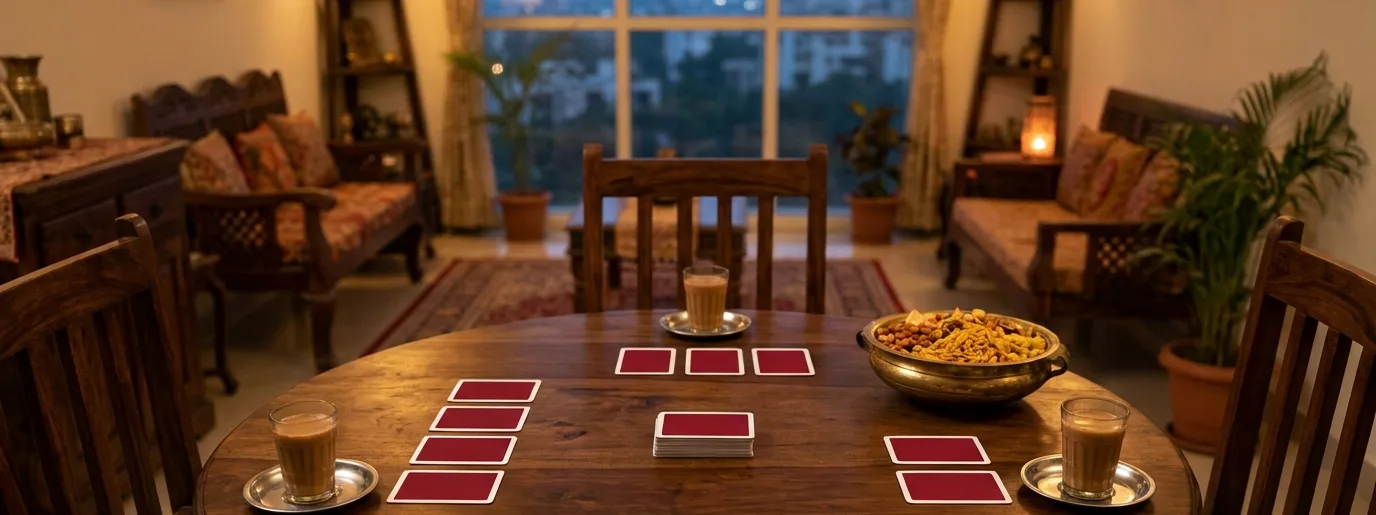
You sit at the bottom, with Right and Left as your opponents; play goes to the right. A game is six deals, so everyone deals twice and plays each quota twice. When you are to the dealer’s right, you choose trumps from your first five cards and lead. Only the cards you are allowed to play are lit, and your trumps are shaded. From the second deal on, if you won more tricks than your quota you pick cards face down from the player who fell short and choose what to give back; if you were short, the computer pulls from you and the game tells you what you lost and what you got.
The scoreboard shows each player’s quota and tricks in the current deal, how far over or under their quotas they are across the game, and their total tricks. After six deals, the player with the most tricks wins.
| 3 2 5 (Teen Do Paanch) | |
|---|---|
| Other names | 325, 2-3-5, 5-3-2, Teen Do Panch, Do Teen Paanch |
| Players | 3, each playing alone |
| Cards | 30: A K Q J 10 9 8 in each suit, plus the 7♠ and 7♥ |
| Direction | Anticlockwise (to the right) |
| Cards each | 10, dealt 5 + 3 + 2 |
| Quotas | Dealer 2 tricks, dealer’s right 5 (chooses trumps, leads), dealer’s left 3 |
| Trumps | Chosen by the 5-trick player after seeing five cards |
| Special rule | From the second deal, over-quota players pull cards from under-quota players |
| Scoring | 1 point per trick (some versions score only tricks above quota) |
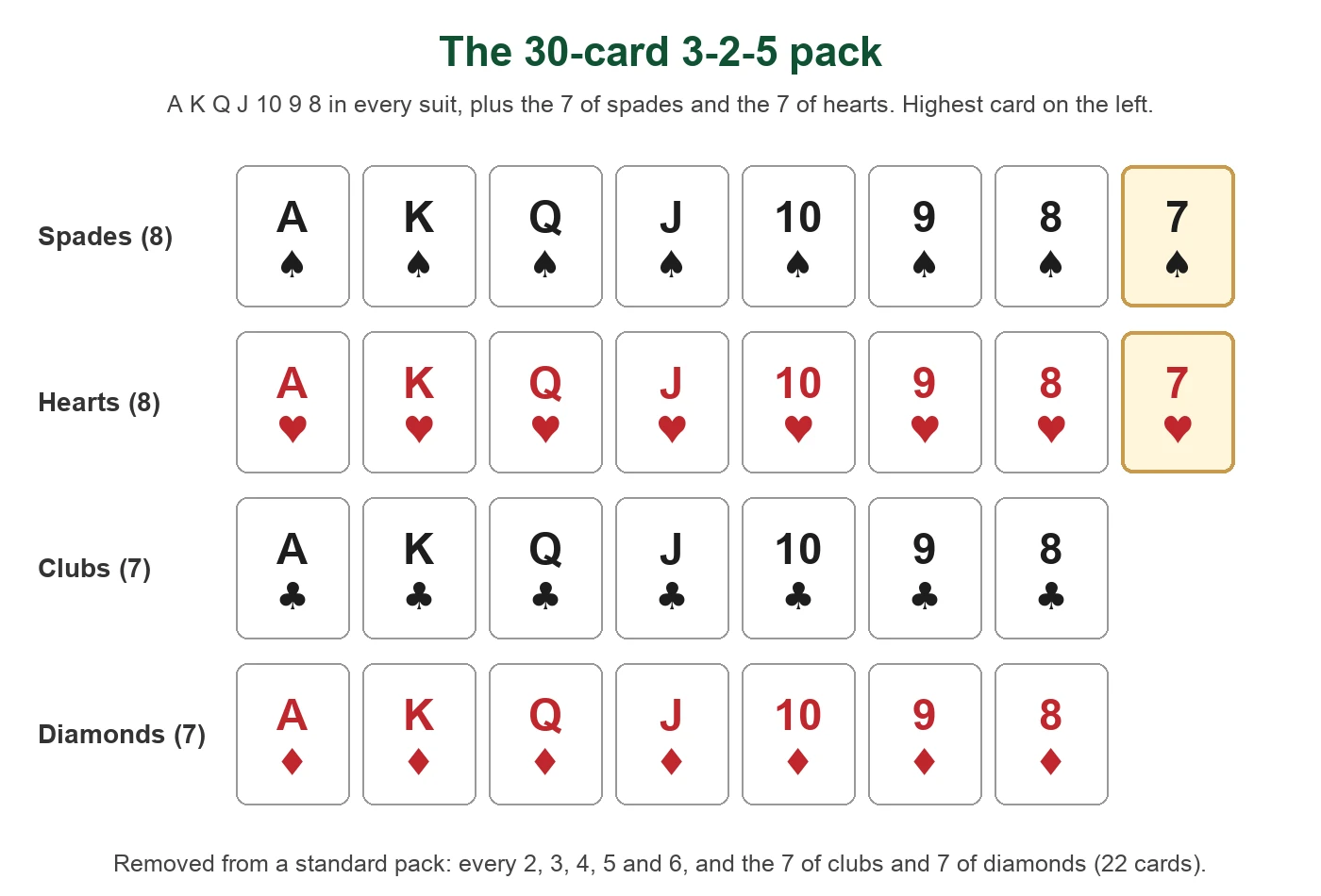
3 2 5 uses a 30-card pack made from a standard 52-card pack: take out every 2, 3, 4, 5 and 6, and two of the four sevens. Usually the 7 of hearts and 7 of spades stay in, so spades and hearts have eight cards each and clubs and diamonds seven. In every suit the cards rank from high to low: A, K, Q, J, 10, 9, 8, (7).
Thirty cards between three players gives each of them 10 cards, and every card is dealt: there is no kitty and nothing left over. A 10-card hand can be any of 30,045,015 combinations.
The name is the three quotas. Each player tries to win at least a set number of the ten tricks, and the quota depends on where you sit in relation to the dealer:
| Seat | Quota | Job in this deal |
|---|---|---|
| Dealer’s right | 5 tricks | Chooses trumps after five cards and leads to the first trick |
| Dealer’s left | 3 tricks | Plays second to the first trick |
| Dealer | 2 tricks | Shuffles and deals; plays last to the first trick |
The quotas add up to ten, the number of tricks in a deal, so if anyone wins more than their quota somebody else must have fallen short. The deal passes to the right after each hand, so the quotas move round the table: the player who needed 5 becomes the dealer and needs only 2 next time.
Choosing the first dealer: a neat way is to take a 5, a 3 and a 2 from the cards left out of the pack, mix them face down and let each player draw one. Whoever draws the 2 deals, the player with the 5 sits on the dealer’s right and the player with the 3 on the dealer’s left, so everyone’s first quota matches the card they drew.
Naming trumps from only five cards is the 5-trick player’s gamble. Most of the time those five cards hold no more than two of any suit (66.0% of all five-card hands), three of a suit turn up 30.6% of the time, and four or five of a suit only 3.4%. So the choice is usually between two-card suits, and the strength of the cards decides it.
Some players let the trump maker put off the choice: the next batch of three cards is dealt face up and the suit of the highest of them becomes trumps (see Variations below).
A note on words: in India and Pakistan players often say “hand” for what Western card players call a trick, one card from each player, won by the best card. On this page a trick is a trick and a deal is the whole hand of ten tricks.
This is the part that makes 3 2 5 different. In the first deal of a session nobody pulls. From the second deal on, after the cards are dealt and trumps chosen, each player who won more tricks than their quota in the previous deal pulls one card for each extra trick from a player who fell short, and a player who was short gives up one card for each trick they were under.
If everyone made exactly their quota last time, nobody pulls. If two players were over quota, the player to the dealer’s right pulls first, then the player to the dealer’s left, then the dealer. If two players were under quota, the over-quota player pulls first from the dealer, then from the player to the dealer’s left, and last from the player to the dealer’s right. Seats here are those of the new deal:
| Last deal (tricks over or under quota) | Order of pulls in this deal |
|---|---|
| The dealer’s right +1, The dealer’s left -2, The dealer +1 | 1. The dealer’s right pulls from the dealer’s left 2. The dealer pulls from the dealer’s left |
| The dealer’s right +2, The dealer’s left -1, The dealer -1 | 1. The dealer’s right pulls from the dealer 2. The dealer’s right pulls from the dealer’s left |
| The dealer’s right +1, The dealer’s left +1, The dealer -2 | 1. The dealer’s right pulls from the dealer 2. The dealer’s left pulls from the dealer |
It is part of the fun for the player being robbed to shuffle their cards around before fanning them out, and to give misleading advice about which card to take.
Pulling makes up a big part of the game. In 21,000 computer-played deals, players pulled on average 1.6 cards per deal, and in only 6.5% of deals did all three players make exactly their quota so that nobody pulled in the next deal.
When played as a children’s game, nobody usually keeps a score: you just play deal after deal, and the pulling of cards is the reward and the punishment. For a more competitive game, score 1 point for each trick you win. After each player has dealt the same number of times, the player with the highest total wins. The free game above plays six deals, so everyone deals twice.
Some online versions score only the tricks you win above your quota, so a 6-trick deal by the 5-trick player is worth 1 point, and play until somebody has 5 points or more.
The quotas are not equally easy. In 21,000 computer-played deals (with pulling from the second deal of each game):
| Seat and quota | Made the quota | Average tricks |
|---|---|---|
| Dealer’s right, 5 tricks | 36.4% | 4.0 |
| Dealer’s left, 3 tricks | 66.1% | 3.2 |
| Dealer, 2 tricks | 81.8% | 2.8 |
The 5-trick player chooses trumps and leads, and still falls short most of the time; the dealer, who only needs two, almost always gets there. That is why the deal moving round the table matters: over a full session, everyone takes a turn at each quota.
The “no trump, no deal” rule does not come up often: in computer-played deals the dealer was dealt no trumps in 5.4% of hands and the dealer’s left in 5.8%. The trump maker held 3.4 trumps on average after the full deal.
7-8 (Sath-Aath) is a two-player game played with the same 30-card pack. The dealer tries to win seven tricks and the other player eight, which is where the name comes from. The sevens are always the top trumps: the 7 of hearts is the Big Joker and the 7 of spades the Little Joker.
3-5-8, also called Sergeant Major or 8-5-3, is the 52-card relative of 3 2 5. Three players again have quotas, here 8 for the dealer, 5 for the player to the dealer’s left and 3 for the player to the dealer’s right, and players who were up exchange cards with players who were down.
If you like trick-taking games from India, try Callbreak, the partnership game 29 (Twenty-Nine) and Mendicot and Dehla Pakad, all free to play on this site. For a three-player game with bids instead of fixed quotas, see Oh Hell; for the classic four-player version of trick-taking, Whist.
Another family card game from India: the Donkey card game (Getaway), where a thulla makes someone pick up the trick and the last player holding cards is the donkey.
Another game where trumps are called from the first five cards: Court Piece (Rang / Rung), the four-player partnership game of India and Pakistan, free to play online.
Like choosing trumps from a few cards? In 28 (Twenty-Eight) you bid on your first four cards and hide your trump card face down; play it free.

After going through several successful experiences with several industry pioneers, Fadi Hayek has managed to excel in the world of content for online gaming by providing unique content for several projects that allowed him to obtain the necessary experience to launch his career. Last but not least, Fadi also holds several certificates, including but not limited to content marketing and iGaming.


