Game of the Generals
Hidden ranks, two Spies and one Flag to capture: the ranking, rules and strategy of Salpakan, the Philippines’ own war game.


Hidden ranks, two Spies and one Flag to capture: the ranking, rules and strategy of Salpakan, the Philippines’ own war game.
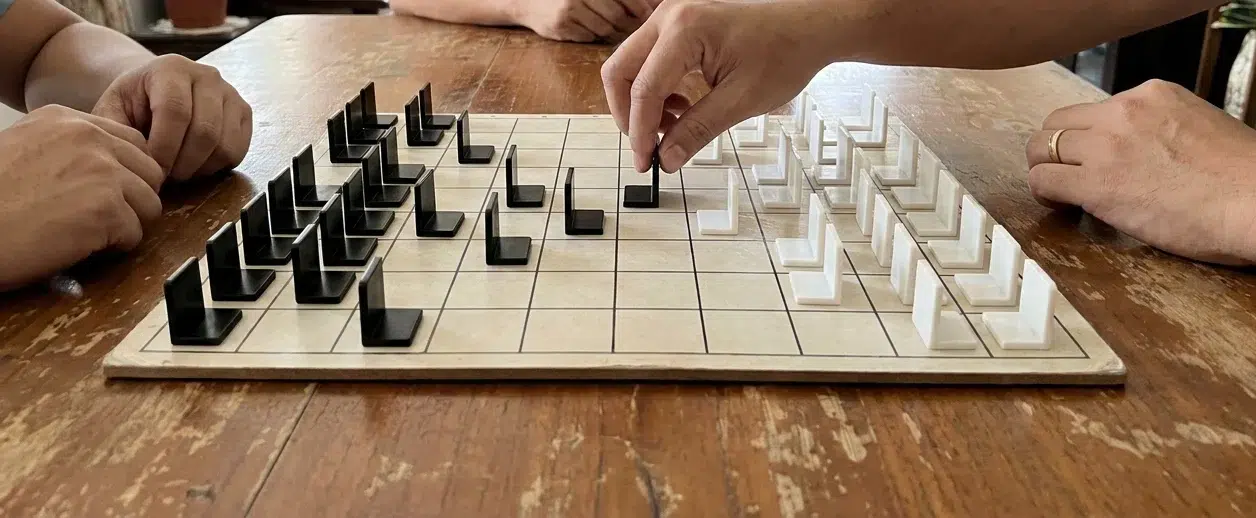
Game of the Generals, also called GG, The Generals or Salpakan, is the Filipino war game of hidden ranks. Each player commands 21 pieces, from a five-star General down to Privates, two Spies and a Flag, but the ranks face only their owner. When two pieces meet, a neutral arbiter checks them in secret and removes the loser, so you learn about your opponent’s army one battle at a time. Capture the enemy Flag, or march your own Flag to the far side of the board, and you win.
| Game of the Generals | |
|---|---|
| Players | Two, plus an arbiter (referee) who settles challenges. You can also play without one. |
| Board | 72 squares: 9 columns by 8 rows. |
| Pieces | 21 each: 15 ranks, including 6 Privates, 2 Spies and 1 Flag. |
| Moves | One square forward, backward or sideways. No diagonal moves. |
| Goal | Eliminate the enemy Flag, or get your own Flag safely to the far row. |
| Game length | Often 20 to 30 minutes, though careful players can take much longer. |
| Invented | By Sofronio H. Pasola Jr. in the Philippines in 1970. |
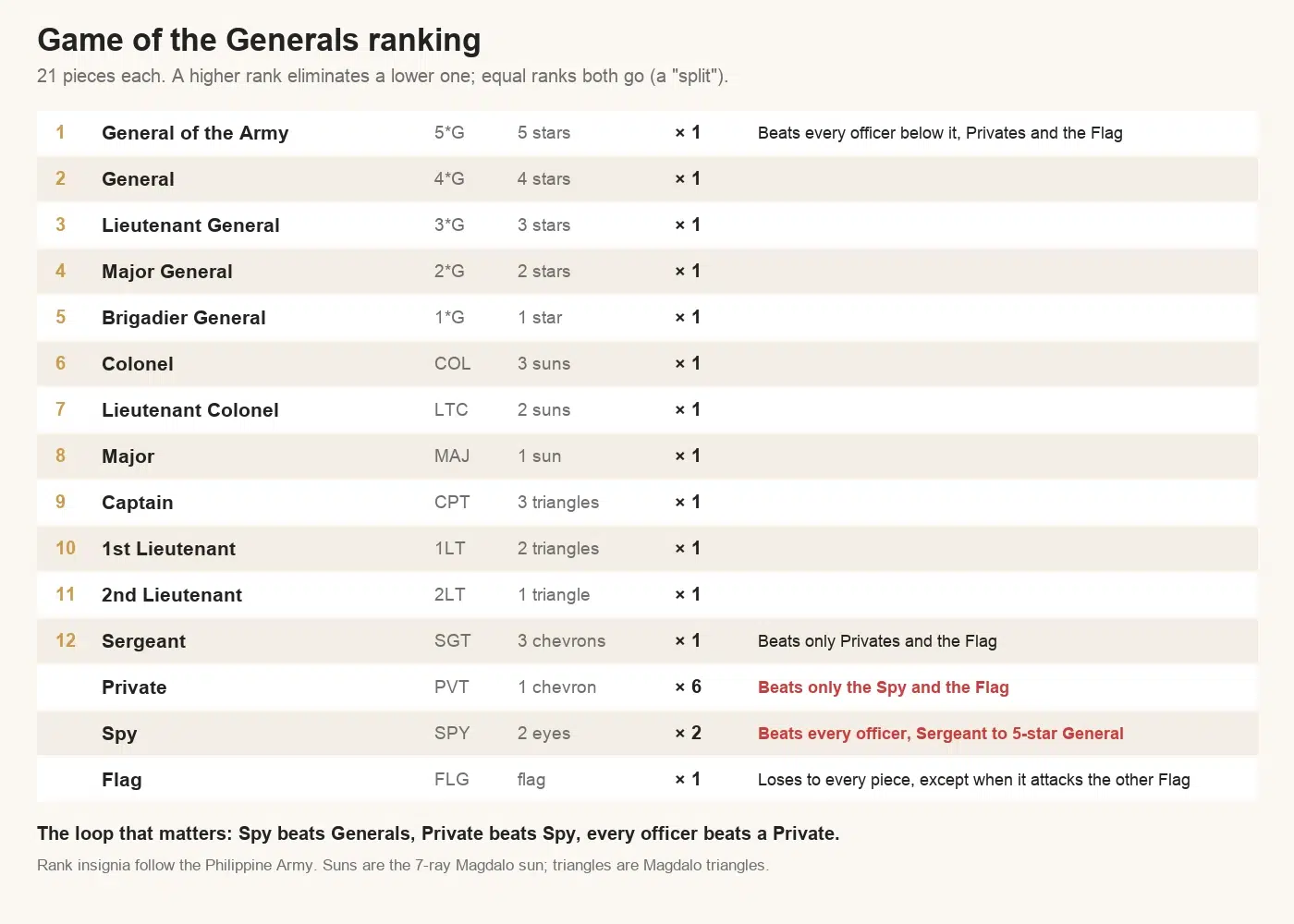
The pieces follow the ranks of the Philippine Army. Higher ranks eliminate lower ones, with two big exceptions: the Spy beats every officer, and the humble Private is the only piece that beats a Spy.
| Rank and insignia | Pieces | Eliminates |
|---|---|---|
| 1. General of the Army 5 stars | 1 | Every lower-ranked officer, Privates and the Flag |
| 2. General 4 stars | 1 | Every lower-ranked officer, Privates and the Flag |
| 3. Lieutenant General 3 stars | 1 | Every lower-ranked officer, Privates and the Flag |
| 4. Major General 2 stars | 1 | Every lower-ranked officer, Privates and the Flag |
| 5. Brigadier General 1 star | 1 | Every lower-ranked officer, Privates and the Flag |
| 6. Colonel 3 suns | 1 | Every lower-ranked officer, Privates and the Flag |
| 7. Lieutenant Colonel 2 suns | 1 | Every lower-ranked officer, Privates and the Flag |
| 8. Major 1 sun | 1 | Every lower-ranked officer, Privates and the Flag |
| 9. Captain 3 triangles | 1 | Every lower-ranked officer, Privates and the Flag |
| 10. 1st Lieutenant 2 triangles | 1 | Every lower-ranked officer, Privates and the Flag |
| 11. 2nd Lieutenant 1 triangle | 1 | Every lower-ranked officer, Privates and the Flag |
| 12. Sergeant 3 chevrons | 1 | Privates and the Flag |
| Private 1 chevron | 6 | Spies and the Flag |
| Spy 2 eyes | 2 | Every officer from Sergeant up to General of the Army, and the Flag |
| Flag The Philippine flag | 1 | Only the other Flag, when it moves onto it |
When two pieces of the same rank meet, both are removed. Players call this a split. A Spy meeting a Spy, or a Private meeting a Private, is a split too.
| When this meets | Result |
|---|---|
| A higher rank and a lower rank | The lower rank is eliminated. |
| Two pieces of the same rank | Both are eliminated (a split). |
| A Spy and any officer, Sergeant to General of the Army | The officer is eliminated. |
| A Spy and a Private | The Spy is eliminated. |
| Any officer and a Private | The Private is eliminated. |
| Any piece and the Flag | The Flag is eliminated, and its owner loses. |
| Flag and Flag | The Flag that moves onto the other wins the game. |
It doesn’t matter which piece moved in; only the ranks decide, apart from the Flag against Flag case.
Official games use an arbiter, but at home you can play without one. When a challenge happens, both players say the rank of their piece and the lower one comes off. You give away more information this way, so games are quicker and less of a bluff.
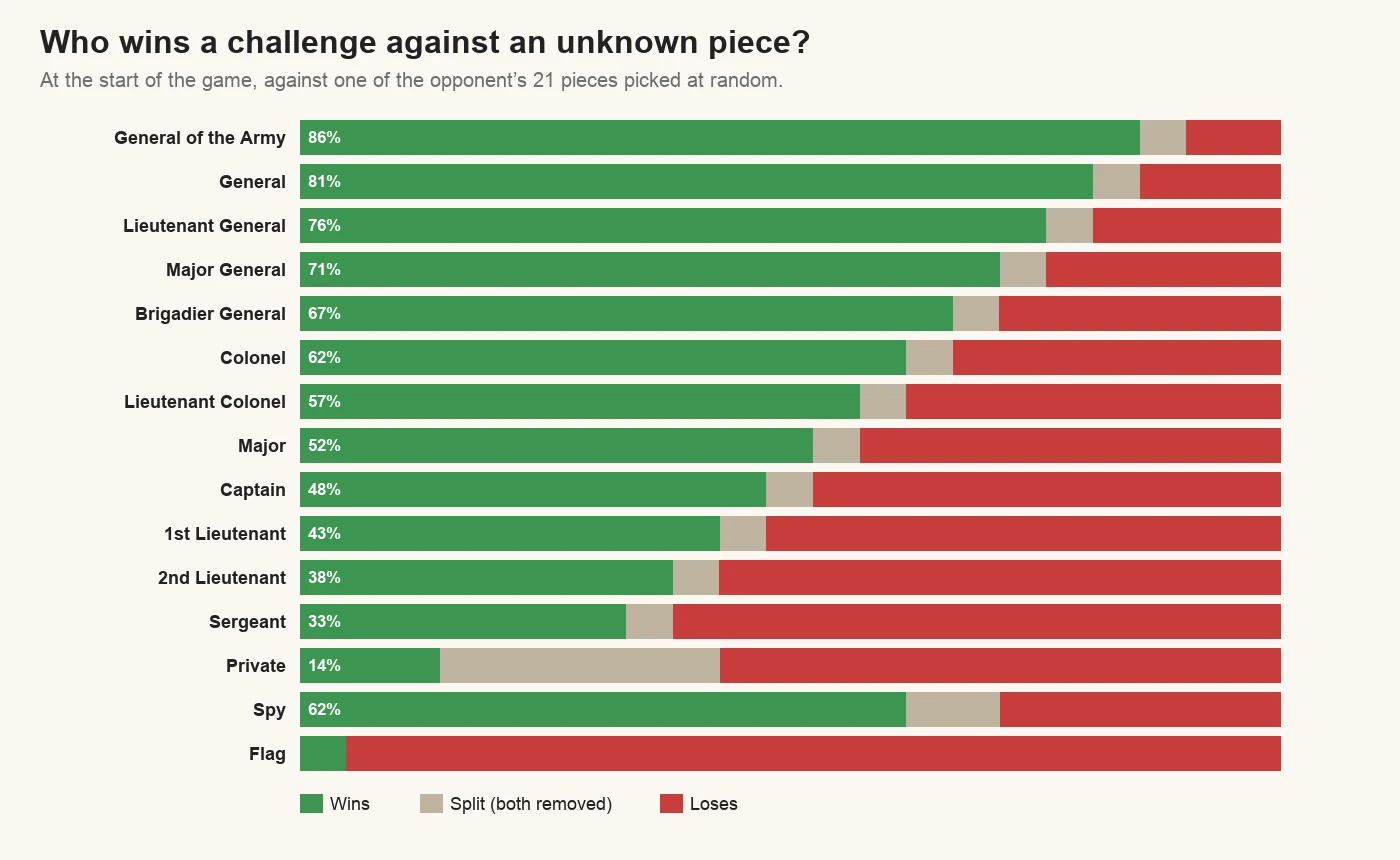
At the start, every enemy piece is a mystery, so the chances of a challenge come straight from the 21 pieces. Against one picked at random:
| Your piece | Wins | Split | Loses |
|---|---|---|---|
| General of the Army | 86% | 5% | 10% |
| General | 81% | 5% | 14% |
| Lieutenant General | 76% | 5% | 19% |
| Major General | 71% | 5% | 24% |
| Brigadier General | 67% | 5% | 29% |
| Colonel | 62% | 5% | 33% |
| Lieutenant Colonel | 57% | 5% | 38% |
| Major | 52% | 5% | 43% |
| Captain | 48% | 5% | 48% |
| 1st Lieutenant | 43% | 5% | 52% |
| 2nd Lieutenant | 38% | 5% | 57% |
| Sergeant | 33% | 5% | 62% |
| Private | 14% | 29% | 57% |
| Spy | 62% | 10% | 29% |
| Flag | 5% | 0% | 95% |
So a Captain is a coin flip against an unknown piece, a Private usually loses unless it finds a Spy, and the Spy wins 62% of the time but is the one piece that must fear the six Privates. Any unknown enemy piece is a Private 29% of the time, a Spy 10% and the Flag 5%.
The hidden set-up is what makes every game different. With 21 pieces and 6 gaps on 27 squares, and the Privates and Spies interchangeable, each player can lay out their army in about 10,500 billion billion different ways (1.05 × 10²²).
| Game of the Generals | Stratego | |
|---|---|---|
| Who settles battles | A hidden arbiter; neither player sees the other’s piece | Both players reveal the two pieces |
| Spies | Two, and they beat every officer | One |
| Bombs | None | Yes, with Miners to clear them |
| Long moves | None: every piece moves one square | Scouts move several squares |
| Flag | Can move, and can win by reaching the far row | Can’t move |
| Board | 72 squares, all open | 100 squares, with two lakes in the middle |
| Set-up | Three rows with six empty squares | Four rows, completely filled |
Sofronio H. Pasola Jr. invented the game in 1970 with help from his son Ronnie. They first tried it on a chessboard, added the Spies after thinking of James Bond and Mata Hari, and hid the ranks after the example of card games. It was released to the public on 28 February 1973. Apart from the Flag, which shows the Philippine flag, and the Spy’s pair of eyes, the insignia are those of the Philippine Army, including the seven-ray Magdalo sun and the Magdalo triangle.
For more games played in the Philippines, see sungka, the traditional mancala game, and the card games tongits and pusoy dos. For another board game of moving and capturing, try checkers, whose Filipino version is dama.

After going through several successful experiences with several industry pioneers, Fadi Hayek has managed to excel in the world of content for online gaming by providing unique content for several projects that allowed him to obtain the necessary experience to launch his career. Last but not least, Fadi also holds several certificates, including but not limited to content marketing and iGaming.


