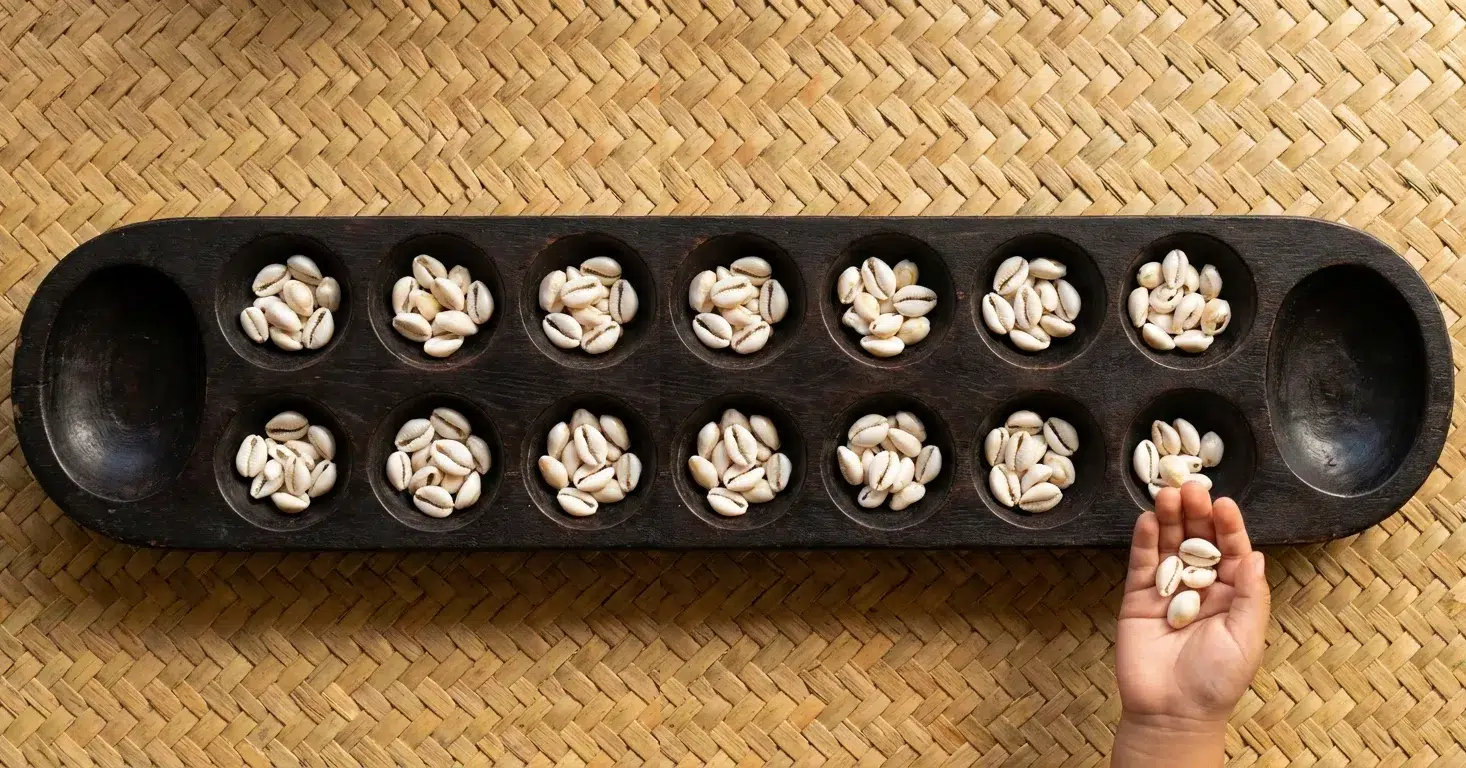
A wooden sungka board on a woven mat, seen from above: two rows of seven holes filled with cowrie shells, an empty store at each end, and a child holding shells
Fourteen holes, two stores and 98 shells: a sungka board ready to play.

Sungka is the Philippines’ traditional mancala game: two players, a long wooden board with two rows of seven holes, and 98 cowrie shells or seeds. Players scoop up the shells from one hole and drop them one at a time around the board, landing in their own store to earn another turn and in an empty hole on their own side to capture. Its big difference from the mancala sold in toy shops is that a move often keeps going: if your last shell lands in a hole that already has shells, you pick them all up and sow again. This guide covers how to play sungka, the full rules including the later rounds, a winning strategy and the odds.

Sungka Rules at a Glance

Sungka
PlayersTwo.
BoardTwo rows of seven small holes (bahay or balay, “house”) and a large store at each end (ulo, “head”).
Shells7 in every small hole, 98 in all. Stores start empty.
Your sideThe seven holes nearest you, and the store on your left.
DirectionClockwise: along your row towards your store, then along your opponent’s row. Skip your opponent’s store.
GoalFinish the round with more shells in your store. Over several rounds, leave your opponent without enough shells to fill a hole.

How to Set Up

  1. Place the board lengthways between the two players, so each has a row of seven holes in front of them.
  2. Put seven shells in each of the 14 small holes. Leave both stores empty.
  3. Your store is the large hole on your left. Every shell that ends up there is yours.

How to Play Sungka

  1. Start. Traditionally both players start at the same time, each scooping up the shells from one of their own holes. Others simply take turns from the beginning.
  2. Sow. Drop one shell into each hole in turn, moving clockwise and starting with the next hole. Put one in your own store each time you pass it; never put one in your opponent’s store.
  3. Look at where the last shell lands:
    • In your own store: take another turn, scooping up any of your holes.
    • In a hole that already had shells (on either side): pick up all the shells in that hole and keep sowing.
    • In an empty hole on your side: capture. Take the shells in your opponent’s hole directly opposite, plus your last shell, and put them in your store. Your turn ends. If the opposite hole is empty, only your last shell goes to your store.
    • In an empty hole on your opponent’s side: your turn ends, and the shell stays there.
  4. End of the round. The round is over when one player has no shells left in their holes. The shells still on the board go to the other player. Whoever has more in their store has won the round.
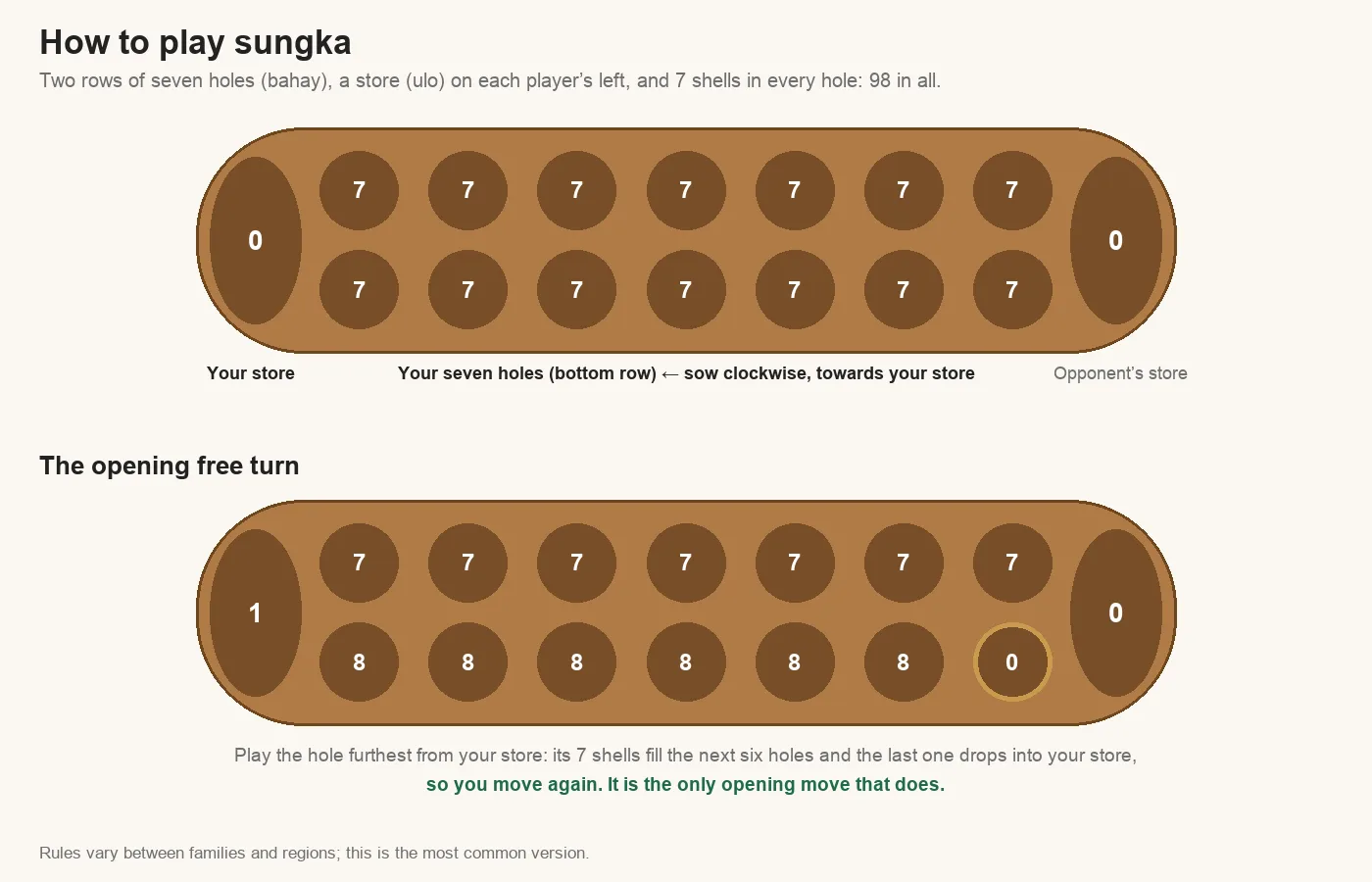
Sungka rules diagram: the board with 7 shells in each of the 14 holes and empty stores, and the opening move from the hole furthest from the store ending in the store for a free turn
The best first move: the hole furthest from your store ends in your store.

The Next Rounds: Burnt Holes

A full game of sungka is played over several rounds:

  1. Refill. Each player takes the shells from their store and puts seven back in each of their holes, starting from the left.
  2. Burnt holes. If you don’t have enough to fill all seven holes, the holes you can’t fill are “burnt” and out of play for that round. Extra shells stay in your store. Nobody drops shells into a burnt hole; a shell dropped into one by mistake goes to the opponent.
  3. The loser starts the next round.
  4. Game over. The game ends when a player cannot fill a single hole, or concedes.

Sungka Variations

VariationHow it differs
Board sizeMost boards have seven holes a side, but boards with anything from three to nine holes are played, sometimes in the same area.
CountersCowrie shells are traditional, but tamarind seeds or pebbles are also used.
End of the roundSome players keep going until every shell is in a store, rather than stopping when one side runs out.
Congkak, congklak and dakonThe same family of games in Malaysia, Indonesia, Singapore and Brunei, with almost identical rules on seven-hole boards.
ChongkaThe version played in the Mariana Islands, taken there by Filipino migrants.

Sungka Strategy

  • Open from the far hole. At the start, the hole furthest from your store holds seven shells and is exactly seven steps from your store, so the last one lands in the store and you move again. It is the only opening move that does this.
  • Count before you scoop. A hole gives you a free turn when its shells exactly reach your store. Look for these first, and play the one nearest the store before the others so you don’t spoil them.
  • Follow the chain in your head. Because a last shell in a full hole keeps you sowing, one move can run round the board several times. Trace it before you commit.
  • Aim for empty holes on your side opposite a big pile of your opponent’s, and keep your own big piles away from the holes they can land in.
  • Keep your store growing towards the next round. In the later rounds, every seven shells you are short costs you a hole.
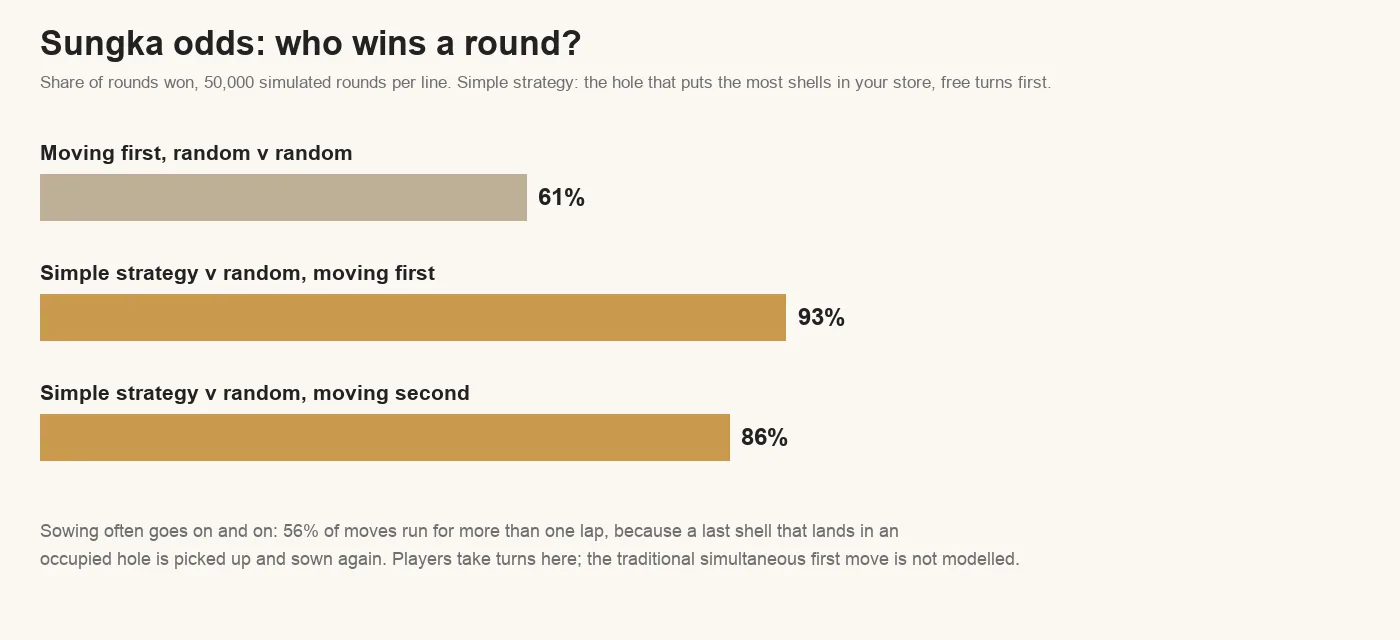
Chart of sungka odds: moving first wins 61% of rounds in random play; a simple strategy beats a random player 93% of the time moving first and 86% moving second
Going first helps, but even a simple strategy matters much more.

Sungka Odds

Sungka is a game of skill: there are no dice and nothing is hidden. To see how much the first move and a little planning matter, 50,000 rounds were simulated for each pairing below, with players taking turns (the simultaneous start is left out):

Who playsResult
Two players moving at randomFirst player wins 61%, second 35%, tied 49–49 4%
Simple strategy against a random player, moving firstWins 93%
Simple strategy against a random player, moving secondWins 86%

The simple strategy just picks the hole that puts the most shells in its store straight away, preferring a free turn. Moves are long, too: 56% of all sowing moves went round more than one lap, because the last shell landed in a hole that already had shells.

Where Sungka Comes From

Sungka belongs to the mancala family, games of sowing and capturing played across Africa, the Middle East and Asia. Like the other Southeast Asian versions, it counts your own store as part of the sowing, so shells drop into it as you pass. The same game is played as congkak in Malaysia and congklak or dakon in Indonesia, and similar games exist in Sri Lanka, India (pallanguzhi) and the Maldives. Spanish writers spelled the Philippine name chonca or chongca, it is also known as kunggit, and Filipino migrants took it to the Mariana Islands and Taiwan. How mancala first reached Southeast Asia is not known; one idea is that it came along Austronesian trade routes with South Asia.

More Games to Try

For the version with six holes a side and four stones in each, played around the world, see mancala. For more Filipino favourites, try the card games tongits and pusoy dos.

Another Filipino classic: Game of the Generals, the war game of hidden ranks, Spies and Flags.

Sungka: frequently asked questions

How do you play sungka?

Put seven shells in each of the 14 holes. On your turn, scoop up all the shells from one of your holes and drop one in each hole clockwise, including your own store but not your opponent’s. If the last shell lands in your store, go again; in a hole with shells, pick them up and keep sowing; in an empty hole on your side, capture the shells opposite. The player with more shells in their store at the end of the round wins.

How many shells are used in sungka?

98: seven in each of the 14 small holes. The two stores start empty.

Which store is mine in sungka?

The large hole on your left. Your seven holes are the row nearest you, and you sow clockwise towards your store.

What happens when your last shell lands in a hole with shells?

You pick up all the shells in that hole, including the one you just dropped, and carry on sowing from the next hole. A move can go round the board several times this way.

How do you capture in sungka?

When your last shell lands in an empty hole on your own side, take the shells in your opponent’s hole directly opposite, plus your last shell, and put them in your store. Your turn then ends.

What is the best first move in sungka?

The hole furthest from your store. It holds seven shells and is exactly seven steps from your store, so the last shell lands in the store and you get another turn.

What are burnt holes in sungka?

In the next round each player refills their holes with seven shells each from their store. Holes they cannot fill are burnt and out of play for that round. The game ends when a player cannot fill any hole.

What is sungka called in other countries?

It is congkak in Malaysia, congklak or dakon in Indonesia, and chongka in the Mariana Islands. It belongs to the mancala family of sowing games played around the world.

Fadi Hayek
Author & Casino Expert

After going through several successful experiences with several industry pioneers, Fadi Hayek has managed to excel in the world of content for online gaming by providing unique content for several projects that allowed him to obtain the necessary experience to launch his career. Last but not least, Fadi also holds several certificates, including but not limited to content marketing and iGaming.

Latest News

Artificial Intelligence in Gambling – How It Is Changing the Future of the Industry

As online casinos adopt machine learning models and artificial intelligence in gambling becomes the next disruption, you don’t want to be left behind. Read on to learn about the impact AI will have on the future of the gambling industry.

Arabian Football Betting Trends – Stay Current on Betting Preferences in the Middle East!

Keep abreast of the latest Arabian football betting trends with the Arabian sports betting insights below. This guide covers the most popular bet types with Arab bettors and the top bookmakers for Arabian and global football competitions.

Al-Nassr vs PSG | Cristiano Ronaldo vs Lionel Messi

The biggest event in world football is scheduled to take place later this month as Al Nassr vs PSG is on the cards.

Yggdrasil Collaborate with Reflex to Release Dublin Up DoubleMax

Yggdrasil and Reflex are set to launch Dublin Up DoubleMax, an Irish-style video, as one of their latest releases. The slot game is designed by incorporating Yggdrasil’s proprietary Game Engagement Mechanic (GEM) DoubleMax coupled with unique features like free spins bonus and fairy magic.