Kemps Card Game Rules
Swap cards for four of a kind, flash your partner a secret signal, and call Kemps before the other team stops you: how to play Kemps.


Swap cards for four of a kind, flash your partner a secret signal, and call Kemps before the other team stops you: how to play Kemps.
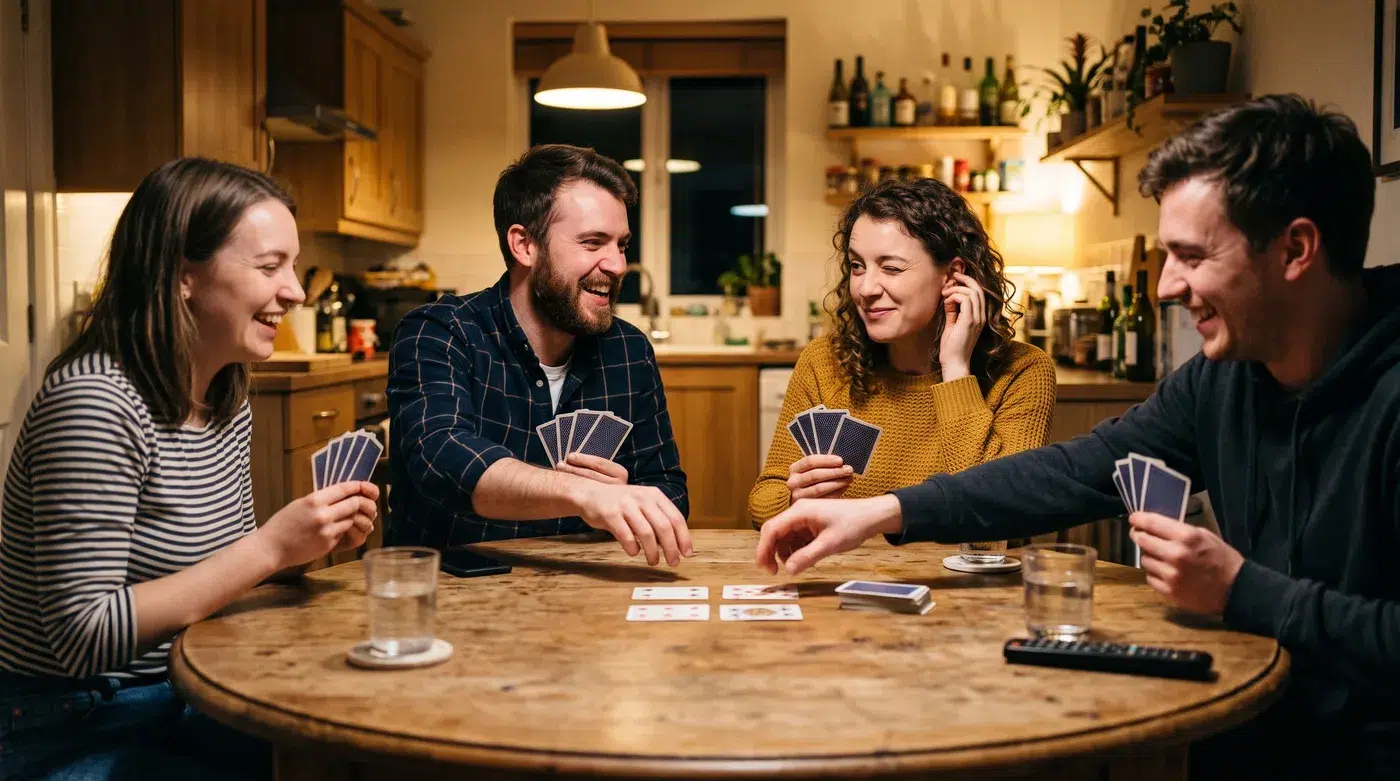
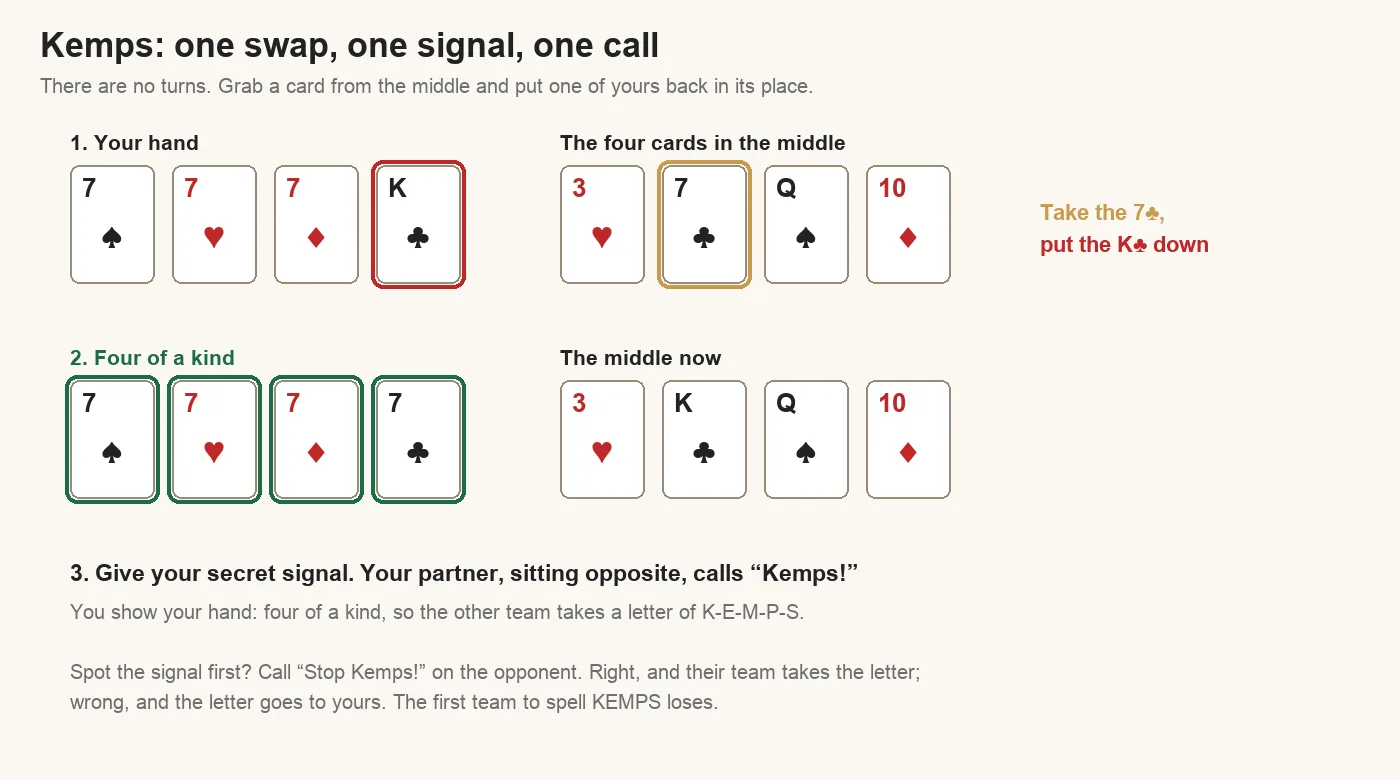
Kemps is a fast party card game for teams of two. Everyone grabs and swaps cards from the middle of the table at the same time, trying to collect four of a kind. When you have it, you give your partner a secret signal, and your partner has to shout “Kemps!” before the other team spots the signal and shouts “Stop Kemps!”. It is part card game and part bluffing game, and it is also known as Kent, Cash and Canes. This guide covers the Kemps card game rules, how to choose a good signal, the main variations and the odds.
| Kemps | |
|---|---|
| Players | Four or more, in an even number: teams of two, partners sitting opposite each other. |
| Cards | One standard 52-card deck. With more than eight players, use two. |
| Hand | Four cards each, with four more face up in the middle. |
| Turns | None. Everyone swaps cards with the middle at the same time. |
| Goal | Collect four of a kind and signal your partner to call “Kemps!”. |
| Penalty | The team that loses a hand takes a letter of K-E-M-P-S. |
| Winning | The first team to spell KEMPS loses the game. |
Split into teams of two. Before the game, each team goes somewhere the others can’t see or hear them and agrees a secret signal that means “I have four of a kind”. It must not be spoken: a gesture, a facial expression or a way of holding your cards. You can have more than one signal, and you can make fake signals to confuse the other team, but a signal may never mean anything other than “I have four of a kind”. Agreeing extra signals, such as “I need sevens”, counts as cheating, and a team caught doing it loses the game.
Partners sit opposite each other so that every player can see everyone else. Teams may agree new signals after any hand, for example when they think the other team has worked out their old one.
The hand ends the moment anyone calls.
Letters are written down in order: K, then E, then M, then P, then S. With more than four players, every team on the other side of a correct “Kemps!” takes a letter. The first team to spell KEMPS, which means losing five hands, loses the game.
| Variation | How it differs |
|---|---|
| One card at a time | You must put a card down before you pick up another, so nobody can grab two at once. |
| Countdown start | The dealer starts each row with “Ready, set, go!” or a countdown, so nobody gets a head start. |
| Points instead of letters | A correct call wins your team a point and a wrong call loses one. The first team to an agreed score, such as 4, wins. |
| Cash or Kent | The same game under another name: players call “Cash!” and “Counter cash!”, and the losers spell C-A-S-H. The middle cards are dealt face down and turned over together after a countdown. |
| Peanut Butter | Call “Peanut butter!” for your partner and “Jelly!” for an opponent. Spoken signals are allowed, and the teams play an agreed odd number of hands. |
| Carré-Coupé | The French version, played for chips from a pot, with extra calls for when two players hold four of a kind at once. |
A good signal is something you can do naturally that the other team won’t notice: tapping the table, holding your cards a certain way, puckering your lips, winking or touching your ear. Avoid signals you might make by accident, such as scratching your head or rubbing your eyes,. The more subtle the signal, the better.
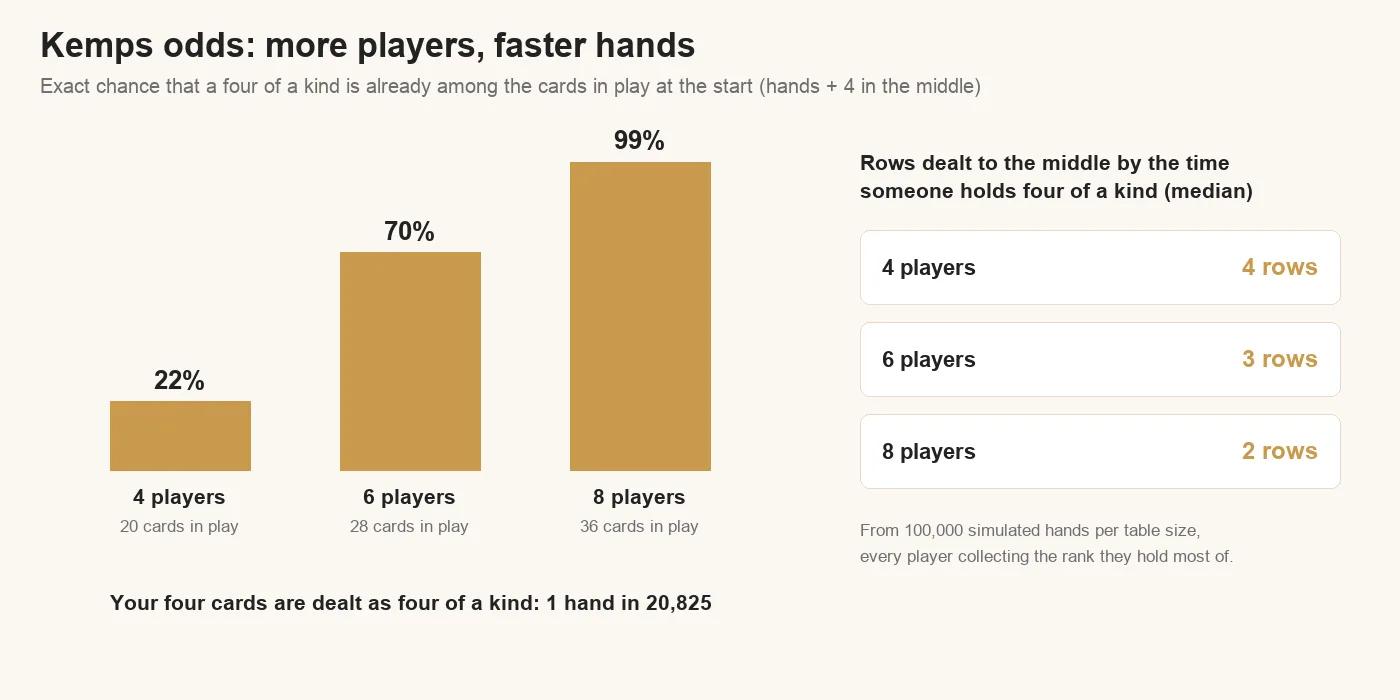
The more players there are, the more cards are in play and the faster the hands go:
| Players | Cards in play at the start | Four of a kind already among them | Rows dealt before someone has it (median) |
|---|---|---|---|
| 4 | 20 | 22% | 4 |
| 6 | 28 | 70% | 3 |
| 8 | 36 | 99% | 2 |
The first two columns are exact. The last comes from 100,000 simulated hands at each table size in which every player collects the rank they hold most of. In those hands somebody completed four of a kind before the deck ran out more than 99% of the time. Your own first four cards are four of a kind only once in 20,825 deals; 32% of the time they include at least a pair, and 0.9% of the time three of a kind.
David Parlett describes Kemps as a cross between the old card games Commerce and Authors, with the unusual twist of playing in partnerships. It is a modern game, played in America, France and Switzerland. One account traces it to the French game Carré-Coupé, which appeared in the early 1990s and spread quickly among young players because of its speed and bluffing. In Switzerland a similar game is called Gemsch.
For another game where everyone grabs at once, try Spoons, where the player left without a spoon loses the hand. Cheat is all about bluffing, and Snap rewards the fastest hands.

After going through several successful experiences with several industry pioneers, Fadi Hayek has managed to excel in the world of content for online gaming by providing unique content for several projects that allowed him to obtain the necessary experience to launch his career. Last but not least, Fadi also holds several certificates, including but not limited to content marketing and iGaming.


