How to Play Mahjong
Draw a tile, discard a tile, and be first to make four sets and a pair: mahjong rules for beginners, from the tiles to American mahjong.


Draw a tile, discard a tile, and be first to make four sets and a pair: mahjong rules for beginners, from the tiles to American mahjong.
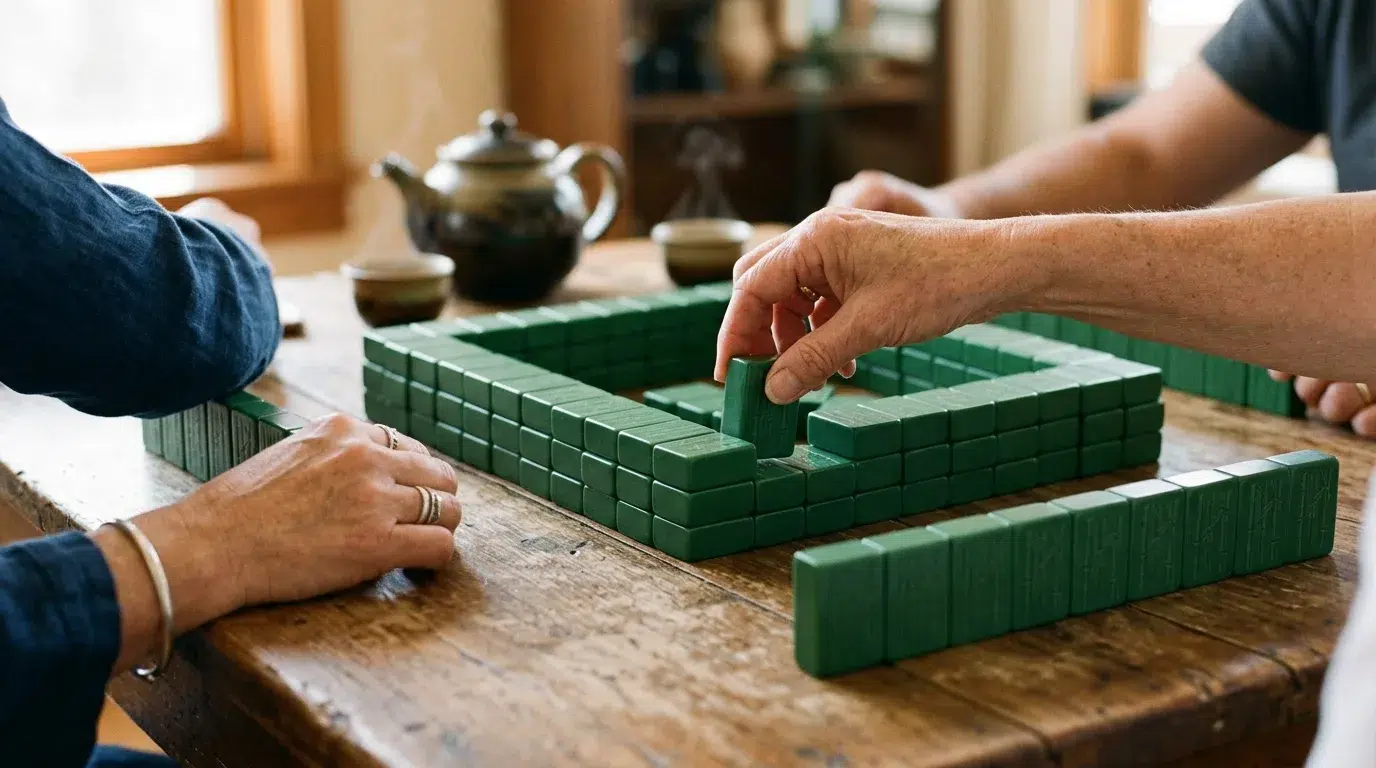
Mahjong is a tile game for four players that began in China in the 19th century. It plays a lot like the card game rummy: each turn you draw a tile and discard one, trying to be first to turn your 13 tiles into a complete hand, usually four sets and a pair. There are many versions, and the two most people learn are the classic Chinese game and American mahjong, which uses jokers and a new card of winning hands every year. This guide explains how to play mahjong step by step, starting with the tiles, then the classic rules, then what changes in the American game.
| Classic (Chinese / Hong Kong) mahjong | |
|---|---|
| Players | Four. Seats are named after the winds: East, South, West and North. |
| Tiles | 144: 108 suit tiles, 28 honours and 8 flowers and seasons. Many players leave out the flowers and play with 136. |
| Hand size | 13 tiles; you hold 14 for a moment after drawing. |
| Turn | Draw a tile, then discard one. Play passes counter-clockwise. |
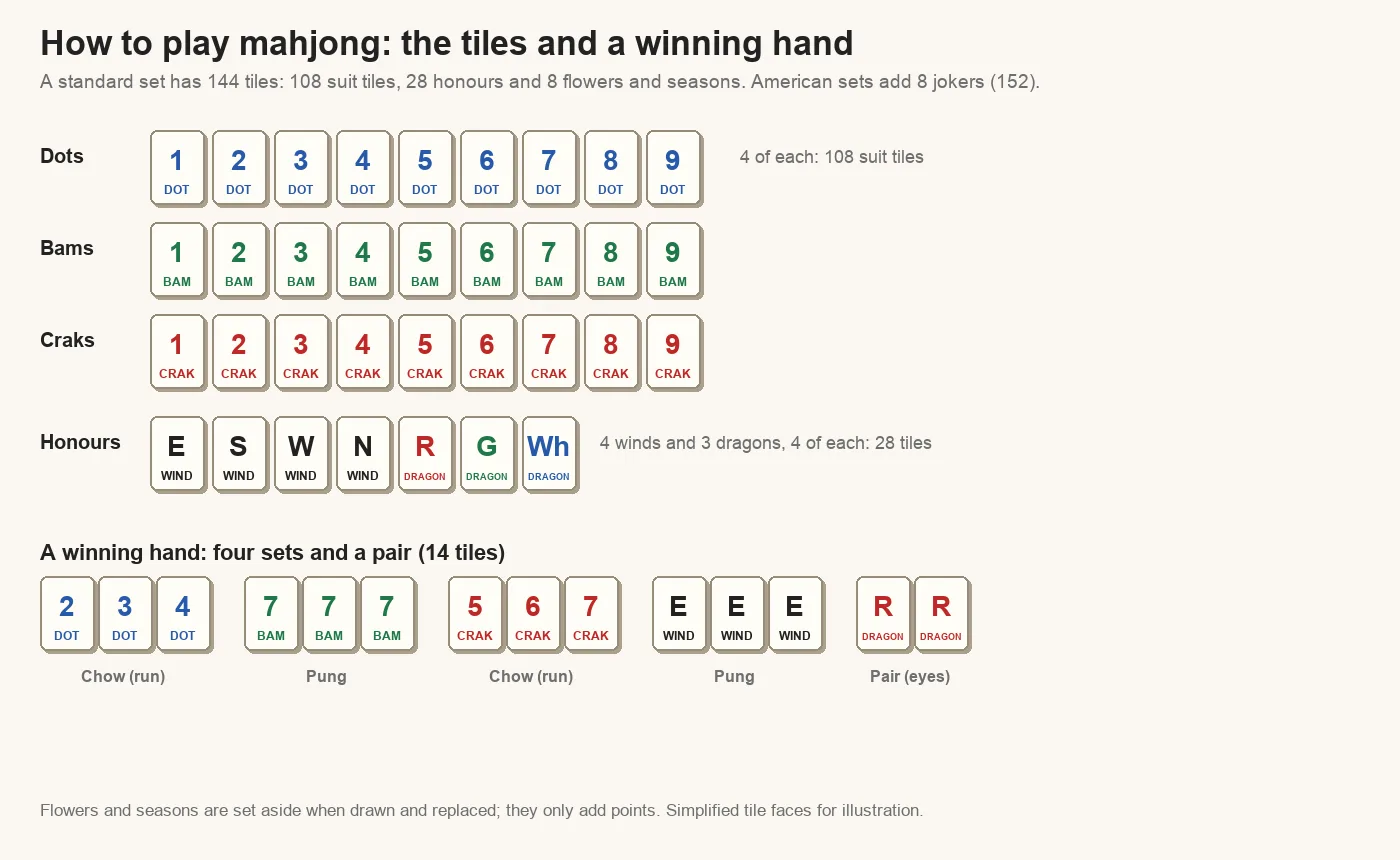
| Sets | Chow (three in a row in one suit), pung (three of a kind) and kong (four of a kind). |
| Winning hand | 14 tiles: four sets and a pair, completed by your own draw or someone’s discard. |
| End of a hand | Someone declares “mahjong”, or the wall runs out and the hand is a draw. |
| Group | Tiles | How many |
|---|---|---|
| Dots (circles) | 1 to 9 | 36 (4 of each) |
| Bamboos (bams) | 1 to 9; the 1 bamboo is usually a bird | 36 (4 of each) |
| Characters (craks) | 1 to 9 | 36 (4 of each) |
| Winds | East, South, West, North | 16 (4 of each) |
| Dragons | Red, green and white | 12 (4 of each) |
| Flowers and seasons | One of each, numbered 1 to 4 | 8 |
| Jokers (American sets only) | All identical | 8 |
The three suits and the honours (winds and dragons) make up the 136 tiles used to build hands. Flowers and seasons are bonus tiles: when you draw one, you put it aside and draw a replacement. That is why a classic set has 144 tiles and an American one 152.
Scoring is where versions differ most, so agree it before you start. In Hong Kong mahjong only the winner scores, counting faan (points) for features of the hand: all pungs, a hand in one suit, dragon pungs, flowers and so on. Most tables require a minimum of three faan to win, and winning with a tile from the wall doubles what each loser pays. The international Mahjong Competition Rules use a longer list of scoring patterns and an eight-point minimum. Beginners often start with simple scoring, such as a fixed amount per win, and add patterns later.
American mahjong, standardised by the National Mah Jongg League (NMJL) from 1937, plays very differently once the tiles are dealt:
| Rule | American mahjong |
|---|---|
| Tiles | 152: the classic 144 plus 8 jokers. Racks hold your tiles. |
| Winning hands | Only the hands printed on that year’s official card count. The card changes every year, with sections such as year hands, 2468, consecutive runs, 13579, winds and dragons, 369, and singles and pairs. |
| The Charleston | Before play, everyone passes three unwanted tiles to the right, then across, then left. A second Charleston (left, across, right) follows if everyone agrees, then an optional “courtesy pass” of up to three tiles with the player opposite. Jokers can never be passed. |
| Sets | Pairs, pungs, kongs, quints (five) and sextets (six). There are no chows; runs on the card are built from separate tiles. |
| Jokers | Can stand in for any tile in a pung, kong, quint or sextet, but never in a pair or as a single tile. If someone exposes a set with a joker, you can swap in the real tile on your turn and take the joker. |
| Calling discards | You can call a discard to complete a pung, kong, quint or sextet, and must expose it. You can’t call for a single tile or a pair unless it completes your mahjong. |
| Payment | Hands on the card have point values, and the minimum is 25. The player who discarded the winning tile pays double; others pay single. On a win from the wall, everyone pays double. |
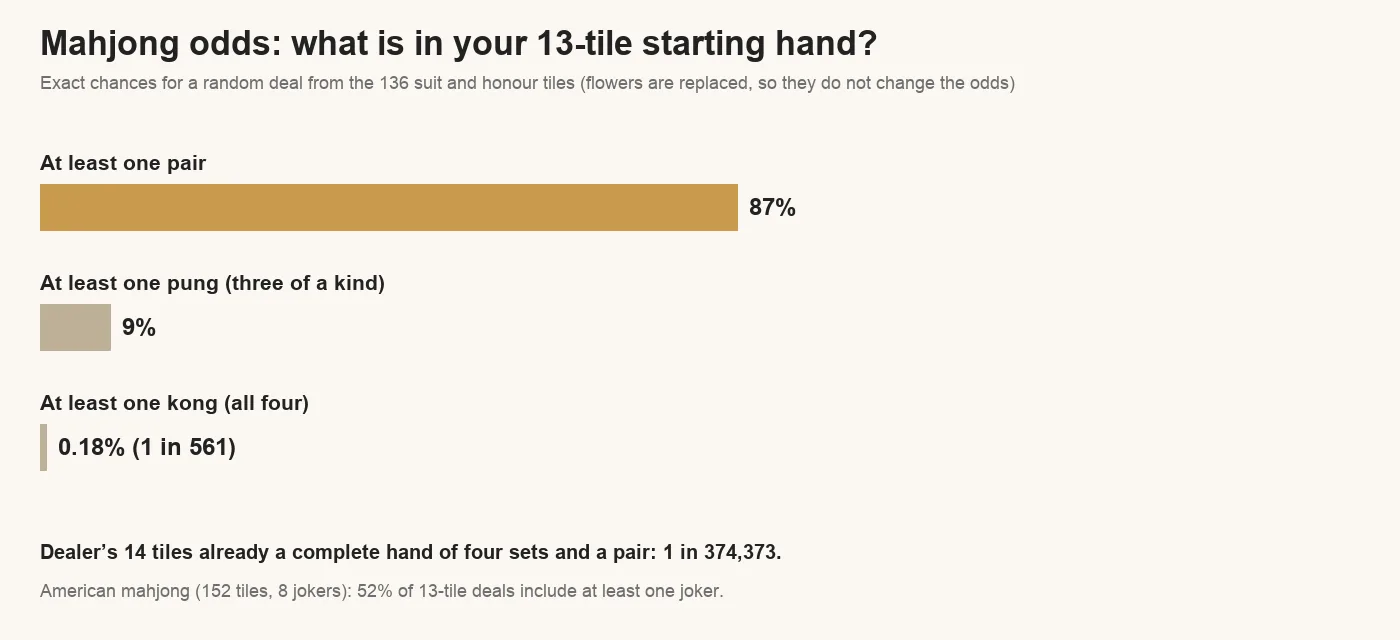
These are the exact chances for a 13-tile starting hand dealt at random from the 136 suit and honour tiles (flowers are replaced as soon as they appear, so they don’t change the odds):
| Your 13 tiles contain | Chance |
|---|---|
| At least one pair | 87% |
| At least one pung (three of a kind) | 9% |
| At least one kong (all four of a tile) | 0.18% (1 in 561) |
Being dealt a winning hand is far rarer. The chance that the dealer’s 14 tiles already form four sets and a pair before anyone moves is 1 in 374,373. In American mahjong, with eight jokers among 152 tiles, 52% of 13-tile hands include at least one joker, and the average is 0.68.
Mahjong grew out of Chinese draw-and-discard card games of the 18th and 19th centuries, played with money-suited cards in three suits of nine, which is where the dots, bamboos and characters come from. The switch from cards to tiles probably happened in the mid-19th century, and the oldest surviving tile sets date from around 1870. Ningbo and Fujian both claim to be its birthplace. The game reached the United States in 1920, when Abercrombie & Fitch began selling sets and Joseph Park Babcock published his Rules of Mah-Jongg, and the National Mah Jongg League was founded in 1937.
If you like collecting sets and runs, try the card game it most resembles, rummy. For another game played with tiles, see the dominoes guide, and for a strategy game for two, checkers.
Another tile game: Rummikub, a rummy game played with numbered tiles on racks.

After going through several successful experiences with several industry pioneers, Fadi Hayek has managed to excel in the world of content for online gaming by providing unique content for several projects that allowed him to obtain the necessary experience to launch his career. Last but not least, Fadi also holds several certificates, including but not limited to content marketing and iGaming.


