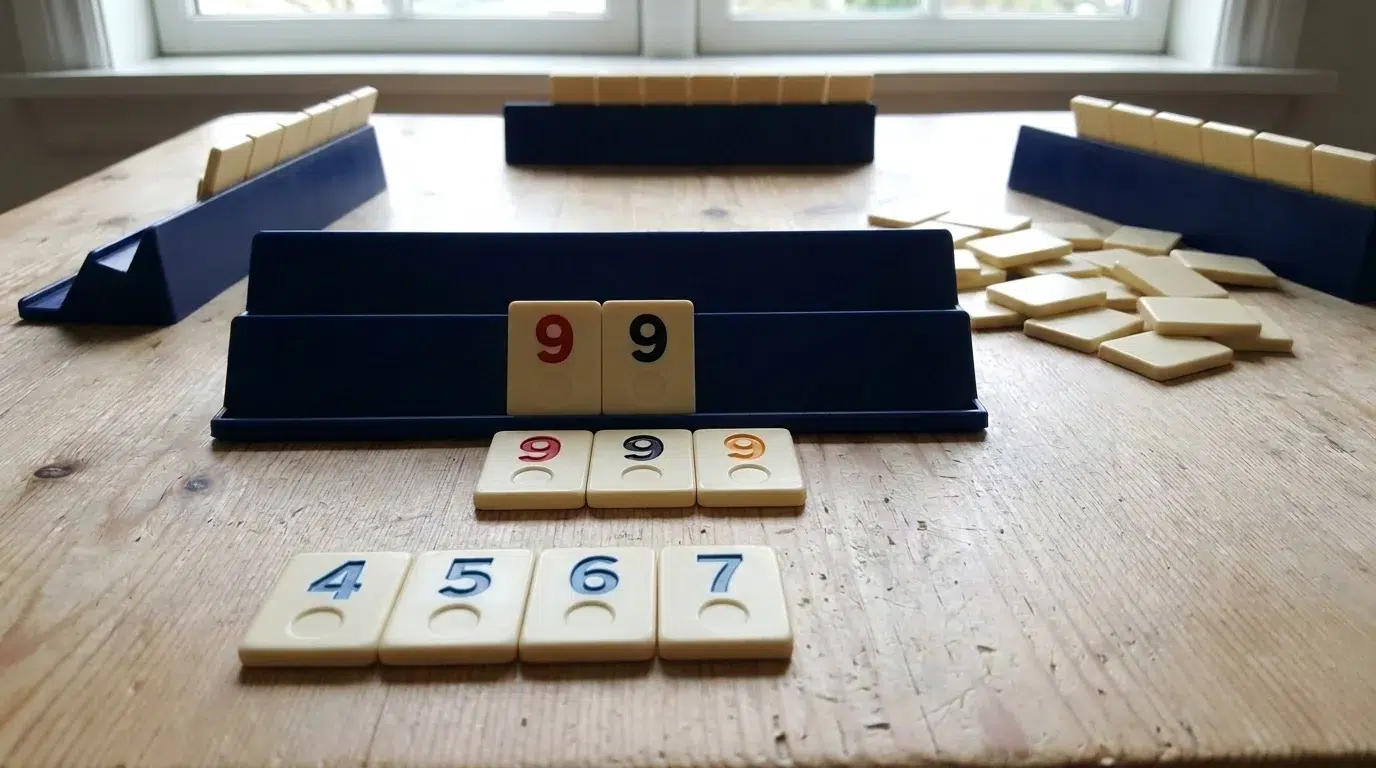
A tile rummy game on a wooden table: a blue run of 4, 5, 6 and 7, a group of three 9s in red, black and orange, tile racks and a pile of face-down tiles
A run in one colour and a group in three: the two kinds of set in Rummikub.

Rummikub is rummy played with tiles instead of cards. Two to four players each start with 14 numbered tiles on a rack and race to be the first to play them all, laying them out in runs (same colour, numbers in a row) and groups (same number, different colours). What makes it different from card rummy is that every tile on the table belongs to everyone: on your turn you can split, extend and rearrange any set to fit your own tiles in. Your first play has to be worth at least 30 points, and the first player to empty their rack calls “Rummikub!” and wins the game.

Rummikub Rules at a Glance

Rummikub
Players2 to 4 (5 or 6 with the XP edition and its 160 tiles).
Tiles106: the numbers 1 to 13 in four colours, two of each, plus 2 jokers. Each player has a rack.
Deal14 tiles each. The rest stay face down as the pool.
GoalBe the first to play every tile from your rack.
SetsA run is 3 or more tiles of one colour in number order. A group is 3 or 4 tiles of one number in different colours.
First playThe initial meld: one or more sets from your own rack worth at least 30 points.
If you can’t playDraw one tile from the pool. Your turn ends.
ScoringLosers count the tiles left on their racks as minus points (a joker is 30). The winner scores the total.

Runs and Groups

Every tile you play has to be part of a set of at least three tiles.
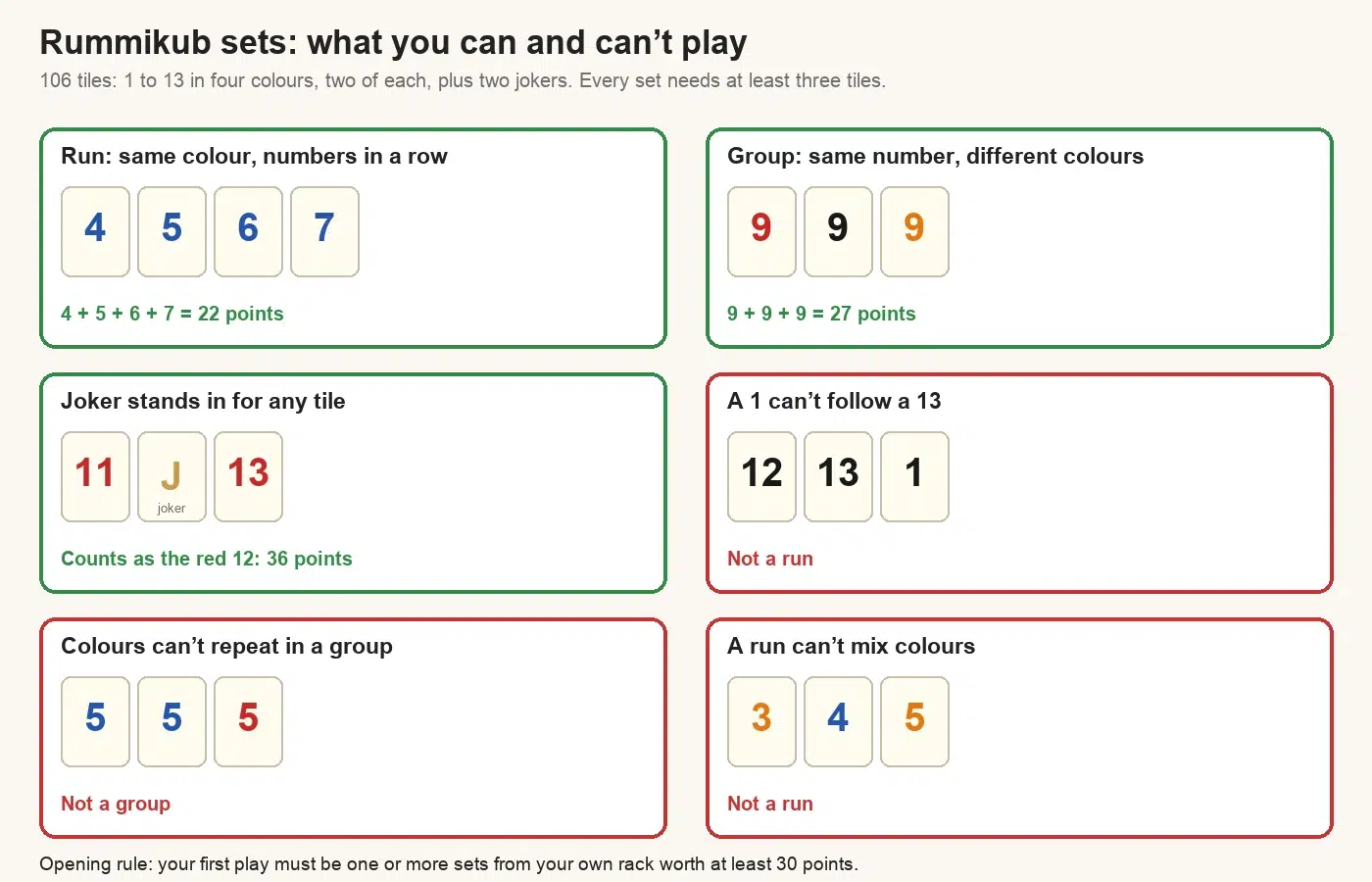
  • A run is three or more tiles of the same colour in consecutive order, such as blue 4, 5, 6, 7. A run can be as long as you like, but the 1 is always the lowest number: it can’t follow a 13, so 12, 13, 1 is not a run.
  • A group is three or four tiles of the same number, each in a different colour, such as a red, black and orange 9. Because there are only four colours, a group can never be longer than four, and two tiles of the same colour can’t share a group.
Rummikub sets: a blue run 4-5-6-7, a group of 9s in three colours, a joker standing in for a red 12, and three invalid sets: 12-13-1, a group with two blue 5s, and a run mixing orange and blue
Three sets that work and three that don’t.

How to Set Up

  1. Turn all the tiles face down and mix them on the table (or put them in a bag).
  2. Choose who starts. Each player takes a tile and the highest number goes first. Put the tiles back and mix again.
  3. Take 14 tiles each and stand them on your rack so only you can see them. Stacking the pool in piles of seven makes this quicker.
  4. The tiles left over are the pool. Play passes clockwise.

How to Play Rummikub

  1. Make your initial meld. Until you have, your only move is to lay one or more sets from your own rack worth at least 30 points in total, counting each tile at its number. You can’t use tiles already on the table for this, and a joker counts as the tile it replaces.
  2. Otherwise, draw. If you can’t play, or don’t want to, take one tile from the pool and your turn is over. You can’t play a tile you have just drawn until your next turn.
  3. After your meld, build. On later turns you can lay new sets, add tiles to any set on the table, and rearrange sets to fit your tiles in, as long as you play at least one tile from your rack.
  4. Leave the table tidy. At the end of your turn every tile on the table must be in a valid set of three or more.
  5. Go out. The first player to play their last tile calls “Rummikub!” and wins the game.

The official rules give each player one minute per turn. If time runs out, you draw a tile. If you leave the table in a mess, you have to put everything back where it was, take back your tiles and draw three tiles as a penalty.

If the pool runs out before anyone goes out, play continues until nobody can play. The player with the lowest total on their rack then wins.

Rearranging the Table

Rummikub calls this manipulation, and it is where most of the game’s skill lies. Once you have made your initial meld you can:

MoveExample
Add to a setBlue 4, 5, 6 is on the table. Add your blue 3 or blue 7 to it.
Take the fourth tile from a groupA group of four 4s is on the table. Take the blue 4 and use it with your blue 3, 5 and 6 to make a new run.
Extend one end, take from the otherRed 3, 4, 5 is on the table. Add your red 6 and take the red 3 to use elsewhere.
Split a runRed 4, 5, 6, 7, 8 is on the table. Put your red 6 in the middle to make 4, 5, 6 and 6, 7, 8.
Swap into a groupBlue, red and orange 6 are on the table. Add the black 6 and take one of the others.
Combine several setsBreak up two or three sets at once and rebuild them into new ones, as long as every tile ends in a valid set.

Any tile you take from the table must be played again on the same turn. You can’t take it back to your rack.

Joker Rules

  • A joker can stand in for any tile in a set. It takes the number and colour of the tile it replaces.
  • You can take a joker from the table by replacing it with the real tile it stands for, from your rack or from the table. In a group of three, either missing colour will do.
  • A joker you take must be used in a new set on the same turn, and you must also play at least one tile from your rack that turn.
  • You can’t take a joker until you have made your initial meld.
  • A joker still on your rack when someone goes out costs you 30 points.

How to Score Rummikub

When a player goes out, everyone else adds up the tiles left on their rack. Each tile is worth its number, and a joker is worth 30. Each loser scores that total as a minus, and the winner scores the sum of all the losers’ totals as a plus, so the scores for each game add up to zero.

Example gameTiles leftScore
Player A goes outNone+33
Player Bred 3, blue 7, black 5−15
Player Corange 12−12
Player Dblue 2, red 4−6

A round has as many games as there are players, so four games with four players. The player who wins the most games wins; if that is tied, the highest score decides. You can also simply keep a running total across games.

Rummikub Rules Questions

QuestionAnswer
Can you play with 2 players?Yes. The rules are the same, and a round is two games.
Can a run go 12, 13, 1?No. The 1 is always the lowest tile.
Can you add to other sets on the turn of your initial meld?No. The 30 points must come from your own rack, and you build on the table from your next turn.
Can you play the tile you just drew?No, not until your next turn.
How many tiles in a group?Three or four, all different colours.
Do you have to play if you can?No. You may draw a tile instead, which some players do on purpose.
What if nobody can go out?When the pool is empty and nobody can play, the lowest rack wins.

Rummikub Variations

  • Rummikub XP: 160 tiles and four jokers for five or six players.
  • Draw two / the river: when drawing, take two tiles, keep one and discard the other face up into a row. Later you can take a tile from the row along with every tile after it.
  • “French” rules: groups are laid vertically through runs already on the table, crossword-style.
  • Okey: a Turkish game played with very similar tiles, popular in cafés and at family gatherings.
  • With cards: the game can be played with two decks of playing cards, ace to king standing for 1 to 13, with the suits as the colours.
  • Time limit: rules vary between publishers, and some sets allow two minutes a turn instead of one.

Rummikub Strategy

  • Don’t empty your rack too early. The official rules suggest holding some tiles back at first, so other players open up the table and give you more to build on.
  • Play three, keep the fourth. If you have four tiles of a run or group, lay three and keep the last one, so next turn you can play it instead of drawing.
  • Keep the joker for a hard tile, but not too long. It is the most flexible tile in the game, but it costs 30 points if someone goes out while you still hold it.
  • Play high tiles first. They count most against you, and they make the 30-point opening easier.
  • Look at the whole table. Before drawing, check whether splitting a long run or swapping a tile in a group frees space for one of yours.
  • Watch rack sizes. When an opponent is down to two or three tiles, get your own high tiles and any joker out of your rack.
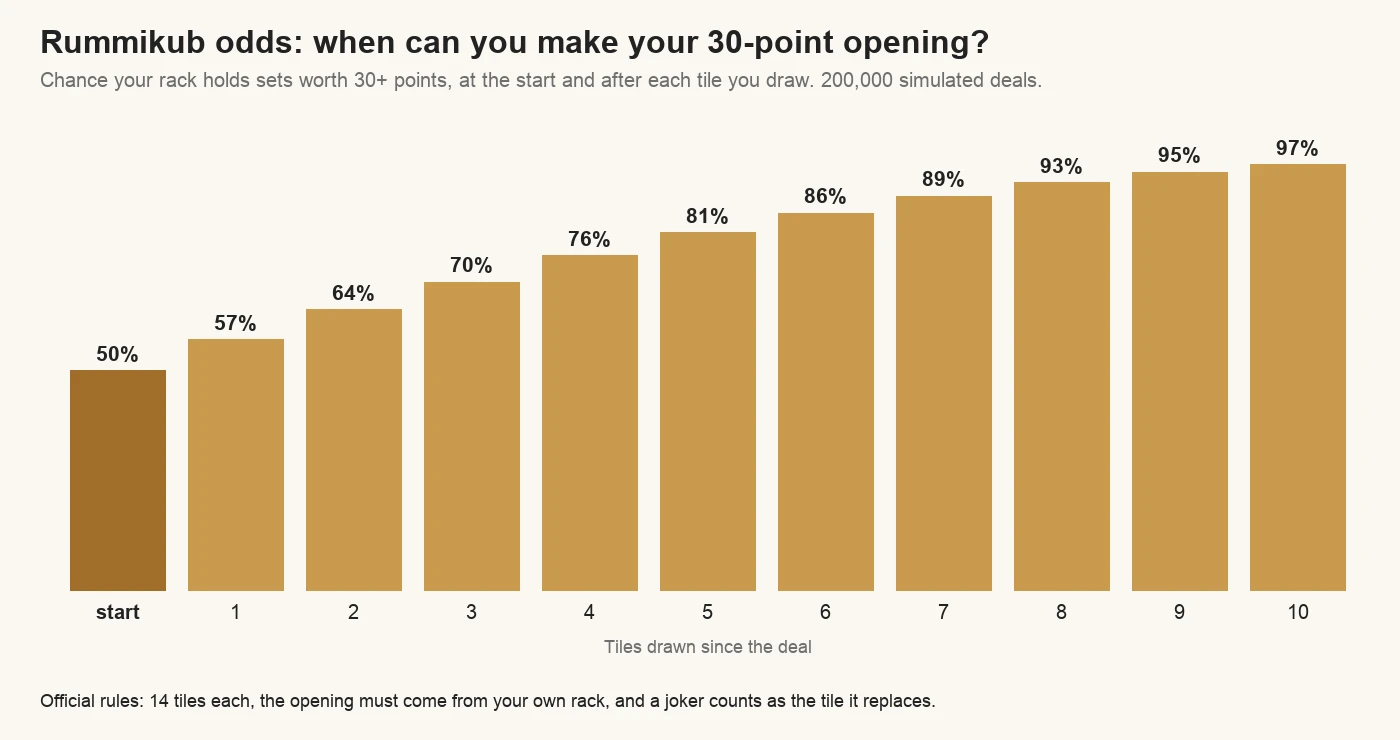
Chart of the chance of being able to make the 30-point initial meld in Rummikub: 50% at the start, 57% after one draw, 70% after three, 81% after five and 97% after ten
Half of all starting racks can open straight away, and most can within five draws.

Rummikub Odds

The figures below are exact where they come from counting, and from 200,000 simulated deals for the initial meld, using the official rules: 14 tiles each, sets from your own rack only, and a joker worth the tile it replaces.

QuestionAnswer
Tiles in the pool after the deal78 with 2 players, 64 with 3, 50 with 4
Chance your 14 tiles include at least one joker25%
Chance you are dealt both jokersAbout 1 in 61
Average total of the numbered tiles in a starting rackAbout 96 points
Chance you can make the 30-point initial meld straight away50%
Chance you can make it after drawing 1 tile57%
After drawing 3 tiles70%
After drawing 5 tiles81%
After drawing 10 tiles97%
Chance a starting rack holds no valid set at all21%

Where Rummikub Comes From

Rummikub was created by Ephraim Hertzano, a Romanian-born Jew who moved to Israel after the Second World War. He made the first sets by hand with his family and sold them door to door and through small shops, and it became Israel’s best-selling export game. In the 1970s it reached the United States, where by 1977 it was a best seller, and in 1980 it won the German Spiel des Jahres, Game of the Year. More than 50 million copies have been sold. The name means “rummy cube”.

More Games to Try

The rummy rules guide covers the card game Rummikub is based on. For more rummy games, try gin rummy, Rummy 500 and Shanghai rummy, and for another tile game, mahjong or dominoes.

Rummikub: frequently asked questions

How do you play Rummikub?

Each player takes 14 tiles from a pool of 106 (1 to 13 in four colours, two of each, plus two jokers). On your turn you lay tiles from your rack in runs (same colour, numbers in a row) or groups (same number, different colours), or draw a tile if you can not or choose not to play. Your first play must total at least 30 points. After that you can add to and rearrange any sets on the table. The first player to play all their tiles wins.

How many tiles do you start with in Rummikub?

14 tiles each. The remaining tiles stay face down as the pool.

How many tiles are in Rummikub?

106: two sets of the numbers 1 to 13 in each of four colours (104 tiles) plus 2 jokers. The XP edition for five or six players has 160 tiles and 4 jokers.

What is the 30-point rule in Rummikub?

Your first play, the initial meld, must be one or more sets from your own rack whose numbers add up to at least 30. You can not use tiles already on the table for it, and a joker counts as the tile it replaces.

Can you move a joker in Rummikub?

Yes, once you have made your initial meld. Replace it with the real tile it stands for, from your rack or the table, then use the joker in a new set on the same turn, and play at least one tile from your rack that turn.

How do you score Rummikub?

When a player goes out, the others add up the tiles left on their racks, with a joker worth 30. Each loser scores that as a minus, and the winner scores the total of all the losers as a plus.

Can a run in Rummikub go from 13 to 1?

No. The 1 is always the lowest tile, so a run can not continue from 13 to 1.

Can you play Rummikub with 2 players?

Yes. The rules are the same as for three or four players, and a round is two games.

Fadi Hayek
Author & Casino Expert

After going through several successful experiences with several industry pioneers, Fadi Hayek has managed to excel in the world of content for online gaming by providing unique content for several projects that allowed him to obtain the necessary experience to launch his career. Last but not least, Fadi also holds several certificates, including but not limited to content marketing and iGaming.

Latest News

Artificial Intelligence in Gambling – How It Is Changing the Future of the Industry

As online casinos adopt machine learning models and artificial intelligence in gambling becomes the next disruption, you don’t want to be left behind. Read on to learn about the impact AI will have on the future of the gambling industry.

Arabian Football Betting Trends – Stay Current on Betting Preferences in the Middle East!

Keep abreast of the latest Arabian football betting trends with the Arabian sports betting insights below. This guide covers the most popular bet types with Arab bettors and the top bookmakers for Arabian and global football competitions.

Al-Nassr vs PSG | Cristiano Ronaldo vs Lionel Messi

The biggest event in world football is scheduled to take place later this month as Al Nassr vs PSG is on the cards.

Yggdrasil Collaborate with Reflex to Release Dublin Up DoubleMax

Yggdrasil and Reflex are set to launch Dublin Up DoubleMax, an Irish-style video, as one of their latest releases. The slot game is designed by incorporating Yggdrasil’s proprietary Game Engagement Mechanic (GEM) DoubleMax coupled with unique features like free spins bonus and fairy magic.