Shanghai Rummy Rules
Seven rounds, seven contracts: collect the books and runs each round asks for, buy discards with May I? and keep your score low.


Seven rounds, seven contracts: collect the books and runs each round asks for, buy discards with May I? and keep your score low.
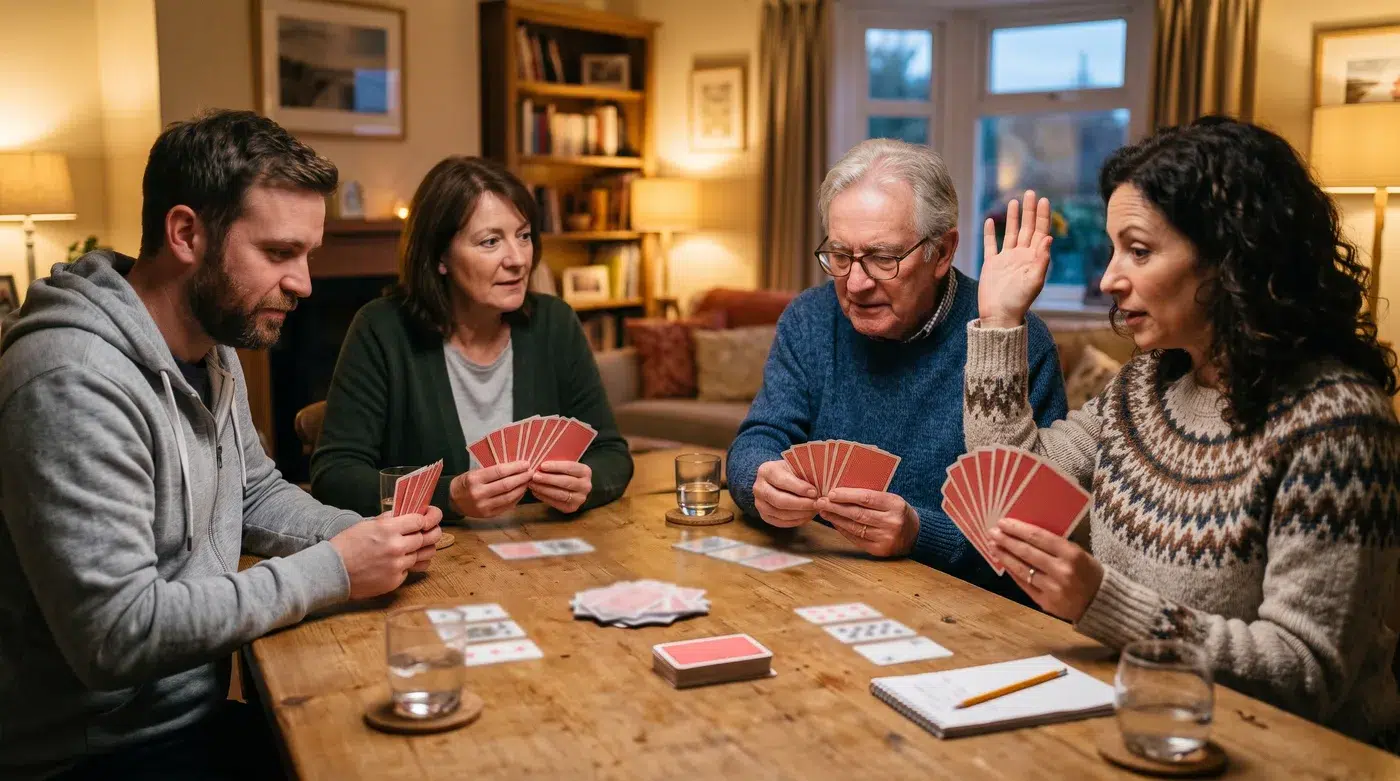
Shanghai rummy is a rummy game for three to five players, played over seven rounds. Each round has its own contract, a set combination of books and runs you must collect before you can lay anything down, and the contracts get harder as the game goes on. Players can grab the discard out of turn by calling “May I?”, and the lowest total of penalty points after the last round wins. Shanghai is one of a family of contract rummy games that also includes Liverpool Rummy, May I? and Progressive Rummy. Rules vary from table to table, so this guide gives the most widely used Shanghai rummy rules and shows how the other versions differ.
| Shanghai rummy | |
|---|---|
| Players | Three to five. |
| Cards | Two standard decks plus four jokers: 108 cards. |
| Cards each | 11 in every round. |
| Rounds | Seven, each with its own contract. |
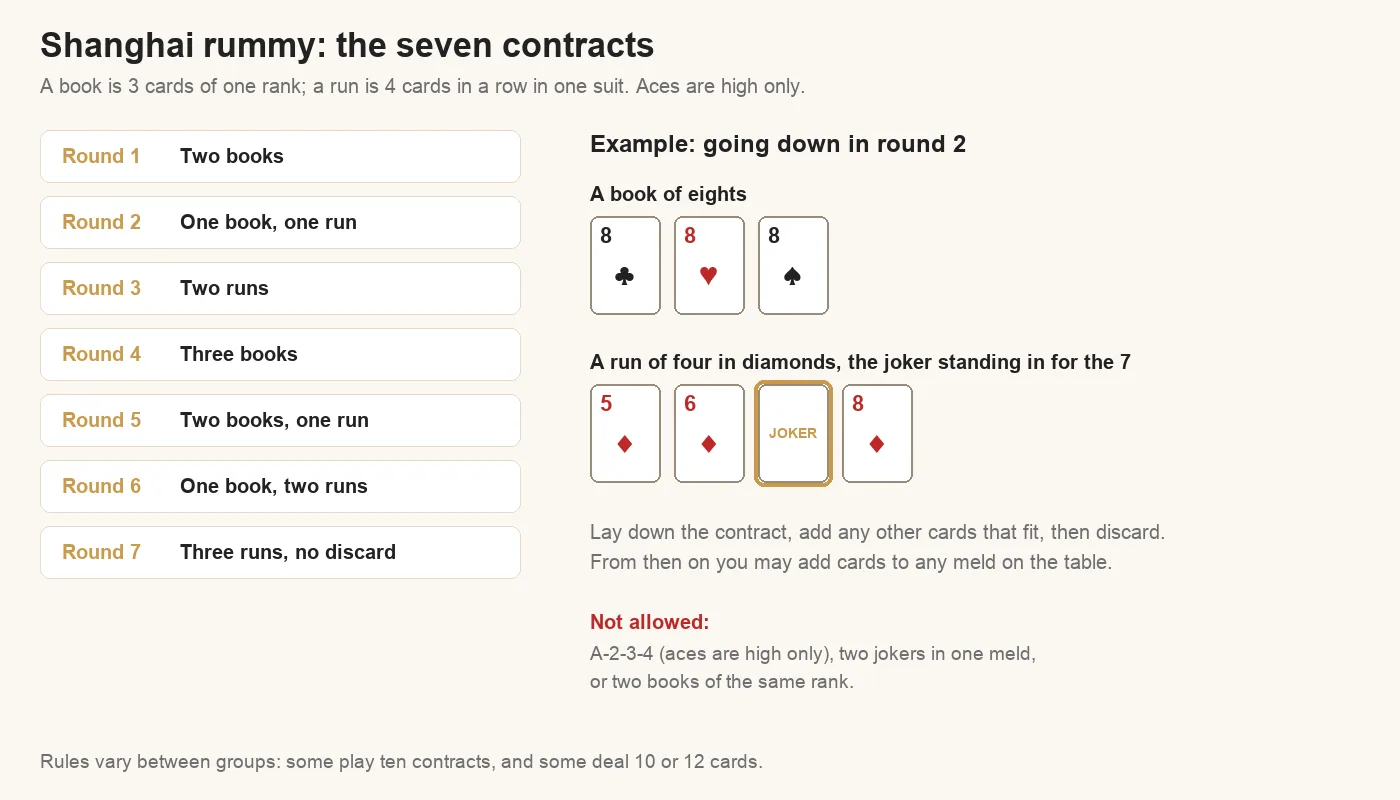
| Melds | A book is three cards of the same rank; a run is four cards in sequence in one suit. Aces count high only. |
| Jokers | Wild, but no more than one in any book or run. |
| May I? | Take the discard out of turn, with two penalty cards, up to twice a round. |
| Winning | The lowest total of penalty points after seven rounds. |
| Round | Contract | Cards needed |
|---|---|---|
| 1 | Two books | 6 |
| 2 | One book and one run | 7 |
| 3 | Two runs | 8 |
| 4 | Three books | 9 |
| 5 | Two books and one run | 10 |
| 6 | One book and two runs | 11 |
| 7 | Three runs, with no discard | 12 |
If the stock runs out, the discard pile except its top card is shuffled to make a new stock.
May I? If the player whose turn it is doesn’t want the top card of the discard pile, any other player can ask for it. A player who takes it this way also takes the top two cards of the stock as a penalty, and does not meld or discard; play then carries on from the player whose turn it was. Each player may do this at most twice per round, so pennies or other tokens are handy for keeping count. If several people want the same card, the one whose turn comes soonest gets it.
Shanghai! If you discard a card that could be added to a meld already on the table, you can call “Shanghai” as you discard it, and nobody may then pick it up. If you discard such a card without calling, any other player may call “Shanghai”, add it to the meld, and then hold out their hand face down so that you draw a card from it as a penalty. A Shanghai call takes priority over a May I?.
When someone goes out, everyone else scores penalty points for the cards still in their hand:
| Card | Penalty points |
|---|---|
| 2 to 7 | 5 each |
| 8 to King | 10 each |
| Ace | 20 |
| Joker | 50 |
The player who went out scores 0. Add each round to a running total; after round 7 the lowest total wins.
The contract idea is shared by several games that differ mostly in the deal, the contracts and the details of buying discards:
| Game | How it differs from Shanghai |
|---|---|
| Contract Rummy | The same seven contracts, but 10 cards are dealt in rounds 1 to 3 and 12 in rounds 4 to 7. It uses one joker fewer than the number of players, aces can be high or low, there is no limit on taking discards out of turn (with one penalty card), and you may lay down only the contract itself on the turn you go down. Aces and jokers count 15, picture cards 10, number cards their face value. |
| Liverpool Rummy | Contract Rummy with a cutting bonus: before the deal, the player who cuts the deck takes 50 points off their score if they cut exactly the number of cards needed for the deal plus the upcard. |
| May I? | One deck for every two players, all jokers included. Your first meld may be longer than the contract, jokers can’t be taken back once melded, and a joker left in your hand costs 25. |
| Progressive Rummy | Fifteen contracts instead of seven, with twos as well as jokers wild, and in the later rounds players buy extra cards for a penny each. |
| Ten-hand Shanghai | A longer version with later contracts that need up to 17 cards, so buying is essential: three buys per player per hand, four in the last two hands. |
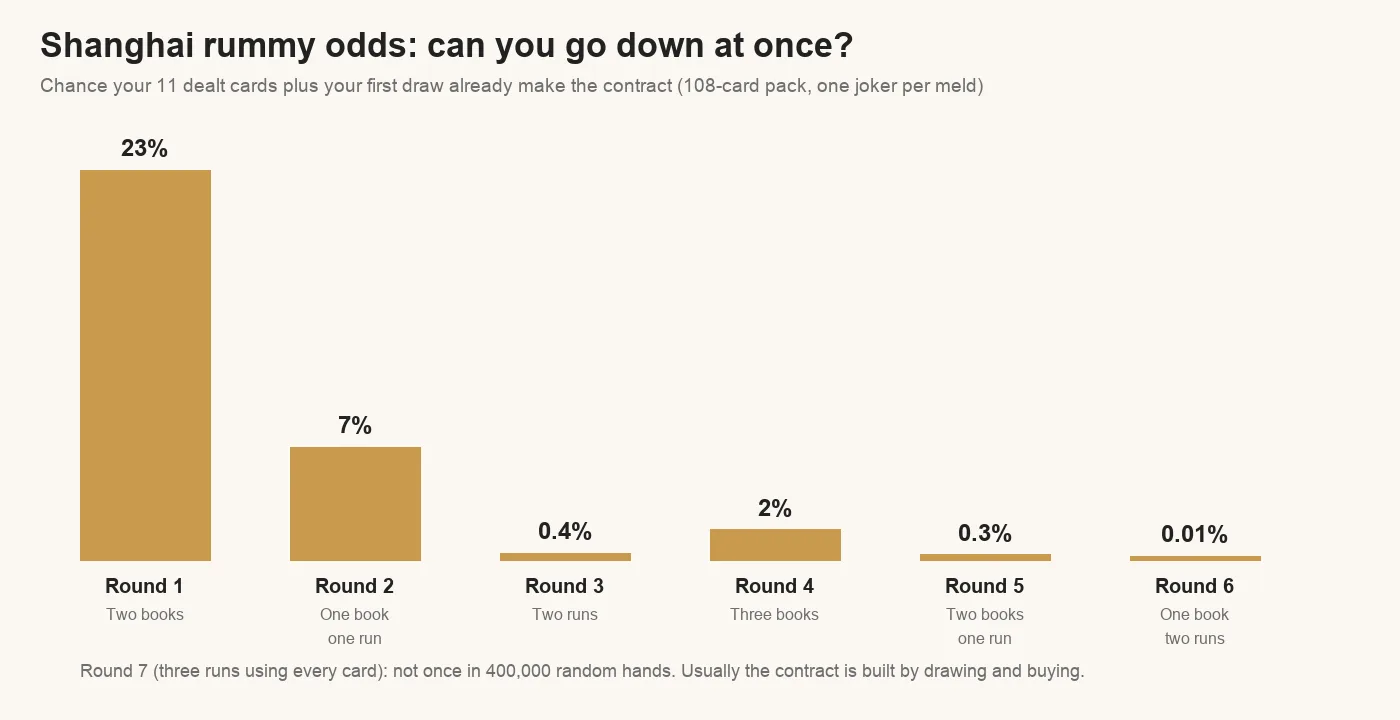
How often can you go down on your very first turn? These are the chances that your 11 dealt cards plus your first draw already make each contract, under the rules above (108 cards, aces high, one joker per meld), from 400,000 random hands per round:
| Round | Contract | Chance |
|---|---|---|
| 1 | Two books | 23% |
| 2 | One book, one run | 7% |
| 3 | Two runs | 0.4% |
| 4 | Three books | 2% |
| 5 | Two books, one run | 0.3% |
| 6 | One book, two runs | about 1 in 10,000 |
| 7 | Three runs, every card used | not once |
Books are far easier to collect than runs: three books (9 cards) turn up in 2% of opening hands, but two runs (8 cards) in only 0.4%. A book can use any three cards of one rank, while a run needs four particular cards of one suit. That is why the run rounds, 3, 6 and 7, take the longest.
The first game of the family was Zioncheck, created by Ruth Armson in the 1930s, which had six contracts. Contract Rummy and its relatives grew from it, and the commercial card game Phase 10, created by Kenneth Johnson in 1982, is built on the same idea. Shanghai rummy is also sometimes called California rummy.
The rummy rules guide covers the basic game and its main variants. For other games with a different target each round, try Phase 10 or Five Crowns, and for a points race, Rummy 500.
The tile version: Rummikub, with runs, groups and a 30-point opening.

After going through several successful experiences with several industry pioneers, Fadi Hayek has managed to excel in the world of content for online gaming by providing unique content for several projects that allowed him to obtain the necessary experience to launch his career. Last but not least, Fadi also holds several certificates, including but not limited to content marketing and iGaming.


