Phase 10 Rules
Ten Phases, one per round, and the first to finish Phase 10 wins: how to play Phase 10, step by step.


Ten Phases, one per round, and the first to finish Phase 10 wins: how to play Phase 10, step by step.
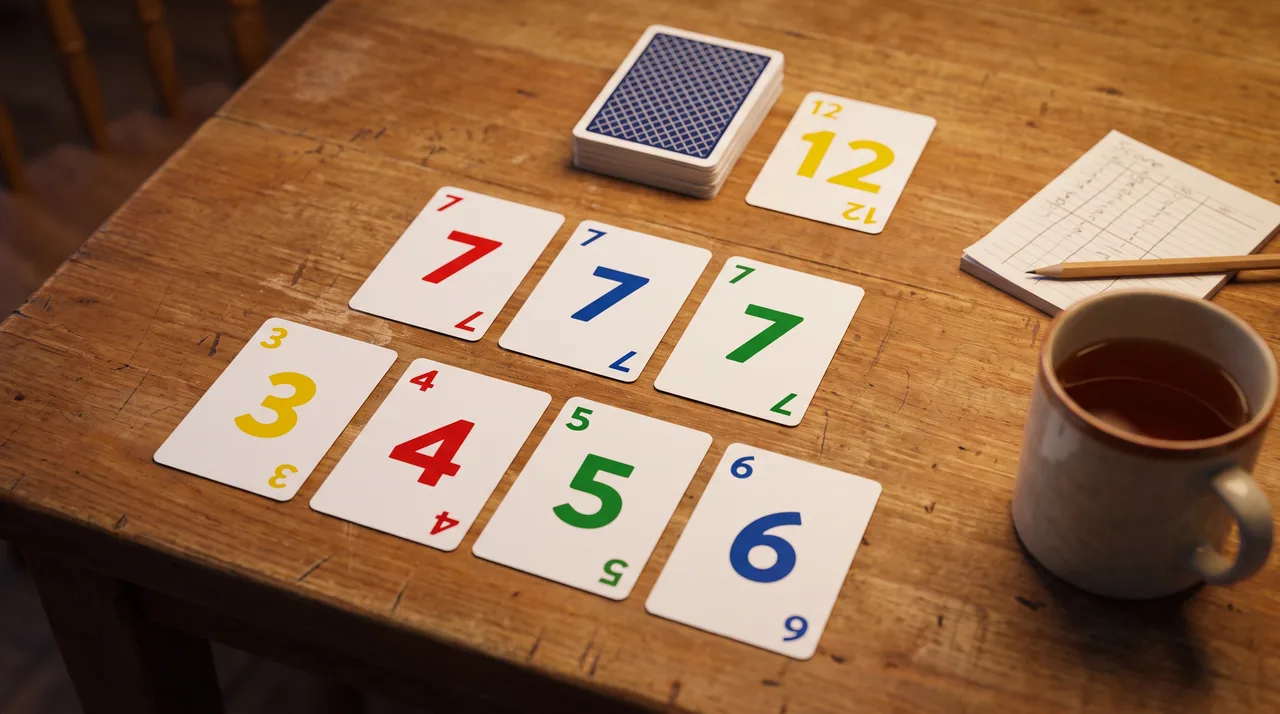
Phase 10 is a rummy-style card game in which every player works through the same ten combinations, called Phases, in order. You have to lay down your current Phase before you can move on to the next one, and the first player to complete Phase 10 wins. Kenneth Johnson created it in 1982, basing it on contract rummy, and Mattel bought the rights in 2010. In 2024 it was inducted into the National Toy Hall of Fame. This guide covers the Phase 10 rules in full: the ten Phases, the deal, Wild and Skip cards, hitting, going out, scoring, the official variations and how to play with ordinary cards.
| Phase 10 | |
|---|---|
| Players | Two to six, ages 7 and up. |
| Cards | 108 playing cards: 96 numbered cards (1 to 12 twice in red, blue, green and yellow), 8 Wild cards and 4 Skip cards. The box adds 2 reference cards that list the Phases. |
| Deal | 10 cards to each player. |
| Each turn | Draw one card, lay down your Phase if you can, hit on Phases already down, then discard one card. |
| End of a round | A player goes out by getting rid of every card in their hand. |
| Scoring | Cards left in your hand count against you. Low score is best. |
| Winning | The first player to complete Phase 10. |
| Phase | What you need | Example |
|---|---|---|
| 1 | 2 sets of 3 | 7-7-7 and 10-10-10 |
| 2 | 1 set of 3 + 1 run of 4 | 9-9-9 and 3-4-5-6 |
| 3 | 1 set of 4 + 1 run of 4 | 2-2-2-2 and 8-9-10-11 |
| 4 | 1 run of 7 | 2-3-4-5-6-7-8 |
| 5 | 1 run of 8 | 4 to 11 |
| 6 | 1 run of 9 | 1 to 9 |
| 7 | 2 sets of 4 | 5-5-5-5 and 11-11-11-11 |
| 8 | 7 cards of 1 colour | Any seven green cards |
| 9 | 1 set of 5 + 1 set of 2 | 6-6-6-6-6 and 12-12 |
| 10 | 1 set of 5 + 1 set of 3 | 3-3-3-3-3 and 9-9-9 |
You must make the Phases in order, only one per round, and you must hold the whole Phase in your hand before you lay it down.
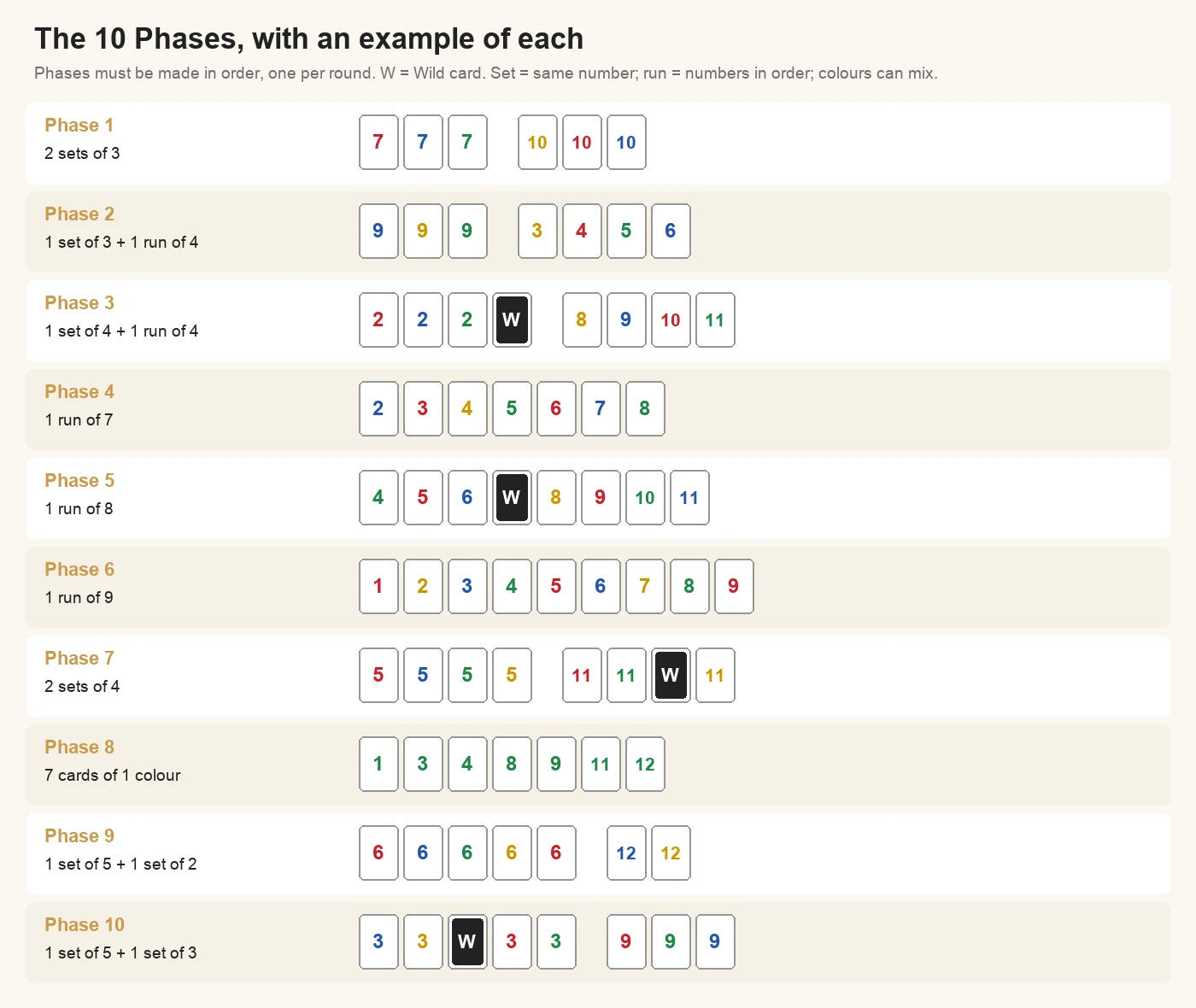
Wild cards can stand in for any number or any colour. With a 3, 4 and 6, a Wild can be the 5 that makes a run of four; with six green cards, a Wild can be the seventh for Phase 8. You can use as many Wilds as you like in a Phase as long as it includes at least one numbered card, and a Wild stays where it was played for the rest of the round. If the first card of the discard pile is a Wild, the first player may pick it up.
Skip cards make another player lose their next turn. Discard the Skip and choose who misses a go. Playing a Skip counts as your discard and ends your turn. A Skip can never be used in a Phase or picked up from the discard pile, and you cannot skip the same player two turns in a row. If the dealer turns up a Skip to start the discard pile, the first player loses their first turn.
After your Phase is down, you can hit: add cards from your hand to any Phase on the table, yours or another player’s, as long as they fit. You can add a 4 to a set of 4s, a 2 or a 7 to a run of 3-4-5-6, a green card to seven greens, or a Wild to any of them. You may hit only on your own turn, but you can play as many cards as you like.
You go out by getting rid of every card in your hand, by hitting, by discarding your last card, or both. The first player out wins the round and ends it for everyone.
| Card left in your hand | Points against you |
|---|---|
| 1 to 9 | 5 each |
| 10, 11 and 12 | 10 each |
| Skip | 15 |
| Wild | 25 |
The player who went out scores 0. Everyone else adds up the cards still in their hand; cards on the table do not count. Keep a running total for each player on paper, and pass the deal to the left after each round.
The first player to complete Phase 10 wins. If two or more players finish Phase 10 in the same round, the one with the fewest total points wins. If that is tied too, the tied players replay Phase 10 and the first one out wins.
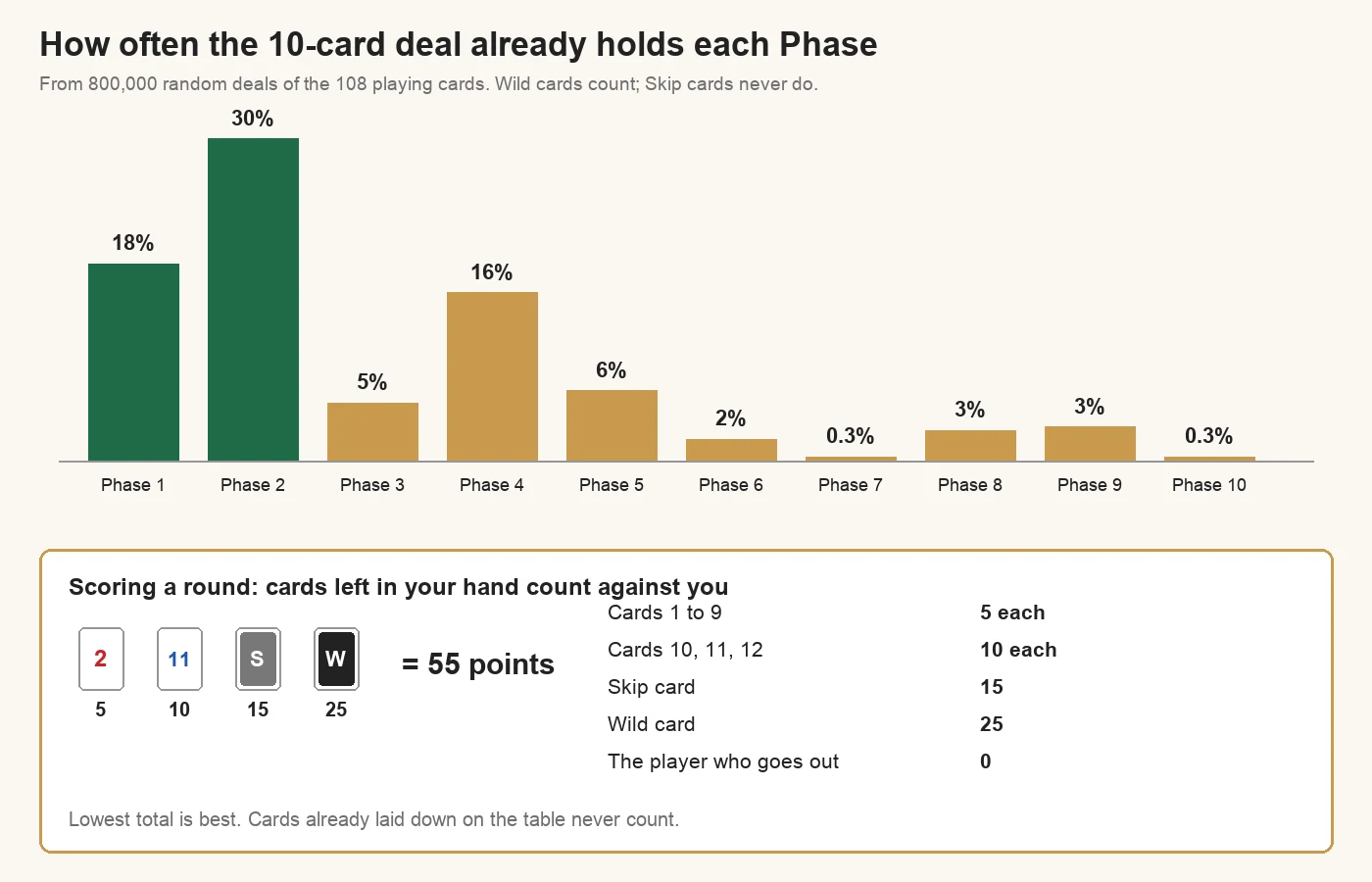
How often the 10 cards you are dealt already make each Phase:
| Phase | Chance in the deal |
|---|---|
| 1 | 18% |
| 2 | 30% |
| 3 | 5% |
| 4 | 16% |
| 5 | 6% |
| 6 | 2% |
| 7 | 0.3% |
| 8 | 3% |
| 9 | 3% |
| 10 | 0.3% |
The figures come from 800,000 random deals of the 108 playing cards.
| Variation | What changes |
|---|---|
| Ten rounds | Everyone moves on to the next Phase every round, whether they made it or not. After ten rounds, the lowest score wins. |
| Shorter game | Agree before you start to play only five or seven Phases. Everything else stays the same. |
| Masters Edition | A separate version of the game. Each player chooses which of their remaining Phases to try in each round, and once per round can put a card in a private “save” pile instead of the discard pile. Saved cards carry over between rounds and can be taken back at the start of a turn instead of drawing. |
Two standard packs of cards with their two Jokers each make a full Phase 10 pack. Aces are 1, cards 2 to 10 count their number, Jacks are 11 and Queens 12; the eight Kings are the Wild cards and the four Jokers are the Skips. The suits stand in for the four colours, so Phase 8 becomes seven cards of one suit. That gives the same 96 numbered cards, 8 Wilds and 4 Skips, and the scoring is unchanged.
Phase 10 is one of the rummy family covered in the rummy rules guide, which also explains Contract Rummy, the game it grew from. If you like scoring as you meld, try Rummy 500; for two players, Gin Rummy. For another family game where you race to empty your hand, see Crazy Eights.
Another Mattel family favourite: Skip-Bo, where you build from 1 to 12 to empty your stock pile.
Another rummy game that changes every round: Five Crowns, where the wild card moves up one rank each round.
The game it grew from: Shanghai and Contract Rummy, seven rounds with a new contract of books and runs each time.

After going through several successful experiences with several industry pioneers, Fadi Hayek has managed to excel in the world of content for online gaming by providing unique content for several projects that allowed him to obtain the necessary experience to launch his career. Last but not least, Fadi also holds several certificates, including but not limited to content marketing and iGaming.


