How to Play Scrabble
Seven tiles, a 15 x 15 board and a bag of letters: the official Scrabble rules, letter values and scoring, explained simply.


Seven tiles, a 15 x 15 board and a bag of letters: the official Scrabble rules, letter values and scoring, explained simply.
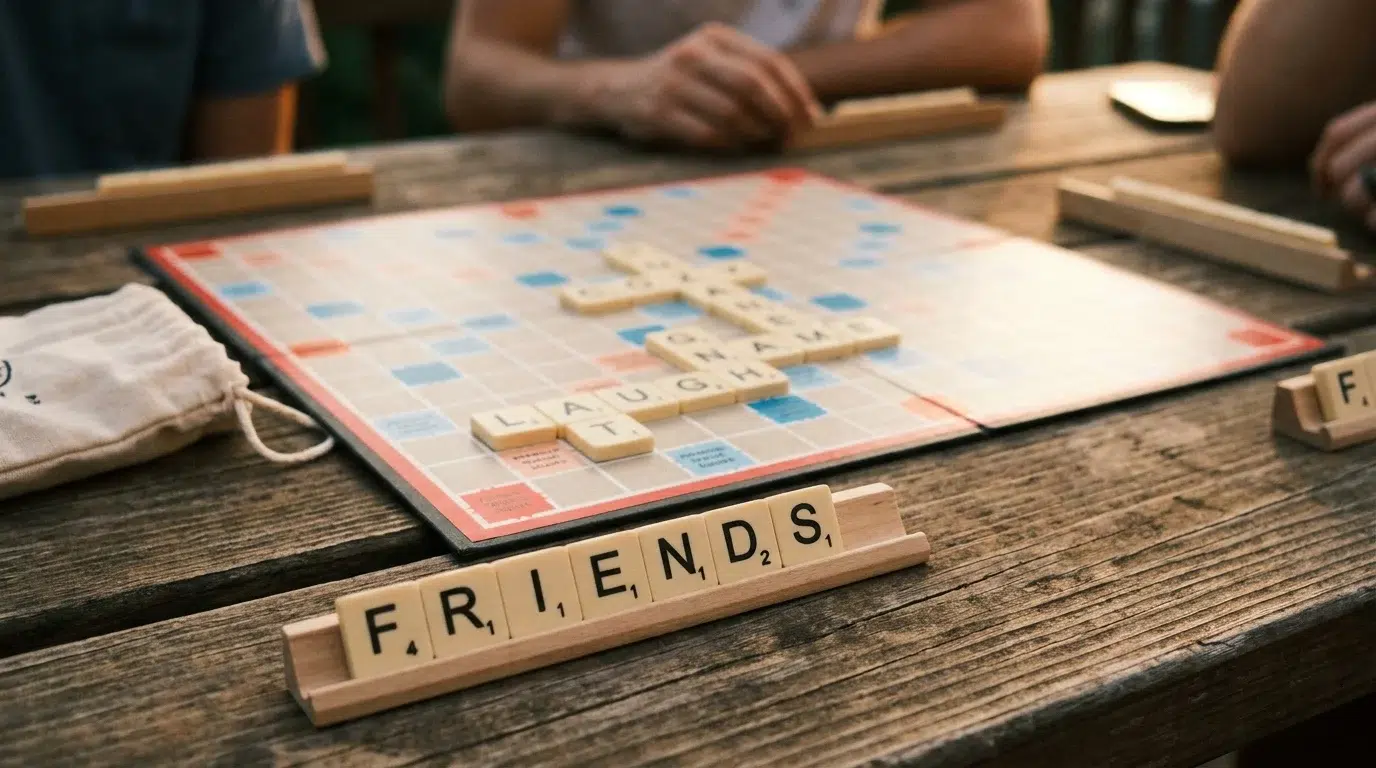
Scrabble is a word game for 2 to 4 players. Each player draws seven letter tiles and takes turns building words, crossword style, on a 15 × 15 board. Every letter has a point value, and coloured premium squares double or triple a letter or a whole word. The player with the highest score when the tiles run out wins. In a 2-player game, a good player scores in the 300 to 400 range, according to the official rules.
| Scrabble | |
|---|---|
| Players | 2 to 4, ages 8 and up |
| Equipment | Board (15 × 15 = 225 squares), 100 letter tiles, a tile bag, 4 racks |
| Tiles | 98 letters and 2 blanks; 187 points in the whole English set |
| Rack | 7 tiles each, refilled after every turn |
| First word | At least two letters, across or down, covering the centre star |
| Your turn | Play a word, exchange tiles, or pass |
| Bingo | Use all 7 tiles in one turn: +50 points |
| End | Bag empty and one player has used every tile |
There are three ways to make a new word: add letters to a word already on the board (HORN to HORNS), cross a word at right angles using one of its letters, or lay a whole word parallel to another so that every touching pair of letters also makes a word.
The rarer a letter, the more it is worth. These are the values and tile counts in the English-language set:
| Points | Letters (number of tiles) |
|---|---|
| 0 | Blank (2 tiles) |
| 1 | E ×12, A ×9, I ×9, O ×8, N ×6, R ×6, T ×6, L ×4, S ×4, U ×4 |
| 2 | D ×4, G ×3 |
| 3 | B ×2, C ×2, M ×2, P ×2 |
| 4 | F ×2, H ×2, V ×2, W ×2, Y ×2 |
| 5 | K ×1 |
| 8 | J ×1, X ×1 |
| 10 | Q ×1, Z ×1 |
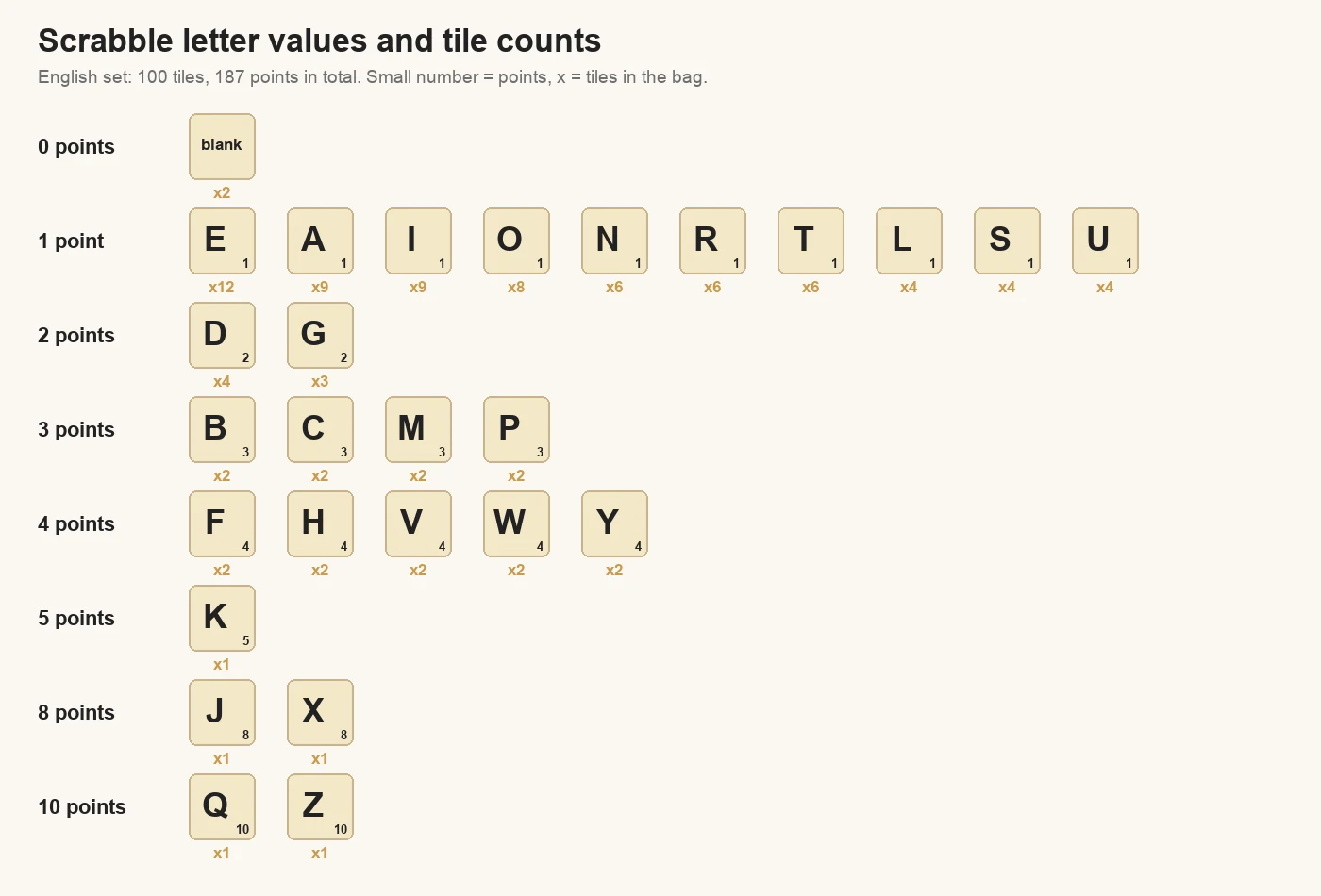
How many tiles are in Scrabble? 100: 98 letter tiles and 2 blanks. There are 42 vowels (A, E, I, O, U), and E is the most common letter with 12 tiles. Add up every tile and the set is worth 187 points.
| Example | Score |
|---|---|
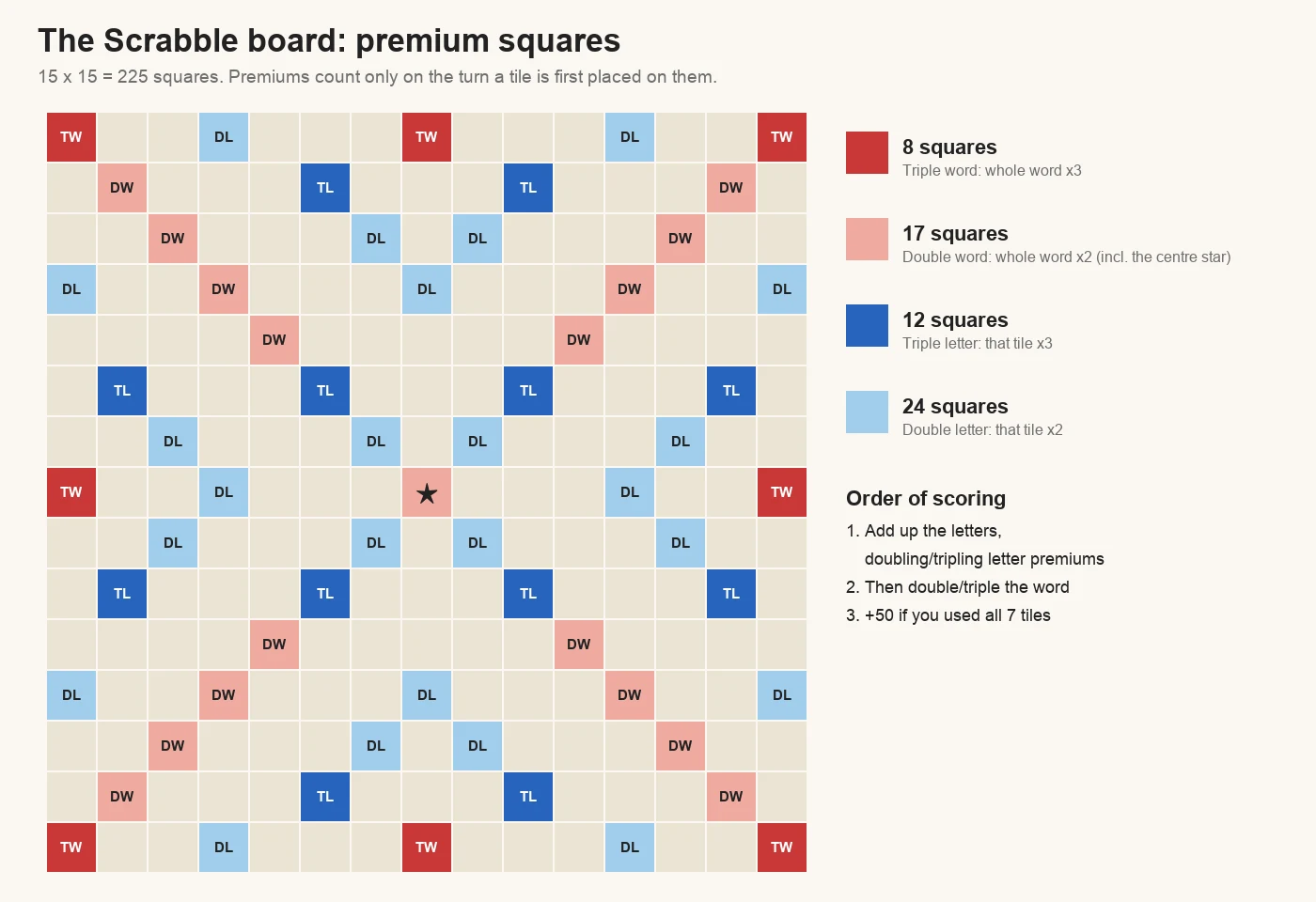
| Opening word PLAY on the centre star (P 3 + L 1 + A 1 + Y 4) | 9 × 2 = 18 |
| FOX with the X on a triple letter and the F on a double word | (4 + 1 + 8 × 3) × 2 = 58 |
| PLAYERS using all seven tiles, no premiums | 12 + 50 = 62 |
Any word in the agreed dictionary is allowed, including archaic, slang and foreign-origin words. Not allowed: words always written with a capital letter, abbreviations, prefixes and suffixes on their own, and words that need a hyphen or an apostrophe.
Any play can be challenged before the next player starts. If a word is not acceptable, the player takes the tiles back and loses that turn. If the play stands, the challenger loses their next turn. A challenge covers every word made in that play.
Clubs and tournaments use fixed word lists: the NASPA Word List (NWL2023) in the United States and Canada, and Collins Scrabble Words (CSW24) in most other countries.
| Question | Answer |
|---|---|
| Can you play words diagonally? | No. Words read across from left to right or down from top to bottom. |
| Can you add an S to a word? | Yes. Adding an S to pluralise one word while making another at the same time is a classic way to score two words in one turn. |
| Can you make two words in one turn? | Yes. Every new word you form, including short words made where your tiles touch others, scores in full. |
| Can you move tiles after playing them? | No. Once a play has been scored, the tiles stay where they are. |
| Can you change what a blank stands for? | No. A blank stays the letter you named for the rest of the game. |
| Does the first word have to be two letters? | At least two, and one of them must cover the centre star. |
| Can you pass? | Yes, scoring zero. In tournament play, the game can end after six scoreless turns in a row. |
| How many two-letter words are there? | 107 in the North American NWL2023 list and 127 in Collins Scrabble Words (CSW24). |
Two-letter words are the most useful words in the game: they let you slip a tile alongside another word and score in two directions at once. The official rule sheet says learning the two- and three-letter words can add as much as 50 points to an average game. The North American tournament list has 107 two-letter words; Collins has 127. Foreign words are allowed once they have entered English, which is why QI is playable; so are the names of letters, such as XI from the Greek alphabet.
The Q is worth 10 points but usually needs a U. The rule sheet lists Q-without-U words from the third edition of the Official Scrabble Players Dictionary, including QAT, QAID, QOPH, FAQIR, QANAT, TRANQ, QINDAR, QINTAR and QWERTY.
| Question | Answer |
|---|---|
| Squares on the board | 225, of which 61 are premium squares |
| Tiles and total points | 100 tiles worth 187 points |
| Chance of a blank in your opening rack | 14% |
| Chance of at least one S in your opening rack | 26% |
| Chance of an S or a blank | 36% |
| Chance of no vowels and no blank | 1.4% |
| Chance of drawing the Q in your opening rack | 7% |
| Chance of the Q and a U together | 1.6% |
| Highest game score in club play (NWL) | 830, by Michael Cresta in 2006 |
| Highest single play in club play | 365 points, for QUIXOTRY (Michael Cresta, 2006) |
| Highest single play possible in theory | 1,786 points, built around OXYPHENBUTAZONE |
| Level | Target score with 2 / 3 / 4 players |
|---|---|
| Beginner | 70 / 60 / 50 |
| Intermediate | 120 / 100 / 90 |
| Expert | 200 / 180 / 160 |
An American architect, Alfred Mosher Butts, invented the game in 1931 as a variation on his earlier word game, Lexiko, and called it Criss-Crosswords. He set the tile counts and values by counting how often letters appear in sources including The New York Times. In 1948 James Brunot bought the rights to make it, rearranged some premium squares, simplified the rules and renamed it Scrabble. Today Hasbro makes Scrabble in the United States and Canada and Mattel makes it elsewhere; by 2008 it was sold in 121 countries in more than 30 languages.
If you like Scrabble, try Rummikub and mahjong for more tile games, or family board games such as Clue, Sequence and Yahtzee.

After going through several successful experiences with several industry pioneers, Fadi Hayek has managed to excel in the world of content for online gaming by providing unique content for several projects that allowed him to obtain the necessary experience to launch his career. Last but not least, Fadi also holds several certificates, including but not limited to content marketing and iGaming.


