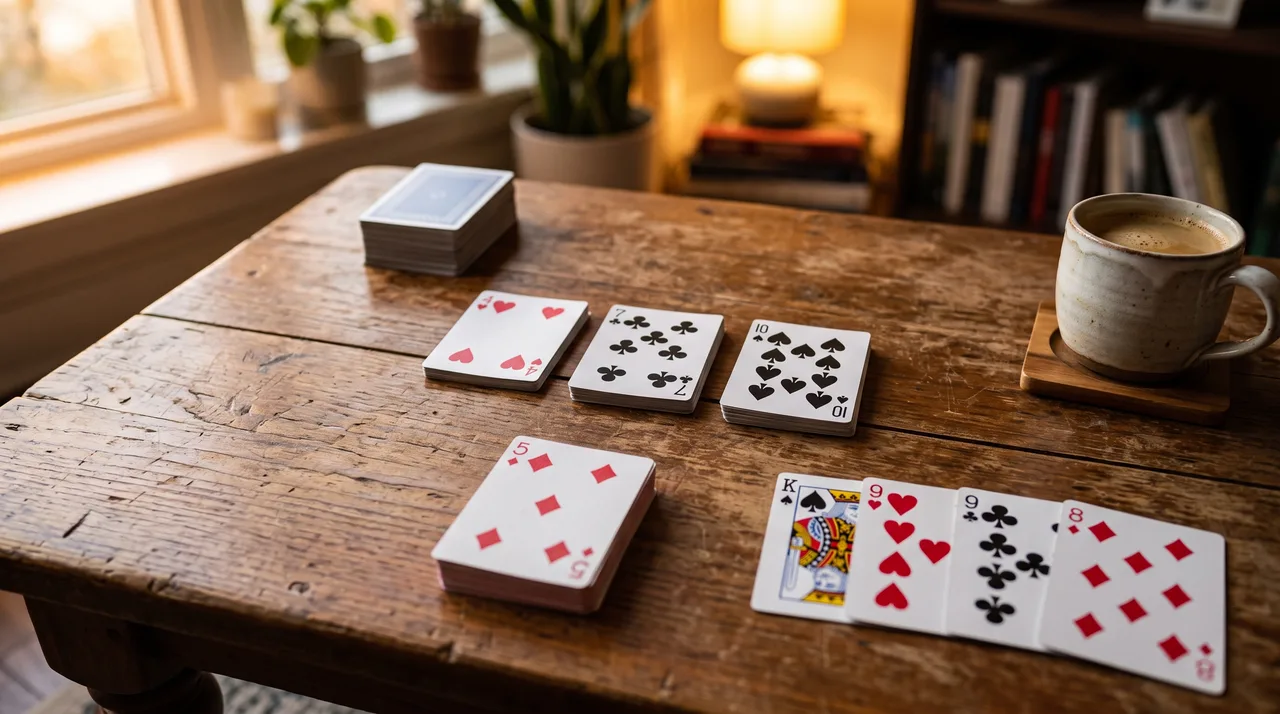
A game of Spite and Malice on a wooden table: three centre stacks showing the 4 of hearts, 7 of clubs and 10 of spades, a pay-off pile with the 5 of diamonds face up, side stacks topped by the King of spades, 9 of hearts, 9 of clubs and 8 of diamonds, and a face-down stock
The 5 of diamonds on top of the pay-off pile can go straight onto the 4.

Spite and Malice (also called Cat and Mouse) is a two-player card game in which both players race to empty a pay-off pile by building shared stacks in order from Ace to Queen, with Kings wild. It is a kind of competitive patience, played in turns rather than at speed. The game is American and first appears in print in the 1960s, and it is a reworking of the older game Russian Bank. Hasbro sells a boxed version under the same name, and Mattel’s Skip-Bo is another. This guide covers the Spite and Malice rules most people play, a full turn, the main variations, how it differs from Skip-Bo, strategy and odds.

Spite and Malice Rules at a Glance

Spite and Malice
PlayersTwo (versions for more players exist).
CardsTwo standard 52-card packs, shuffled together. Aces are low, Queens high, Kings wild; suits don’t matter.
Pay-off pile20 cards each, face down, with the top card turned face up.
HandFive cards, topped up at the start of every turn.
Centre stacksUp to three, shared, built from Ace up to Queen.
Side stacksUp to four of your own. Playing a card to one ends your turn.
WinningThe first player to play every card from their pay-off pile.

How to Set Up

  1. Shuffle two packs together. That gives 104 cards: eight each of Ace to Queen and eight wild Kings.
  2. Deal the pay-off piles. Deal 20 cards face down to each player and turn the top card of each pile face up.
  3. Deal the hands. Each player takes five cards. The rest of the cards go face down between you as the stock.
  4. Decide who starts. The player whose pay-off card is higher goes first. If they are equal, both reshuffle their pay-off piles and turn up a new card.

How to Play Spite and Malice

  1. Draw up to five. At the start of your turn, draw from the stock until you hold five cards.
  2. Build the centre stacks. Start a centre stack with an Ace and add the next card up, regardless of suit: a 6 on a 5, a Jack on a 10. Cards can come from your hand, the top of your pay-off pile or the top of any of your side stacks. When you play your pay-off card, turn up the next one.
  3. Use Kings as anything. A King played on a centre stack counts as the next card up.
  4. Five out, five more. If you play all five cards from your hand, draw five more and keep going.
  5. End with a side stack. When you’re done, put one card from your hand on one of your four side stacks, in any order. That ends your turn.

When a centre stack reaches a Queen it is complete: the other player shuffles it into the stock, which frees the space for a new stack. You can never put a pay-off card on a side stack, move cards between side stacks, or take cards back from the centre.
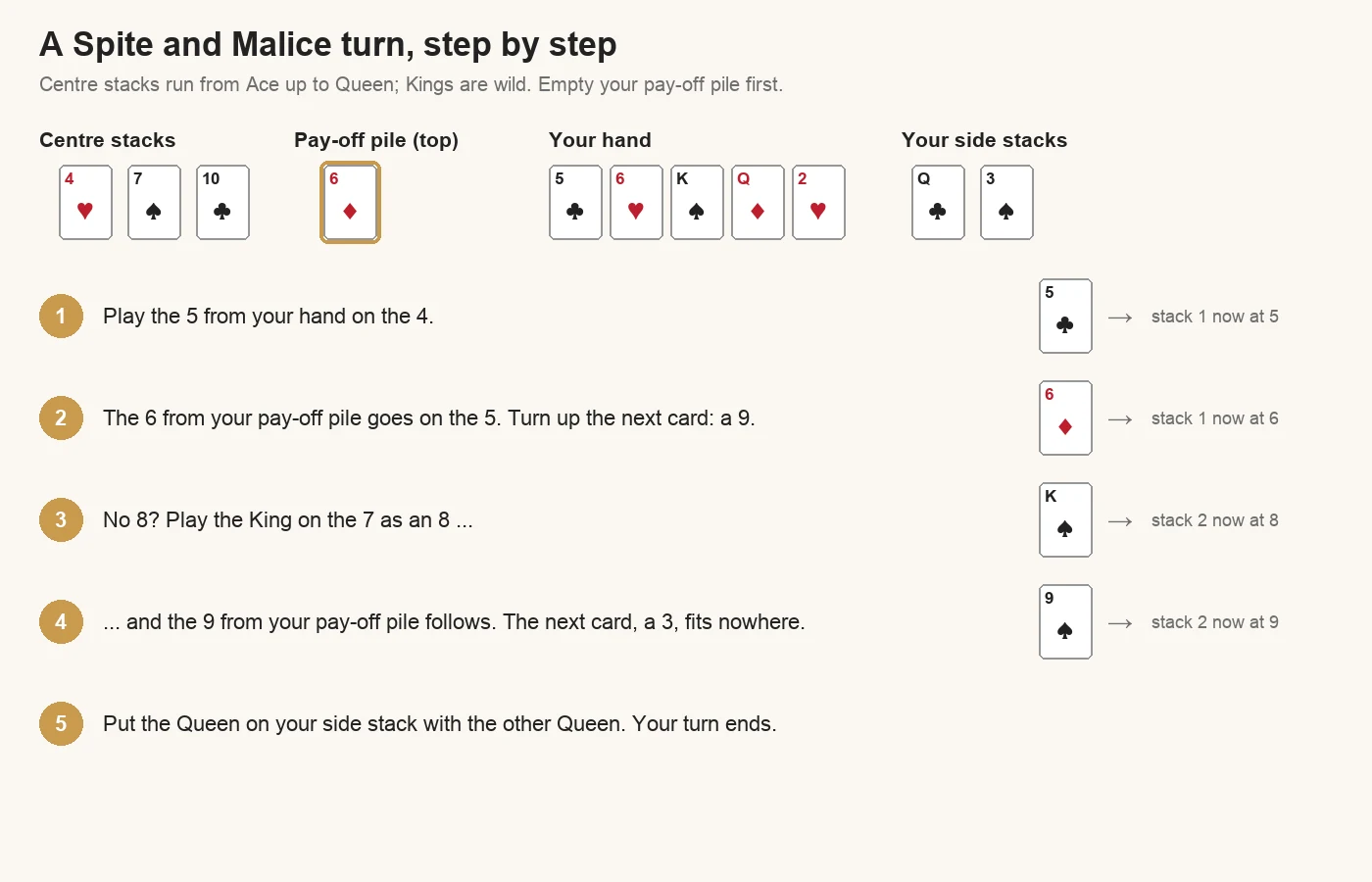
A Spite and Malice turn step by step: with centre stacks at 4, 7 and 10, a 6 on the pay-off pile and a hand of 5, 6, King, Queen and 2, the player plays the 5 and then the pay-off 6 on the 4, the King on the 7 as an 8, the next pay-off card, a 9, on top of it, then ends the turn by putting the Queen on a side stack
Two pay-off cards in one turn, with a King bridging the gap to the 9.

Winning, Draws and Scoring

The first player to play the last card of their pay-off pile wins. If the stock runs out first, the game is a draw; some players give the win to whoever has fewer pay-off cards left. To play a series, the winner scores 5 points plus 1 for every card left in the other player’s pay-off pile, and the first to an agreed target, such as 50, wins the match.

Spite and Malice Variations

There are many versions of the game, so agree on the rules before you start. The most common differences:

VariationWhat changes
Bigger pay-off piles26 cards each, or 13 for a quick game. Some groups use 21 or 25.
Four centre stacksUp to four centre stacks instead of three, or no limit at all.
Kings can’t be AcesA King can stand for any card except an Ace, so every centre stack must start with a real Ace.
Compulsory AcesAn Ace in your hand or on your pay-off pile must be played to the centre straight away.
JokersJokers are added as extra wild cards, or replace the Kings as the only wild cards.
More playersThree or more can play, with an extra pack or two; four or six can play in partnerships, using a partner’s pay-off pile and side stacks.
The “book” versionOlder card-game books deal 26-card pay-off piles from one pack and play from a second pack with jokers; side stacks must go down in order, and an Ace or 2 showing on a pay-off pile or side stack must be played at once.

Spite and Malice vs Skip-Bo

Spite and MaliceSkip-Bo
CardsTwo standard packs (104)A special pack of 162
Wild cards8 Kings18 Skip-Bo cards
Stacks runAce to Queen1 to 12
Pay-off / stock pile20 cards (two players)30 cards (two to four players)
Centre stacksUp to 3Up to 4
PlayersTwo, or more with variationsTwo to six

The idea is the same, which is why many players treat Skip-Bo as Spite and Malice with its own cards.
Spite and Malice Strategy

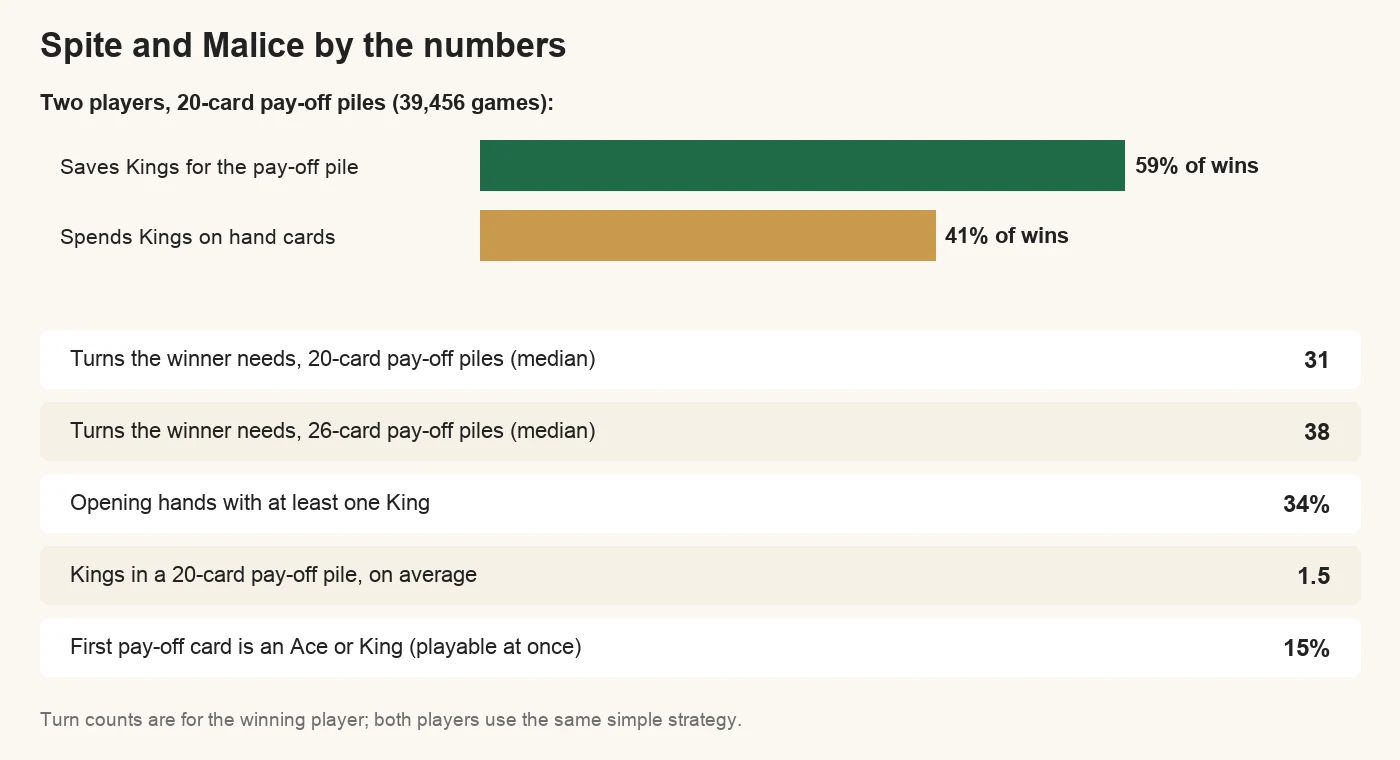
  • Save Kings for your pay-off pile. In 39,456 simulated two-player games, a player who used Kings only to reach their pay-off card won 59% of games against one who also used them to play out hand cards.
  • Watch the other player’s pay-off card. Try not to leave a centre stack one below it.
  • Stack your side stacks downwards. A 9 on a 10 on a Jack can later be played to the centre as a run.
  • Hold back when it helps you. You don’t have to play a card just because you can, especially if it sets up the other player.
  • Empty your hand when you can. Playing all five cards gives you five fresh ones in the same turn.
Spite and Malice by the numbers: with 20-card pay-off piles, a player who saves Kings for the pay-off pile wins 59% of games against one who spends them on hand cards; the winner needs a median of 31 turns, or 38 with 26-card piles; 34% of opening hands hold a King
Kings are scarce, with only eight in 104 cards, so spend them on your pay-off pile.

Spite and Malice Odds

  • Game length: with 20-card pay-off piles, the winner needs a median of 31 turns; with 26-card piles, 38.
  • Kings: only 8 of the 104 cards are wild, so 34% of opening hands hold one and a 20-card pay-off pile holds 1.5 on average.
  • A fast start: your first pay-off card is an Ace or a King, and can be played straight away, 15% of the time.

The game-length and strategy figures come from 40,000 simulated games per set-up, with both players following the same simple strategy.

More Card Games

Try Skip-Bo, the boxed version of the same game. For a fast two-player race played at the same time, see Spit, and for another game of building in order, Kings Corner.

Spite and Malice: frequently asked questions

How do you play Spite and Malice?

Each player has a pay-off pile and a five-card hand. On your turn, build the shared centre stacks from Ace up to Queen using your hand, your pay-off card and your side stacks, then end your turn by putting a card on one of your side stacks. The first to empty their pay-off pile wins.

Is Spite and Malice the same as Skip-Bo?

They are the same kind of game. Skip-Bo is a commercial version with its own 162-card pack, numbers 1 to 12 and 18 wild cards, while Spite and Malice uses two standard packs with Kings wild.

How many decks of cards do you need for Spite and Malice?

Two standard 52-card packs for two players. Groups playing with three or more players often add a third pack.

What is another name for Spite and Malice?

It is also called Cat and Mouse. Skip-Bo is a boxed version of the same idea.

How many cards are in the pay-off pile?

Usually 20 each. Some groups deal 26 for a longer game, or 13 for a quick one.

Are Kings wild in Spite and Malice?

Yes. A King can stand for any card on a centre stack. In some versions it cannot be used as an Ace, so every stack has to start with a real Ace.

What happens when a centre stack reaches a Queen?

It is complete. It is shuffled back into the stock, and the space can be used for a new stack.

What happens if the stock runs out in Spite and Malice?

The game is a draw. Some players instead give the win to whoever has fewer cards left in their pay-off pile.

Fadi Hayek
Author & Casino Expert

After going through several successful experiences with several industry pioneers, Fadi Hayek has managed to excel in the world of content for online gaming by providing unique content for several projects that allowed him to obtain the necessary experience to launch his career. Last but not least, Fadi also holds several certificates, including but not limited to content marketing and iGaming.

Latest News

Artificial Intelligence in Gambling – How It Is Changing the Future of the Industry

As online casinos adopt machine learning models and artificial intelligence in gambling becomes the next disruption, you don’t want to be left behind. Read on to learn about the impact AI will have on the future of the gambling industry.

Arabian Football Betting Trends – Stay Current on Betting Preferences in the Middle East!

Keep abreast of the latest Arabian football betting trends with the Arabian sports betting insights below. This guide covers the most popular bet types with Arab bettors and the top bookmakers for Arabian and global football competitions.

Al-Nassr vs PSG | Cristiano Ronaldo vs Lionel Messi

The biggest event in world football is scheduled to take place later this month as Al Nassr vs PSG is on the cards.

Yggdrasil Collaborate with Reflex to Release Dublin Up DoubleMax

Yggdrasil and Reflex are set to launch Dublin Up DoubleMax, an Irish-style video, as one of their latest releases. The slot game is designed by incorporating Yggdrasil’s proprietary Game Engagement Mechanic (GEM) DoubleMax coupled with unique features like free spins bonus and fairy magic.