Skip-Bo Rules
Build from 1 to 12 and be the first to empty your stock pile: how to play Skip-Bo, step by step.


Build from 1 to 12 and be the first to empty your stock pile: how to play Skip-Bo, step by step.
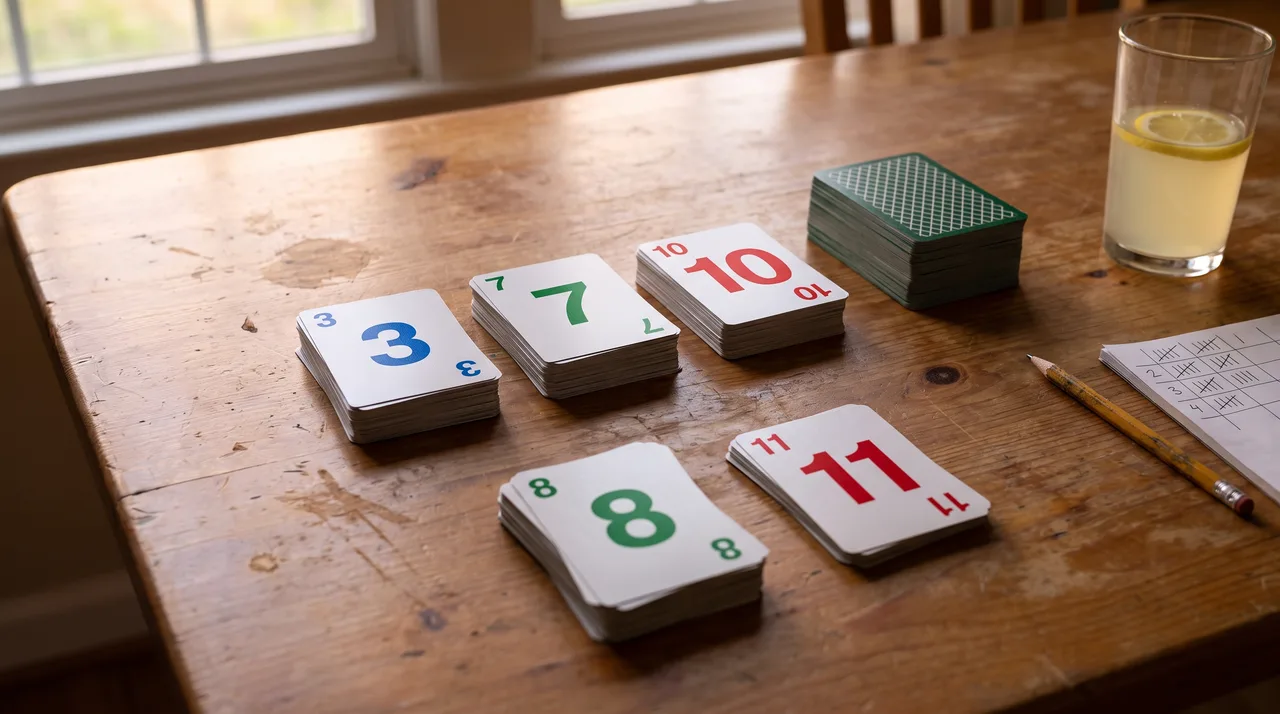
Skip-Bo is a card game for two to six players in which you race to get rid of your stock pile by building shared piles in order from 1 to 12. It is a boxed version of the traditional game Spite and Malice. Minnie Hazel “Skip” Bowman of Brownfield, Texas, began producing a boxed edition under the name Skip-Bo in 1967; International Games bought it in 1980, and Mattel bought International Games in 1992. This guide covers the Skip-Bo rules step by step: the cards, the set-up, a full turn, the three kinds of pile, winning and scoring, partnerships, playing with ordinary cards, strategy and odds.
| Skip-Bo | |
|---|---|
| Players | Two to six, ages 7 and up; partnerships possible. |
| Cards | 162: twelve of each number from 1 to 12, plus 18 wild Skip-Bo cards. |
| Stock pile | 30 cards each with two to four players, 20 each with five or more. |
| Hand | Five cards, topped up at the start of every turn. |
| Building piles | Up to four in the middle, shared by everyone, built from 1 up to 12. |
| Discard piles | Up to four of your own. Any card can go on any of them. |
| Winning | The first player to play every card in their stock pile. |
A Skip-Bo pack has 162 cards: twelve each of the numbers 1 to 12, and 18 Skip-Bo cards, which are wild and can be played as any number. The numbers are printed in blue (1 to 4), green (5 to 8) and red (9 to 12), but the colours make no difference to play. Remove any blank cards from a new pack; they are not used.
The youngest player goes first, then play moves on to the next player. On your turn:
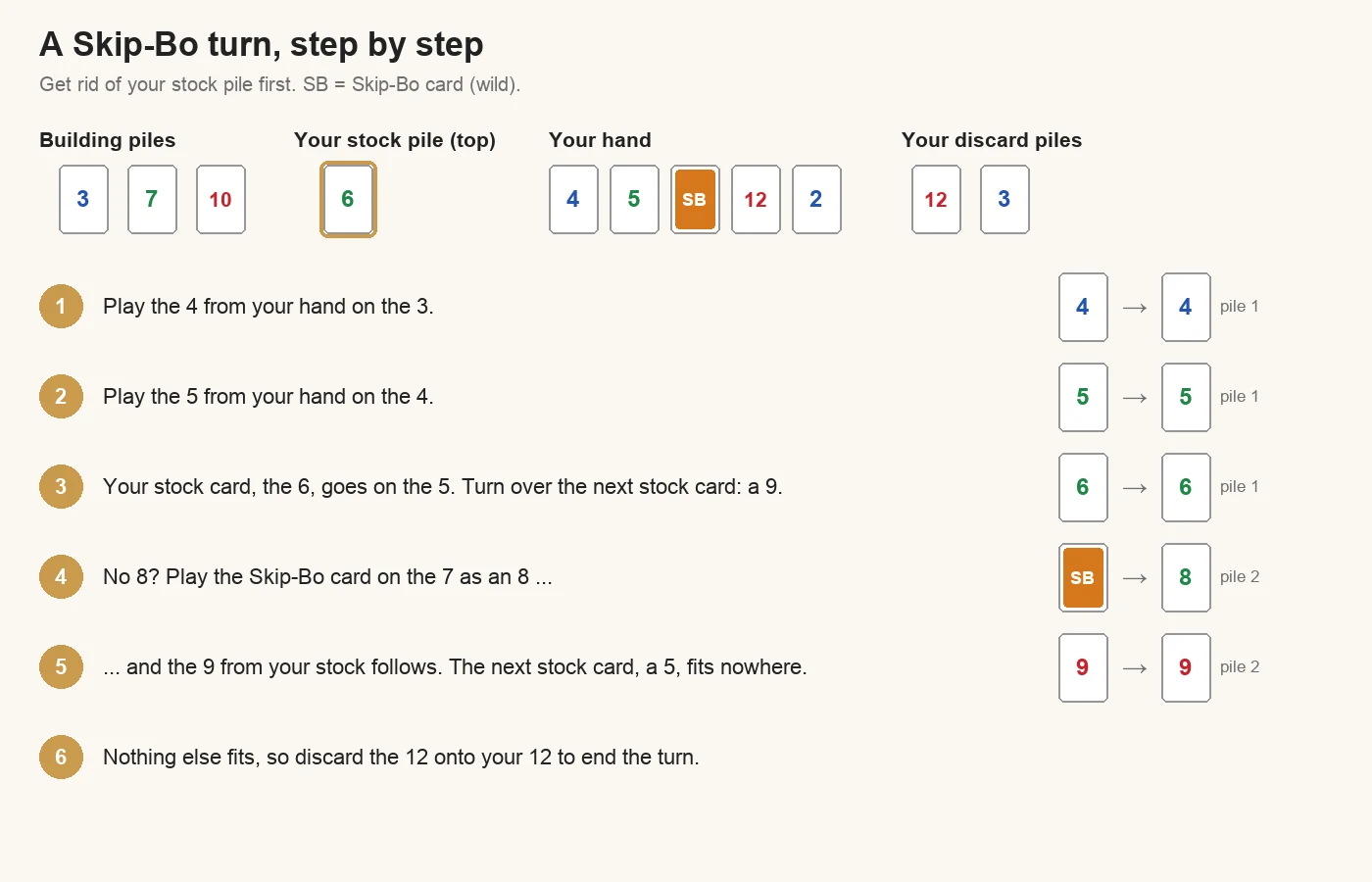
Building piles are shared. A new one must start with a 1 or a Skip-Bo card, and cards go on in order: on a 4 you can play a 5 or a Skip-Bo card, then a 6, and so on. When a pile reaches 12 it is complete and set aside, which frees the space for a new pile. There can never be more than four building piles; if all four are in use, a 1 has to wait. If the draw pile runs out, shuffle the completed building piles to make a new one.
Your stock pile is the one you are trying to empty, so playing its top card should always come first. Only the face-up top card can be played.
Your discard piles belong to you alone. You can put any card on any of your four piles, in any order, but only the top card of each can be played later.
The first player to play the last card from their stock pile wins the game. To play a longer match, the winner of each game scores 25 points plus 5 points for every card left in the other players’ stock piles, and the first player to reach 500 points wins.
| Variation | How it works |
|---|---|
| Short game | Deal stock piles of only 10 cards each. |
| Partnerships | You can play from your own and your partner’s stock and discard piles, but partners may not talk about moves. A partnership wins when both stock piles are empty. |
| Regular cards | Play with three standard packs including their Jokers (see below). |
Three standard 52-card packs with their two Jokers each make a full Skip-Bo pack. Aces count as 1, cards 2 to 10 as their number, Jacks as 11 and Queens as 12; the 12 Kings and 6 Jokers are the wild Skip-Bo cards. That gives twelve of each number and 18 wild cards, 162 in all, and the suits play no part.
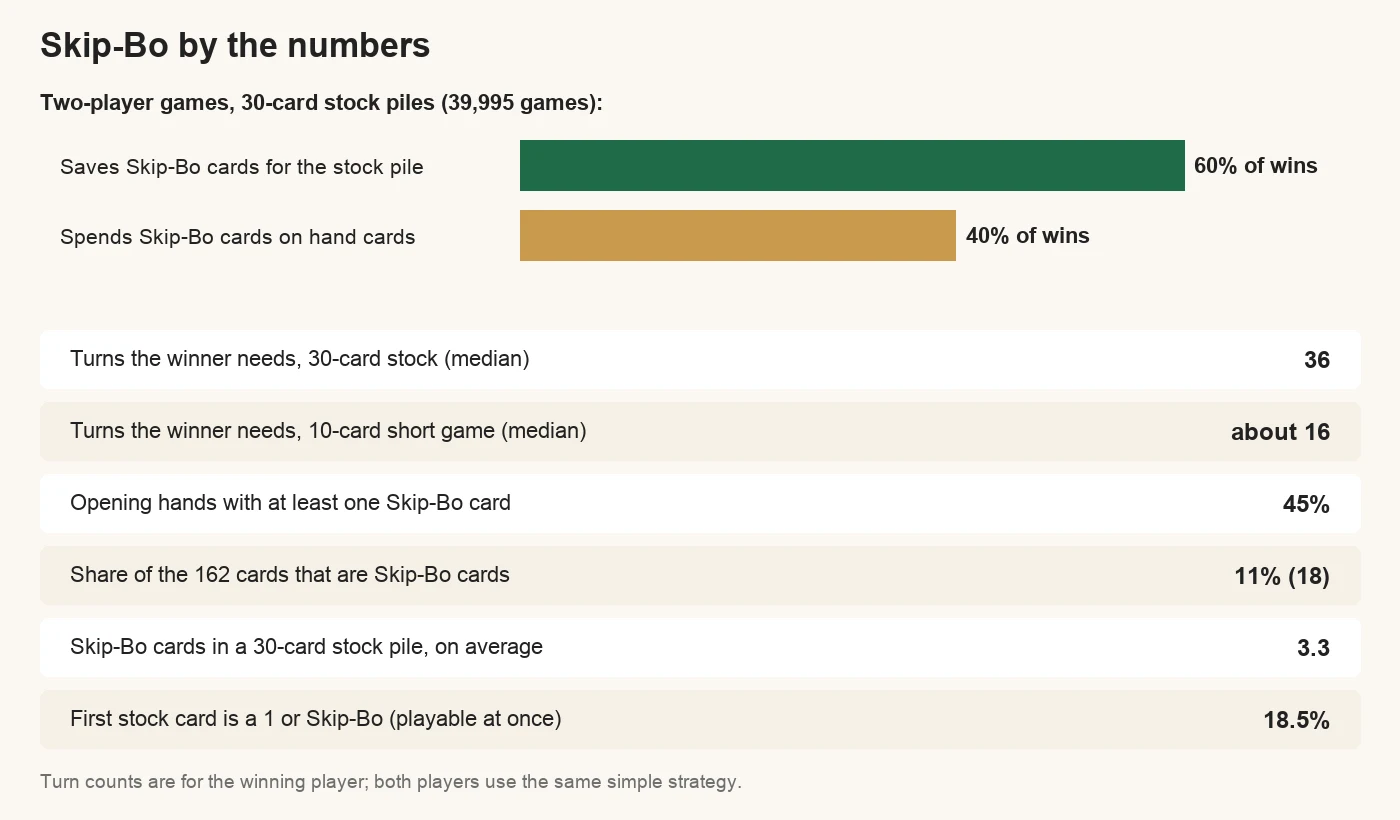
The game-length and strategy figures come from 40,000 simulated games per set-up, with both players following the same simple strategy.
If you like Skip-Bo, try Phase 10, which works through ten combinations instead of one long run. For a fast two-player race, see Spit, and for a patience-style family game, Kings Corner.
A family board game with cards: Sorry!, with every card explained.

After going through several successful experiences with several industry pioneers, Fadi Hayek has managed to excel in the world of content for online gaming by providing unique content for several projects that allowed him to obtain the necessary experience to launch his career. Last but not least, Fadi also holds several certificates, including but not limited to content marketing and iGaming.


