No turns, no waiting: race your opponent to get rid of your cards. How to play Spit (Speed), with variations and tips.
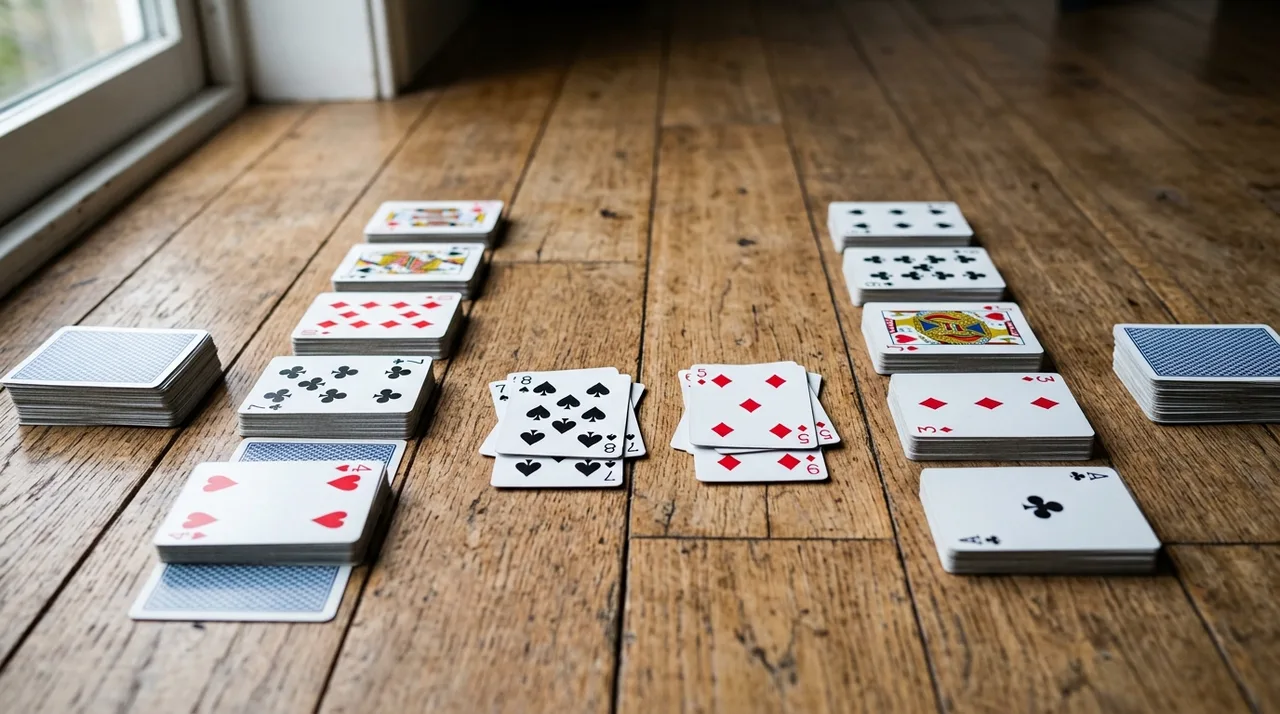
Two spit piles in the middle: any card one higher or one lower goes on top.
Spit is a fast two-player card game in which nobody takes turns. Both players play at once, as fast as they can, putting cards one higher or one lower onto two piles in the middle, and the first to get rid of all their cards wins. In the United States it is usually called Speed (some call it Slam), although strictly Speed is a close cousin played from a five-card hand. This guide covers the Spit card game rules, the Speed version, the common variations and what the odds say about your opening position.
Spit Rules at a Glance
Spit
Players
Two.
Cards
One standard 52-card pack, no Jokers: 26 cards each.
Layout
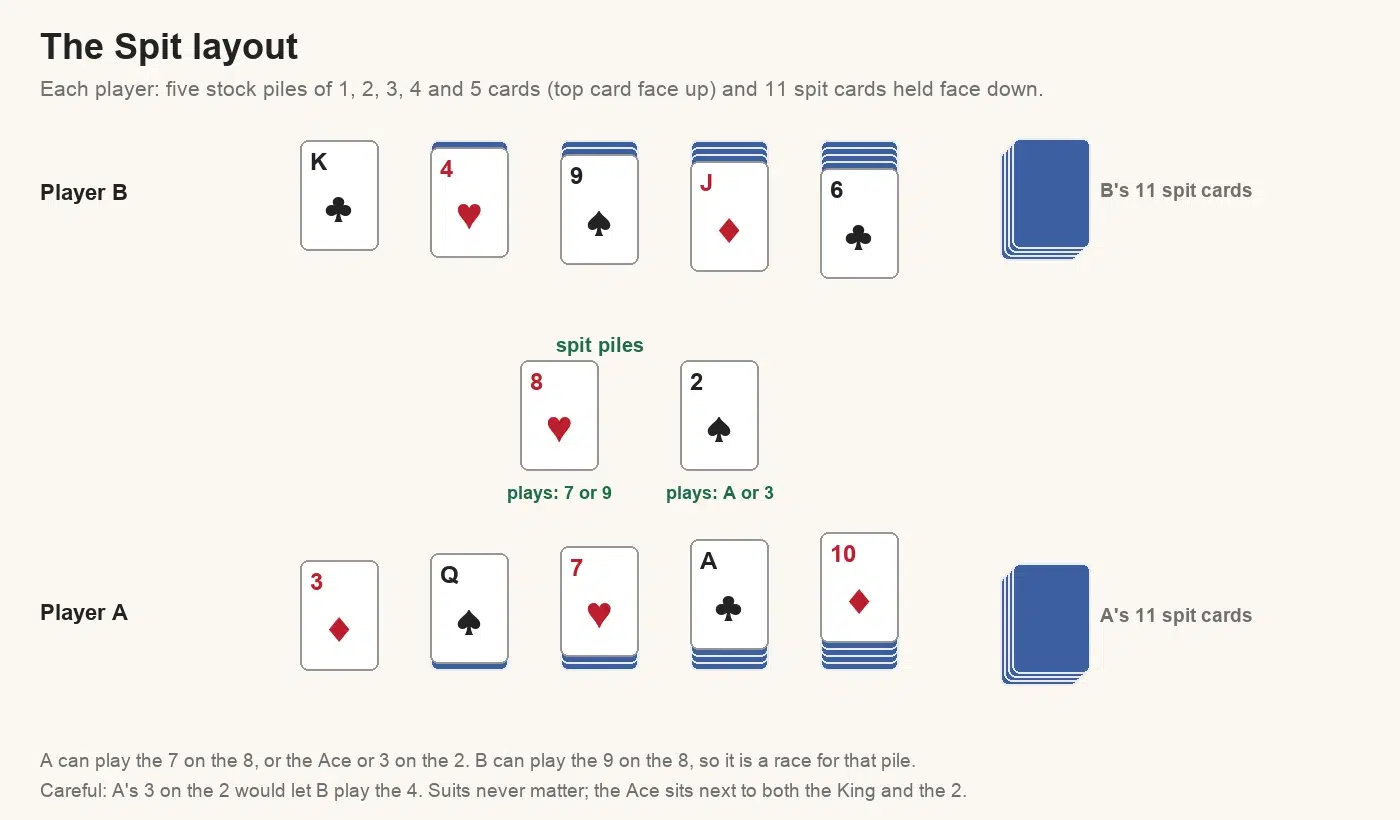
Five stock piles of 1, 2, 3, 4 and 5 cards, top card face up. Your other 11 cards are your spit cards.
Start
Both shout “Spit!” and turn a spit card into the middle, making two spit piles.
Play
No turns. Play any face-up card that is one higher or one lower than the top of either spit pile. Suits do not matter; the Ace goes on a King or a 2.
Stuck
When neither player can move, both spit again.
Round ends
When someone empties their stock piles: both slap the smaller spit pile, and that pile becomes your cards for the next round.
Winner
The first player to get rid of every card.
How to Set Up Spit
Split the pack. Shuffle and give each player 26 cards.
Deal your stock piles. In a row in front of you, deal five piles face down: one card, two cards, three, four and five – 15 cards in all. Turn the top card of each pile face up.
Keep your spit cards. The 11 cards left over are your spit cards. Hold them face down (or keep them in a pile by your hand) and don’t look at them.
The layout, with the moves available after the first spit.
How to Play Spit
Spit! When you are both ready, shout “Spit!” together and each turn your top spit card face up into the middle, side by side. These are the two spit piles.
Play fast. Using one hand and moving one card at a time, play any face-up card from your stock piles onto either spit pile if it is one higher or one lower. On a 7 you can play a 6 or an 8; on an Ace, a King or a 2.
Turn up the next card. When you play the top card of a stock pile, turn the card under it face up.
Fill a gap. If one of your five piles is empty, you may move a face-up card from another pile into the space, then turn up the card beneath it. You can never have more than five piles.
First touch wins. A card counts as played as soon as it touches the pile. If you both go for the same pile, whoever gets there first keeps the play and the other takes their card back.
Stuck? Spit again. When neither of you can play, shout “Spit!” again and each turn a new spit card onto your spit pile.
Slap the smaller pile. As soon as one player has played every card from their stock piles, both players slap the spit pile they think is smaller. The quicker hand gets that pile; the other player takes the other pile plus any cards left in their own layout.
Deal again. Each player shuffles their cards with any spit cards they still hold and deals a new layout. The player who won the slap usually has fewer cards to get rid of.
Win. With fewer than 15 cards you can’t build a full layout: deal what you can into your five piles and stop spitting, so play goes on with a single spit pile. If you clear your layout first while you have no spit cards left, you have no cards at all and win the game.
Speed: the Five-Card-Hand Version
In Speed, you play from a hidden hand instead of a row of piles. Deal two face-down piles of ten spit cards at the ends of the middle row, with two single cards between them, and give each player a face-down stock of 15 cards. Each player picks up five cards from their stock. Turn the two middle cards face up at the same moment, then race to play one-higher or one-lower cards from your hand, drawing back up to five as you go. When neither player can move, turn a new card from each end pile onto the middle piles. When your stock and hand are both empty you win the deal and score one point for every card your opponent still holds; first to an agreed total, such as 25, wins.
Spit Variations
Variation
What changes
Four stock piles
Deal piles of 1, 2, 3 and 4 cards instead of five piles.
Long middle pile
Deal eleven cards to the middle stock pile and one card to each of the other four.
Canfield layout
Four single face-up cards and one stack of ten face down with one face up on top.
Stacking equal ranks
If two of your face-up stock cards match (two nines, say), put one on the other to free up a face-down card or make a space.
Alternate colours
Cards played on a spit pile must alternate red and black: on a black 5, only a red 4 or a red 6.
No slapping
The first player to clear their layout simply picks the smaller pile; if play is blocked, the player with fewer stock cards picks.
Two hands
Some players agree to allow both hands. Agree before you start.
Jokers (Speed)
In Speed, Jokers can be added as wild cards.
Spit Odds: Your Opening Position
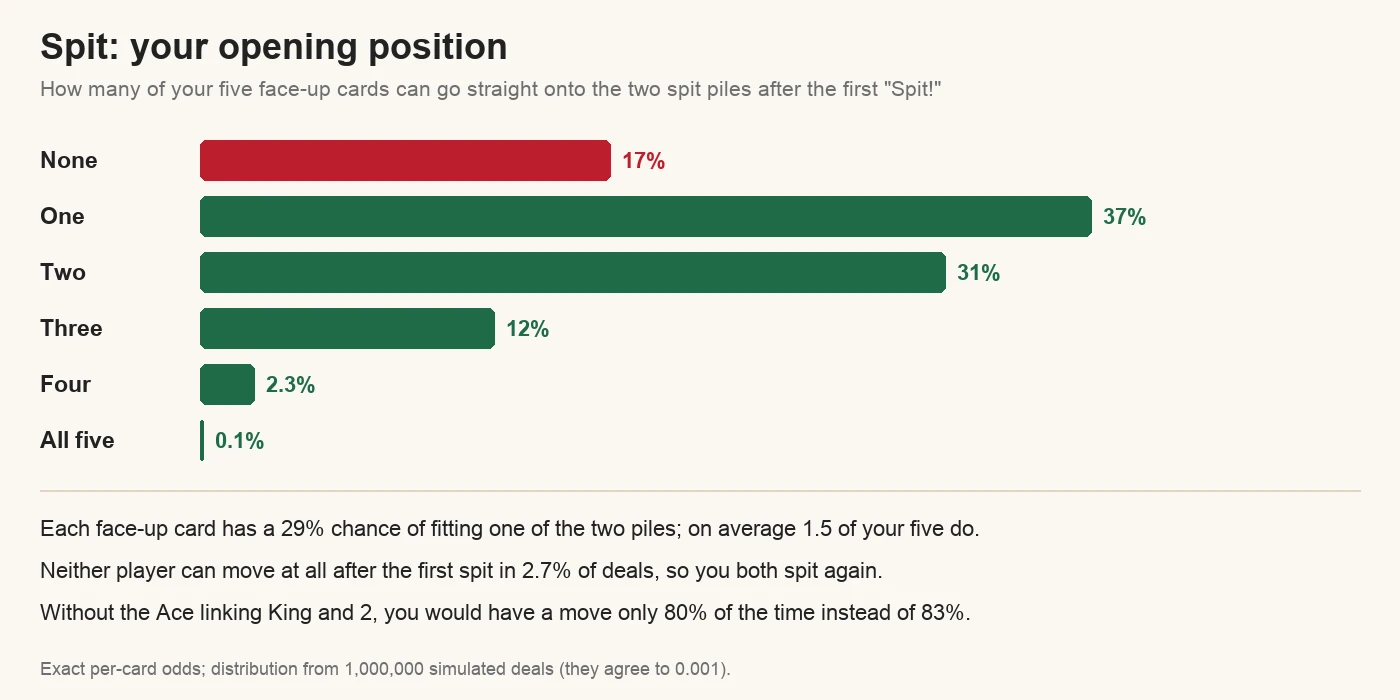
Spit is a game of speed, but the deal still decides how fast you can start. Your five face-up cards and the two spit cards are a random seven cards from the pack:
How many of your five cards fit the first two spit piles.
You usually have a move straight away: 83% of the time at least one of your five face-up cards fits a spit pile, and 46% of the time two or more do.
Each card has a 29% chance of fitting one of the two piles, so on average 1.5 of your five can go at once. Against a single pile, any card fits only 15.7% of the time – which is why play speeds up so much when there are two piles to aim at.
A dead start is rare. Neither player can move after the first spit in 2.7% of deals.
The Ace matters. Because the Ace links the King and the 2, you have an opening move 83% of the time; without that rule it would be 80%.
Tips for winning at Spit
Don’t feed your opponent. Before playing a card, check whether it lets them play next. In the layout above, Player A’s 3 on the 2 would hand Player B a home for their 4.
Watch both piles at once. Most lost plays come from staring at one pile while the other changes.
Turn up face-down cards early. Every new face-up card is another chance to play, and the face-down cards in your bigger piles are the slowest to clear.
Use your spaces. Moving a face-up card into an empty space uncovers a new card. Do it as soon as a space appears.
Look before you slap. The smaller spit pile is your next round’s cards. A quick glance at both is worth more than slapping first and taking the bigger one.
Play on the floor. Cards fly in Spit. An old pack and plenty of space save arguments.
Where Spit Comes From
Spit is a children’s game passed from player to player rather than written down, and no one knows who invented it. One of the first written descriptions is in Margie Golick’s 1973 book Deal Me In!, which called it a game that seems more familiar to children than to adults and a good one for learning quick responses. It belongs to the family of competitive patience games – solitaire played as a race.
Another game of fast hands:Snap, where the first to spot two matching cards and shout wins the piles.
Like building down in alternating colours? Try Kings Corner, the slower, take-turns cousin of solitaire.
Like racing to empty a pile? Try Skip-Bo, built on the same idea for two to six players.
Rather take turns than race? Try Spite and Malice, a two-player game of building from Ace to Queen.
Spit for more than two players:Nertz, where everyone races to empty their own pile onto shared foundations.
Spit card game: frequently asked questions
How do you play the card game Spit?
Each player gets 26 cards and deals five stock piles of one to five cards, top cards face up. Both shout Spit and turn a card into the middle to make two piles, then race to play cards one higher or one lower onto either pile. When someone clears their stock piles, both slap the smaller pile, which becomes their cards for the next round. The first player to get rid of all their cards wins.
Is Spit the same as Speed?
Almost. Many people use the names for the same game. Strictly, in Spit you play from a row of five face-up stock piles, while in Speed you play from a hidden hand of five cards and draw from a face-down stock.
How many cards do you deal in Spit?
26 each. Fifteen go into your five stock piles of 1, 2, 3, 4 and 5 cards, and the other 11 are your spit cards.
Can you play an Ace on a King in Spit?
Yes. The Ace counts as next to both the King and the 2, so it can go on either, and either can go on an Ace.
What happens when nobody can play in Spit?
Both players shout Spit again and turn a new spit card onto their spit pile, then carry on playing.
Do suits matter in Spit?
No. Only the rank matters: a card can go on any card one higher or one lower. Some players add a rule that colours must alternate.
How do you win Spit?
Get rid of all your cards. Each time you clear your stock piles first and slap the smaller spit pile, you start the next round with fewer cards. Once you have no spit cards left and clear your layout, you win.
Can you use two hands in Spit?
Usually not: the standard rule is one hand, one card at a time. Some players allow two hands, so agree before you start.
Fadi Hayek
Author & Casino Expert
After going through several successful experiences with several industry pioneers, Fadi Hayek has managed to excel in the world of content for online gaming by providing unique content for several projects that allowed him to obtain the necessary experience to launch his career. Last but not least, Fadi also holds several certificates, including but not limited to content marketing and iGaming.
As online casinos adopt machine learning models and artificial intelligence in gambling becomes the next disruption, you don’t want to be left behind. Read on to learn about the impact AI will have on the future of the gambling industry.
Keep abreast of the latest Arabian football betting trends with the Arabian sports betting insights below. This guide covers the most popular bet types with Arab bettors and the top bookmakers for Arabian and global football competitions.
Yggdrasil and Reflex are set to launch Dublin Up DoubleMax, an Irish-style video, as one of their latest releases. The slot game is designed by incorporating Yggdrasil’s proprietary Game Engagement Mechanic (GEM) DoubleMax coupled with unique features like free spins bonus and fairy magic.