Mancala Rules
Sow your stones around the board, land in your store for a free turn and in an empty pit to capture: how to play mancala, and how to win.


Sow your stones around the board, land in your store for a free turn and in an empty pit to capture: how to play mancala, and how to win.
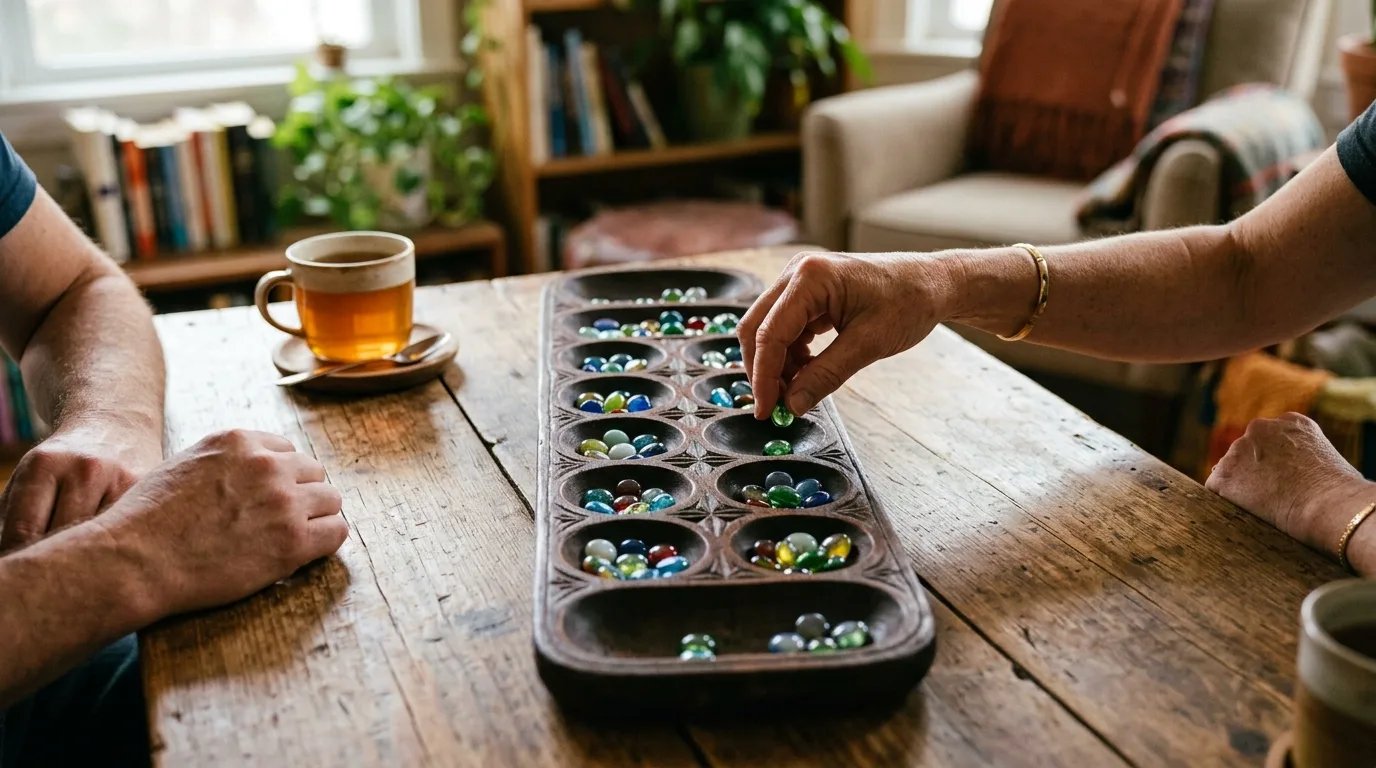
Mancala is a two-player board game of sowing and capturing stones. Players take turns scooping up the stones from one pit and dropping them one at a time around the board, trying to end in their own store for a free turn or in an empty pit to capture. There are no dice and nothing is hidden, so every game is decided by the moves. The name covers a whole family of games played across Africa, the Middle East and Asia; the version sold in most boxed sets in the US and UK is Kalah, and that is the one these mancala rules describe, followed by the main variations and the strategy that wins games.
| Mancala (Kalah) | |
|---|---|
| Players | Two. |
| Board | Two rows of six pits, with a large store at each end. Your pits are the row nearest you and your store is on your right. |
| Stones | 48: four in each pit to start. Colour doesn’t matter. |
| Direction | Counter-clockwise, one stone per pit, skipping your opponent’s store. |
| Free turn | If your last stone lands in your own store, you go again. |
| Capture | If your last stone lands in an empty pit on your side, take it and the stones in the pit directly opposite. |
| End | When one player’s six pits are all empty. |
| Winning | Most stones in your store. With 48 stones, 25 is a guaranteed win. |
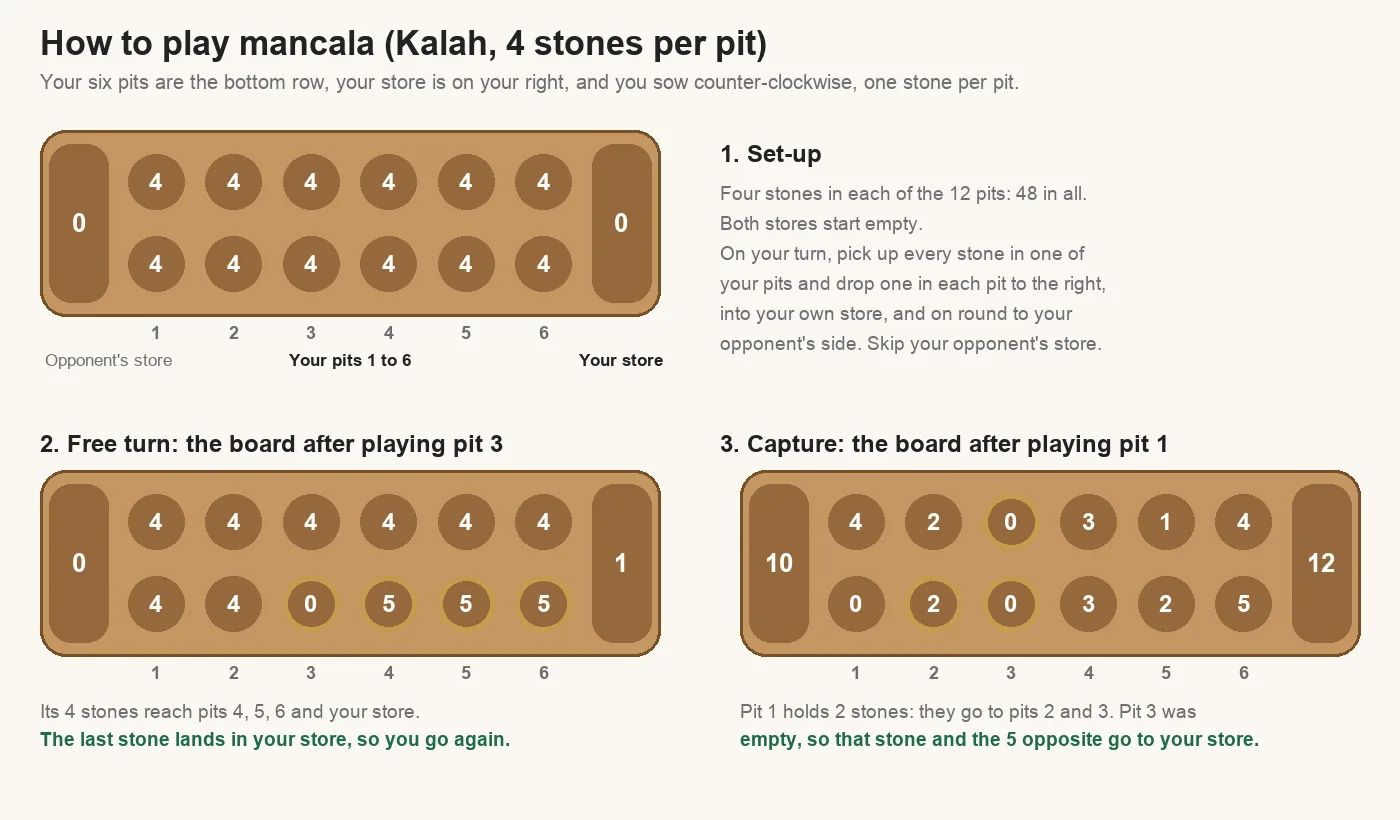
At the start every pit holds four stones. Count your pits 1 to 6 from your left. If you play pit 3, its four stones go into pits 4, 5 and 6 and the last one into your store, so you get a free turn. It is the only opening move that does.
Later in the game, suppose your pit 1 holds two stones and your pit 3 is empty, with five stones in the pit across from it. Playing pit 1 drops a stone in pit 2 and the last one in empty pit 3. That is a capture: the stone in pit 3 and the five opposite go to your store, six in all.
Mancala sets often come with slightly different instructions, so agree on these before you start:
| Variation | How it works |
|---|---|
| Empty capture | You capture your last stone even when the pit opposite is empty. A common variant, and the one used in most computer analysis of the game. |
| Stones left at the end | In the standard rule the player who still has stones keeps them. Some sets give them to the player who emptied their side, and some don’t count them at all. |
| Three, five or six stones | Three stones per pit makes a shorter game for beginners or children; five or six make a longer, deeper one. Some teachers start young players on two. |
| Clockwise sowing | Some groups sow to the left instead, which takes more stones to reach the store. |
| No captures or free turns | A simpler game for young children: just sow, and count the stores at the end. |
Kalah is a modern version, but mancala games are played under many names around the world:
| Game | Where | How it differs |
|---|---|---|
| Oware (Awari, Wari) | West Africa and the Caribbean | No stores in play: you capture from your opponent’s pits when your last stone makes a count of exactly two or three, plus any run of two-or-three pits behind it. 25 stones wins, and you must leave your opponent stones to play. |
| Sungka and Congkak | The Philippines, Malaysia, Indonesia, Singapore and Brunei | Usually seven pits a side, sown clockwise, and both players move at the same time on the first turn. |
| Bao | East Africa | Four rows of eight pits, and known as one of the most complex games in the family. |
| Pallanguzhi | Tamil Nadu, India | Seven pits a side; a turn continues with the stones in the pit after the last one sown. |
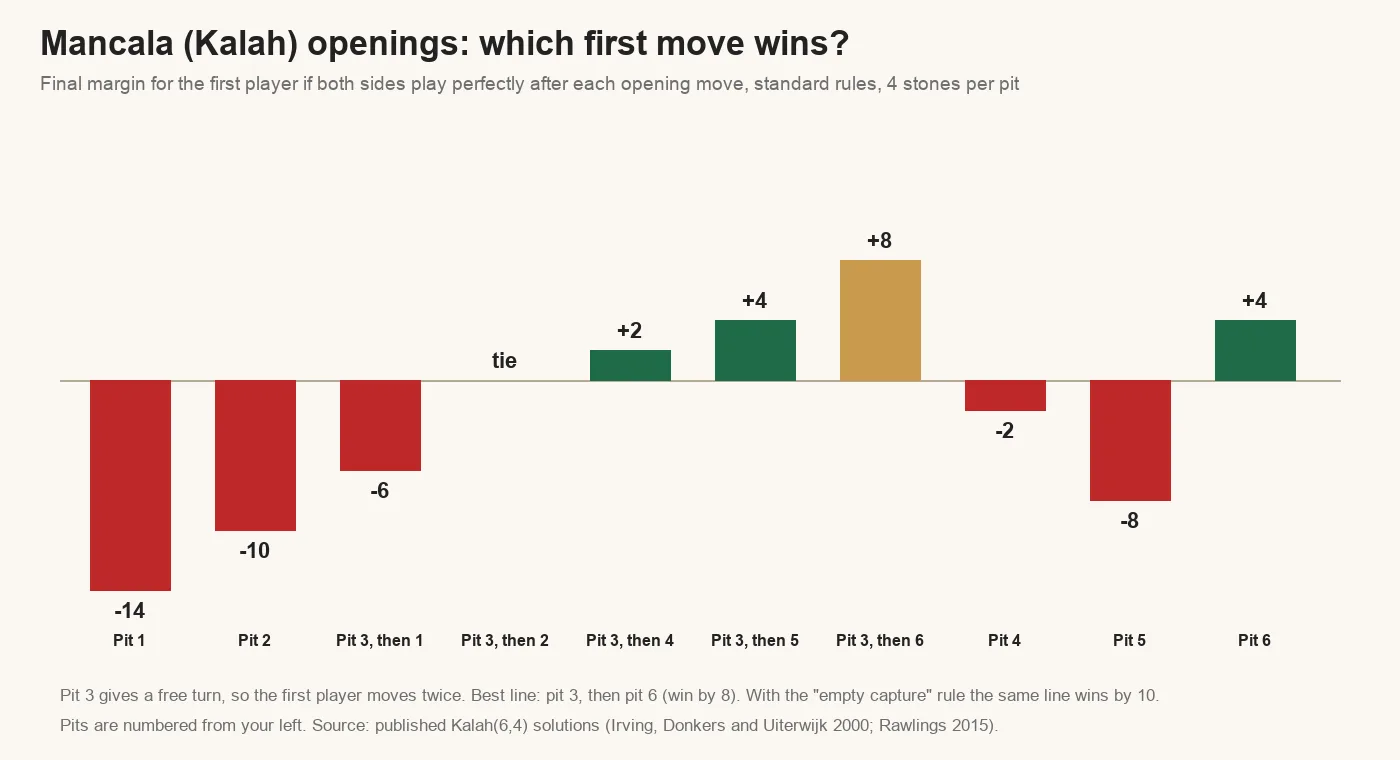
Yes. Kalah with six pits and four stones has been solved by computer: with perfect play the first player wins by 8 stones, or by 10 under the empty-capture rule (Irving, Donkers and Uiterwijk proved the empty-capture result in 2000, and Mark Rawlings worked out every opening in 2015). Pit 3 gives the first player a second move at once, so there are ten possible openings:
| Opening | Standard rules | Empty capture |
|---|---|---|
| Pit 1 | lose by 14 | lose by 14 |
| Pit 2 | lose by 10 | lose by 8 |
| Pit 3, then pit 1 | lose by 6 | lose by 8 |
| Pit 3, then pit 2 | tie | lose by 2 |
| Pit 3, then pit 4 | win by 2 | win by 2 |
| Pit 3, then pit 5 | win by 4 | win by 4 |
| Pit 3, then pit 6 | win by 8 | win by 10 |
| Pit 4 | lose by 2 | lose by 2 |
| Pit 5 | lose by 8 | lose by 6 |
| Pit 6 | win by 4 | win by 4 |
Between real players the edge is far smaller. In 100,000 simulated games between two players who move at random, the first player won 48%, the second 45%, and 6% were draws. Simple rules matter far more than going first: a player who always takes a free turn when one is there, and otherwise the move that puts the most stones in the store, beat a random opponent 99% of the time going first and 98% going second. Drop the free-turn rule and keep only “biggest gain”, and those figures fall to 97% and 94%.
The word comes from the Arabic manqala, from the root naqala, “to move”. Mancala boards cut in stone and pottery have been found at Roman-era sites in Israel from the 2nd and 3rd centuries AD and in the Aksumite towns of Eritrea and Ethiopia, and the game is mentioned in the 10th-century Arabic Book of Songs. Kalah itself is American: William Julius Champion Jr. patented and sold his board in the mid-20th century, and it is now the best-known mancala game in the West. It was also one of the first games played by computer, on a PDP-1 in the early 1960s.
For another game of counting and planning for two, try backgammon or checkers, and for up to six players, Chinese checkers. For tiles rather than stones, see the dominoes guide and Mexican Train, and for dice, Farkle.
The Filipino version: Sungka, played with seven holes a side, 98 shells and moves that keep going round the board.

After going through several successful experiences with several industry pioneers, Fadi Hayek has managed to excel in the world of content for online gaming by providing unique content for several projects that allowed him to obtain the necessary experience to launch his career. Last but not least, Fadi also holds several certificates, including but not limited to content marketing and iGaming.


