Tambola (Housie)
The rules of the 90-ball party game played across India, every prize explained, and a free number caller with tickets you can use right now.


The rules of the 90-ball party game played across India, every prize explained, and a free number caller with tickets you can use right now.
Tambola, also called housie, is the 90-ball number game played at Indian kitty parties, family reunions and office events. Everyone holds a ticket of 15 numbers, a caller draws the numbers from 1 to 90 one at a time, and the first players to complete set patterns, from Early Five to the Full House, win the prizes. Outside India the same game is known as 90-ball bingo, and in Britain it was traditionally called housey-housey.
This page has a free tambola number caller and ticket generator you can use right here, followed by the full rules: how a ticket is laid out, how a game runs, every standard prize, how claims and bogeys work, and how many calls each prize usually takes.
| Tambola (housie) | |
|---|---|
| Numbers | 1 to 90, each called once |
| Ticket | 3 rows × 9 columns: 15 numbers, 5 in every row |
| Standard prizes | Early Five, Top Line, Middle Line, Bottom Line, Four Corners, Full House |
| Players | Any number; one caller runs the game |
| Winning | First valid claim for each prize |
| Wrong claim | A “bogey”: the ticket is usually cancelled |
| Game ends | When the Full House is won, or all 90 numbers are called |
This free tambola number generator draws the numbers 1 to 90 at random, each one only once. Use it as the caller for a game at home, or play a round by yourself. Press Call next number for each draw, or Auto-call to draw a number every four seconds. The board shows every number called so far. Pick 1, 2, 3 or 6 tickets; numbers are marked on them automatically, and each prize lights up as soon as a ticket completes it. New game clears the board and keeps the same tickets.
Hosting a party with real tickets? Put the caller on a laptop or a TV so everyone can see the board: it settles “was 16 called or 60?” arguments instantly.
A tambola ticket has 27 boxes in 3 rows and 9 columns. Each row holds 5 numbers and 4 blanks, so a ticket carries 15 numbers in all. The columns are fixed by tens: the first column holds 1 to 9, the second 10 to 19, the third 20 to 29, and so on to the last column, which holds 80 to 90. Each column holds up to three numbers.
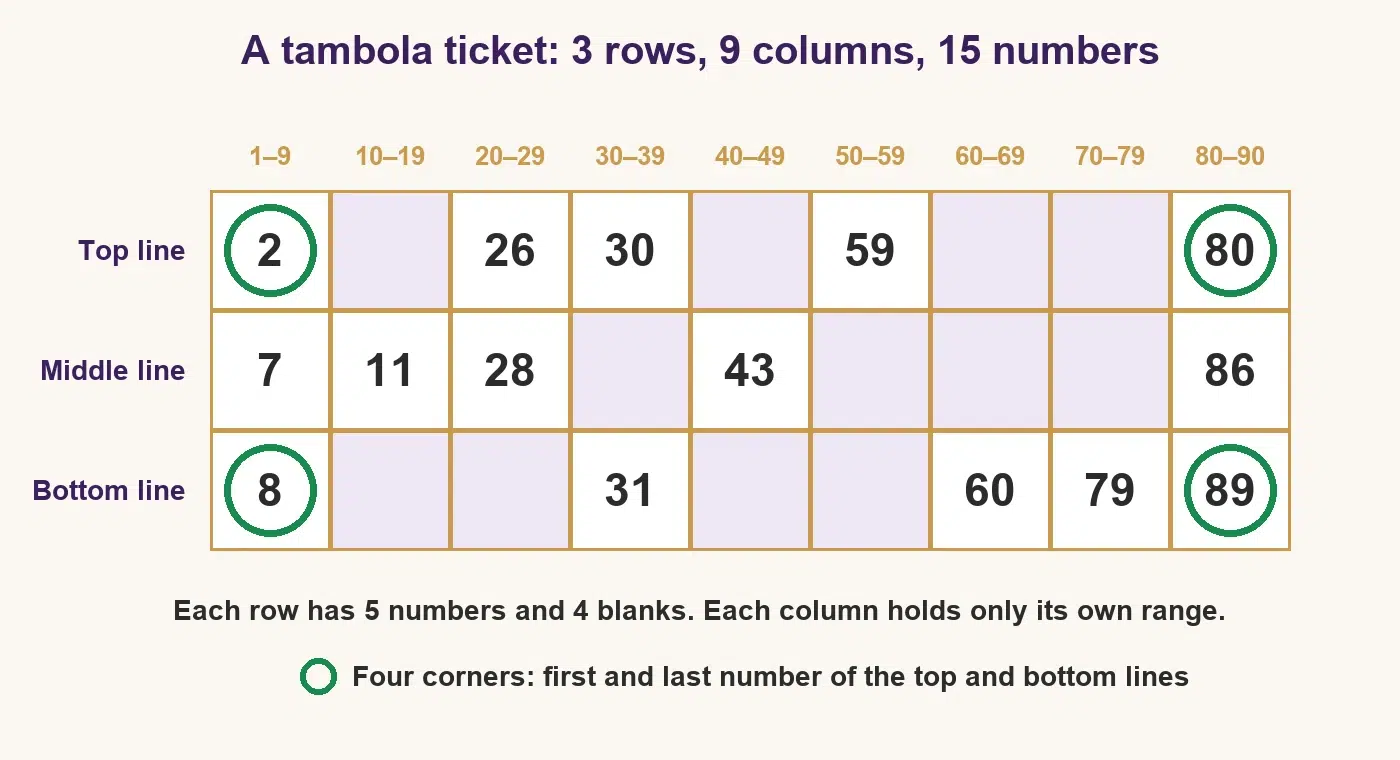
Some printed books shift the ranges by one, with 1 to 10 in the first column and 81 to 90 in the last; the game plays the same either way. Tickets are often printed in strips of six that between them contain every number from 1 to 90 exactly once, so a player with a full strip marks a number on every call. To print full strips for a party, use our tambola ticket generator: numbered sheets of six, ready to print or save as a PDF.
These six patterns are played in almost every game:
| Prize | What you need |
|---|---|
| Early Five | Any 5 numbers on the ticket |
| Top Line | All 5 numbers in the first row |
| Middle Line | All 5 numbers in the second row |
| Bottom Line | All 5 numbers in the third row |
| Four Corners | The first and last numbers of the top row and of the bottom row |
| Full House | All 15 numbers on the ticket |
The Full House is the main prize and is usually worth the most. Hosts often add extra patterns for variety, such as the Pyramid (the 3rd number of the top row, the 2nd and 4th of the middle row and the 1st, 3rd and 5th of the bottom row) or prizes called Star, Breakfast, Lunch and Dinner. The meaning of these extras varies from one host to another, so agree them before the first call.
The first valid claim wins the prize, so claim straight away: if the next number is called before you speak up, the claim is often ruled invalid. A claim that turns out to be wrong is called a bogey (or “bogie”), and the usual penalty is that the ticket is cancelled for the rest of the game. When two players complete the same prize on the same number, house rules decide: some games pay whoever claimed first, others share the prize. Settle it before the game starts.
With all 90 numbers in the bag, the chances can be worked out exactly. For a single ticket, these are the average number of calls before each prize is complete:
| Prize on your ticket | Average calls | Half the time by call |
|---|---|---|
| Early Five | 28.4 | 28 |
| Four Corners | 72.8 | 76 |
| One line (for example Top Line) | 75.8 | 79 |
| Full House | 85.3 | 87 |
One ticket on its own needs almost the whole bag for a Full House: the chance of finishing it within 60 calls is 0.12%, and within 80 calls 14.5%. A game ends much sooner, because the Full House goes to whichever ticket finishes first. These figures come from 20,000 simulated games for each group size, with every player holding one ticket:
| Players | First Early Five (average call) | First Full House (average call) |
|---|---|---|
| 10 | 15.4 | 76.0 |
| 20 | 13.3 | 73.1 |
| 50 | 11.1 | 69.3 |
So at a party of 20, expect the Early Five within the first 15 or so numbers and the Full House at around call 73. More tickets in play means quicker prizes; more tickets in your own hands means a better chance that one of them is the first to finish.
Callers often give numbers a nickname as well as reading them out. The traditional calls come from British housie, and many groups add their own. A few of the classics:
| Number | Call |
|---|---|
| 1 | Kelly’s eye |
| 11 | Legs eleven |
| 22 | Ducks on the pond |
| 45 | Halfway there |
| 66 | Clickety click |
| 88 | Two fat ladies |
| 90 | Top of the shop |
The full list from 1 to 90 is in the bingo calls guide.
Online, tambola appears as 90-ball bingo: the same 15-number tickets, the same lines and Full House, with the numbers drawn by a random number generator and marked for you. The bingo guide explains how online rooms, ticket prices and bingo bonuses work, and the bingo odds guide goes further into the maths of winning.
Tambola is at its best as a social game with small stakes. If you play bingo for money, set a budget before you start and stop when it is gone. Free, confidential support is available at BeGambleAware.org. 18+ only.
Another family favourite: Snakes and Ladders (Saanp Seedhi). Free to play online against the computer, with the rules and the odds.

After going through several successful experiences with several industry pioneers, Fadi Hayek has managed to excel in the world of content for online gaming by providing unique content for several projects that allowed him to obtain the necessary experience to launch his career. Last but not least, Fadi also holds several certificates, including but not limited to content marketing and iGaming.


