Tien Len (Thirteen) Rules
Beat each play with a higher one, bomb the 2s, and be first to empty your hand: how to play Thirteen, the national card game of Vietnam.


Beat each play with a higher one, bomb the 2s, and be first to empty your hand: how to play Thirteen, the national card game of Vietnam.

Tien Len (properly Tiến Lên, “go forward”) is often called the national card game of Vietnam, and Vietnamese communities have taken it around the world. In the United States it is often called Thirteen, after the 13 cards each player is dealt, and sometimes Killer or VC. It is a climbing game: players take turns to beat the last play with a higher card or combination, and the goal is to get rid of all your cards. The 2 is the highest card, and the only way to beat a 2 other than with a higher 2 is a bomb. This guide covers the Tien Len rules (the 13 card game), the plays, bombs, variations, tips and odds.
| Tien Len / Thirteen | |
|---|---|
| Players | 4 is standard; 2 or 3 can play, and 5 to 8 with two decks. |
| Cards | A standard 52-card deck, no jokers or wild cards. |
| Card order | 3 (lowest) up to A, then 2 (highest). Suits: spades, clubs, diamonds, hearts (highest). |
| Deal | 13 cards each. |
| Plays | Single, pair, triple, four of a kind, sequence, double sequence. |
| Your turn | Beat the last play with the same type and number of cards, or pass. |
| Goal | Get rid of all your cards. The last player holding cards loses. |
Cards rank 3 4 5 6 7 8 9 10 J Q K A 2, so the 2 is the highest card. Rank always matters more than suit, but when two cards share a rank, the suit decides: spades ♠ (lowest), clubs ♣, diamonds ♦, hearts ♥ (highest). The 3♠ is the lowest card in the deck and the 2♥ the highest.
Choose the first dealer at random; after that, the loser of each game deals the next. Deal 13 cards to each of four players. With two or three players, still deal 13 each and set the rest aside (by agreement, three players can take 17 each). Don’t deal the whole deck between two players, or each would know the other’s hand.
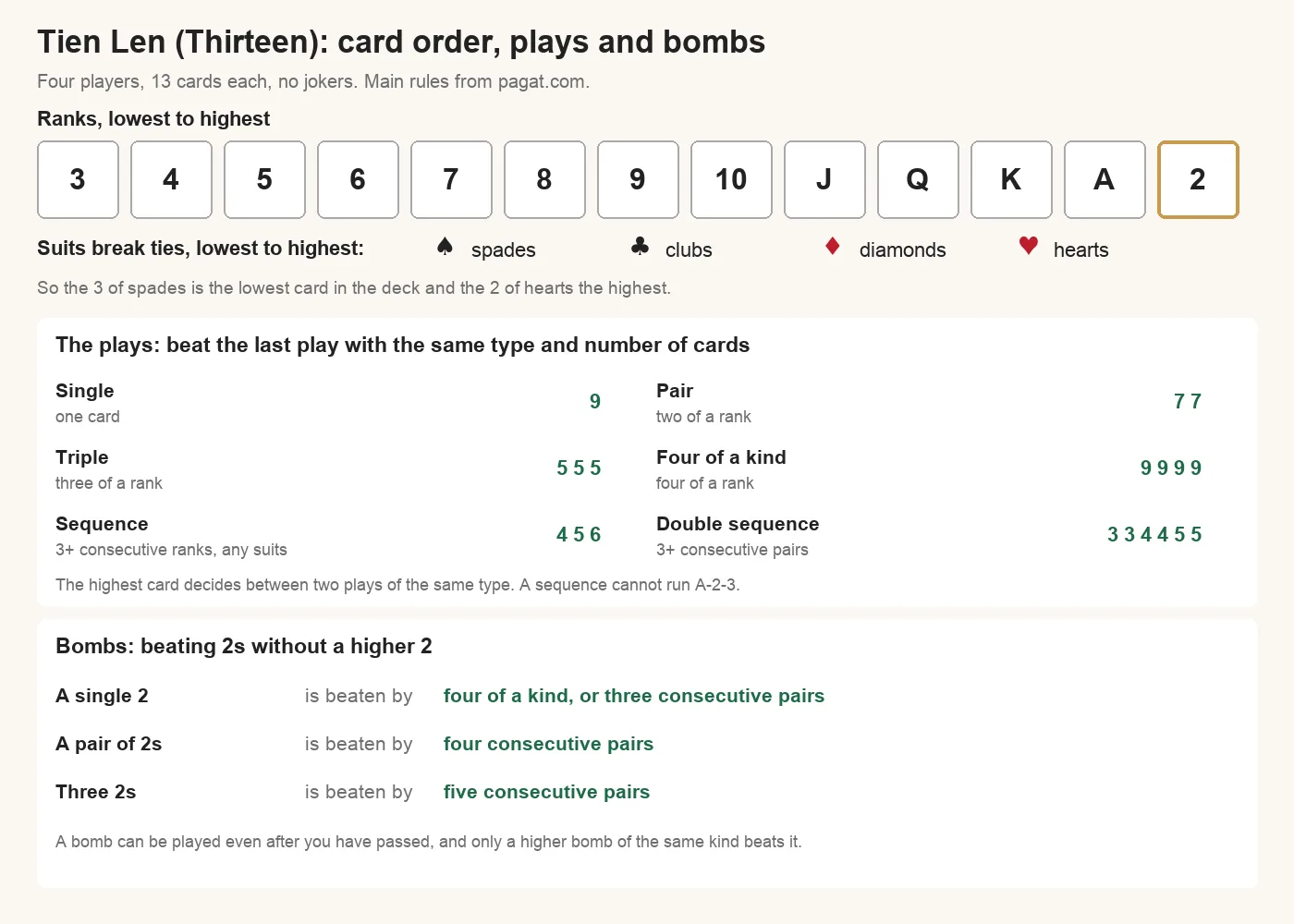
| Play | What it is | Example |
|---|---|---|
| Single | One card | 9 |
| Pair | Two cards of the same rank | 7 7 |
| Triple | Three of the same rank | 5 5 5 |
| Four of a kind | Four of the same rank | 9 9 9 9 |
| Sequence | Three or more consecutive ranks, any suits | 4 5 6, or J Q K A 2 |
| Double sequence | Three or more consecutive pairs | 3 3 4 4 5 5 |
Between two plays of the same type, compare the highest card: 8 9 10♥ beats 8 9 10♦, because the ten of hearts beats the ten of diamonds. A sequence cannot wrap around from the 2 back to the 3, so A 2 3 is not a sequence.
Normally only the same type of play can beat a play. The exceptions are bombs, which can beat 2s:
| To beat | Play |
|---|---|
| A single 2 | Four of a kind, or three consecutive pairs (such as 7 7 8 8 9 9) |
| A pair of 2s | Four consecutive pairs |
| Three 2s | Five consecutive pairs |
A bomb can be played even by a player who has already passed, and it can only be beaten by a higher bomb of the same kind. Bombs only work against 2s: you cannot bomb an ace. But if someone beats the ace with a 2, your bomb can now beat the 2.
As players run out of cards they drop out, and if the player due to lead has no cards left, the lead passes on to the next player. The game ends when only one player still has cards. That player loses, and deals the next game.
Tien Len has many local versions, so agree the rules before you start:
| Variation | How it differs |
|---|---|
| No 2s in sequences | Many players only allow sequences from 3 up to ace. |
| Four of a kind is stronger | In some groups four of a kind beats a pair of 2s as well as a single 2, or even any single card or pair. |
| Four 2s win | In VC rules, a player dealt all four 2s wins at once. |
| VC “slams” | A pair of 2s needs two consecutive fours of a kind or five consecutive pairs; three 2s need three consecutive fours of a kind or seven consecutive pairs. |
| Stacking | After everyone else passes, the last player can keep playing higher combinations of the same type. |
| Trading | After the deal, the loser of the last game gives their best cards to the winner in exchange for unwanted ones, as in President; or any two players may swap cards by agreement. |
| First out wins | Some play that the game ends as soon as one player goes out, and everyone else scores against the cards left in their hand. |
| More players | Five to eight players use two decks shuffled together. |
Tien Len belongs to the same family as the Chinese game Big Two and its Filipino version, Pusoy Dos. In all three the 2 is the top card and you race to empty your hand, but the details differ, and only Tien Len has bombs made of consecutive pairs:
| Tien Len | Big Two | Pusoy Dos | |
|---|---|---|---|
| Suits, low to high | ♠ ♣ ♦ ♥ | ♦ ♣ ♥ ♠ | ♣ ♠ ♥ ♦ |
| First lead | 3♠ | 3♦ | 3♣ |
| Sequences | Any length from 3 cards | Five-card poker hands | Five-card poker hands |
| Combinations | Singles, pairs, triples, four of a kind, sequences, double sequences | Singles, pairs, triples, five-card hands | Singles, pairs, triples, five-card hands |
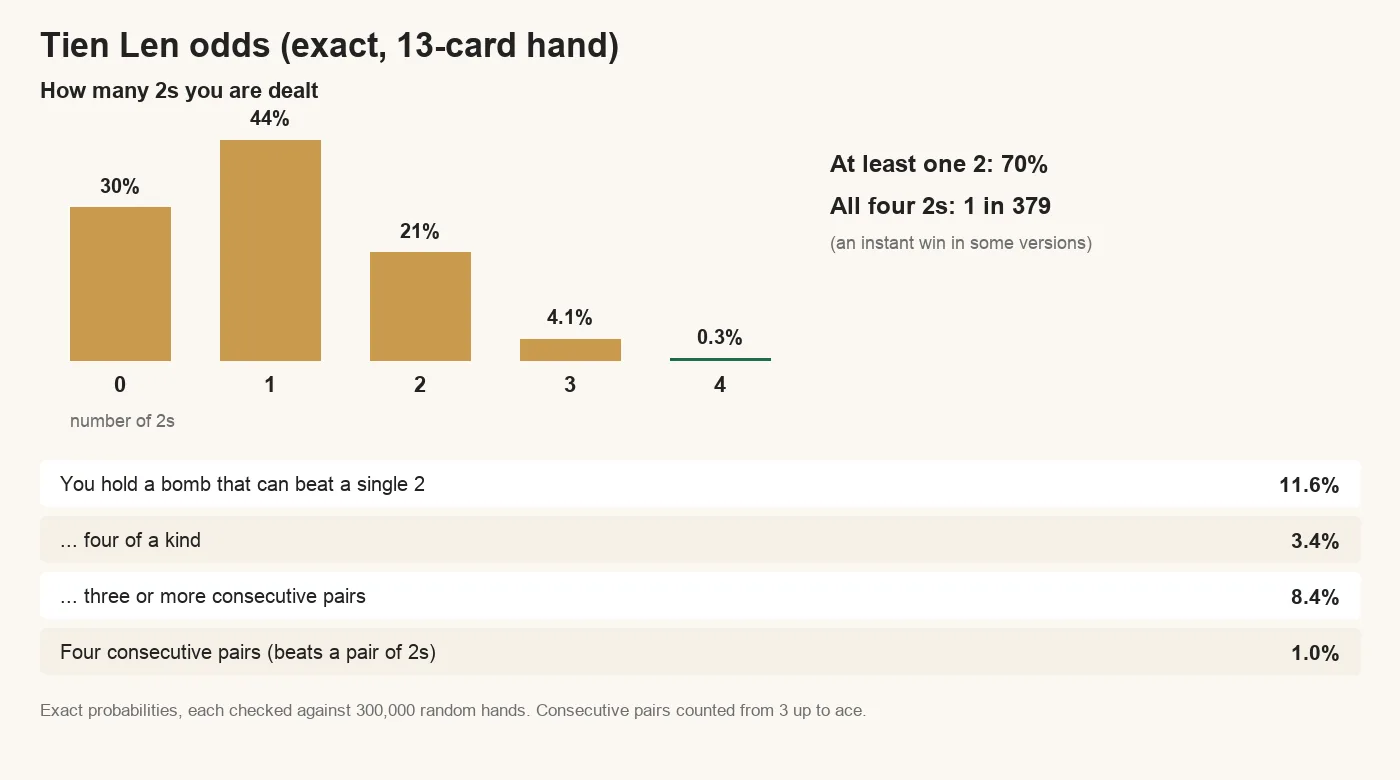
Exact probabilities for a 13-card hand, each checked against 300,000 random hands:
Consecutive pairs are counted from 3 up to ace, since groups differ on whether a 2 can be part of one.
Tien Len is a Vietnamese game, played wherever Vietnamese communities have settled. It spread to parts of the United States, probably as a result of the Vietnam War, where it took the names Thirteen, Killer and Viet Cong (VC); Thirteen is also the usual English name among Vietnamese Australians. Its relatives include the Chinese climbing games Big Two and Dou Dizhu.
Try Pusoy Dos, the Filipino version of Big Two, or President, the party game where the winner takes the loser’s best cards. For another 13-card game, see Whist.

After going through several successful experiences with several industry pioneers, Fadi Hayek has managed to excel in the world of content for online gaming by providing unique content for several projects that allowed him to obtain the necessary experience to launch his career. Last but not least, Fadi also holds several certificates, including but not limited to content marketing and iGaming.


