Whist Card Game Rules
Four players, two partnerships, 13 tricks and a trump suit: how to play classic whist, plus Bid Whist, Knockout Whist and German Whist.


Four players, two partnerships, 13 tricks and a trump suit: how to play classic whist, plus Bid Whist, Knockout Whist and German Whist.
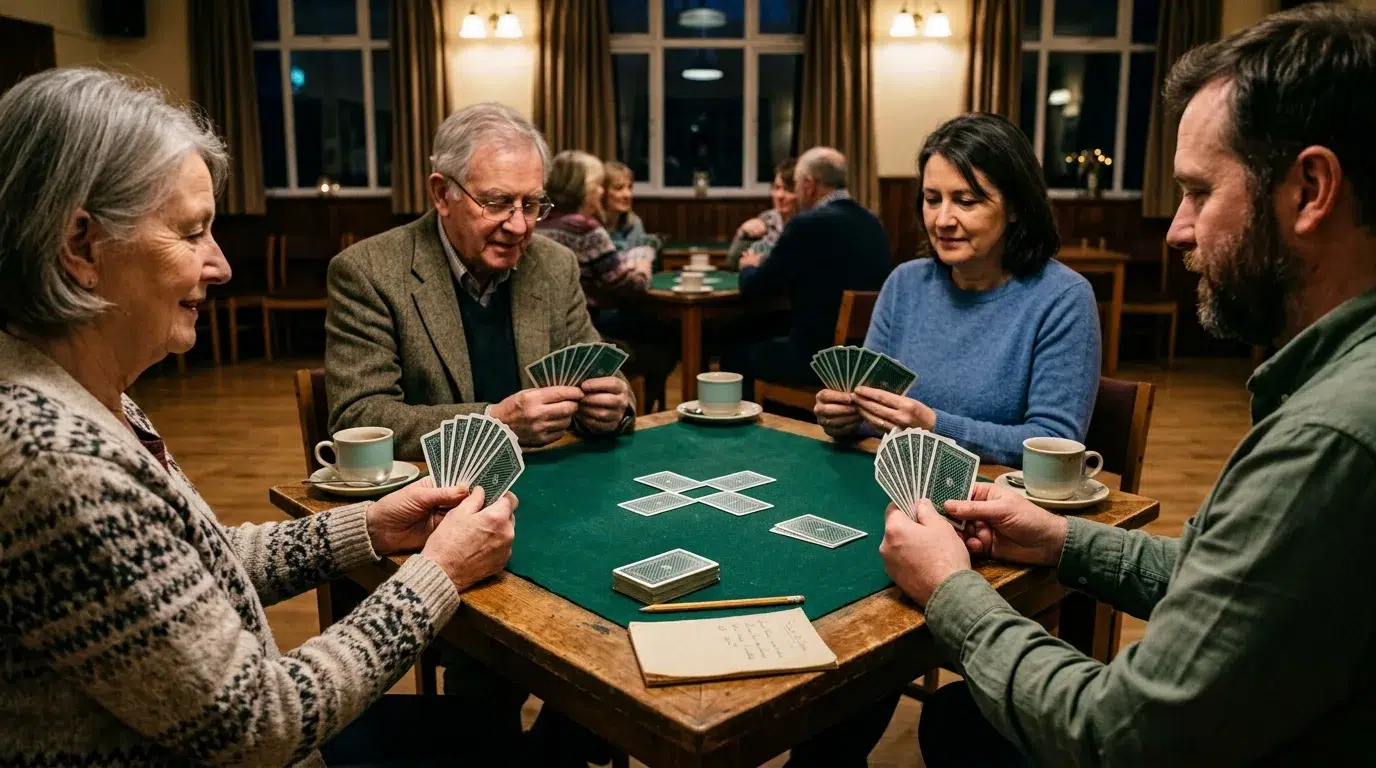
Whist is the classic English trick-taking card game for four players in two partnerships. Each player gets 13 cards, one suit is trumps, and the side that wins more than six of the 13 tricks scores a point for each extra trick. There is no bidding and the rules are simple, but there is plenty of room for skill. It was the great card game of the 18th and 19th centuries before Bridge replaced it, and it is still played in Britain at whist drives. This guide covers the whist card game rules, scoring and honours, strategy, the popular versions (Bid Whist, Knockout Whist and German Whist) and the odds.
| Classic whist | |
|---|---|
| Players | 4, in two partnerships. Partners sit opposite each other. |
| Cards | A standard 52-card deck. Ace high, two low. |
| Deal | 13 cards each. The dealer’s last card is turned face up: its suit is trumps. |
| Play | Follow suit if you can. The highest trump wins the trick, or the highest card of the suit led. |
| Scoring | 1 point for each trick over six. |
| Game | 5 points in Britain (often best of three games), 7 in America. |
Four players form two partnerships, with partners facing each other across the table, and play goes clockwise. The cards in each suit rank A K Q J 10 9 8 7 6 5 4 3 2.
Players traditionally use two decks: while one is dealt, the dealer’s partner shuffles the other, ready for the next dealer on the left.
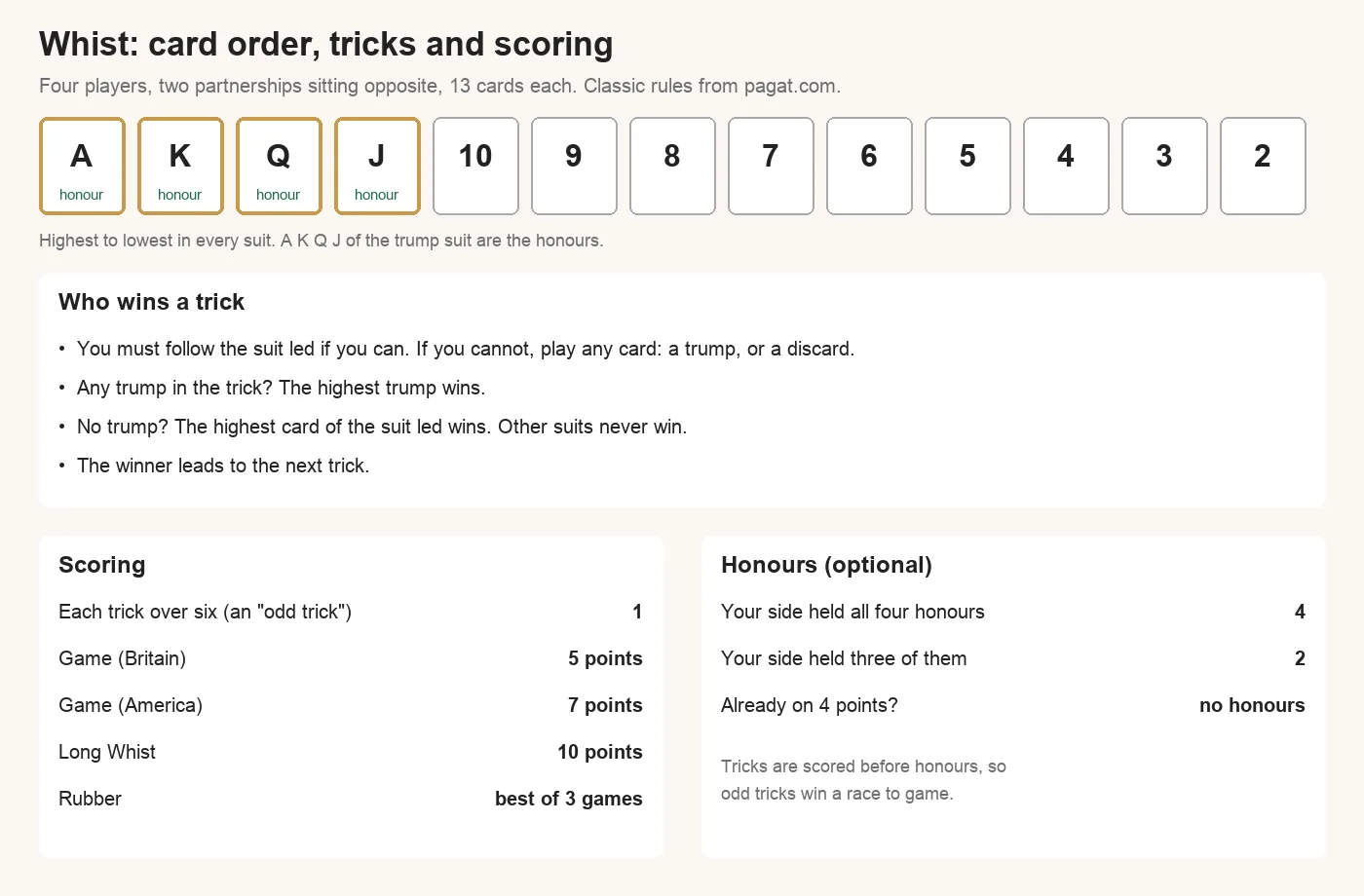
The first six tricks a side takes (its “book”) score nothing. The side that wins the majority scores 1 point for each trick over six, called an odd trick: winning 9 tricks scores 3. Keep playing hands until one side reaches the target:
| Version | Game |
|---|---|
| Short Whist (Britain) | 5 points, usually played as a rubber: the first side to win two games |
| American Whist | 7 points |
| Long Whist | 10 points |
In the traditional game, the honours are the ace, king, queen and jack of trumps. A side whose players held all four between them scores 4 points; a side that held three scores 2. They are claimed at the end of the hand. A side already on 4 points cannot score honours, and tricks are scored before honours, so a side that makes its odd tricks wins a close race to game. Many players today leave honours out, since they add an element of luck: as the odds below show, one side holds three or four honours in most deals.
A whist drive is a local whist tournament, the way whist is still most often played in Britain. Instead of turning up the last card, trumps follow a fixed order: hearts for the first hand, then diamonds, spades and clubs, and round again; some drives add a hand with no trumps every fifth deal. Because every table should play the same number of hands, a drive plays a fixed number of deals rather than games, and each player’s score is the total of odd tricks their side made.
Bid Whist is a partnership game with bidding, especially popular among African Americans. It uses the 52-card deck plus two jokers, a big joker and a little joker: 54 cards. Tricks are called books.
| Result | Score |
|---|---|
| Bidding side makes its bid | +1 for each book over six it took |
| Bidding side falls short (“set”) | minus the number it bid |
| No trump bid | double the score, either way |
| Game | first side to 7, or a side falls to −7, loses |
A bid of 7, promising all 13 books, is a Boston. Many groups have house rules: a minimum bid of 4, a downtown bid outranking an uptown bid of the same number, or a 52-card game with no jokers and a four-card kitty played to 21.
Knockout Whist is the version many families simply call whist, and a good way to teach children trick-taking. Two to seven players each play for themselves.
German Whist is a two-player version, and despite the name it appears to be British. Each player gets 13 cards; the rest form a stock with the top card face up, and that card’s suit is trumps. For the first 13 tricks the winner takes the face-up stock card and the loser the face-down one beneath it. When the stock is empty, the last 13 tricks are played out, and only those count: whoever wins most of them wins the hand. So in the first half, only try to win a trick if the face-up card is worth having.
| Game | How it plays |
|---|---|
| Solo Whist | A British game for individuals, who bid to win 5, 9 or 13 tricks, or to lose every trick. |
| Nomination Whist | A British game in which the highest bidder calls a card to choose a partner. The name is also used in Britain for Oh Hell, where you predict exactly how many tricks you will take. |
| Minnesota Whist | No trumps, and each hand is played either to win tricks or to lose them. |
| Romanian and Israeli Whist | Players bid the exact number of tricks they will take, as in Oh Hell. |
| Danish Whist | Played with fixed partnerships, or with partners chosen by calling an ace. |
Bridge grew out of whist and replaced it in clubs in the 1890s. The trick-taking is the same: 13 cards each, partners opposite, follow suit, trumps win. The difference is bidding. In whist trumps are set by the turned-up card and there is no auction, so you learn about your partner’s hand only from the cards played. In bridge, an auction decides the trump suit and how many tricks a side must win, and one hand is laid face up on the table as the dummy.
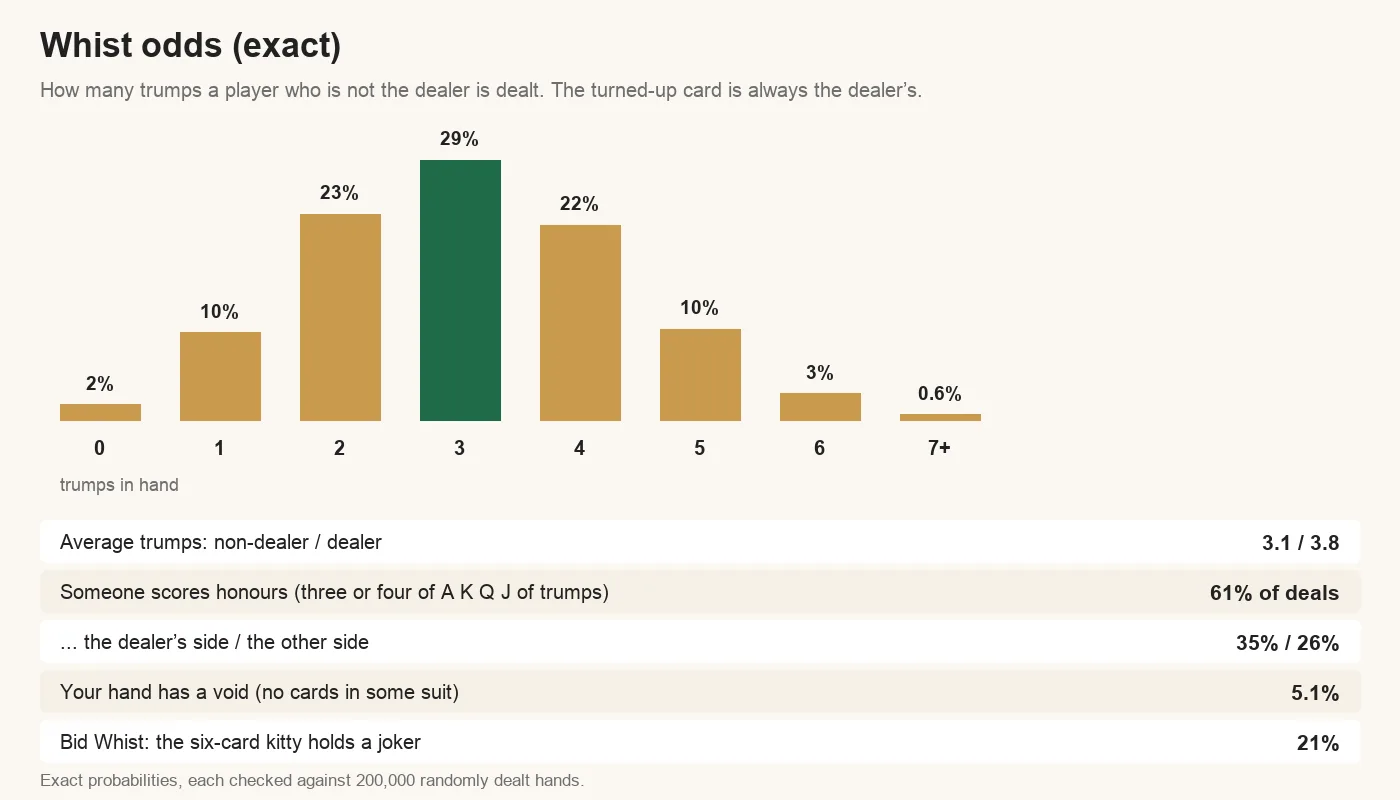
These are exact probabilities for a classic whist deal, checked against 200,000 randomly dealt hands:
Whist grew out of the 17th-century English game Ruff and Honours and had replaced it by the 18th century. Its name comes from an old word whist, meaning quiet or attentive, the root of the modern wistful. Gentlemen played it seriously at the Crown Coffee House in London around 1728, and Edmond Hoyle’s A Short Treatise on the Game of Whist (1742) became the standard rules for a century. In the early 1890s Bridge took its place in the clubs, but whist lived on as a social game and at whist drives.
For a partnership game with bidding, try Spades; to predict your tricks exactly, play Oh Hell. Hearts turns the idea round, and Pinochle and Briscola score the cards you win.
A faster partnership game: Euchre, five cards each and the two jacks of the trump colour as the top trumps.

After going through several successful experiences with several industry pioneers, Fadi Hayek has managed to excel in the world of content for online gaming by providing unique content for several projects that allowed him to obtain the necessary experience to launch his career. Last but not least, Fadi also holds several certificates, including but not limited to content marketing and iGaming.


