Play 28 (Twenty-Eight) free in your browser with a computer partner and learn every rule: J 9 A 10 order, bidding from 14, the hidden trump and scoring.
28 (Twenty-Eight) is the partnership card game of Kerala, where it is called Irupathiyettu or Thuruppu, and it is popular across much of south India. It is a close cousin of 29 (Twenty-Nine): the jack and the nine are the highest cards in every suit, there are exactly 28 points in the pack, and the player who wins the bidding chooses trumps in secret by placing one card face down.
Play 28 free below with a computer partner, then read the rules step by step: the cards and points, the deal and bidding, the hidden trump card, how play changes once trumps are shown, redeals, scoring, how 28 differs from 29, house rules, the odds and some tips.
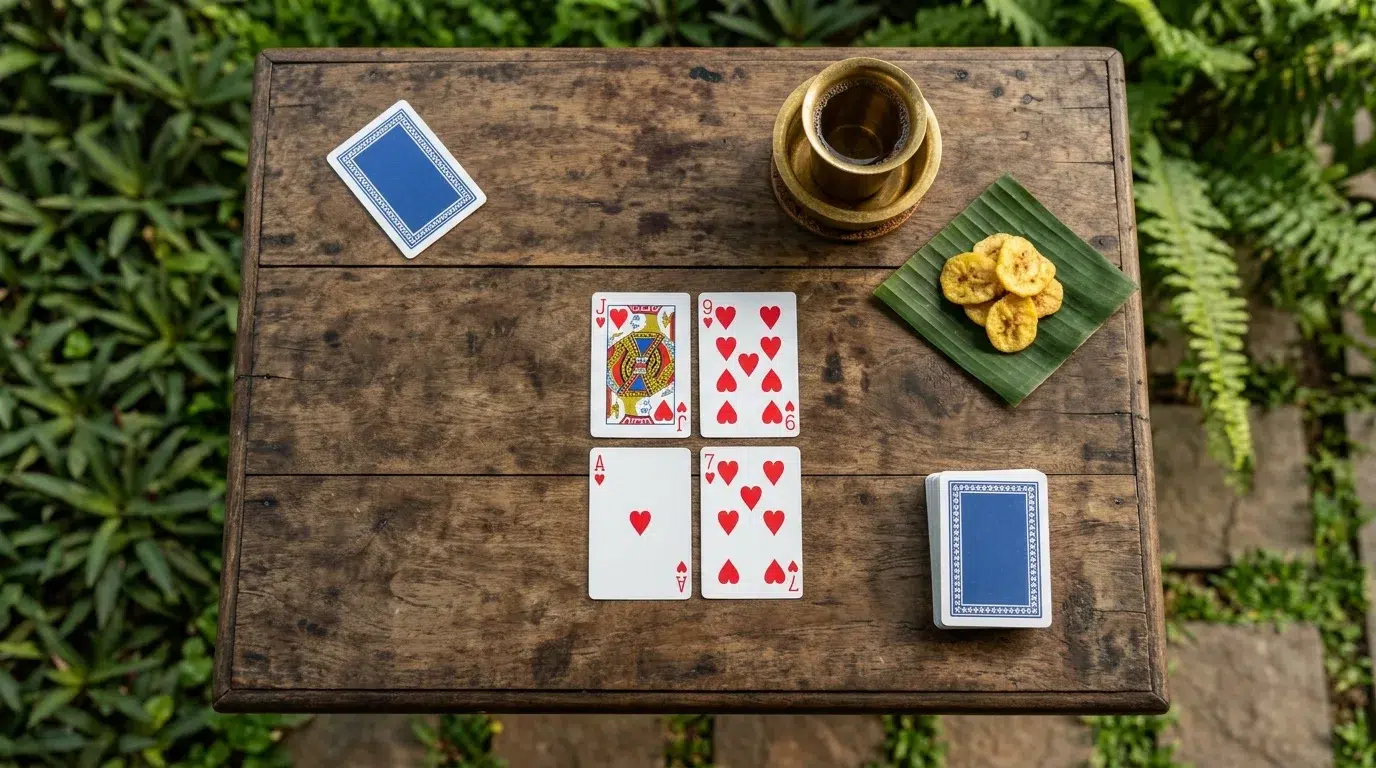
Jack, nine, ace and seven of hearts: 3 + 2 + 1 + 0 = 6 card points in one trick. The card lying face down on its own is the bidder’s hidden trump.
Play 28 Card Game Free Online
You sit at the bottom with Across as your partner; Right and Left are your opponents, and play goes to the right. Bid on your first four cards; if you win the bidding, tap the card to place face down as your trump. When you cannot follow suit you can discard, or press Ask for trumps; if you are the bidder, you can show your trump card and play it. The scoreboard keeps each side’s card points, the bid and the game points; the first side to 10 game points wins.
Twenty-Eight (28)
Free, no sign-up, nothing to download. You and the computer sitting Across play as a team against Right and Left; play goes to the right (anticlockwise). Bid on your first four cards; the winning bidder (★) hides a trump card face down. Point cards (J 3, 9 2, A 1, 10 1) are shaded in your hand; a blue ring marks a card that counted as a trump.
In the free game a pass is final, the deal passes to the right after every hand, the same dealer deals again after a redeal, and the Cot and Thani bonuses described below are not played. In the second round the bidder, then the bidder’s partner, may each raise once.
28 Card Game at a Glance
28 (Twenty-Eight)
Other names
Irupathiyettu, Thuruppu (Kerala)
Players
4, in two partnerships, partners sitting opposite
Cards
32: 7, 8, 9, 10, J, Q, K, A in each suit
Card order
J (highest), 9, A, 10, K, Q, 8, 7
Card points
J 3, 9 2, A 1, 10 1: 28 in all
Direction
Anticlockwise: the deal and the play pass to the right
Bids
14 to 28 (over your partner: at least 20; in the second round: at least 24)
Trumps
Chosen by the bidder with one card placed face down, shown later
Game
First side to 10 game points
Cards, Ranking and Points
28 uses 32 cards: the 7, 8, 9, 10, jack, queen, king and ace of each suit. In every suit the cards rank from high to low J, 9, A, 10, K, Q, 8, 7, so the jack beats everything and the nine beats the ace. You win points by capturing these cards in tricks:
Card
Points each
In the pack
Jack
3
4 × 3 = 12
Nine
2
4 × 2 = 8
Ace
1
4
Ten
1
4
King, Queen, 8, 7
0
0
Total
28
That total of 28 card points gives the game its name. There is no extra point for the last trick (that is one of the differences from 29).
The Deal and the Bidding
Deal four cards each. The dealer shuffles, the player to the dealer’s left cuts, and the dealer gives everyone four cards, one at a time, anticlockwise.
The first bid is compulsory. The player to the dealer’s right speaks first and must bid at least 14. Only if that player’s four cards have no points at all (only kings, queens, 8s and 7s) may they demand a redeal instead.
Bid higher or pass. A bid is the number of card points your side promises to take if you choose trumps. Each player in turn, anticlockwise, bids higher or passes; a player who passes is out of the bidding for that hand. The bidding ends when three players have passed. The highest bid is 28.
Bidding over your partner. If your partner holds the highest bid and you want to bid over it, you must bid at least 20.
The hidden trump. The winner of the bidding chooses trumps from their four cards and places one card of that suit face down (the turup). Nobody else knows the trump suit.
Four more cards each, so everyone holds eight.
A second chance to bid. Having seen all eight cards, the bidder or the bidder’s partner may raise the bid, but a raise must be at least 24.
Card points in your first four cards
How often
0 (you may ask for a redeal if you bid first)
5.1%
1 to 2
28.1%
3 to 5
50.4%
6 or more
16.6%
On average your first four cards hold 3.5 of the 28 points, and 43.1% of four-card hands include at least one jack. You are bidding on half your hand: the other four cards, and your partner’s eight, decide the rest.
How to Play 28: Before and After Trumps Are Shown
The player to the dealer’s right leads to the first trick, and the winner of each trick leads to the next. Everyone must follow suit if they can. The play has two phases.
Phase 1: trumps are hidden
Each trick is won by the highest card of the suit led. Cards of the (secret) trump suit have no special power yet.
If you cannot follow suit you have two choices: discard any card (it cannot win the trick), or ask for trumps before you play. The bidder then turns the face-down card over for everyone to see and takes it into their hand, and you must play a trump to this trick if you have one.
The face-down card is not part of the bidder’s hand until it is shown.
The bidder plays under extra restrictions while trumps are hidden:
The bidder may not lead the trump suit unless they hold nothing else; a card led that way has no trump power.
If someone leads the trump suit, the bidder follows suit from hand or discards another suit, and may not reveal trumps on that trick.
If someone leads another suit and the bidder has none of it, the bidder may not play a trump from hand: they either discard a card of another non-trump suit, or show the face-down card and play it, which starts phase 2.
If the bidder wins the seventh trick with trumps still hidden, they show the face-down card and lead it to the last trick.
Phase 2: trumps are shown
From the moment the face-down card is turned over, its suit is trumps. A trick is won by the highest trump in it, or by the highest card of the suit led if it holds no trump. If you cannot follow suit you may trump or discard, as you like, and the bidder can now lead anything, trumps included.
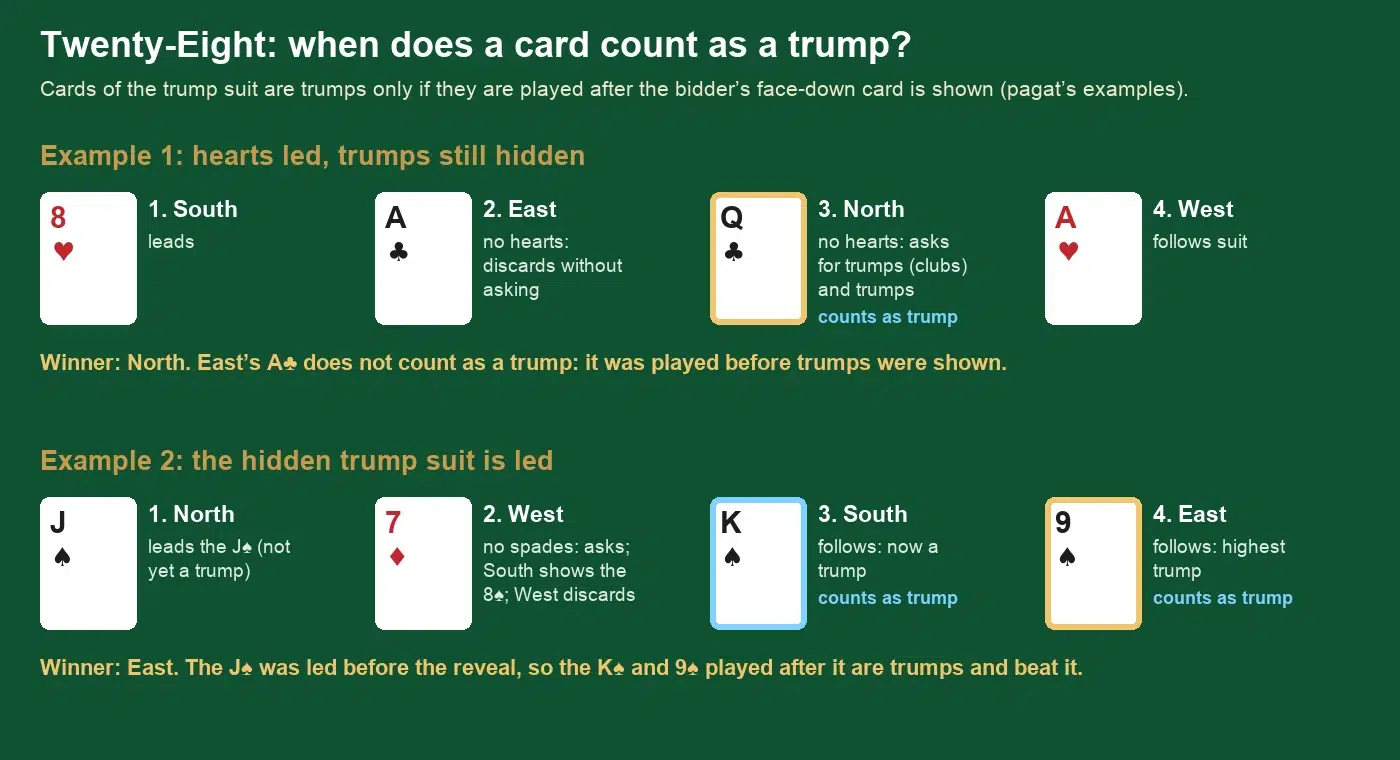
The tricky part is the trick in which trumps are shown. A card of the trump suit counts as a trump only if it was played after the reveal; any played earlier in that trick are ordinary cards:
Two worked examples from the rules: a blue ring marks a card that counts as a trump, gold the winner.
Redeals
The first bidder’s four cards hold no points: they may demand a redeal (5.1% of deals).
Someone is dealt all four jacks in their eight cards: they show them and the cards are redealt (0.78% of deals).
When trumps are shown it turns out that the bidding side holds all eight trumps and the opponents none: redeal.
After a redeal the same dealer shuffles and deals again.
Scoring and Winning the Game
When all eight tricks are played, each side counts the card points in its tricks. The bidding side needs at least as many points as the bid. What the hand is worth depends only on the bid, not on how many points were taken:
Bid
Made
Failed
14 to 19
+1 game point
−2 game points
20 to 24 (“Honours”)
+2
−3
25 to 28
+3
−4
The scores are kept on paper as a running total; the first side to reach 10 game points wins the game.
28 vs 29: The Differences
28
29
Last trick
No extra point
1 extra point in some versions (often left out)
Highest bid
28
29 with the last-trick point, otherwise 28
King + queen of trumps
No bonus
The Pair (Royals): the bid goes down or up by 4
Scoring
1 to 3 game points by bid, more lost than won
1 game point won or lost
Game
First to 10
First to 6
The card order and the points are the same in both. Try the free 29 game as well.
House Rules and Other Versions
No jack discard: when you cannot follow suit, you may not discard the jack of a suit that has not yet been led (trumping with the jack of trumps is still allowed).
Pointless hand: any player whose eight cards hold no jack, nine, ace or ten may show them and annul the hand.
Cot: a side that wins every trick scores double. The opponents may surrender first; if the winners refuse and then lose a trick, they lose double.
Thani (or Adi): the bidder announces they will win every trick alone. If they do, their side scores 4; if not, it loses 5.
Three players: remove the 7s and 8s (24 cards); the first player must bid at least 12, and the highest bidder plays alone against the other two.
Six players: add the 6s (36 cards), three teams of two, all cards dealt three at a time before the bidding, minimum bid 12.
56: a bigger version from Kerala played with a double pack.
28 Card Game Odds
Situation
Chance
First four cards hold no points
5.1%
First four cards include at least one jack
43.1%
First four cards hold 6 or more points
16.6%
One player is dealt all four jacks (redeal)
0.78%
Bidding side makes its bid (free game, computer players)
71.2%
Trumps shown because a player asked (free game)
67.3%
Trumps shown by the bidder playing the face-down card (free game)
33.1%
The first four rows are exact. The others come from 352,891 hands played by the computer players of the free game; on average the trump card was turned over during trick 3.5.
Tips for Playing 28
Count the jacks and nines. They are 20 of the 28 points; knowing which are still out tells you whether your ace or ten is safe.
Bid on trumps, not just points. A suit with the jack and another card is worth more than scattered aces, because you choose that suit as trumps.
Hide a low trump. Your face-down card is out of play until trumps are shown, so placing a low card of the suit keeps your jack and nine in hand.
Ask for trumps when it pays. Asking forces you to trump if you can; do it when the trick holds points and the opponents are winning it.
Feed your partner points. When your partner is sure to win a trick, play your ace or ten into it.
Respect the bands. A failed bid of 20 costs 3 game points against 2 won; bid Honours only with a strong hand.
Four players in two partnerships use 32 cards (7 to ace). Everyone gets four cards and bids for the right to choose trumps; the winner places a trump card face down and four more cards are dealt. Players must follow suit; trumps only count once the face-down card is shown. The bidding side must take at least as many card points as it bid.
What are the card points in 28?
Jacks are worth 3 points, nines 2, aces 1 and tens 1; kings, queens, 8s and 7s score nothing. That makes 28 points in the pack, which is where the name comes from.
What is the card order in 28?
In every suit the cards rank from high to low: jack, nine, ace, ten, king, queen, 8, 7. The jack is the highest card and the nine beats the ace.
What is the minimum bid in 28?
The player to the dealer’s right must open with at least 14. To bid over your partner you need at least 20, and a raise in the second round, after all eight cards are dealt, must be at least 24. The highest bid is 28.
When are trumps shown in 28?
When a player who cannot follow suit asks for trumps, or when the bidder, unable to follow a non-trump suit, shows the face-down card and plays it. Cards of the trump suit played before that moment do not count as trumps.
How is 28 scored?
A bid of 19 or less wins 1 game point or loses 2; a bid of 20 to 24 (Honours) wins 2 or loses 3; a bid of 25 or more wins 3 or loses 4. The first side to 10 game points wins.
What is the difference between 28 and 29?
They use the same 32 cards, card order and points. 29 adds a point for the last trick in some versions and has the Pair (king and queen of trumps), which moves the bid by 4, and it is usually scored 1 game point a hand to 6.
What is 28 called in Kerala?
In Kerala the game is called Irupathiyettu, which means twenty-eight, or Thuruppu, which means trump.
Fadi Hayek
Author & Casino Expert
After going through several successful experiences with several industry pioneers, Fadi Hayek has managed to excel in the world of content for online gaming by providing unique content for several projects that allowed him to obtain the necessary experience to launch his career. Last but not least, Fadi also holds several certificates, including but not limited to content marketing and iGaming.
As online casinos adopt machine learning models and artificial intelligence in gambling becomes the next disruption, you don’t want to be left behind. Read on to learn about the impact AI will have on the future of the gambling industry.
Keep abreast of the latest Arabian football betting trends with the Arabian sports betting insights below. This guide covers the most popular bet types with Arab bettors and the top bookmakers for Arabian and global football competitions.
Yggdrasil and Reflex are set to launch Dublin Up DoubleMax, an Irish-style video, as one of their latest releases. The slot game is designed by incorporating Yggdrasil’s proprietary Game Engagement Mechanic (GEM) DoubleMax coupled with unique features like free spins bonus and fairy magic.