Seep Card Game
Play Seep (Sweep) free in your browser with a computer partner and learn every rule: capture values, houses, sweeps, scoring and the baazi.


Play Seep (Sweep) free in your browser with a computer partner and learn every rule: capture values, houses, sweeps, scoring and the baazi.
Seep (also called Sweep, Sip, Siv or Shiv) is a four-player partnership card game from north India and the Punjab, played in both India and Pakistan. It is a fishing game: you play cards from your hand to capture cards from the floor, build them into piles called houses, and try to clear the whole floor in one go for a sweep worth 50 points. Partners sit opposite each other and the first side to build a lead of 100 points wins a baazi.
Play Seep free below with a computer partner, then read the rules step by step: card values and point cards, the deal and the bid, building, breaking and cementing houses, picking up, sweeps, scoring, the two-player game, the 30-point Punjabi version, odds and tips.
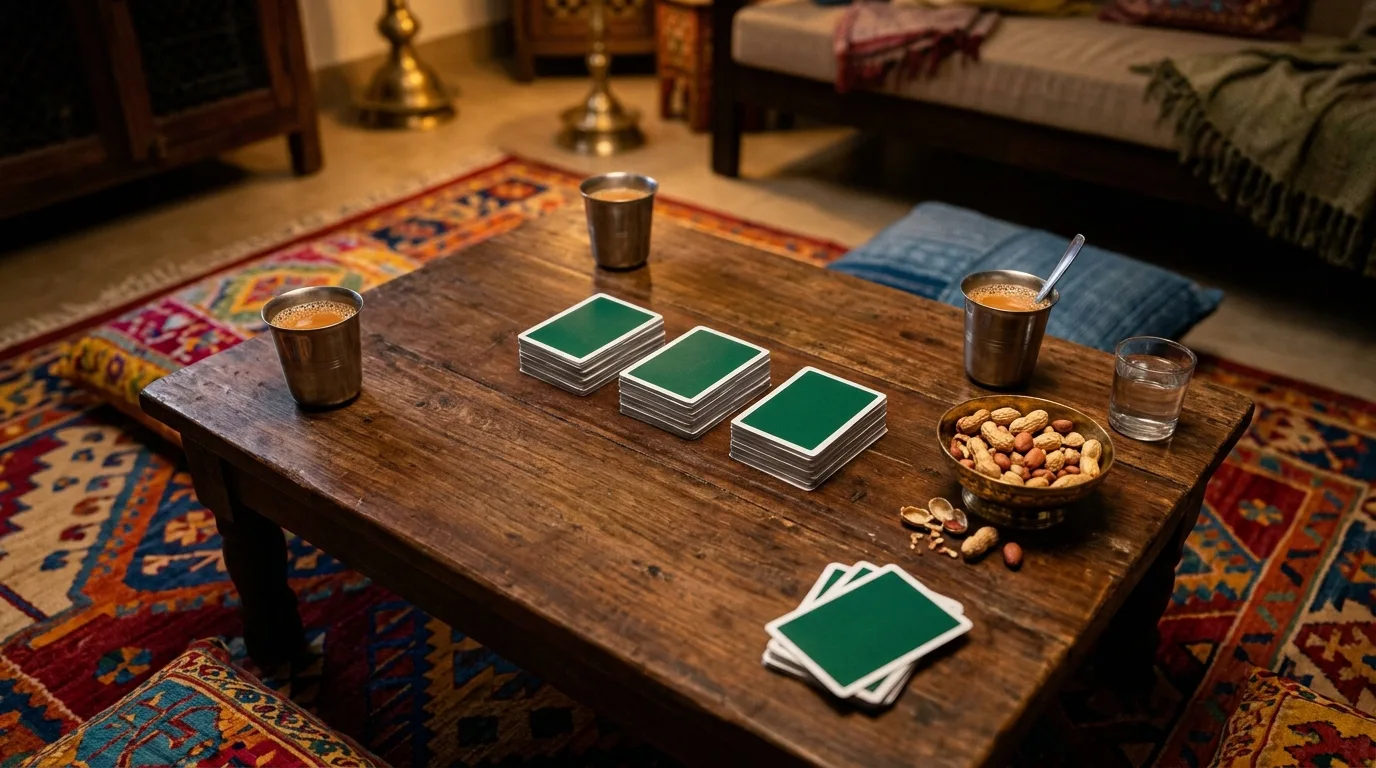
You sit at the bottom with Across as your partner; Right and Left are your opponents, and play goes to the right. Tap a card to play it. If it can be used in more than one way (pick up, build a house, add to a house, break a house, or throw it down), the game lists every legal option and you choose. Houses show their value, whether they are cemented and who owns them; point cards are shaded. The scoreboard tracks each side’s points in the current deal, the running lead and the baazis won.
The free game follows the rules below with one simplification: when you build or add to a house, any loose card or set of loose cards on the floor that matches its value is always added to the house (the rules say you may add them).
| Seep (100-point game) | |
|---|---|
| Other names | Sweep, Sip, Siv, Shiv |
| Players | 4, in two partnerships, partners opposite (a 2-player version exists) |
| Cards | Standard 52-card pack, no jokers |
| Direction | Anticlockwise: each turn passes to the right |
| Capture values | A = 1, 2–10 face value, J = 11, Q = 12, K = 13 |
| Point cards | All 13 spades (1–13 points), the other three aces (1 each), 10♦ (6): 100 points |
| Sweep | 50 points (25 on the very first play, nothing on the last play) |
| Houses | Piles worth 9 to 13 that can only be captured as a unit |
| Game (baazi) | First side to lead by 100 points; a side that scores under 9 in a deal loses a baazi at once |
Every card has a capture value: aces 1, 2 to 10 at face value, jack 11, queen 12 and king 13. That is what you use to pick cards up and build houses. Only 17 cards score points when you capture them:
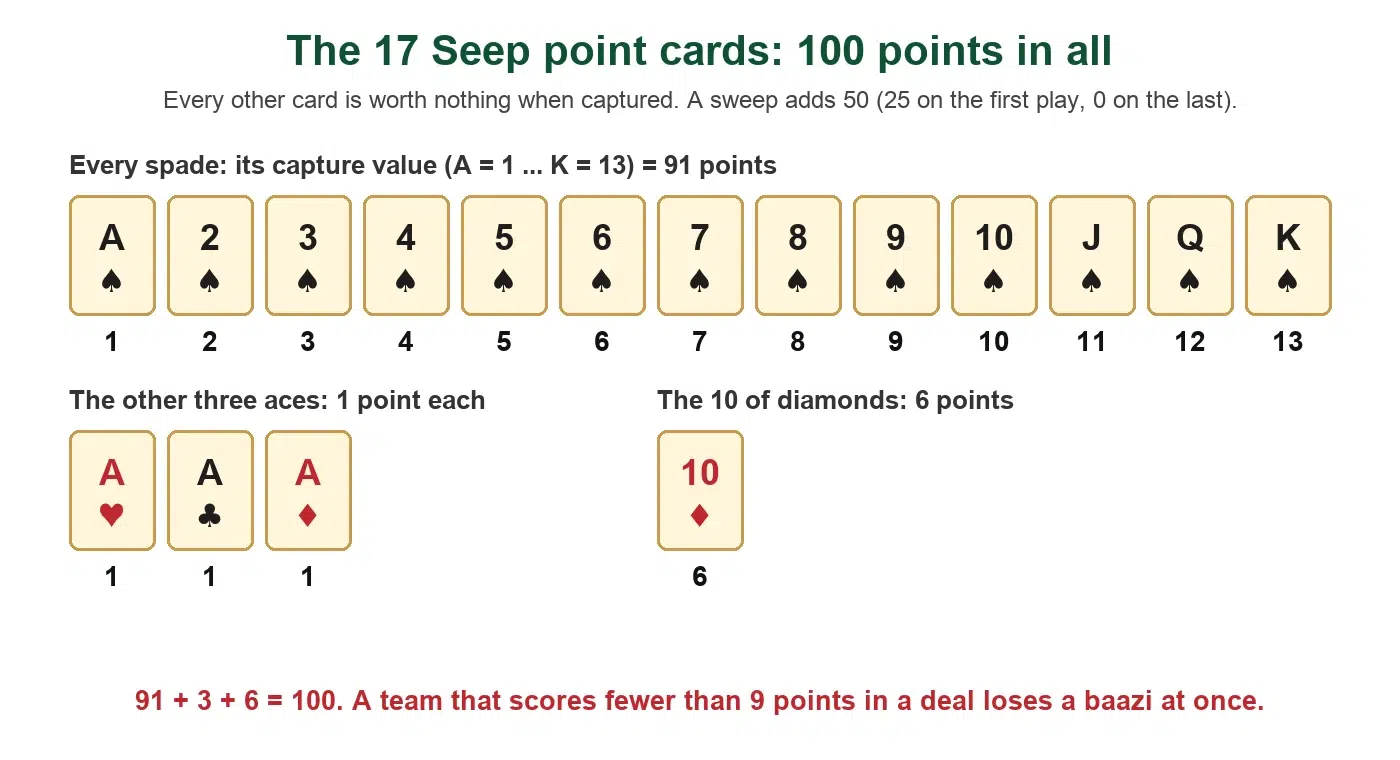
A team also scores 50 points for each sweep: picking up every card on the floor in one play. A sweep with the very first play of a deal is worth only 25, and a sweep with the last card of the deal is worth nothing.
A redeal is not rare: the bidder’s first four cards contain nothing from 9 to king 13.3% of the time, about one deal in 7.5.
After the bidder’s first play, the turn passes to the right (to the dealer’s partner) and goes round anticlockwise. Every turn you play exactly one card from your hand, so the deal ends after everyone has played all their cards. Your card can do one of three things:
| Play | What happens |
|---|---|
| Pick up | Your card matches a loose card, a set of loose cards that adds up to its value, or a house of its value. You take the matching cards together with your card and add them to your team’s captured pile. |
| Build or add to a house | Your card goes into a house on the floor: a new one, an existing one, or another player’s house that you break. |
| Throw a loose card | Your card does not match anything and is not used in a house, so it stays on the floor as a loose card for others to use. |
Picking up is compulsory: if your card is not used in a house, you must pick up everything it can capture. If several things on the floor match, you take all of them, single cards, sets and a house, as long as the sets do not overlap. With 2, 3, 5 and 6 on the floor, a jack takes either 2+3+6 or 5+6, never both. A house can only be picked up by a card of its own value, never as part of a set.
A house is a pile of two or more cards worth 9 to 13 that can only be captured as a unit. Houses are how you protect cards and steer the points towards your team. Every house has an owner, and an owner must always keep a card of the house’s value in hand until the house is picked up or broken. That is why you can only build a house of a value you hold.
Play a card and combine it with one or more loose cards to make 9, 10, 11, 12 or 13, while keeping a card of that value in hand. For example, with 2, 3 and 5 loose on the floor and a 6 and a jack in your hand, you can play the 6 with the 2 and 3, or with the 5, to build a jack house. You can only build a house for yourself, never for your partner.
A cemented (pukka) house holds more than one copy of its value: for example a queen house of 4+8 and Q, or of Q and Q. You cement a house by adding a card of its value, a card that makes its value with loose cards, or another player’s ordinary house that you break into its value. A cemented house can never be broken. If you have two cards of the same value as a loose card or set on the floor, you can play one of them to make a cemented house straight away.
If you add to an opponent’s house you become a second owner and must also keep a card of its value. If your partner already owns the house, you can add to it without becoming an owner.
An ordinary (uncemented) house can be broken by adding a card from your hand that raises its value, if you hold a card of the new value. With a 2 and a king in hand, you can break an ordinary jack house with the 2 and turn it into your own king house. You cannot break your own house, you can never break a cemented house, and you cannot use a loose card from the floor to break one.
There can never be two houses of the same value on the floor, or a loose card next to a house of the same value. A play that would create a second house of a value combines the two into one cemented house.
A sweep (the “seep” that gives the game its name) is picking up every card on the floor in one play. It scores 50 for your team, except on the very first play (25) and the last play (0). The card that made the sweep is usually turned face up in the captured pile so the sweeps can be counted at the end.
Sweeps snowball. After a sweep the next player has nothing to capture and must throw a card on the empty floor, and if the following player can match it, that is another sweep for the same team. In 12,000 deals played by the free game’s computer players there were 4.6 sweeps per deal on average, and only 3.6% of deals had none. The bidder swept all four floor cards with the first play in 3.5% of deals.
The deal ends when everyone has played all their cards. Houses are always gone by then, because their owners have to keep a card to pick them up. Any loose cards still on the floor go to the team that picked up last.
Each team adds up its point cards and its sweeps. If both teams have at least 9 points, the difference between them is added to a running total. When one team’s lead reaches 100 points or more, it wins a baazi (a game), and the running total goes back to zero. A team that scores fewer than 9 points in a deal loses a baazi on the spot, whatever the running total was.
The next deal is always dealt by a member of the team that is behind. If the team that just dealt is behind, or the scores are level, the same player deals again; if they are now ahead, the deal passes to the right. After a baazi, the deal goes to the partner of the player who would otherwise have dealt.
Playing last is an advantage: in the computer-played deals the dealer’s side, which plays the last card of the deal, finished 4 points ahead of the bidder’s side on average.
In the Punjab, in India and Pakistan, an older version counts only a few cards: the 10♦ is worth 12, the 9♠ 9, the 2♠ 1 and each ace 1, and the team that captures more cards scores 4, for 30 in all. A sweep scores the capture value of the card that made it. The game usually ends when a team leads by 30 points, and taking all 30 card points in one deal is a satthi, worth 60.
Seep belongs to the same family as Casino and Scopa, where you also capture cards from the table by matching and adding. For more card games from India, play Mendicot and Dehla Pakad, 29 (Twenty-Nine), Callbreak, 3 2 5 and Donkey free on this site.

After going through several successful experiences with several industry pioneers, Fadi Hayek has managed to excel in the world of content for online gaming by providing unique content for several projects that allowed him to obtain the necessary experience to launch his career. Last but not least, Fadi also holds several certificates, including but not limited to content marketing and iGaming.


