Court Piece (Rang / Rung)
Play Court Piece free in your browser with a computer partner, single trick or Double Sar, and learn every rule: trumps, courts and who deals next.


Play Court Piece free in your browser with a computer partner, single trick or Double Sar, and learn every rule: trumps, courts and who deals next.
Court Piece is one of the most popular partnership trick-taking games in India and Pakistan. In Pakistan it is usually called Rung or Rang, and you will also see it written Coat Piece, Court Pees or Kot Pees; in Iran the same game is Hokm. Four players in two teams try to take seven of the thirteen tricks. The twist is that one player, the trump caller, picks the trump suit after seeing only their first five cards.
Play Court Piece free below with a computer partner, in the classic single-trick version or as Double Sar, then read the rules step by step: the deal, calling trumps, playing a trick, winning a deal, scoring courts, who deals next, Double Sar, the other versions, the odds and some tips.
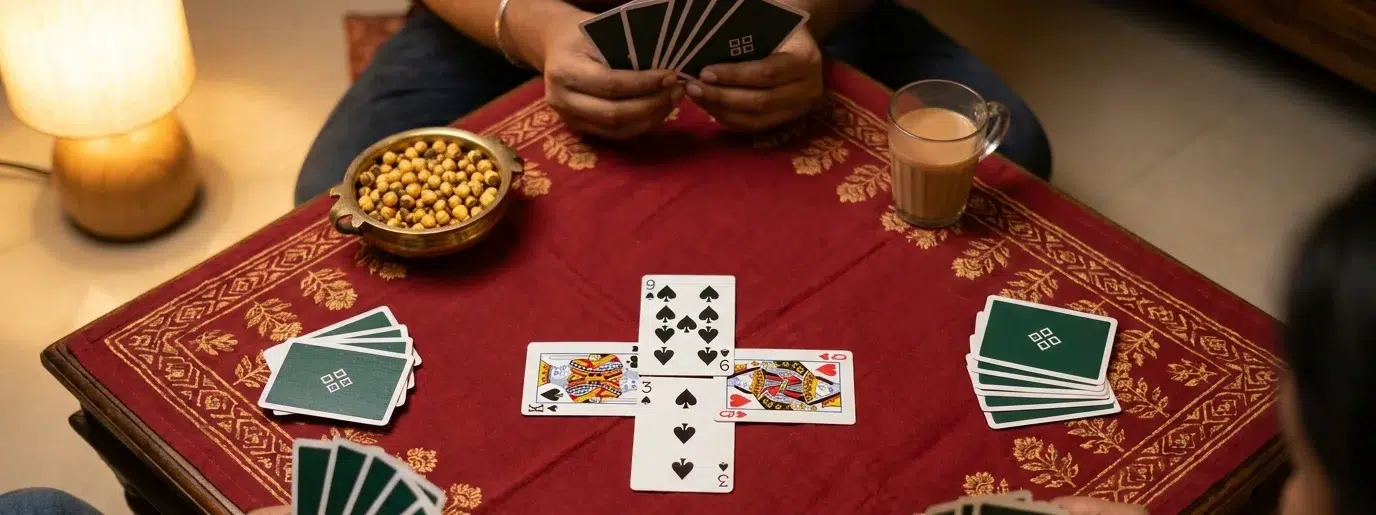
You sit at the bottom with Across as your partner; Right and Left are your opponents, and play goes to the right. When you are the trump caller you see your first five cards and choose trumps; then the rest of the deal arrives. Tap a lit card to play it. The scoreboard keeps the tricks taken this deal, deals won, each side’s run of deals in a row and the courts. Choose Double sar in the menu for the version where tricks pile up in the centre.
In the single-trick game play stops as soon as one side has seven tricks, as many players do. In Double sar all 13 tricks are played and a court means taking all 13. A side that takes every trick in the single-trick game would score a bavney (52 courts), but the free game always stops at seven.
| Court Piece (Rang / Rung) | |
|---|---|
| Other names | Rung, Rang, Coat Piece, Court Pees, Kot Pees; Hokm in Iran; Seven Hands |
| Players | 4, in two partnerships, partners sitting opposite |
| Cards | Standard 52-card pack, ace high: A K Q J 10 9 8 7 6 5 4 3 2 |
| Direction | Anticlockwise: the deal and the play pass to the right |
| Trumps | Called by the player to the dealer’s right from their first five cards |
| Win a deal | Take 7 of the 13 tricks |
| Court | Take the first seven tricks, or win seven deals in a row |
| Bavney (52-court) | Take all 13 tricks: worth 52 courts |
| Game | Most courts when the agreed playing time is up (or a points target) |
Court Piece is a game for four players in two partnerships, each player sitting directly across the table from their partner. It uses an ordinary 52-card pack with no jokers, and the cards rank in the usual order from ace (high) down to 2. There are no point cards: only the number of tricks matters.
One way to pick teams is for everyone to draw a card: the two lowest play against the two highest, and the player who drew the lowest card of all deals first. Partnerships may also be chosen at random. Deal and play go anticlockwise, so the next player is always the one to your right.
The dealer shuffles, the player to the dealer’s right cuts, and the dealer gives everyone five cards, face down, anticlockwise. The player to the dealer’s right is the trump caller. That player picks up their five cards and names the trump suit (the rang or hokm). Nobody else may look at their cards until trumps have been called.
Then the dealer deals the rest of the pack in packets of four, two rounds, so that everyone holds 13 cards. The trump caller leads to the first trick.
| Your longest suit in the first five cards | How often |
|---|---|
| 2 cards | 62.9% |
| 3 cards | 32.6% |
| 4 cards | 4.3% |
| 5 cards | 0.2% |
So the trump caller usually chooses between suits of only two cards: 62.9% of five-card hands have no suit longer than two. If you call your longest suit you end up, on average, with 4.22 trumps out of 13 cards. In about 14.5% of deals the first five cards hold no jack, queen, king or ace; some players let the trump caller ask for a redeal then (see below).
Leading a trump to the very first trick has its own name, t’rup chaal; playing a high card to the first trick to stop the other side running off seven in a row is rafeh koti.
The side that takes seven or more tricks wins the deal. To save time, many players stop the deal the moment one side reaches seven. There are no points for individual tricks; what counts is the court:
| How | Worth |
|---|---|
| Win the first seven tricks of a deal in a row | 1 court (and the deal) |
| Win seven deals in a row | 1 court |
| Win all 13 tricks (a bavney or 52-court) | 52 courts |
Each time either side scores a court, the count of deals in a row starts again from zero for both sides. Players usually agree a playing time before they start; when it runs out, the current deal is finished and the side with more courts wins.
The names vary from table to table. A court (also spelled coat or kot, or called kap) is the achievement that gives the game its name. Some players call a first-seven-tricks court a goon court; others keep that name for a court won against the trump caller’s side.
Some players keep a points score instead of counting courts. In one popular online version the trump caller’s side scores 1 point for winning a deal and the other side 2, with 2 extra points for a court; the first side to 10 points wins (or 5, 15 or 20). In Iranian Hokm the winners of a deal score 1 point, or 2 if they took the first seven tricks and the other side took none, or 3 if the side that took the first seven was playing against the trump caller (the Hâkem); the first side to 7 points wins.
The trump caller is always the player to the dealer’s right, so the deal decides who calls trumps. The next dealer always comes from the side that lost:
| Result of the deal | Next dealer |
|---|---|
| The dealer’s side won | The player to the dealer’s right (the trump caller) |
| The trump caller’s side won, no court | The same dealer deals again |
| The trump caller’s side won and scored a court | The dealer’s partner |
That means a side that keeps winning as trump callers keeps the right to call trumps. In 100,000 computer-played deals of the free game, the trump caller’s side won 59.0% of deals in the single-trick game and 61.6% in Double sar.
Double sar (double sir, double rang or double rung) is the most widely played version in India and Pakistan. Everything is the same as above except what happens to a finished trick:
Two tricks in a row by your partner does not count: it must be the same player. So in Double sar you try to keep a second winner behind your first one, and the last tricks of the deal can be worth a lot.
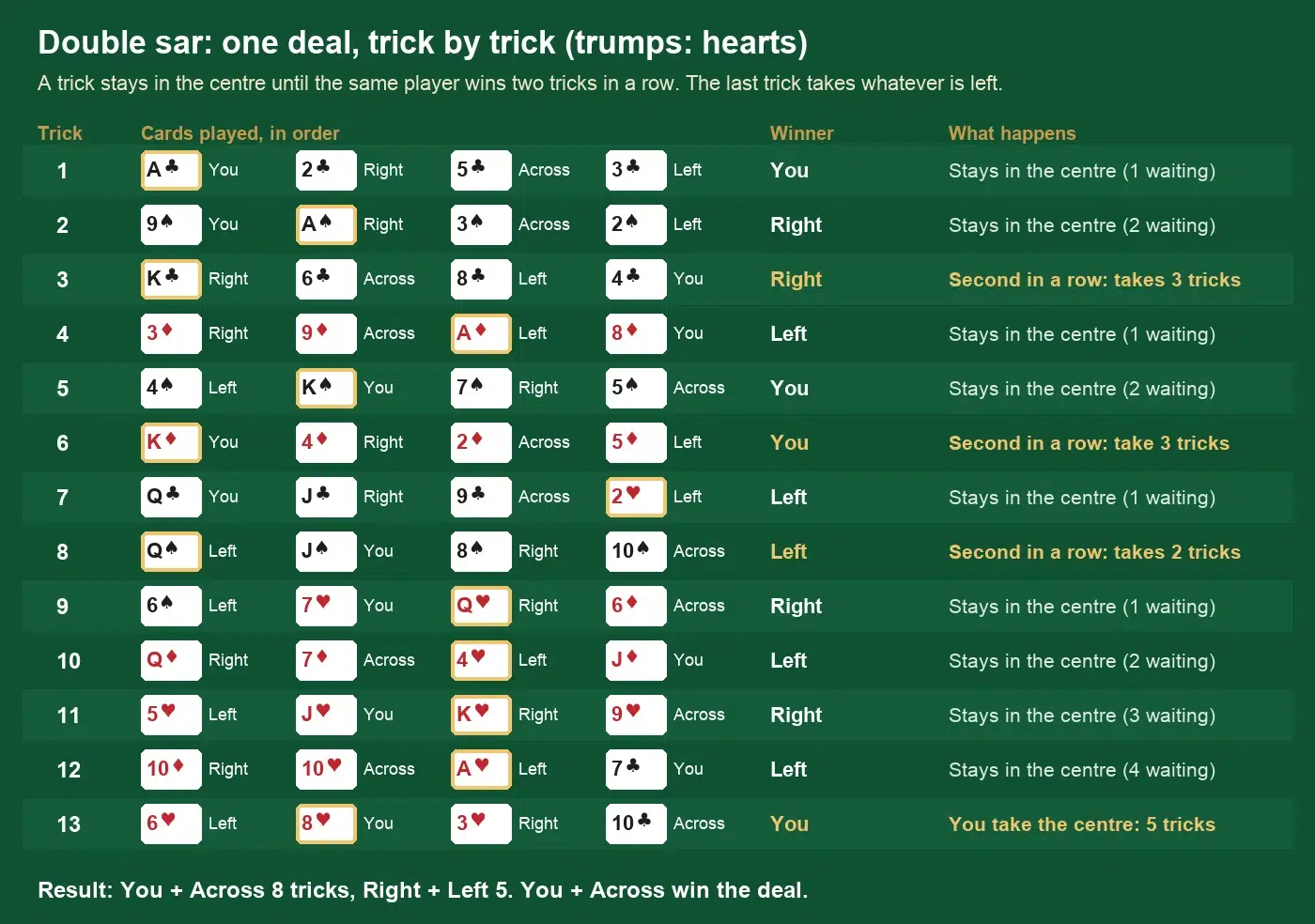
The courts change too. Because a big centre pile can change hands in one trick, a court in Double sar usually means taking all 13 tricks, which happens far more often than in the single-trick game. In 100,000 computer-played deals of Double sar, one side took all 13 tricks in 22.2% of them, a player took the centre 3.4 times per deal on average, and the biggest single pick-up averaged 6.7 tricks.
House rules for Double sar you may meet:
Dehla Pakad is Double sar in which you count the tens you capture instead of the tricks; it has its own page with a free game.
| Situation | Chance |
|---|---|
| Trump caller’s first five cards have no suit longer than two | 62.9% |
| First five cards hold three of one suit | 32.6% |
| First five cards hold four or five of one suit | 4.5% |
| No jack, queen, king or ace in the first five cards | 14.5% |
| No jack, queen, king or ace in all 13 cards | 0.364% |
| Trump caller’s side wins the deal (free game, single trick) | 59.0% |
| A court for the first seven tricks (free game, single trick) | 2.4% |
| A court for seven deals in a row (free game, per deal) | 1.1% |
| One side takes all 13 tricks (free game, Double sar) | 22.2% |
The first five rows are exact, from all 2,598,960 possible five-card hands; the rest come from 100,000 computer-played deals of each version. Single-trick deals lasted 11.1 tricks on average before one side reached seven.
| Word | Meaning |
|---|---|
| Rang, rung, hokm | The trump suit (rang means colour; hokm means command) |
| Sar, sir | A trick (single sar, double sar) |
| Court, coat, kot, kap | Seven tricks in a row from the start of a deal, or seven deals won in a row |
| Goon court, goon kot | A court won against the trump caller’s side (some players use it for any first-seven court) |
| Bavney, baunie, 52-court | All 13 tricks |
| Kaat lagana | Cutting: playing a trump when you cannot follow suit |
| Pees | To deal (as in Court Pees) |
| Seven Hands | Another name for the game: “hands” is Indian English for tricks |
Like Court Piece? Try 3 2 5 (Teen Do Paanch), Twenty-Nine, Callbreak, Mendicot and Dehla Pakad, Whist and Spades, or the Indian fishing game Seep.
Another trump game from India with a twist: in 28 (Twenty-Eight) the bidder chooses trumps secretly by placing a card face down; free to play online.

After going through several successful experiences with several industry pioneers, Fadi Hayek has managed to excel in the world of content for online gaming by providing unique content for several projects that allowed him to obtain the necessary experience to launch his career. Last but not least, Fadi also holds several certificates, including but not limited to content marketing and iGaming.


