Play the classic game of hidden fleets free, and learn the rules, the best layout and the best strategy.
Battleship is the classic two-player guessing game of hidden fleets: each player hides five ships on a 10 × 10 grid and the two of you take turns calling shots until one fleet is sunk. Play it free below against the computer, then read the official rules, the Salvo variation, and what the maths says about the best layout and the best way to shoot.
Computer’s waters (fire here)
Your fleet
Red = hit, white dot = miss, dark red = sunk. Ships: Carrier 5, Battleship 4, Destroyer 3, Submarine 3, Patrol Boat 2. Easy hunts at random, Normal uses a checkerboard search, Hard aims where ships are most likely to be. Free, no sign-up.
Battleship at a Glance
Battleship
Players
2
Grid
Two 10 × 10 grids each: rows A to J, columns 1 to 10
Fleet
5 ships, 17 squares in all
Goal
Be the first to sink all 5 of your opponent’s ships
Each turn
One shot (in Salvo, one shot for every ship you still have)
Ages
7 and up
Playing time
About 10 to 60 minutes
Board game since
1967 (Milton Bradley); played on paper long before that
The Ships
Ship
Squares
Name in sets before 2002
Carrier
5
Carrier
Battleship
4
Battleship
Destroyer
3
Cruiser
Submarine
3
Submarine
Patrol Boat
2
Destroyer
In 2002 Hasbro renamed the 3-square Cruiser to Destroyer and called the 2-square ship the Patrol Boat. The sizes did not change, so the fleet still covers 17 of the 100 squares.
How to Set Up Battleship
Sit facing each other with the lids of the game units raised, so neither of you can see the other’s ocean grid. On paper, draw two 10 × 10 grids each and keep yours hidden.
Place your five ships on your ocean grid (the flat one). Each ship goes on squares in a straight line, across or down.
Follow the placing rules: no ship may be placed diagonally, hang over the edge of the grid or overlap another ship.
Leave them there. Once the game has begun you may not move a ship.
How to Play Battleship
Decide who goes first. Then take turns, one shot per turn.
Call your shot. Pick a square on your target grid (the upright one) and call it out by letter and number, such as “D-4”.
Hit or miss. Your opponent checks their ocean grid and tells you whether your shot is a hit or a miss. On a hit they also say which ship you hit: “Hit. Destroyer.”
Mark it. Put a red peg in that square of your target grid for a hit, or a white peg for a miss, so you never call the same square twice. Your opponent puts a red peg in their ship where it was hit.
Sinking a ship. When every square of a ship has been hit, its owner must say which ship has been sunk.
Winning. The first player to sink the whole fleet of five ships wins.
How to Play Salvo
The rule book recommends Salvo for experienced players. All the normal rules apply, except:
On your turn you call out 5 different shots. At the end of the salvo, your opponent says which shots were hits and which ships were hit.
Every time one of your ships is sunk, you lose one shot from your next salvo: with 4 ships left you fire 4 shots, with 1 ship left only 1. The more ships sunk, the fewer shots you get.
For a harder game, the defender does not say which ships were hit, only how many shots hit.
Some players fire a fixed 5 shots for the whole game, or as many shots as the size of their largest undamaged ship. Tick Salvo in the game above to play the rule-book version.
Battleship Rules Questions
Can ships touch? Yes. The rules only say ships may not overlap, so they can sit side by side or end to end.
Can you place ships diagonally? No, only across or down.
Do you have to say which ship was hit? Yes, in the standard rules you name the ship on every hit and announce it when it sinks. For a harder game the rule book suggests keeping quiet about which ships were hit in Salvo, and some players do not announce when a ship sinks.
How many hits does it take to sink a ship? One for each of its squares: 5 for the Carrier down to 2 for the Patrol Boat, 17 for the whole fleet.
Can you move your ships during the game? No. Some house rules let a player move one undamaged ship every few turns, but that is not in the official rules.
Do you mark your opponent’s misses? You can, but the rule book says it is not necessary. Your own misses matter more: mark them so you never waste a shot.
Is it the same game on paper? Yes. Draw two grids each and mark your ships and every shot in pencil.
The Best Battleship Layout
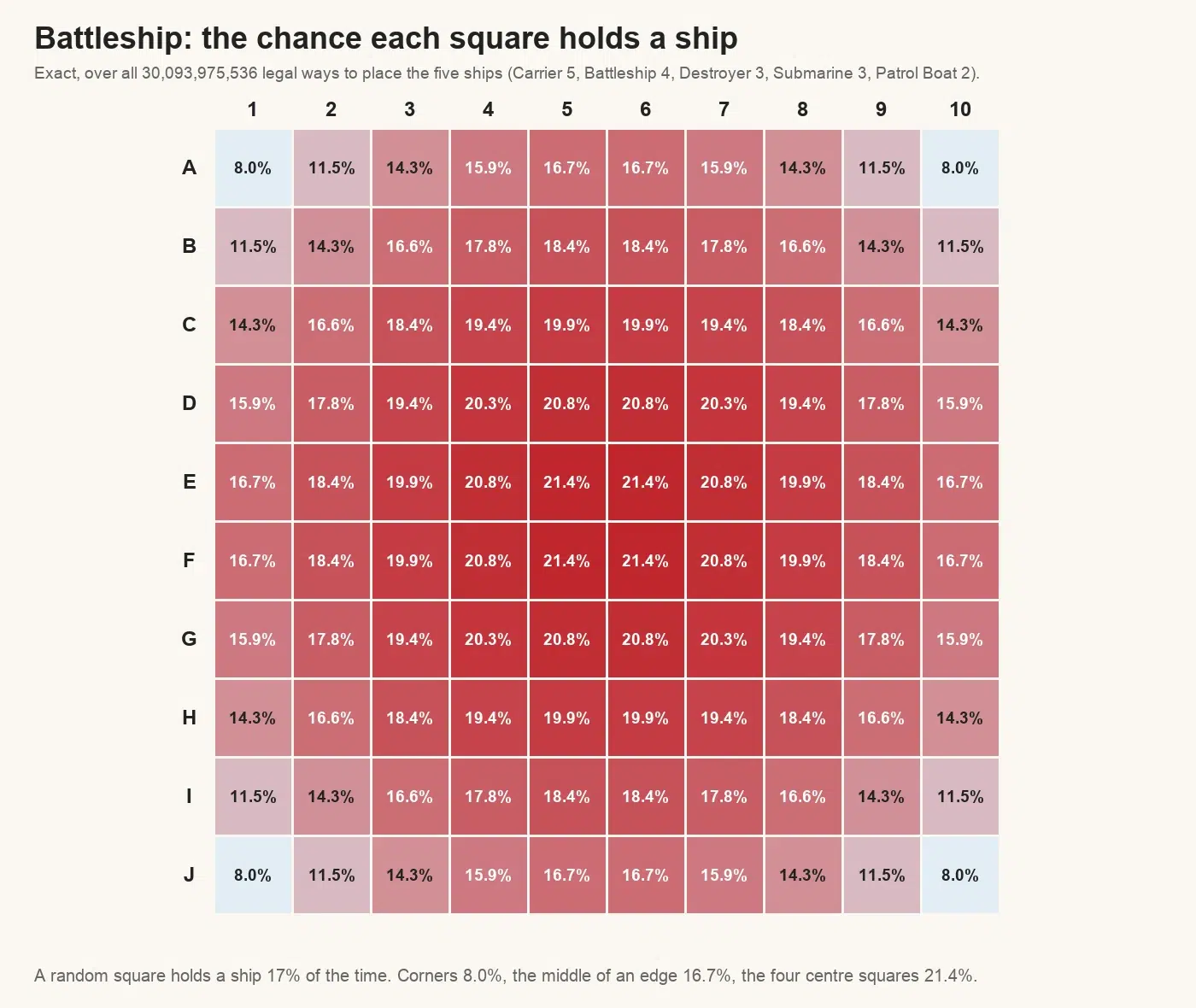
There are exactly 30,093,975,536 legal ways to place the five ships on a 10 × 10 grid. Counting every one of them shows that squares near the middle are far more likely to hold a ship than squares at the edges, simply because more ship positions pass through them.
The exact chance that each square holds a ship, over every legal layout.
A corner square holds a ship only 8.0% of the time, the middle of an edge 16.7%, and the four centre squares 21.4%. A smart opponent therefore shoots the middle first. To see what that means for your layout, the three computer players from the game above each played thousands of games against four kinds of layout. The table shows the average number of shots each needed to sink the fleet; more shots is better for you.
Your layout
Share of all layouts
v Easy (hunt and target)
v Normal (checkerboard)
v Hard (probability)
Ships anywhere (random)
100%
59.8
51.4
44.3
Every ship touches an edge
1.0%
60.1
50.8
47.7
No two ships touching
19%
61.6
53.2
44.7
All five ships in one group
1.0%
55.8
47.4
43.8
Do not bunch your ships. Five ships in one connected group are found fastest by every method: once one is hit, the others are next to it.
Spread them out. Keeping every ship apart costs the Easy and Normal players about 1.8 and 1.8 extra shots.
Edges only work against a probability player. Pushing every ship to an edge makes the Hard player, who aims at the middle, need 3.4 more shots, but it gives no help against the others.
Change it every game. A real opponent learns your habits. The best layout is one they cannot predict, so mix spread-out, edge-heavy and random layouts.
Battleship Strategy: How to Shoot
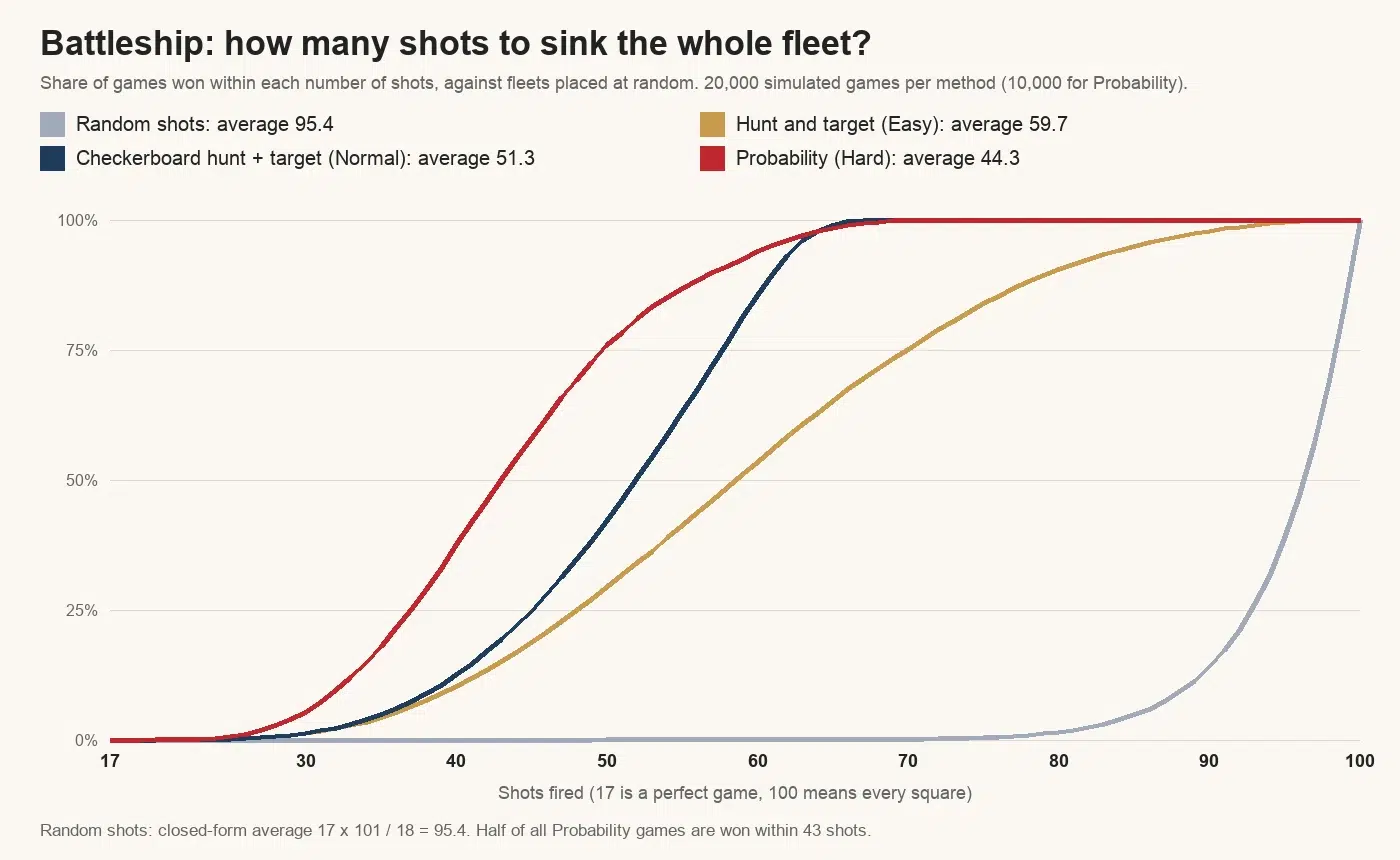
Shooting is where most games are won. The four methods below were each simulated over 20,000 games against randomly placed fleets (10,000 for the probability method), using the answers the rules give: hit or miss, and which ship was hit.
Method
How it works
Average shots
Won within 50 shots
Random
Any square not yet tried
95.4
0%
Hunt and target
Random until a hit, then the squares around it until the ship sinks
59.7
29%
Checkerboard hunt and target
Hunt only on squares of one colour of a checkerboard, then target as above
51.3
42%
Probability
Shoot the square that the most possible ship positions pass through
44.3
76%
Share of games won within each number of shots, by method.
Random shooting is hopeless. It needs 95.4 shots on average, almost the whole grid; the exact figure is 17 × 101 / 18 ≈ 95.4.
Always follow up a hit. Shooting the squares around a hit until the ship sinks cuts the average to 59.7.
Hunt on a checkerboard. Every ship covers at least two squares, so it must cover a square of each colour. Searching one colour only halves the hunting and brings the average down to 51.3, and in 20,000 games it never needed more than 70 shots. Once the Patrol Boat is sunk, every remaining ship is at least 3 long, so you can space your hunting shots three apart.
Shoot where ships can fit. Counting the positions where each remaining ship could still be is the strongest method: 44.3 shots on average and half of all games won within 43. It aims at the middle first and avoids gaps too small for any ship that is left.
Use the ship names. When your opponent says “Hit. Carrier”, you know there are 4 more squares to find in a straight line, and which other hits belong to a different ship.
Remember the gaps. A pocket of empty squares surrounded by misses that is shorter than the smallest ship left cannot hold anything, so never shoot it.
Battleship Versions
Paper Battleship: the original pencil-and-paper game, still played with two grids each.
Salvo: the 1931 first commercial edition, where all shots of a turn are fired at once; now the rule book’s variation for experienced players.
Electronic Battleship (1977) and Electronic Talking Battleship (1989): microprocessor versions with sound effects, and later a voice.
Battleship Islands (2008): hexagonal tiles and islands, with ships placed only around the islands on your half of the board.
Video game versions often change the grid size or the fleet, or add special missiles, sonar and air reconnaissance.
History of Battleship
Battleship began as a pencil-and-paper game around the time of the First World War; Russian officers are said to have played it before the war. The first commercial version, Salvo, came out in the United States in 1931, followed by other printed pad games in the 1930s and 1940s. Milton Bradley released the plastic board game with pegboards and miniature ships in 1967, and Hasbro, which later bought Milton Bradley, still makes it. It inspired the 2012 film Battleship, and in 2025 it was inducted into the National Toy Hall of Fame.
More Strategy Games
For another game of hidden pieces, play Stratego against the computer. If you like deduction, try Mastermind or Clue, and for a war game with dice, see Risk.
Each player secretly places five ships on a 10 x 10 grid, across or down. Players take turns calling one square by letter and number, such as D-4; the opponent says hit or miss and, on a hit, which ship. When every square of a ship is hit it is sunk, and the first player to sink all five ships wins.
What ships are in Battleship?
Carrier (5 squares), Battleship (4), Destroyer (3), Submarine (3) and Patrol Boat (2): 17 squares in all. Sets made before 2002 call the 3-square ship a Cruiser and the 2-square ship a Destroyer.
Can Battleship ships touch?
Yes. The rules only forbid placing ships diagonally, off the edge of the grid or overlapping another ship, so ships may sit next to each other.
What is the best Battleship layout?
There is no layout that always wins, but simulations show that keeping your ships apart costs a typical opponent about two extra shots, and bunching them together helps the opponent. Against a player who aims at the middle, ships along the edges last longer, since an edge square holds a ship far less often than a centre square.
What is the best Battleship strategy?
Hunt on a checkerboard pattern until you hit, then shoot the squares around the hit until that ship sinks. The strongest method counts where each remaining ship could still fit and shoots the most likely square: about 44 shots on average, against 95 for random shooting.
How many hits does it take to sink a ship in Battleship?
One per square of the ship: 5 for the Carrier, 4 for the Battleship, 3 each for the Destroyer and Submarine and 2 for the Patrol Boat. All 17 squares must be hit to sink the whole fleet.
How does Salvo work in Battleship?
Each turn you fire 5 shots at once, and your opponent then says which were hits and which ships were hit. Every time one of your ships is sunk you fire one shot fewer, so with one ship left you get only one shot.
How many possible Battleship layouts are there?
With the standard five ships on a 10 x 10 grid there are exactly 30,093,975,536 legal layouts, counting the two 3-square ships as different ships.
Fadi Hayek
Author & Casino Expert
After going through several successful experiences with several industry pioneers, Fadi Hayek has managed to excel in the world of content for online gaming by providing unique content for several projects that allowed him to obtain the necessary experience to launch his career. Last but not least, Fadi also holds several certificates, including but not limited to content marketing and iGaming.
As online casinos adopt machine learning models and artificial intelligence in gambling becomes the next disruption, you don’t want to be left behind. Read on to learn about the impact AI will have on the future of the gambling industry.
Keep abreast of the latest Arabian football betting trends with the Arabian sports betting insights below. This guide covers the most popular bet types with Arab bettors and the top bookmakers for Arabian and global football competitions.
Yggdrasil and Reflex are set to launch Dublin Up DoubleMax, an Irish-style video, as one of their latest releases. The slot game is designed by incorporating Yggdrasil’s proprietary Game Engagement Mechanic (GEM) DoubleMax coupled with unique features like free spins bonus and fairy magic.