How to Play Sudoku
The rules, a step-by-step way to start, the solving techniques for hard puzzles, and a free Sudoku game with hints.


The rules, a step-by-step way to start, the solving techniques for hard puzzles, and a free Sudoku game with hints.
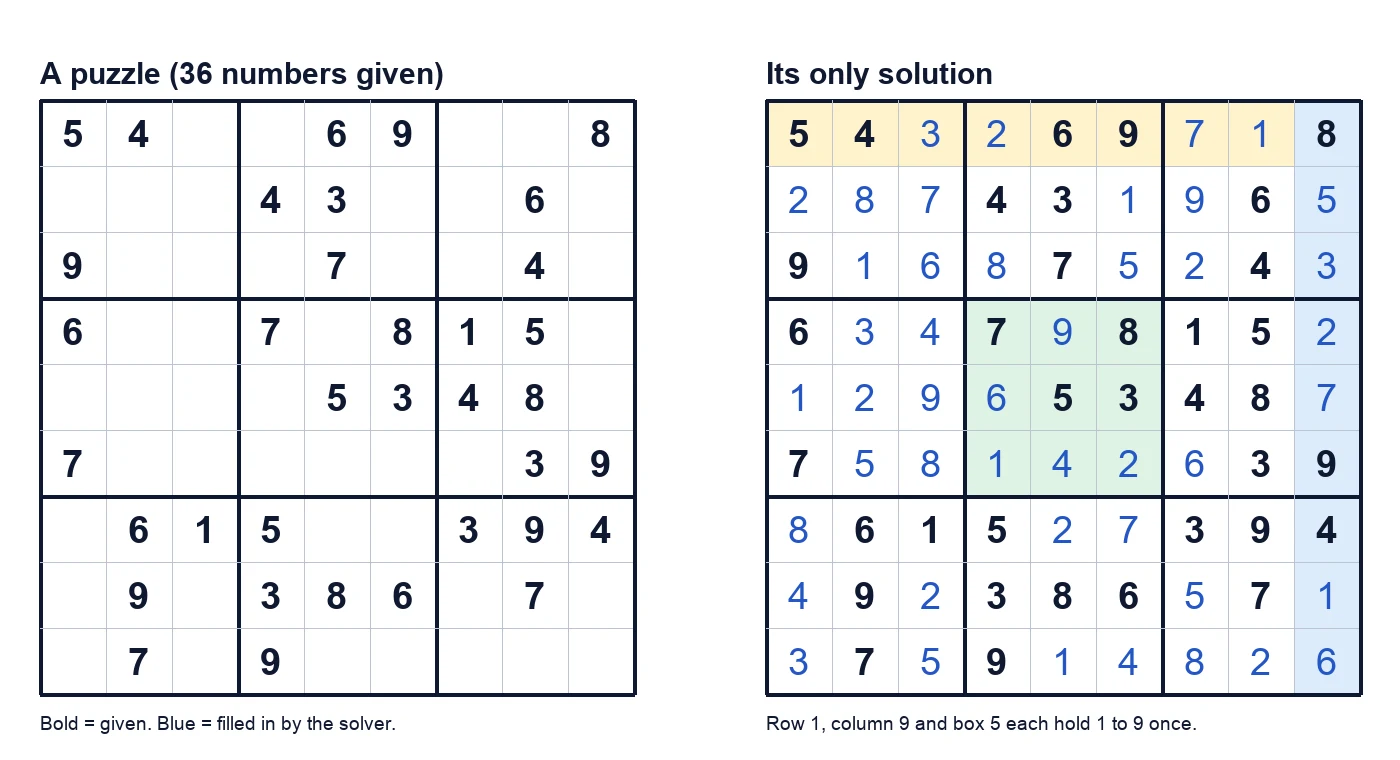
Sudoku is a number puzzle with one rule: fill the 9×9 grid so that every row, every column and every 3×3 box holds the digits 1 to 9 exactly once. There is no maths in it beyond counting to nine, and every proper puzzle has exactly one answer, so it can always be solved by logic alone, without guessing.
This page has a free Sudoku game you can play right here, the rules in plain words, a step-by-step way to start any puzzle, and the solving techniques that take you from easy to hard puzzles, each one shown on a real grid.

Pick Easy, Medium or Hard. Tap a cell, then a number. Turn on Notes to pencil in the digits a cell could still be. Stuck? Hint fills in one cell and tells you which technique finds it, so you learn the move rather than just get the answer; if you have made a mistake, it points to the wrong number first. Every puzzle has exactly one solution and can be solved without guessing, and your game is saved in this browser if you leave the page.
A Sudoku grid has 81 cells in 9 rows and 9 columns, divided into nine 3×3 boxes. Some cells are filled in already: these are the givens (or clues) and they cannot be changed. Your job is to fill in the empty cells so that:
That is the whole rulebook. The numbers are only symbols: you never add them up, and the puzzle would work just as well with nine letters or nine colours. A well-made puzzle has exactly one solution, which is why you never need to guess: every number can be worked out from the ones around it.
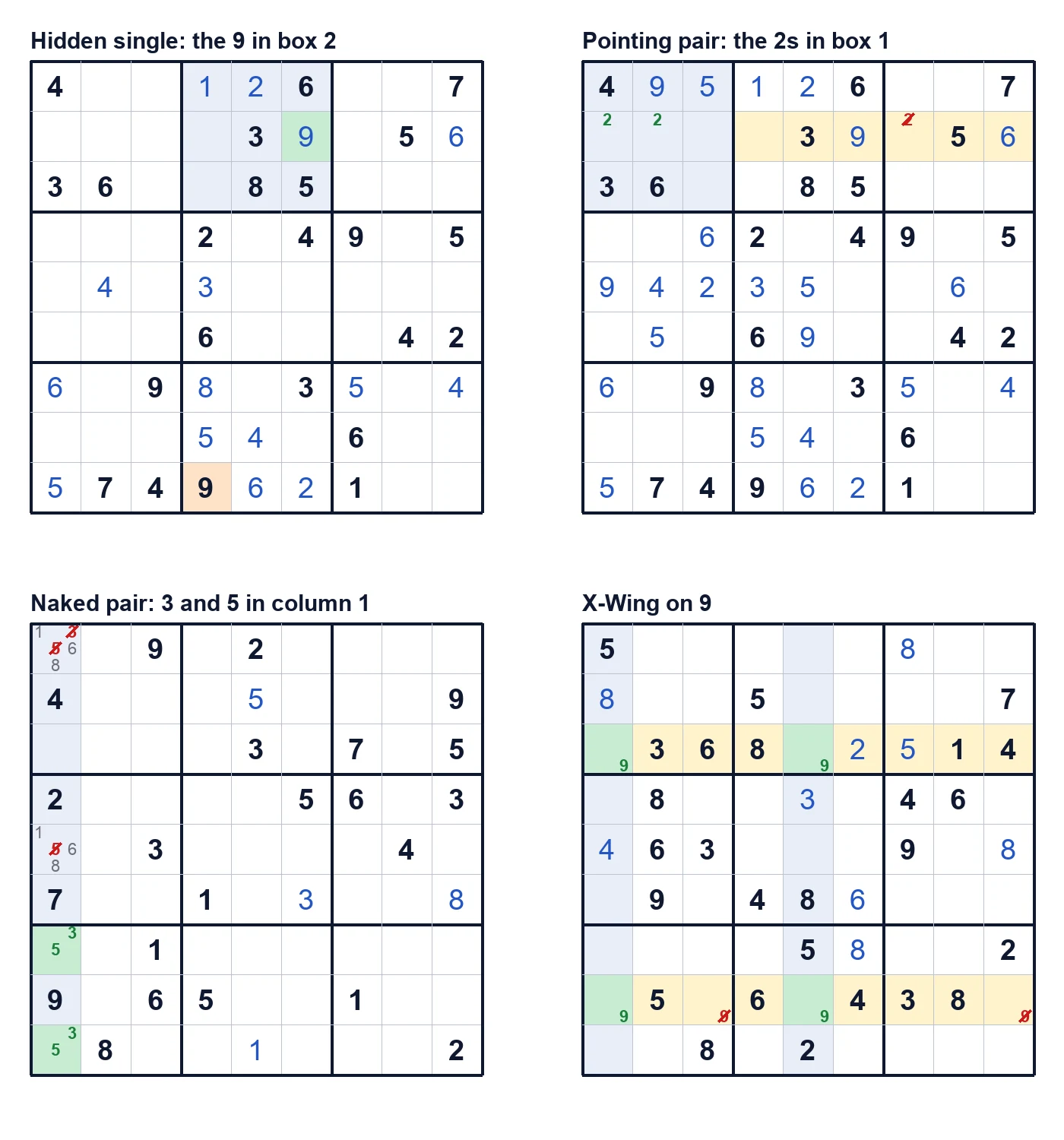
Almost every Sudoku you will meet in a newspaper or an app can be solved with a handful of techniques. Here they are from the simplest up. The Hint button in the game names the one it used, so you can practise them one by one.
A cell where eight of the nine digits are already in its row, column or box. Only one digit is left, so it goes in. On Easy puzzles you can solve the whole grid with naked and hidden singles.
A digit that has only one possible cell in a row, column or box, even though that cell could hold other digits too. This is what the scanning in step 1 finds, and it is the move most players use most of the time.
If, inside one box, a digit can only go in cells that lie in the same row, then that digit must be in that row within the box, so you can cross it off the rest of the row outside the box. This is a pointing pair (or pointing triple). The reverse is box-line reduction: if within a row or column a digit can only go in cells of one box, cross it off the other cells of that box. These two are what our Medium puzzles need.
If two cells in the same row, column or box can each only be the same two digits, say 3 or 5, then those two cells take the 3 and the 5 between them, and no other cell in that unit can be 3 or 5. Three cells sharing three candidates work the same way (a naked triple).
If two digits can only go in the same two cells of a unit, those cells must hold those two digits, so any other candidates in them can be erased. Hidden pairs are harder to spot than naked ones, because the extra candidates hide the pattern.
Take one digit. If in two rows it can only go in the same two columns, it must sit in opposite corners of that rectangle, whichever way round. So in those two columns it cannot be anywhere else, and you can cross it off the rest of both columns. The same works with rows and columns swapped. X-Wing is the first of the “fish” patterns, and it is rarely needed: just one of our 40 Hard puzzles uses it.
Difficulty is not about how many numbers are given; it is about which techniques you need. Every puzzle in the game above was graded by solving it with the techniques on this page, from the simplest up:
| Level | Numbers given | What you need |
|---|---|---|
| Easy | 36 | Naked and hidden singles only |
| Medium | 22 to 26 | Singles plus pointing pairs or box-line reduction |
| Hard | 22 to 26 | Naked or hidden pairs and triples (all 40), X-Wing (1 of the 40) |
Notice that our Medium and Hard puzzles give the same number of clues. A 22-clue puzzle can be easier than a 26-clue one: what matters is where the givens sit and which moves they leave open.
| Fact | Number |
|---|---|
| Cells in a grid | 81 (9 rows × 9 columns) |
| Units that must each hold 1 to 9 | 27 (9 rows, 9 columns, 9 boxes) |
| Other cells each cell must differ from | 20 (8 in its row, 8 in its column, 4 more in its box) |
| Different completed Sudoku grids | 6,670,903,752,021,072,936,960 |
| Essentially different grids (counting rotations, reflections and relabelling as the same) | 5,472,730,538 |
| Fewest givens a puzzle with one solution can have | 17 |
So there are about 6.7 sextillion possible finished grids, far too many for anyone to run out of puzzles. Yet no proper Sudoku can be built with fewer than 17 givens: with 16 or fewer, there is always more than one way to finish the grid.
Sudoku looks Japanese, but its roots are French and American. On 19 November 1892 the Paris daily Le Siècle printed a partly completed 9×9 magic square with 3×3 sub-squares, and in July 1895 its rival La France published something very close to a modern Sudoku, the “diabolical magic square”.
The modern puzzle was most likely designed by Howard Garns, a 74-year-old retired architect from Connersville, Indiana, and first published in 1979 by Dell Magazines as Number Place. Garns died in 1989, before it became a worldwide craze.
In April 1984 the Japanese puzzle company Nikoli printed it as Sūji wa dokushin ni kagiru, “the digits must be single”, and in 1986 Nikoli’s president Maki Kaji shortened that to sudoku. It reached the rest of the world through Wayne Gould, a retired Hong Kong judge who wrote a computer program to make the puzzles: the Conway Daily Sun in New Hampshire ran one in September 2004, and The Times of London launched “Su Doku” on 12 November 2004. From there it spread quickly to newspapers around the world.
If you like Sudoku’s pure logic, try Nine Men’s Morris or Chinese Checkers against the computer, hunt ships in Battleship, or find words against the clock in Boggle. For a dice game with the whole family, there is Ludo.

After going through several successful experiences with several industry pioneers, Fadi Hayek has managed to excel in the world of content for online gaming by providing unique content for several projects that allowed him to obtain the necessary experience to launch his career. Last but not least, Fadi also holds several certificates, including but not limited to content marketing and iGaming.


