The full rules of the classic world-conquest board game, with an exact battle odds calculator and a dice roller.
Risk is the classic board game of world conquest for 2 to 6 players: you place armies on a map of 42 territories, attack your neighbours with dice, and win by occupying every territory on the board. This guide covers the full rules from the official rule book, and the calculator below gives the exact odds of any battle. You can also roll the dice and fight it out.
Chance to capture the territory
Exact odds, worked out from every possible dice roll (no simulation). The attacker always rolls as many dice as allowed (up to 3, keeping one army behind) and the defender up to 2; ties go to the defender. Free, no sign-up.
Risk at a Glance
Risk
Players
2 to 6 (ages 10 and up)
Board
A world map of 6 continents and 42 territories
Equipment
Armies in 6 colours, 5 dice (3 red for the attacker, 2 white for the defender), 56 cards: 42 territory cards, 2 wild cards and 12 secret mission cards
Army pieces
Infantry = 1 army, Cavalry = 5, Artillery = 10
Goal
Conquer the world: occupy all 42 territories and eliminate every opponent
Each turn
Get and place new armies, attack (if you choose), then fortify
Battles
Attacker rolls up to 3 dice, defender up to 2; ties go to the defender
How to Set Up Risk
Count out your armies. Each player takes Infantry pieces according to the number of players: 35 each with 3 players, 30 with 4, 25 with 5 and 20 with 6. (Two players use different rules; see below.)
Roll for first place. Everyone rolls one die; the highest roller places one army on any territory to claim it.
Claim the map. Going left, each player places one army on an empty territory until all 42 are claimed.
Reinforce. Keep taking turns placing one army at a time on any territory you already hold, until everyone has placed all their armies. There is no limit per territory.
Shuffle the cards. Remove the 12 mission cards, shuffle the rest and place them face down. The player who placed the first army starts.
How to Play Risk: Your Turn
1. Get and place new armies
Territories: count the territories you hold and divide by 3, ignoring fractions. You always get at least 3 armies.
Continents: if you hold every territory of a continent at the start of your turn, you get its bonus (table below).
Cards: trade in a matched set of 3 cards for extra armies (see Risk cards).
Continent
Territories
Bonus armies
Asia
12
7
North America
9
5
Europe
7
5
Africa
6
3
South America
4
2
Australia
4
2
2. Attack
You may attack any territory next to one of yours, or joined to it by a dashed sea line (Alaska and Kamchatka count as neighbours).
You need at least 2 armies on the territory you attack from, because one must always stay behind.
The attacker rolls 1, 2 or 3 red dice and must have at least one more army on the territory than the dice rolled. The defender rolls 1 or 2 white dice; two dice need at least 2 armies on the defending territory.
Compare the dice: the attacker’s highest die against the defender’s highest, then the next highest against the next highest. Each loser removes one army. Ties go to the defender. The attacker never loses more than 2 armies on one roll.
You can keep attacking the same territory, switch to another, or stop at any time.
Capturing: when the last defending army is gone, move in at least as many armies as the dice you rolled in the final battle, always leaving one behind.
3. Fortify
At the end of your turn you may make one free move: shift as many armies as you like from one of your territories to one adjacent territory you hold, leaving at least one behind. Then pass the dice to the left.
An attack in progress: three red dice for the attacker, two white for the defender.
Risk Cards and Trading In Sets
At the end of any turn in which you captured at least one territory, take one card (only one, however many you captured).
A set is three of the same design (Infantry, Cavalry or Artillery), one of each, or any two plus a wild card.
You may trade a set at the start of your turn. With 5 or 6 cards you must trade at least one set. Five cards always contain a set, which is why the rule can force it.
If a traded card shows a territory you occupy, you get 2 extra armies on that territory (no more than 2 extra per turn).
Eliminate a player and you take all their cards. If that gives you 6 or more, trade immediately until you have 4 or fewer.
Set traded in (by anyone)
Armies
1st
4
2nd
6
3rd
8
4th
10
5th
12
6th
15
7th
20
8th and after
5 more each time (25, 30, 35 …)
Winning
The first player to eliminate every opponent by occupying all 42 territories wins.
Risk Dice Odds: One Roll
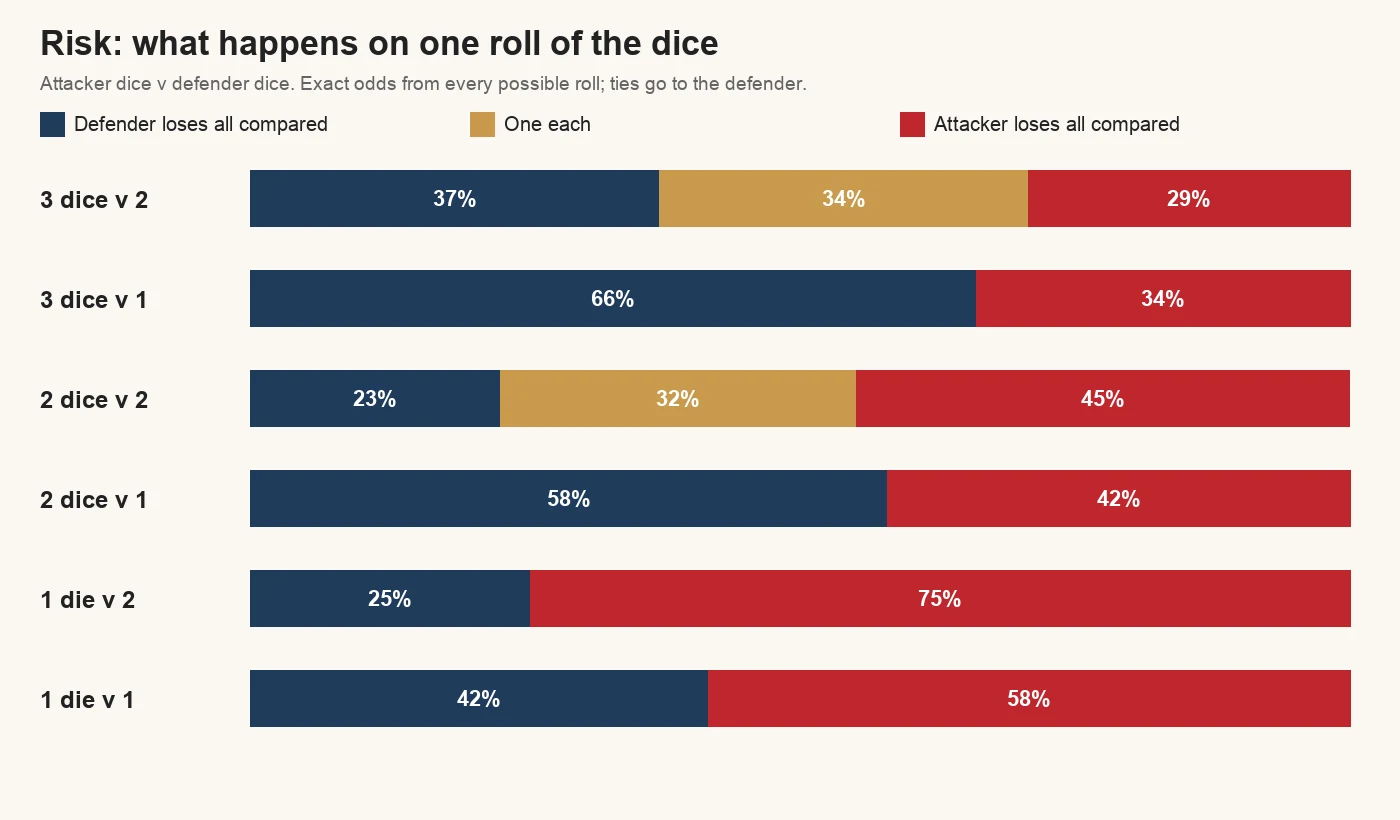
Every possible combination of dice was counted (7,776 of them for 3 dice against 2), so these odds are exact.
Dice (attacker v defender)
Defender loses all
One each
Attacker loses all
3 v 2
37%
34%
29%
3 v 1
66%
–
34%
2 v 2
23%
32%
45%
2 v 1
58%
–
42%
1 v 2
25%
–
75%
1 v 1
42%
–
58%
What happens on one roll, for every combination of dice.
Three dice against two favours the attacker, but only just: on average the defender loses 1.08 armies per roll and the attacker 0.92.
The tie rule hurts with fewer dice. With two dice against two, the attacker loses both armies 45% of the time.
Always roll the most dice you can, unless you want to limit how many armies you might have to move in.
Risk Battle Odds: Capturing a Territory
In a battle to the end, the attacker rolls as many dice as allowed and keeps going until the territory falls or only one army is left. The table shows how many armies you need on your territory, counting the one that stays behind.
Defending armies
50% chance
75% chance
90% chance
1
3
3
4
2
4
5
7
3
5
6
8
4
6
8
10
5
6
9
11
6
7
10
12
7
8
11
14
8
9
12
15
9
10
13
16
10
11
14
17
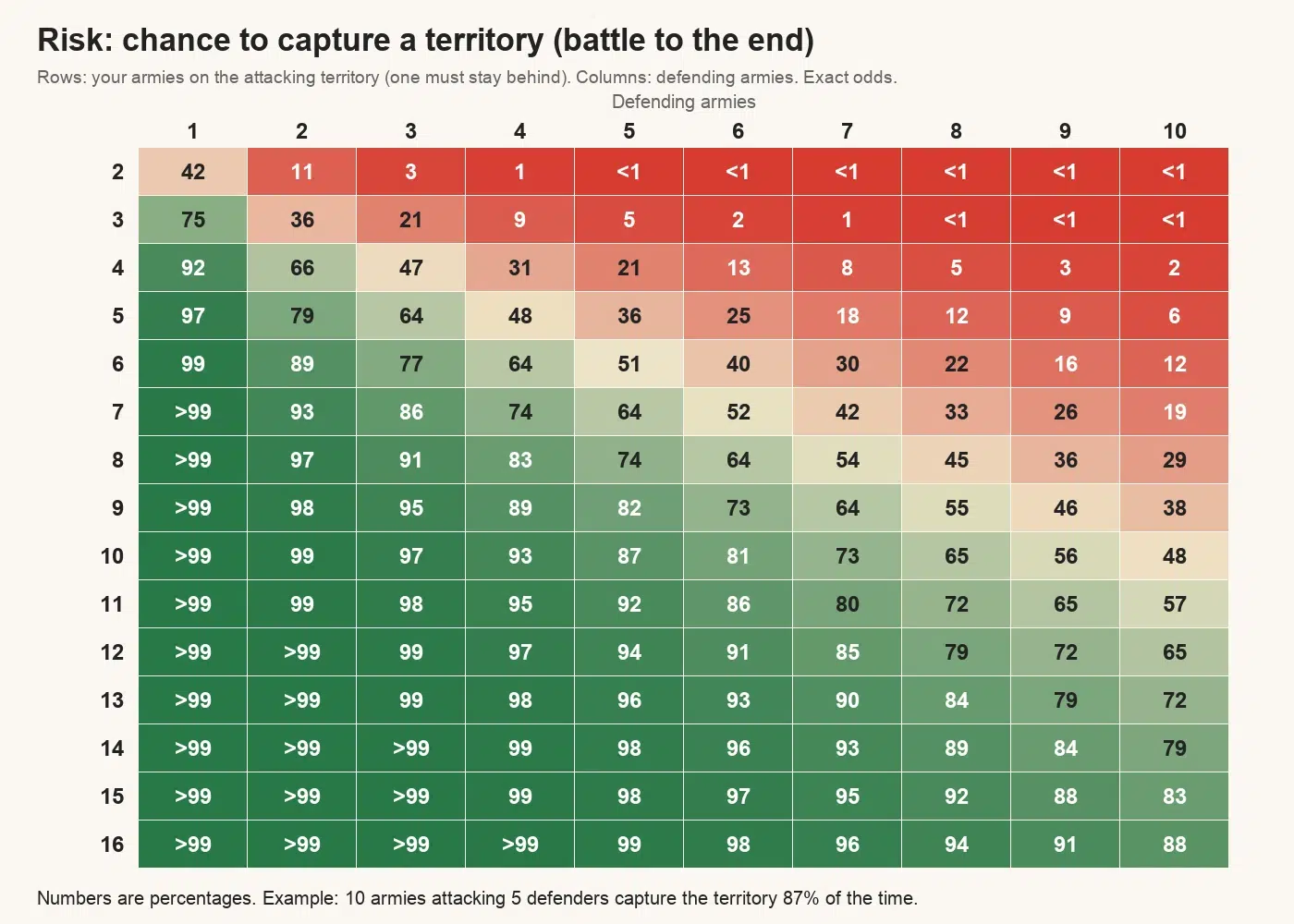
Chance to capture a territory, for 2 to 16 attacking and 1 to 10 defending armies.
Common rules of thumb hold up. 4 armies against 1 capture the territory 92% of the time, 5 against 2 79%, 6 against 3 77% and 8 against 4 83%. Attacking with one and a half times the defenders wins 83% at 15 against 10 and 94% at 30 against 20.
Big battles favour the attacker. With equal numbers on both territories, the attacker wins 36% at 5 against 5, 48% at 10 against 10 and 58% at 20 against 20, because three dice against two pays off over many rolls.
Winning is expensive. 11 armies attacking 10 capture the territory 57% of the time, losing 7.3 armies on average while the defender loses 8.2.
Risk Strategy Tips
Take whole continents. The official rule book’s first tip: continents are where the extra armies come from.
Start small and defensible. Australia can be held by fortifying one territory (Siam or Indonesia). South America has 2 ways in, North America and Africa 3, Europe 4 and Asia 5.
Fortify your borders. Put your armies on territories next to enemies; armies deep inside your own land cannot attack or defend.
Watch the build-ups. A neighbour stacking armies next to you is usually about to attack.
Time your card trades. Set values climb every time anyone trades, so holding cards can pay; but with 5 cards you must trade.
Hunt players with lots of cards. Eliminating them hands you their cards, often enough for an immediate trade.
Check the odds before you attack. Use the calculator above, and set a stop value if you need to keep armies at home.
Risk Variations
Two players: each player takes 40 armies, and a third, neutral colour also gets 40. Deal the territory cards into three piles to claim territories; neutral armies never attack or reinforce, and your opponent rolls to defend them.
Capital Risk: each player secretly picks a headquarters territory. Capture every opposing headquarters while keeping your own to win (or 2 of them with 4 players, 3 with 5 or 6).
Secret Mission Risk (3 to 6 players): each player gets a mission card, such as destroying one colour, and the first to complete it wins. This has long been the standard game in Europe.
Expert rules: sets increase by only 1 army each time; fortify through a chain of your own territories; re-roll one die when attacking from or to a territory on one of your cards; or once per turn turn one attacking die to a 6.
History of Risk
Risk was invented by the French film director Albert Lamorisse and published in France in 1957 as La Conquête du Monde. Parker Brothers released it in the US in 1959 as Risk: The Continental Game, and it is now made by Hasbro in many themed editions.
Another classic war game: learn the Stratego rules and play it free against the computer.
For a naval war game: learn the Battleship rules and play it free.
Risk: frequently asked questions
How do you play Risk?
Players claim the 42 territories of a world map and place their armies. Each turn you receive new armies (territories divided by 3, at least 3, plus continent bonuses and card sets), attack neighbouring territories by rolling dice, and finish with one fortifying move. The first player to occupy all 42 territories wins.
How many armies do you start with in Risk?
35 each with 3 players, 30 with 4, 25 with 5 and 20 with 6. In the two-player game each player and a neutral colour get 40.
How do the dice work in Risk?
The attacker rolls up to 3 red dice (needing one more army than dice rolled) and the defender up to 2 white dice. Compare highest with highest and second with second; the lower die loses an army each time, and ties go to the defender.
What are the odds in Risk with 3 dice against 2?
On one roll the defender loses both armies 37% of the time, each side loses one 34% of the time, and the attacker loses both 29% of the time.
How many armies do you get for continents in Risk?
Asia 7, North America 5, Europe 5, Africa 3, South America 2 and Australia 2, as long as you hold every territory of the continent at the start of your turn.
How much are Risk card sets worth?
The first set traded in by anyone is worth 4 armies, then 6, 8, 10, 12 and 15, and 5 more for each set after that (20, 25 and so on). A card showing a territory you hold adds 2 armies there.
How many armies do you need to win a battle in Risk?
Counting the army that stays behind, 4 armies beat 1 defender 92% of the time, 5 beat 2 defenders 79% of the time and 8 beat 4 defenders 83% of the time. The calculator on this page gives the exact odds for any numbers.
Who invented Risk?
The French film director Albert Lamorisse, who published it in 1957 as La Conquête du Monde. Parker Brothers brought it to the US in 1959.
Fadi Hayek
Author & Casino Expert
After going through several successful experiences with several industry pioneers, Fadi Hayek has managed to excel in the world of content for online gaming by providing unique content for several projects that allowed him to obtain the necessary experience to launch his career. Last but not least, Fadi also holds several certificates, including but not limited to content marketing and iGaming.
As online casinos adopt machine learning models and artificial intelligence in gambling becomes the next disruption, you don’t want to be left behind. Read on to learn about the impact AI will have on the future of the gambling industry.
Keep abreast of the latest Arabian football betting trends with the Arabian sports betting insights below. This guide covers the most popular bet types with Arab bettors and the top bookmakers for Arabian and global football competitions.
Yggdrasil and Reflex are set to launch Dublin Up DoubleMax, an Irish-style video, as one of their latest releases. The slot game is designed by incorporating Yggdrasil’s proprietary Game Engagement Mechanic (GEM) DoubleMax coupled with unique features like free spins bonus and fairy magic.