Learn how to play the classic game of hidden armies, and play it free against the computer.
Stratego is the classic two-player game of hidden armies. Each side has 40 pieces on a 10 × 10 board, every rank facing its owner, and the aim is to find and capture the enemy Flag. Play it free below against the computer, then read the full rules: the pieces, how to set up, move and attack, the Bomb, Miner and Spy, and the odds of every battle.
You have lost:
The computer has lost:
10 Marshal ×19 General ×18 Colonel ×27 Major ×36 Captain ×45 Lieutenant ×44 Sergeant ×43 Miner ×52 Scout ×8S Spy ×1B Bomb ×6F Flag ×1
Red (you) moves first. Pieces move one square up, down or sideways; Scouts move any distance in a straight line. Higher rank wins a battle, equal ranks both go, only a Miner defuses a Bomb and the Spy takes the Marshal only by attacking it. Free, no sign-up.
Stratego at a Glance
Stratego
Players
2
Board
10 × 10 squares with two lakes in the middle, so 92 squares are in play
Pieces
40 per player: 33 that move, 6 Bombs and 1 Flag
Goal
Capture the other player’s Flag, or leave them with no piece that can move
Set-up
Anywhere in your four nearest rows; the two middle rows start empty
Who starts
Red
Playing time
From about 10 minutes to an hour and a half
Ages
8 to adult
The Stratego Pieces
In current sets a higher number means a higher rank, with the Marshal (10) at the top. Older American sets numbered the ranks the other way round, from the Marshal (1) down to the Scout (9).
Rank
Piece
Per player
What it does
10
Marshal
1
The strongest piece, but lost if the Spy attacks it
9
General
1
Loses only to the Marshal and to Bombs
8
Colonel
2
7
Major
3
6
Captain
4
5
Lieutenant
4
4
Sergeant
4
3
Miner
5
The only piece that can defuse a Bomb
2
Scout
8
Moves any number of open squares in a straight line
S
Spy
1
Captures the Marshal if it attacks first; loses to any other piece
B
Bomb
6
Never moves; removes any attacker except a Miner
F
Flag
1
Never moves; lose it and you lose the game
How to Set Up Stratego
Choose colours. One player takes Red and the other Blue. Red moves first.
Place the board between you, with the two lakes in the middle.
Place your 40 pieces on the four rows nearest to you, one piece per square, with the ranks facing you so the other player cannot read them. Some sets include a screen to hide the board while you both set up.
Leave the two middle rows empty. The lakes sit on these rows and no piece may ever enter them.
Start. When both armies are in place, remove the screen and Red makes the first move.
The set-up decides a lot of games, so plan it with the rules for moving and attacking in mind (see the strategy tips below).
How to Play Stratego
Players take turns. On your turn you must do one of two things: move one of your pieces, or attack one of your opponent’s pieces. If you cannot do either, the game is over and you lose.
Moving
A piece moves one square forward, backward or sideways, never diagonally.
It cannot jump over another piece, and it cannot move onto a square that is already occupied unless it is attacking.
No piece may enter or cross the two lakes.
Only one piece moves each turn.
Bombs and the Flag never move: they stay where they were placed for the whole game.
The two-square rule: a piece may not move back and forth between the same two squares for more than three turns in a row.
The Scout’s special move
A Scout can move any number of open squares forward, backward or sideways in a straight line, like a rook in chess, and it can attack at the end of that move. The catch: a long move shows the other player that the piece is a Scout. To keep it hidden, move it one square at a time.
Attacking
You can attack an enemy piece on the square directly in front of, beside or behind your piece, never diagonally. Attacking is always optional.
To attack, tap the enemy piece with yours and call out your rank. The other player calls out theirs.
The lower rank loses and is removed from the board. If the attacker wins, it moves onto the defender’s square; if the defender wins, it stays where it is.
When both pieces have the same rank, both are removed.
The special battles
Bomb: any piece that strikes a Bomb is lost, and the Bomb stays put. The only exception is the Miner, which defuses the Bomb, removes it and moves onto its square.
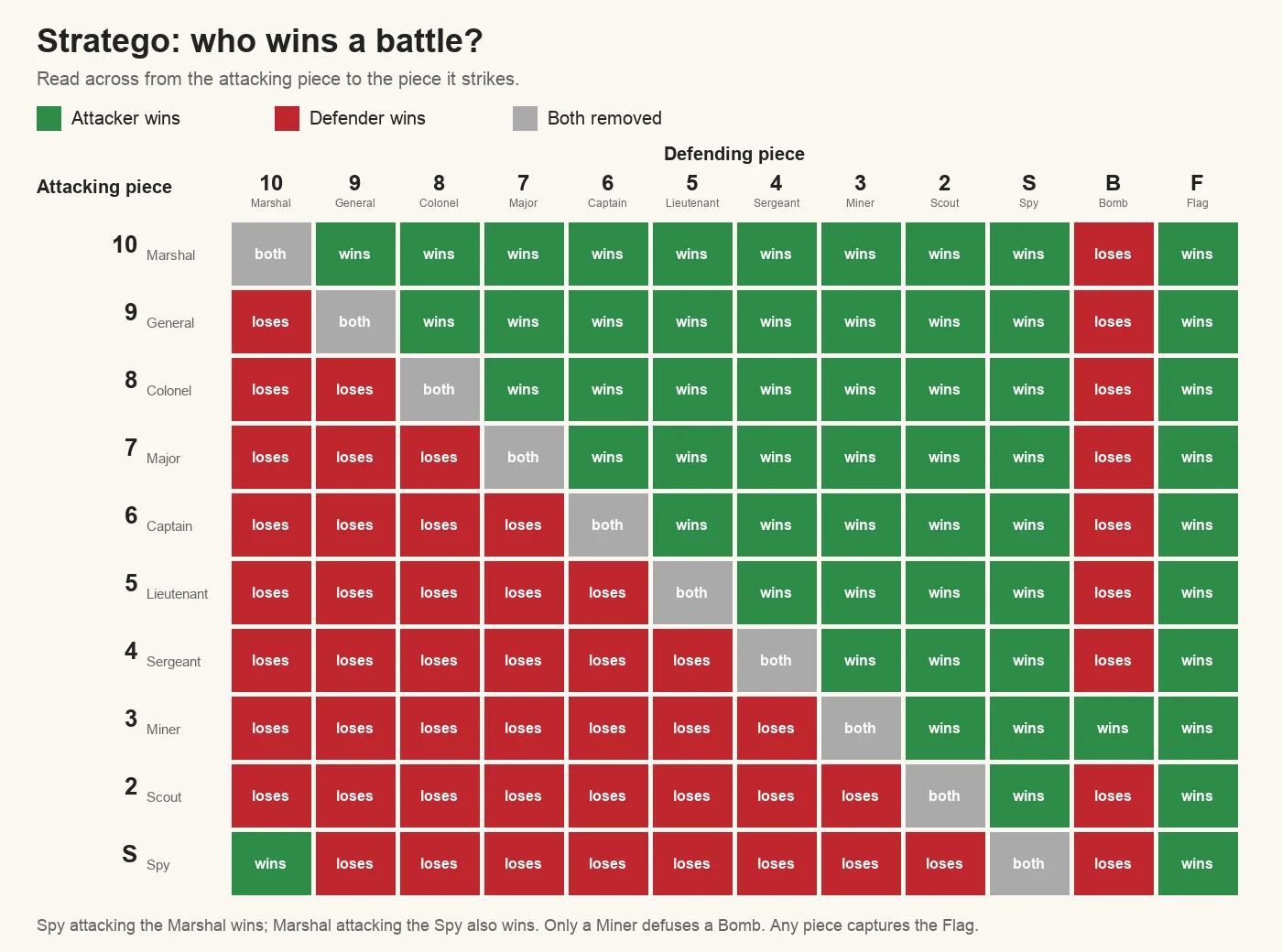
Spy: the Spy is the weakest piece and loses to anything that attacks it. But if the Spy attacks the Marshal first, the Marshal is removed. If the Marshal attacks the Spy, the Spy loses.
Flag: any piece that attacks the Flag captures it and wins the game, even the Spy or a Scout.
Every possible battle: read across from the attacking piece to the piece it strikes.
How to Win at Stratego
The first player to attack the other side’s Flag captures it and wins. You also win if your opponent cannot move or attack on their turn: when all of their movable pieces are gone, or the ones left are boxed in by their own Bombs, they must give up. A draw is possible but rare, for example when both Flags are walled in by Bombs and neither player has a Miner left.
Stratego Rules Questions
Can a Scout move and attack in the same turn? Yes, under the current rules. Some older sets and the Library edition do not allow it, so agree before you start.
Can pieces move diagonally? No. Moves and attacks are only forward, backward and sideways.
Do you have to attack? No, attacking is optional. But you must move or attack with something every turn; you cannot pass.
Can a Bomb or the Flag attack? No. They can only wait for the enemy to strike them.
Who wins if the Marshal attacks the Spy? The Marshal. The Spy only beats the Marshal when the Spy makes the attack.
Can a Scout jump over the lakes? No. Like every other piece it has to go around them.
What happens to captured pieces? They come off the board for the rest of the game, unless you play the Rescue rule below.
How does the two-square rule work? A piece cannot shuttle between the same two squares for more than three turns in a row; whoever started the shuttling must stop first. In the game above, the fourth move back is not allowed.
Optional Tournament Rules
The Milton Bradley rule book adds three optional rules for experienced players. Use any one of them, or all three.
Aggressor advantage: when pieces of the same rank battle, the attacker wins instead of both being removed.
Silent defence: only the attacker calls out a rank. The defender does not reveal theirs, but removes whichever piece has the lower rank. When a Scout attacks, the defender must say their rank.
Rescue: when one of your pieces reaches your opponent’s back row, you can take back one of your captured pieces and place it on any empty square on your half of the board; that ends your turn. Scouts cannot make a rescue, Bombs cannot be rescued, each player can rescue only twice, and the same piece cannot make both rescues.
Stratego Odds
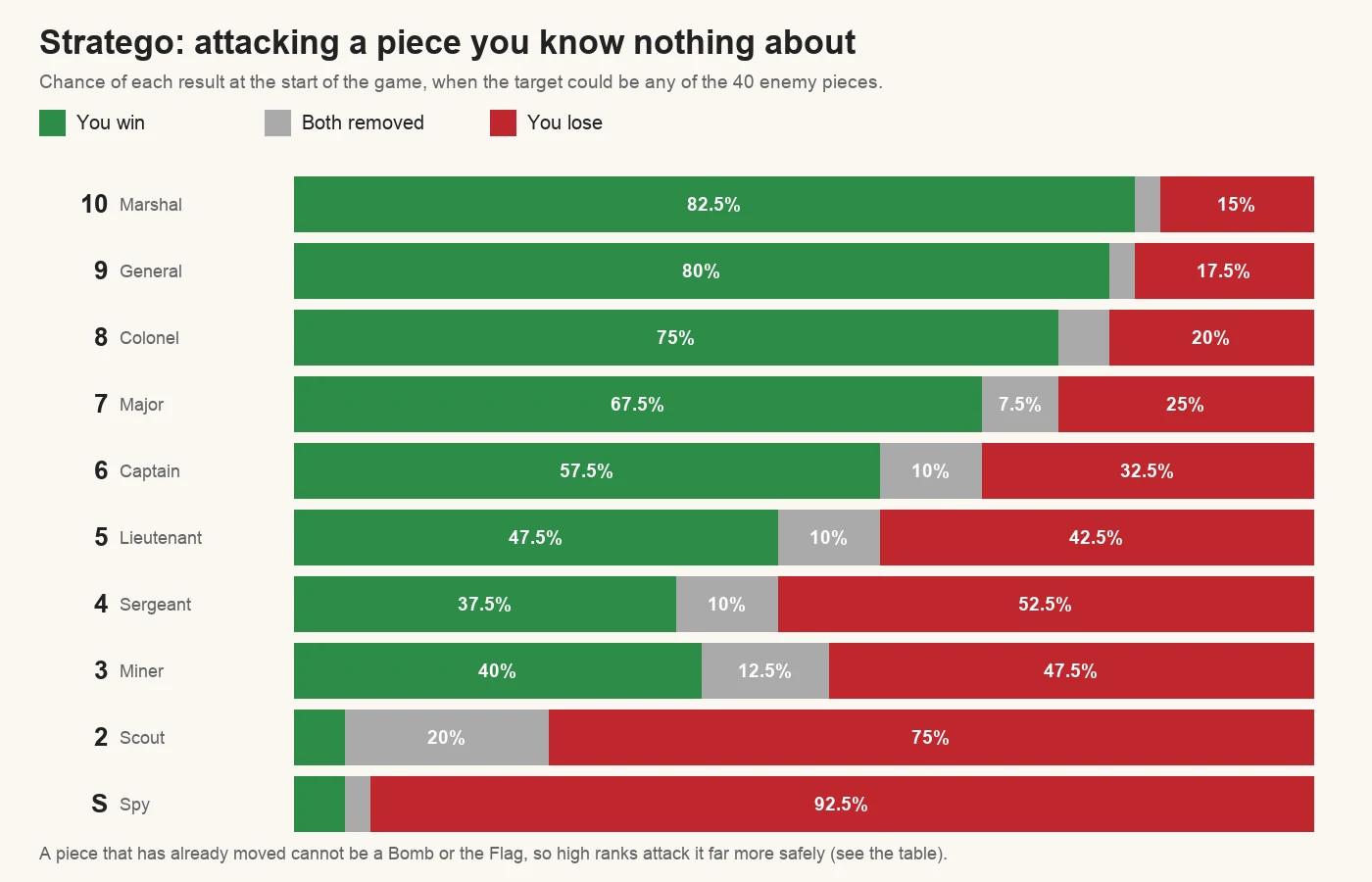
Stratego has no dice, but every attack on an unknown piece is a gamble. At the start of the game an unknown piece is a Bomb 15% of the time (6 of 40) and the Flag 2.5%. Once a piece has moved, it cannot be a Bomb or the Flag, and that changes the odds a lot. The table gives the exact chance of winning, tying and losing for every piece, assuming the target could be any of the enemy pieces with equal chance.
Attacking piece
Unknown piece at the start: win / both go / lose
A piece that has moved: win / both go / lose
10 Marshal
82.5% / 2.5% / 15%
97% / 3% / 0%
9 General
80% / 2.5% / 17.5%
93.9% / 3% / 3%
8 Colonel
75% / 5% / 20%
87.9% / 6.1% / 6.1%
7 Major
67.5% / 7.5% / 25%
78.8% / 9.1% / 12.1%
6 Captain
57.5% / 10% / 32.5%
66.7% / 12.1% / 21.2%
5 Lieutenant
47.5% / 10% / 42.5%
54.5% / 12.1% / 33.3%
4 Sergeant
37.5% / 10% / 52.5%
42.4% / 12.1% / 45.5%
3 Miner
40% / 12.5% / 47.5%
27.3% / 15.2% / 57.6%
2 Scout
5% / 20% / 75%
3% / 24.2% / 72.7%
S Spy
5% / 2.5% / 92.5%
3% / 3% / 93.9%
Attacking an unknown piece at the start of the game: the odds for each rank.
The Marshal loses only to Bombs and the Spy. Attacking a piece that has already moved, it wins 97% of the time and can never lose, because a defending Spy is always beaten.
The Miner attacks unknown pieces better than its rank suggests: 40% at the start of the game, against 37.5% for the Sergeant above it, because it also beats the 6 Bombs.
The Spy should never attack blind. Against an unknown piece it wins only 5% of the time: the Marshal and the Flag are the only pieces it beats.
Scouts are for information, not for capturing. A Scout attacking an unknown piece at the start wins 5% of the time, ties 20% and loses 75%, but whatever happens you learn what the piece is.
Set-ups: one army can be arranged in 1,411,873,643,675,199,617,616,832,128,000,000 different ways, about 1.4 × 1033, and the two armies together in about 2 × 1066.
Game length: a 2010 study of competitive play at Maastricht University put the average game at 381 moves.
Stratego Strategy Tips
Setting up
Put the Flag on the back row, with Bombs around it and plenty of pieces in front. Or turn that idea around: place Bombs in a corner as a decoy and hide the Flag somewhere else on the back row, guarded by a high-ranking piece.
Keep Bombs off the front row. They never move, so they can wall your own army in.
Put some Scouts in the front rows to find out what is coming towards you, and keep a few back for the end of the game, when a long Scout move can reach the Flag.
Protect your Miners. If the enemy Flag is surrounded by Bombs, you will need a Miner late in the game, so keep some in the back rows.
Place a few higher-ranking pieces in the front line to capture Scouts and other low pieces as they probe.
During the game
Do not send your best pieces into unknown territory. One Bomb or the Spy can cost you the Marshal.
Keep your Spy near your General. If the enemy Marshal comes for the General, the Spy can strike back.
Remember what has moved. Once you know you hold the highest piece left on the board, you can attack anything that moves without risk.
Watch the pieces that never move. A cluster that has stayed still all game is very likely to be Bombs around the Flag.
Bluff. Move a low piece boldly, like a Marshal, and keep a strong piece still, like a Bomb. Your opponent only knows what you show them.
Stratego Versions
Version
Pieces each
How it differs
Stratego Original / Classic
40
The standard game described on this page
Nostalgia and Library editions
40
Old American numbering (Marshal = 1); in the Library edition a Scout cannot move and attack in the same turn
Stratego Classic (30-piece sets)
30
Some current sets use 30 pieces each, set up in three rows
Ultimate Lightning
20
A fast tournament version, with a few pieces that move differently
Stratego Duel
10
Marshal, General, 2 Miners, 2 Scouts, the Spy, 2 Bombs and the Flag: a quick game for learning
Stratego Barrage
8
Flag, Marshal, General, 1 Bomb, 1 Miner, 2 Scouts and the Spy: set up in a minute, played in about five
There are also four-player games such as Stratego Conquest, and many themed editions with the same rules and different pictures on the pieces.
Stratego vs Game of the Generals
The Filipino Game of the Generals works on the same idea of hidden ranks, but a neutral arbiter settles each battle so neither player sees the other’s piece. It has two Spies and no Bombs, every piece moves one square, and the Flag can move and win by reaching the far row.
History of Stratego
Games of hidden ranks are older than Stratego. Japanese Military Chess (Gunjin Shogi) was on sale by 1895, and in France Mademoiselle Hermance Edan filed a patent in 1908 for a battle game with movable pieces, sold from 1910 as L’Attaque. Stratego itself was created by the Dutchman Jacques Johan Mogendorff; the name was registered in the Netherlands in 1942, and after the war the game was produced there with Napoleonic-style artwork. Milton Bradley brought it to the United States in 1961, and the trademark now belongs to the Dutch company Jumbo.
World championships have been held almost every year since 1997. Because so much is hidden, Stratego was long one of the hardest games for computers: DeepMind’s DeepNash reached expert human level in 2022, and in 2026 a program called Ataraxos beat the four-time world champion Pim Niemeijer 15–1, with 4 draws.
More Strategy Games
For a war game with dice, try Risk and its battle odds calculator. If you like working out what is hidden, play Mastermind or Clue, and for a classic two-player board game, see Checkers or Chess.
Another game of hidden pieces: play Battleship free against the computer, with the rules and the best layout.
Stratego: frequently asked questions
How do you play Stratego?
Each player secretly sets up 40 pieces on their four nearest rows, ranks facing themselves. Players take turns moving one piece one square forward, backward or sideways, or attacking an adjacent enemy piece; both ranks are then revealed and the lower one is removed. The first player to capture the other side’s Flag wins.
What beats the Spy in Stratego?
Any piece that attacks it, including the Marshal. The Spy only wins when it attacks the Marshal (or the Flag); attacking any other piece, it loses.
What beats a 10 in Stratego?
The Marshal (10) loses if it attacks a Bomb or if the Spy attacks it first. If it battles the other Marshal, both are removed. Nothing else can beat it.
How many pieces are in Stratego?
40 per player: 1 Marshal, 1 General, 2 Colonels, 3 Majors, 4 Captains, 4 Lieutenants, 4 Sergeants, 5 Miners, 8 Scouts, 1 Spy, 6 Bombs and 1 Flag. Some newer sets use 30 pieces each.
Can a Scout move and attack in the same turn?
Yes, under the current rules a Scout can move any number of open squares in a straight line and attack at the end of the move. Some older editions do not allow it.
Can Bombs move in Stratego?
No. Bombs and the Flag stay on the squares where they were placed for the whole game, and they cannot attack.
What happens when two pieces of the same rank battle?
Both pieces are removed from the board. Under the optional Aggressor Advantage rule, the attacker wins instead.
Who goes first in Stratego?
Red always moves first. Players usually decide colours by lot, for example by hiding a red and a blue piece in their hands.
Fadi Hayek
Author & Casino Expert
After going through several successful experiences with several industry pioneers, Fadi Hayek has managed to excel in the world of content for online gaming by providing unique content for several projects that allowed him to obtain the necessary experience to launch his career. Last but not least, Fadi also holds several certificates, including but not limited to content marketing and iGaming.
As online casinos adopt machine learning models and artificial intelligence in gambling becomes the next disruption, you don’t want to be left behind. Read on to learn about the impact AI will have on the future of the gambling industry.
Keep abreast of the latest Arabian football betting trends with the Arabian sports betting insights below. This guide covers the most popular bet types with Arab bettors and the top bookmakers for Arabian and global football competitions.
Yggdrasil and Reflex are set to launch Dublin Up DoubleMax, an Irish-style video, as one of their latest releases. The slot game is designed by incorporating Yggdrasil’s proprietary Game Engagement Mechanic (GEM) DoubleMax coupled with unique features like free spins bonus and fairy magic.