Blackjack Basic Strategy Chart
The blackjack chart for every hand: when to hit, stand, double, split or surrender, as a one-page cheat sheet and in plain words, plus the table rules that change the odds.


The blackjack chart for every hand: when to hit, stand, double, split or surrender, as a one-page cheat sheet and in plain words, plus the table rules that change the odds.
Online casinos with RNG and live dealer blackjack tables where you can put the strategy on this page to use.
Casino availability varies by country. Pick yours below to filter this list, or read each review for the operator's own terms.


18+ | Gamble responsibly |
GambleAware.org T&C’s apply
18+ | Gamble responsibly | GambleAware.org T&C’s apply
18+ | Gamble responsibly | GambleAware.org T&C’s apply

18+ | Gamble responsibly |
GambleAware.org T&C’s apply
18+ | Gamble responsibly | GambleAware.org T&C’s apply
18+ | Gamble responsibly | GambleAware.org T&C’s apply
18+ | Gamble responsibly | GambleAware.org T&C’s apply
21+ | Gamble responsibly | GambleAware.org T&C’s apply
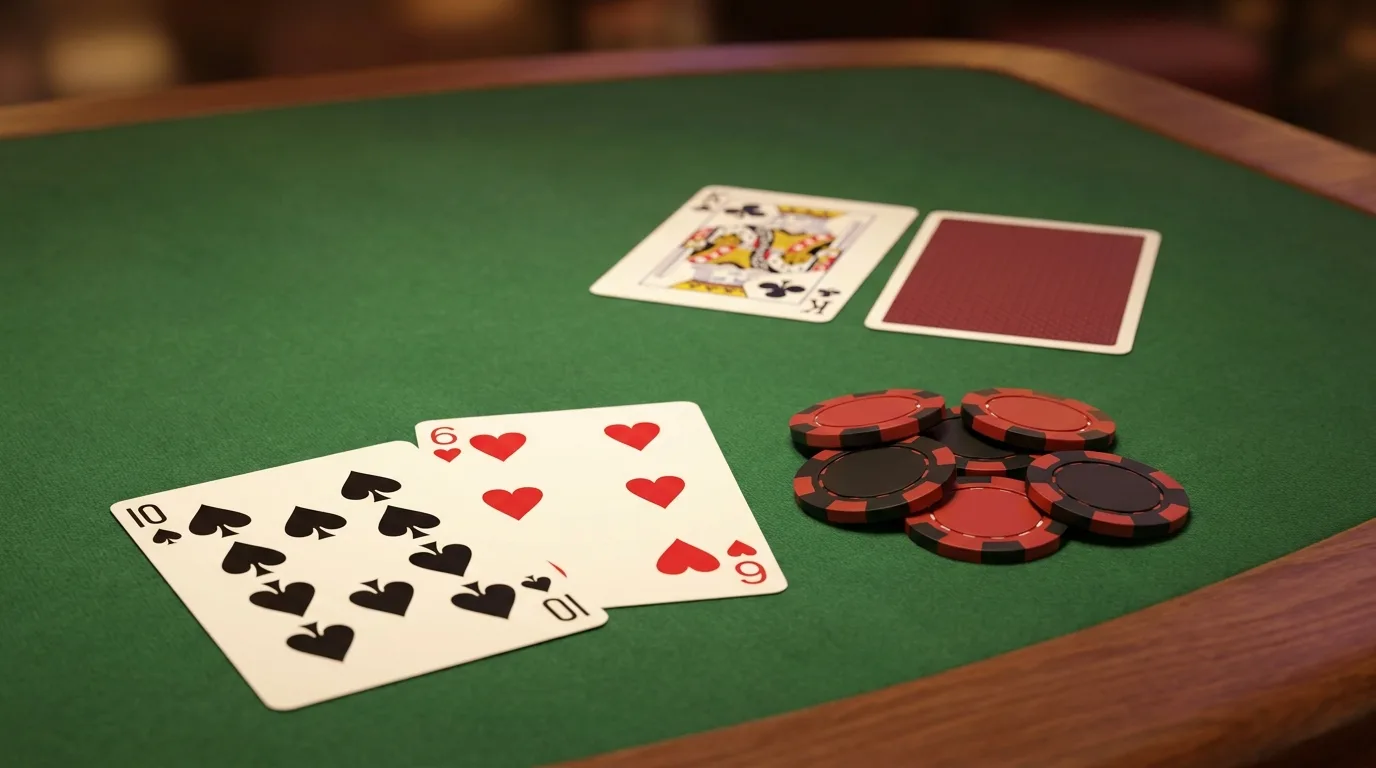
Basic strategy is the mathematically best way to play each blackjack hand, using only two things you can see: your own cards and the dealer’s face-up card. It was first published in 1956 by Roger Baldwin, Wilbert Cantey, Herbert Maisel and James McDermott, and Edward Thorp verified it and built on it in Beat the Dealer in 1963.
Playing it does not guarantee a win on any hand. What it does is cut the house edge to the lowest the rules allow, typically between 0.5% and 1% of what you bet. Guessing, or copying the dealer, costs several times more.
Prefer to look up one hand at a time? Our blackjack calculator gives the best play for any two cards against any dealer card, with a trainer to practise.
Find your hand on the left and the dealer’s up card along the top. This blackjack chart is for the most common online and live-dealer setup: 4 to 8 decks, dealer stands on soft 17, double after split allowed, late surrender.
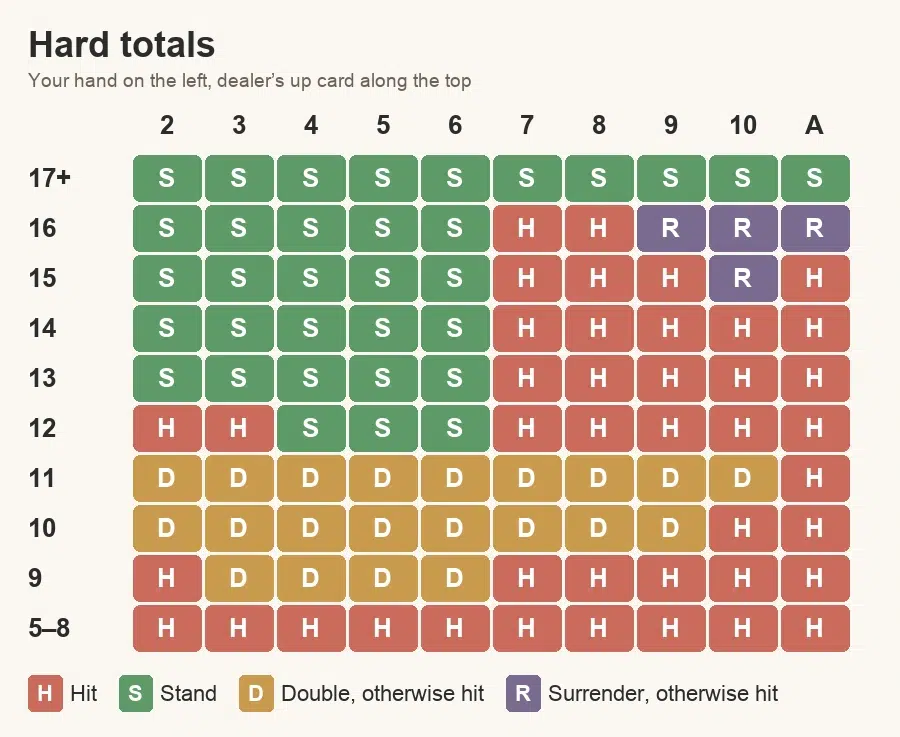
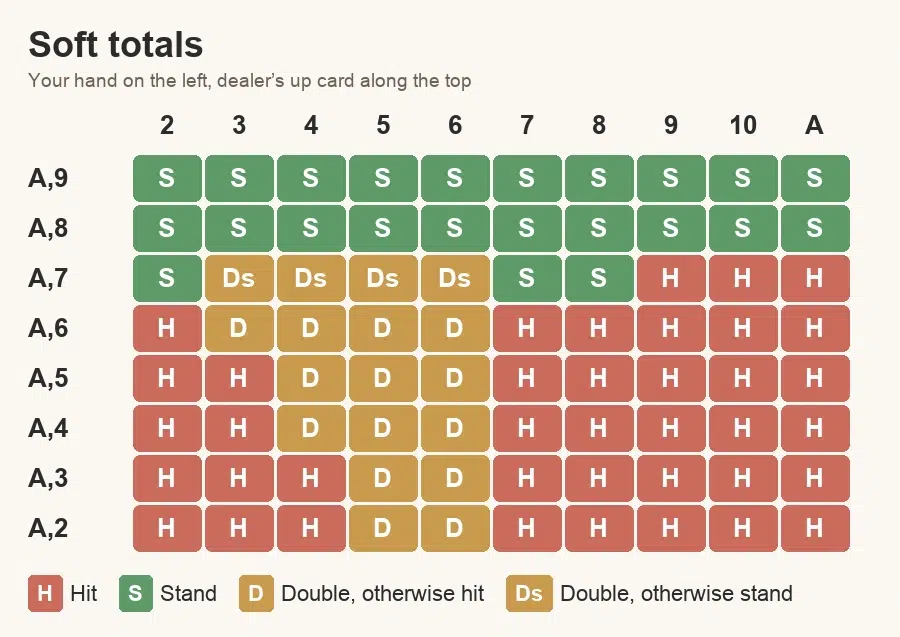
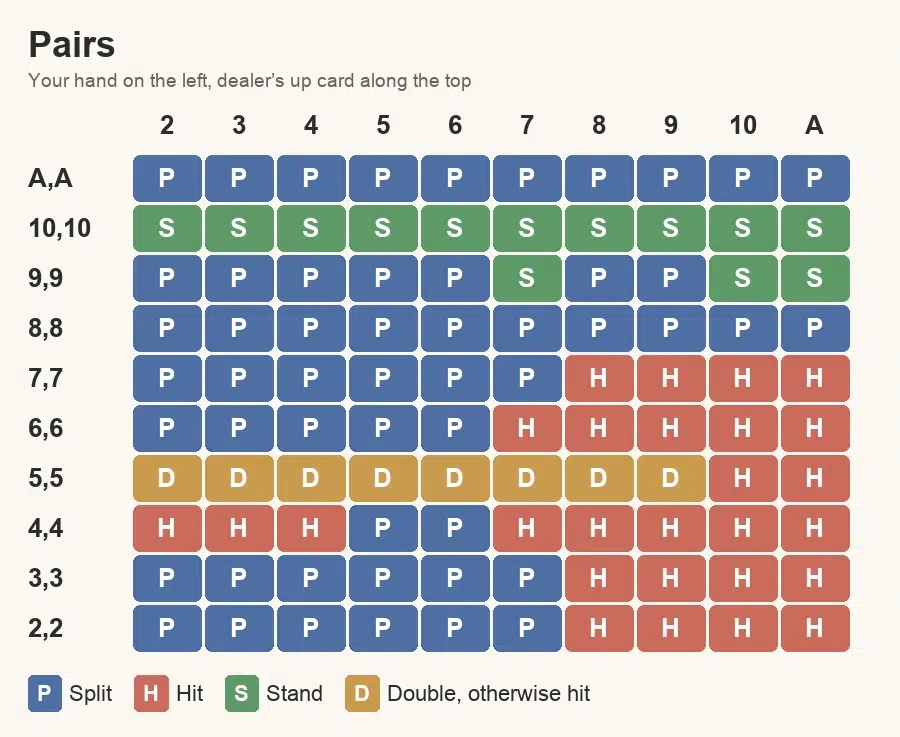
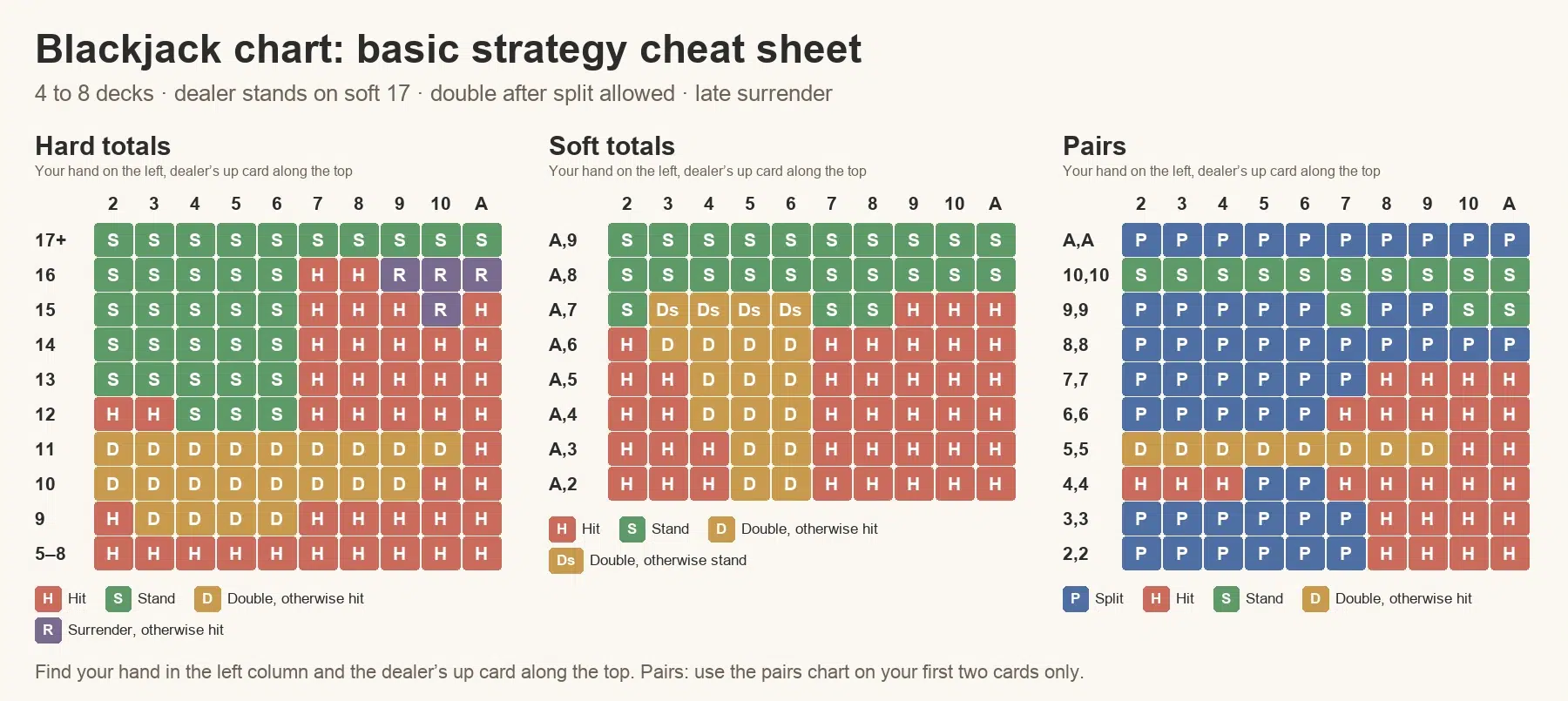
A hard hand has no ace, or an ace that has to count as 1 so the hand does not bust (10-6 or 10-5-A are hard 16). A soft hand has an ace that can still count as 11 (A-6 is soft 17). The pairs chart applies only to your first two cards.
If you prefer rules to a grid, work down this list and use the first rule that fits your hand. It gives exactly the same decisions as the chart.
Surrender hard 16 against a dealer 9, 10 or ace, and hard 15 against a 10. Never surrender a pair of 8s, split them instead. If the table has no surrender, hit these hands.
These splits assume you may double after splitting. If you may not, skip the 4s, split 2s and 3s only against 4 to 7, and split 6s only against 3 to 6.
Where the strategy says double but you already have three or more cards, hit instead (with soft 18, stand). And never take insurance or “even money”.
Some tables make the dealer hit a soft 17 (marked “H17” or “dealer hits soft 17” on the felt or in the game rules). That rule favours the casino by about 0.2%, and six cells of the strategy change:
| Your hand | Dealer stands on soft 17 | Dealer hits soft 17 |
|---|---|---|
| Hard 11 v ace | Hit | Double (otherwise hit) |
| Hard 15 v ace | Hit | Surrender (otherwise hit) |
| Hard 17 v ace | Stand | Surrender (otherwise stand) |
| Soft A, 8 v 6 | Stand | Double (otherwise stand) |
| Soft A, 7 v 2 | Stand | Double (otherwise stand) |
| 8, 8 v ace | Split | Surrender (otherwise split) |
Everything else on the chart stays the same.
At most casinos outside the US the dealer takes a second card only after every player has acted. If the dealer then has blackjack, you lose any extra money you put in to double or split. So against a dealer 10 or ace it is rarely right to double or split. The main exception: still split aces against a 10. For example, hit 11 against a 10 instead of doubling. Some games return the extra stake in that case (the “original bets only” rule), and there the normal chart applies.
Basic strategy gets the most out of whatever rules the table has. The rules themselves still set the price. Here is how common variations change your expected return, compared with 8 decks, dealer standing on soft 17 and doubling after splits allowed:
| Rule | Effect on your return |
|---|---|
| Blackjack pays 6 to 5 | −1.39% |
| Blackjack pays 7 to 5 | −0.45% |
| Dealer hits soft 17 | −0.22% |
| No doubling after a split | −0.14% |
| European no hole card | −0.11% |
| Double on 9, 10 or 11 only | −0.09% |
| Six decks | +0.02% |
| Late surrender | +0.08% |
| Double deck | +0.19% |
| Single deck | +0.48% |
Figures from Wizard of Odds. By far the biggest is the blackjack payout: a 6 to 5 table costs more than every other rule on the list put together, so check for 3 to 2 before you sit down.
Fewer decks help the player, but most of the gain comes from going all the way down to one or two. With the dealer hitting soft 17, doubling after splits and no surrender, the house edge is:
| Decks | House edge |
|---|---|
| 1 | 0.16% |
| 2 | 0.46% |
| 4 | 0.60% |
| 6 | 0.64% |
| 8 | 0.66% |
When the dealer shows an ace, you are offered insurance: a side bet of up to half your stake that pays 2 to 1 if the dealer has blackjack. It only wins when the hole card is a 10, J, Q or K, and on a six-deck shoe that happens about 31 times in 100. Over many hands the bet loses about 7.4% of what you put on it with six decks and 7.5% with eight, far more than the main game. “Even money”, offered when you have blackjack yourself, is the same bet under another name.
The three “common sense” systems you hear at the table are all expensive. Wizard of Odds tested each of them under Atlantic City rules:
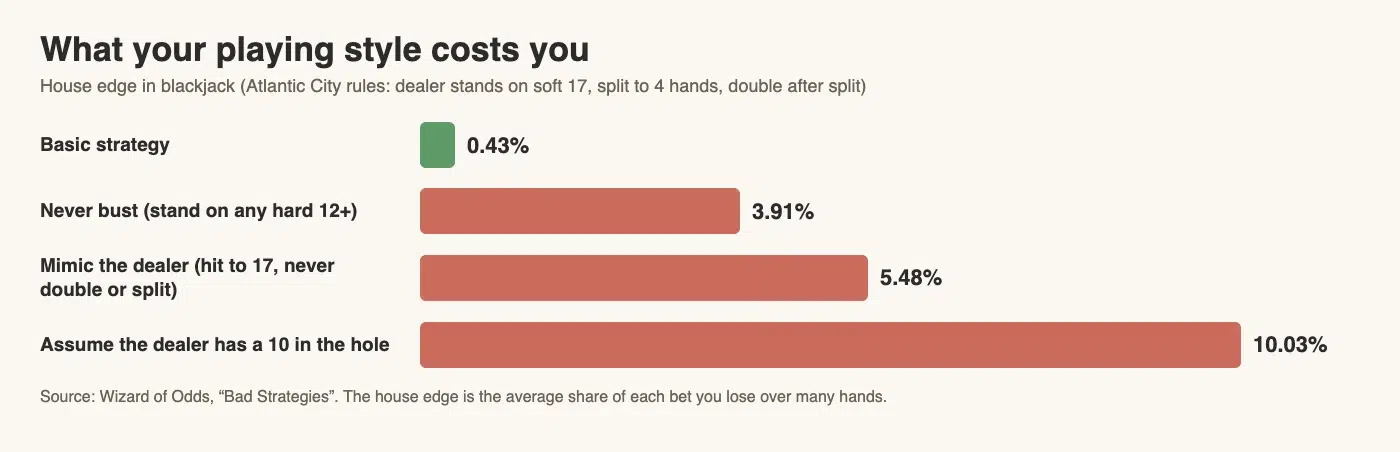
| How you play | House edge | Average loss per £100 bet |
|---|---|---|
| Basic strategy | 0.43% | £0.43 |
| Never bust: stand on any hard 12 or more | 3.91% | £3.91 |
| Mimic the dealer: hit to 17, never double or split | 5.48% | £5.48 |
| Assume the dealer has a 10 in the hole | 10.03% | £10.03 |
The payout is printed on the felt or in the game’s rules. If it says 6 to 5, the house edge goes up by about 1.4%, which undoes everything basic strategy saves you.
It is worth about 0.2%, and online games show which rule they use in the game rules.
At an online table you can keep a strategy chart open next to the game. Over time the decisions become automatic. Watch the plays that feel wrong but are right: hit 12 against a 2 or 3, double 11 against a 10, and hit soft 18 against a 9 or 10.
Many RNG blackjack games have a free demo mode, which is the easiest way to learn the chart without spending anything.
Raising your bet after losses, as the Martingale system does, does not lower the house edge. It only makes the losing sessions bigger. Set a budget before you start and stop when it is gone. For more on the rules, payouts and table options, see our blackjack rules guide, and for the probabilities behind the game, our blackjack odds page.

Wagering: 35x

Wagering: 60x

Wagering: 40x
Also worth a look: try the charts in a free blackjack game that shows the basic strategy play for every hand.

After going through several successful experiences with several industry pioneers, Fadi Hayek has managed to excel in the world of content for online gaming by providing unique content for several projects that allowed him to obtain the necessary experience to launch his career. Last but not least, Fadi also holds several certificates, including but not limited to content marketing and iGaming.


