Spanish 21 Rules and Strategy
Blackjack without the tens: the rules, every bonus payout, the basic strategy chart and how Spanish 21 compares with blackjack.


Blackjack without the tens: the rules, every bonus payout, the basic strategy chart and how Spanish 21 compares with blackjack.
Spanish 21 is blackjack played with the tens taken out of the deck. Losing those four cards per deck would make the game much worse for players, so Spanish 21 pays it back with some of the most generous rules in the casino: your 21 always wins, you can double down on any number of cards, take back a double you regret, and collect bonus payouts for five-card 21s and for 6-7-8 and 7-7-7. With the right strategy, the house edge is about 0.4%. This guide covers the rules, every bonus payout, the basic strategy chart and what each rule is worth.
| Spanish 21 | |
|---|---|
| Cards | 6 or 8 Spanish decks of 48 cards: the four 10s are removed, the jacks, queens and kings stay |
| Blackjack pays | 3 to 2, and it beats a dealer blackjack |
| Player 21 | Always wins, unless the dealer has blackjack |
| Doubling | On any number of cards, including after splitting; you get one card |
| Double-down rescue | After the double card, you may take back the double and give up the original bet |
| Surrender | Late surrender: half the bet, on your first two cards |
| Splitting | Pairs can be split and usually resplit, including aces |
| Bonus payouts | Five-card 21 pays 3 to 2, six-card 2 to 1, seven or more 3 to 1; 6-7-8 and 7-7-7 pay up to 3 to 1 |
| Super Bonus | Suited 7-7-7 against a dealer 7: $1,000 or $5,000, and $50 to everyone else at the table |
| House edge | 0.40% when the dealer stands on soft 17, 0.76% when the dealer hits soft 17 |
| Other names | Pontoon in Australia and Malaysia; Pirate 21 in Betsoft’s online version |
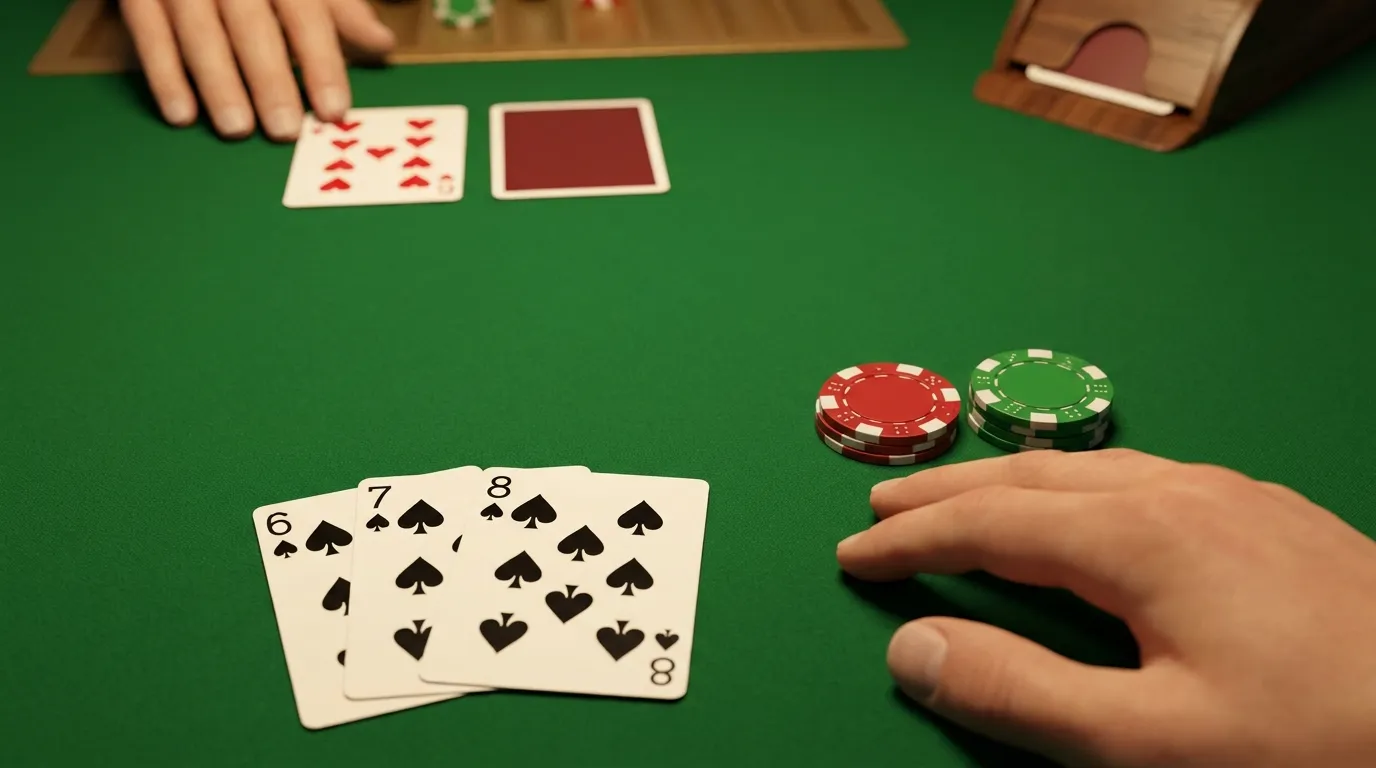
A round of Spanish 21 runs exactly like blackjack. The aim is to beat the dealer’s hand without going over 21. Number cards count their face value, jacks, queens and kings count 10, and an ace counts 1 or 11.
Two limits apply to all of this. If the dealer has blackjack, a player 21 in three or more cards loses, but you only lose your original bet: doubled and split money is returned. And bonus payouts are not made on a hand you doubled or a hand you split.
These bonuses replace the normal 1 to 1 payout on a winning 21. They are paid only on the original bet, never on a doubled hand, and the regulated rules also exclude split hands.
| Winning hand | Pays |
|---|---|
| Five-card 21 | 3 to 2 |
| Six-card 21 | 2 to 1 |
| Seven or more cards totalling 21 | 3 to 1 |
| 6-7-8, mixed suits | 3 to 2 |
| 6-7-8, same suit | 2 to 1 |
| 6-7-8 of spades | 3 to 1 |
| 7-7-7, mixed suits | 3 to 2 |
| 7-7-7, same suit | 2 to 1 |
| 7-7-7 of spades | 3 to 1 |
| Blackjack | 3 to 2 |
If your first three cards are three 7s of the same suit and the dealer’s up card is also a 7, you win a fixed Super Bonus: $1,000 on a bet of $5 to $24, or $5,000 on a bet of $25 or more. Every other player at the table who bet that round collects a $50 “envy bonus”. It does not pay on a doubled or split hand. With six decks the chance is 1 in 668,382 hands, and 1 in 549,188 with eight decks. That is why the strategy chart says to hit suited 7s against a dealer 7 rather than split them.
| Spanish 21 | Blackjack | |
|---|---|---|
| Deck | 48 cards, no 10s | 52 cards |
| Player 21 vs dealer 21 | Player wins | Push |
| Player blackjack vs dealer blackjack | Player wins 3 to 2 | Push |
| Doubling | Any number of cards, with rescue | Usually first two cards only |
| Five-card and 6-7-8 bonuses | Yes | No |
| Surrender | Late surrender | Not always offered |
| House edge with correct play | 0.40% to 0.76% | Typically 0.5% to 1%, depending on the rules |
Removing the 10s is worth about 1.88% to the house on its own: ten-value cards make blackjacks, good doubles and dealer busts, and Spanish decks have 12 of them per 48 cards instead of 16 per 52. The table below shows roughly how much of that each player-friendly rule gives back.
| Rule | Approximate value to the player |
|---|---|
| Player 21 always wins | 1.13% |
| Five-card, 6-7-8 and 7-7-7 bonuses | 0.34% |
| Player blackjack beats dealer blackjack | 0.26% |
| Doubling on any number of cards | 0.16% |
| Double-down rescue | 0.03% |
Values are for a continuous shoe of Spanish decks with the dealer standing on soft 17, each rule taken away on its own from the full set. Six- and eight-deck games differ by a few hundredths of a percent.
Basic strategy in Spanish 21 is not the same as in blackjack. With fewer 10s in the deck and a bonus waiting for five-card 21s, you hit more, double less, and some decisions depend on how many cards you hold. Find your hand on the left and the dealer’s up card along the top; a number in a cell, such as S5, tells you to stand with fewer cards but hit once you hold five or more. Use the chart that matches the table: it says whether the dealer hits or stands on soft 17.
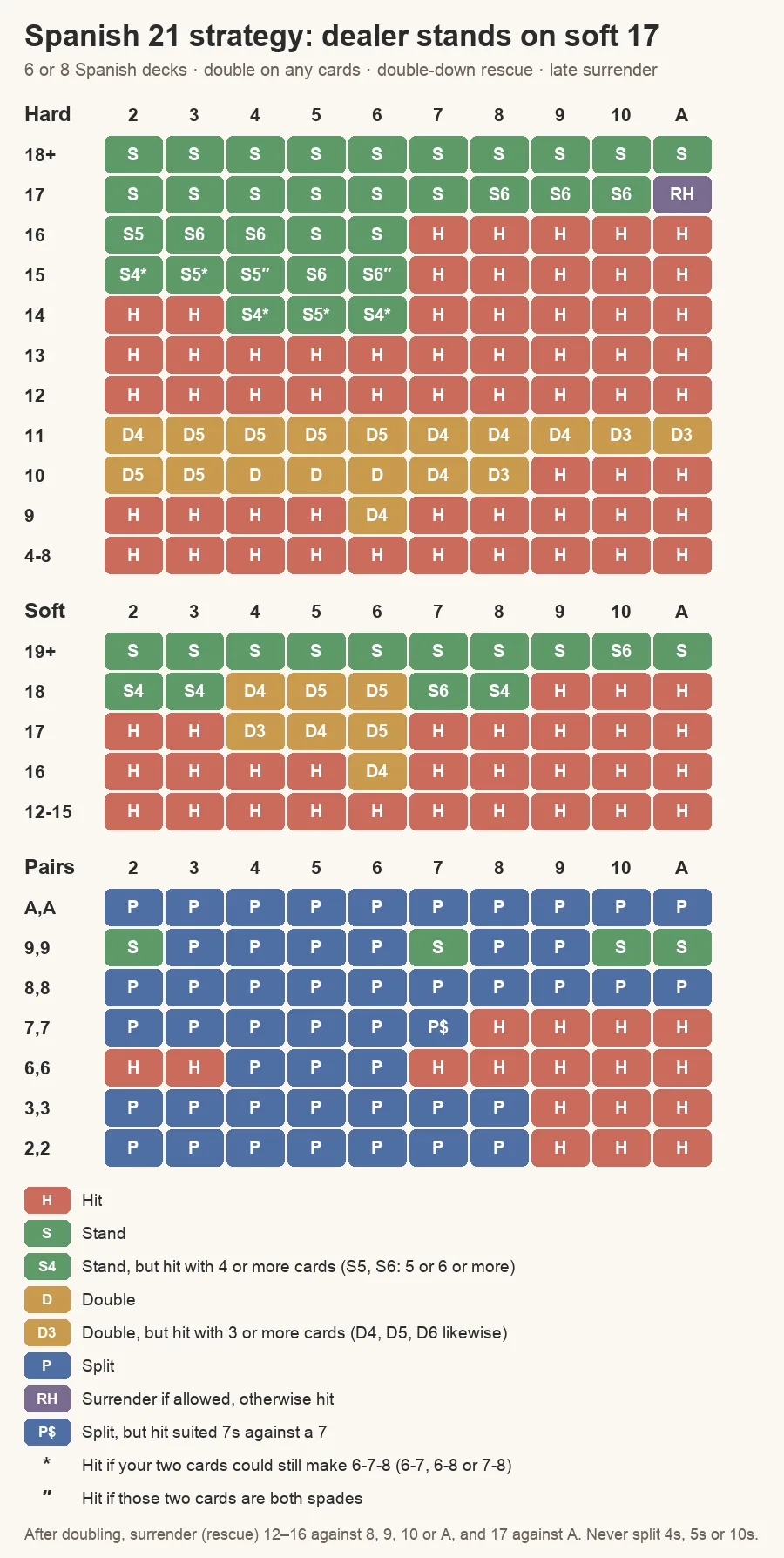
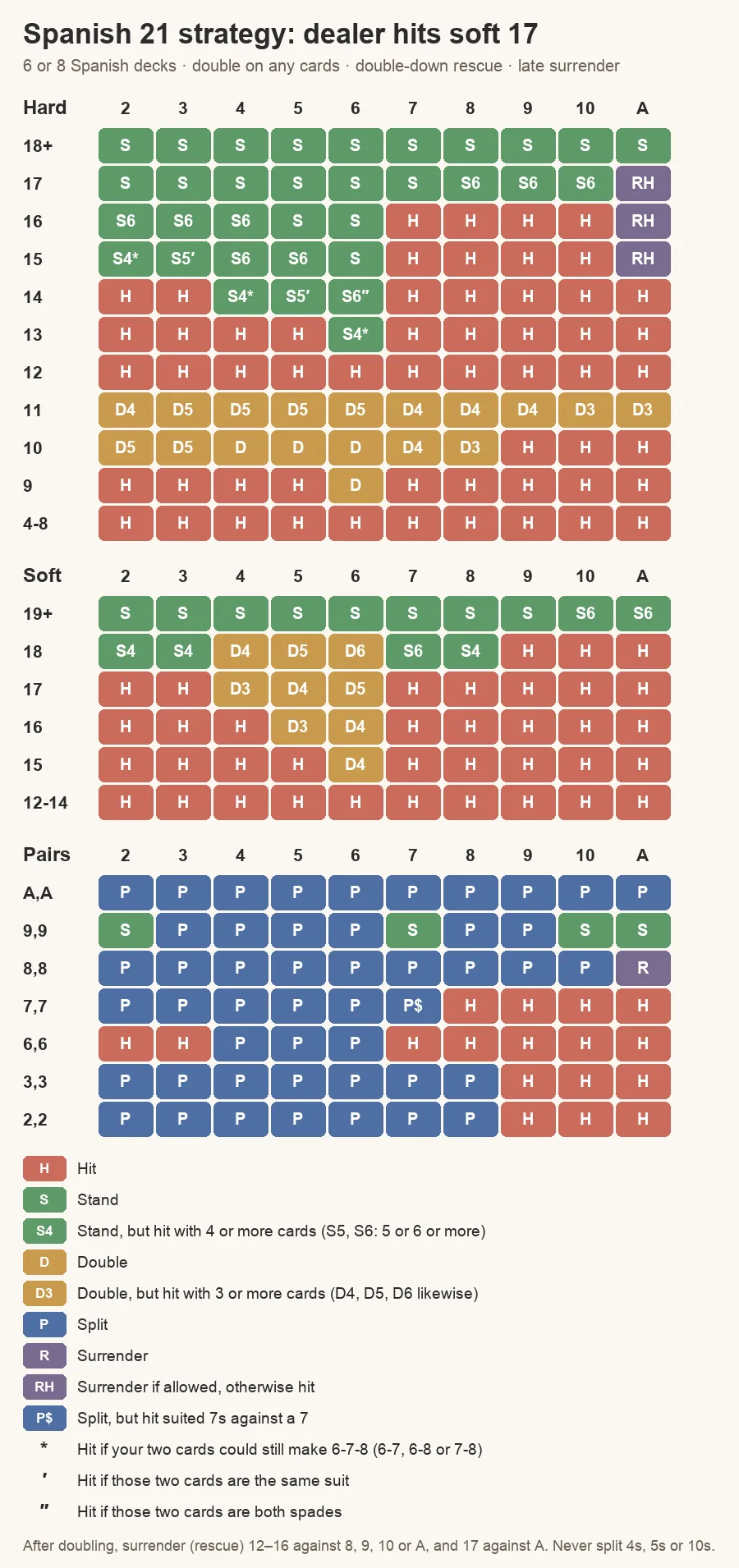
These rules are for the more common game in which the dealer stands on soft 17; the hits-soft-17 chart above differs in a handful of cells.
Notice what is missing compared with blackjack: you never surrender hard 15 or 16 against a 10, because doubling and the bonuses make those hands worth playing out, and you hit 12 against a 4, 5 or 6.
| Rules | House edge with basic strategy |
|---|---|
| Dealer stands on soft 17 | 0.40% |
| Dealer hits soft 17, redoubling allowed | 0.42% |
| Dealer hits soft 17, no redoubling | 0.76% |
These figures are before the Super Bonus, which lowers the edge by about 0.03% on a bet of exactly $5 or $25 in a six-deck game. Two rule changes to look out for: a table that does not let you draw to split aces adds about 0.29% to the house edge, and one that only lets you double on your first two cards adds about 0.16%. Some casinos allow redoubling, up to three times, which is why the hits-soft-17 game can be almost as good as the stands-on-17 one.
Spanish 21 tables often carry a Match the Dealer side bet, which pays when your first two cards match the dealer’s up card. Like most side bets it has a far higher house edge than the main game, around 3%.
Online, look in the blackjack or table-games section of the lobby for Spanish 21 or for Pirate 21, Betsoft’s version of the game. The game’s help screen lists the number of decks and whether the dealer hits soft 17, so you know which chart to use. Availability depends on the casino and your country. These casinos run large table-game lobbies:
| Casino | Welcome offer | Our rating | |
|---|---|---|---|
| iWild Casino | Up to 550% + 400 free spins | 4.8 | Open iWild Casino |
| Kaasino | 225% up to £5,000 + 500 bonus spins | 4.3 | Open Kaasino |
| 1Red Casino | 225% up to €11,500 + 225 free spins over 3 deposits | 4.0 | Open 1Red Casino |
More on twenty-one: blackjack rules and strategy, the Pontoon card game, free blackjack, the blackjack strategy calculator and the blackjack glossary.
Set a budget before you play for real money and stick to it. Free, confidential support is available at BeGambleAware.org. 18+ only.

After going through several successful experiences with several industry pioneers, Fadi Hayek has managed to excel in the world of content for online gaming by providing unique content for several projects that allowed him to obtain the necessary experience to launch his career. Last but not least, Fadi also holds several certificates, including but not limited to content marketing and iGaming.


