Briscola Card Game Rules
Win tricks, collect Aces and Threes, and reach 61 of the 120 points: how to play one of Italy’s most popular card games.


Win tricks, collect Aces and Threes, and reach 61 of the 120 points: how to play one of Italy’s most popular card games.
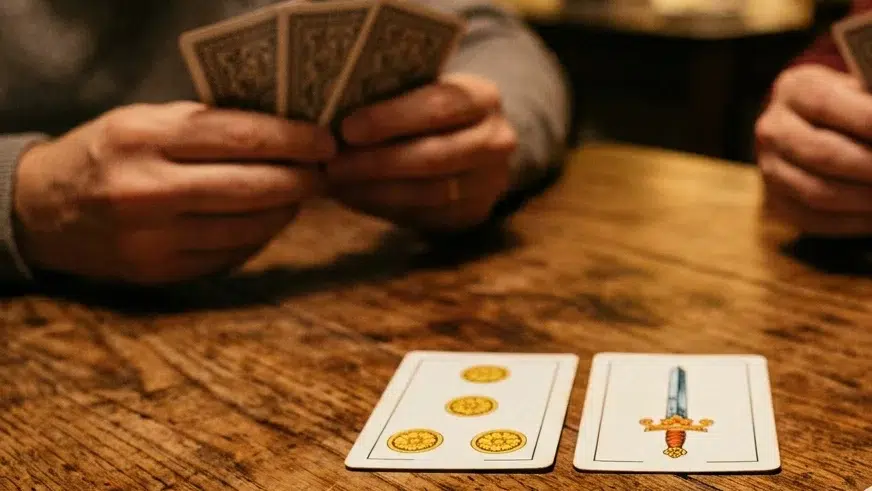
Briscola is one of Italy’s most popular card games, together with Scopa and Tressette. It is a quick trick-taking game for two to six players, played with a 40-card Italian deck. One card turned face up at the start sets the trump suit, the briscola, and you win tricks to collect the cards that carry points: Aces, Threes and face cards. There are 120 points in the deck, so 61 wins. Unlike most trick-taking games, you never have to follow suit, which makes the rules easy to learn and the decisions interesting. This guide covers the Briscola card game rules for two players, the team versions, variations, tips and the odds.
| Briscola | |
|---|---|
| Players | 2, 3, 4 (two teams) or 6 (two teams of three). Briscola chiamata is a five-player version. |
| Cards | A 40-card Italian deck, or a regular deck with the 8s, 9s and 10s removed. |
| Card order | Ace, Three, King, Horse (Queen), Jack, 7, 6, 5, 4, 2. |
| Points | Ace 11, Three 10, King 4, Horse 3, Jack 2; the rest 0. 120 in the deck. |
| Deal | 3 cards each; the next card is turned face up for trumps. |
| Following suit | Not required: you can play any card. |
| Goal | Take 61 or more points; 60–60 is a draw. Usually best of three or five games. |
Briscola uses the 40-card Italian deck: coins, cups, swords and clubs, each with Ace to 7 plus the Jack (Fante), Horse (Cavallo) and King (Re). With a regular deck, take out the 8s, 9s and 10s; the Queen stands in for the Horse. Many southern Italian players swap the Queen and Jack, so agree on it first.
The order of the cards is unusual: the Three is the second-highest card, after the Ace and above the King. Only five ranks carry points, and the Ace and Three, the carichi (“loaded” cards), are worth far more than everything else.
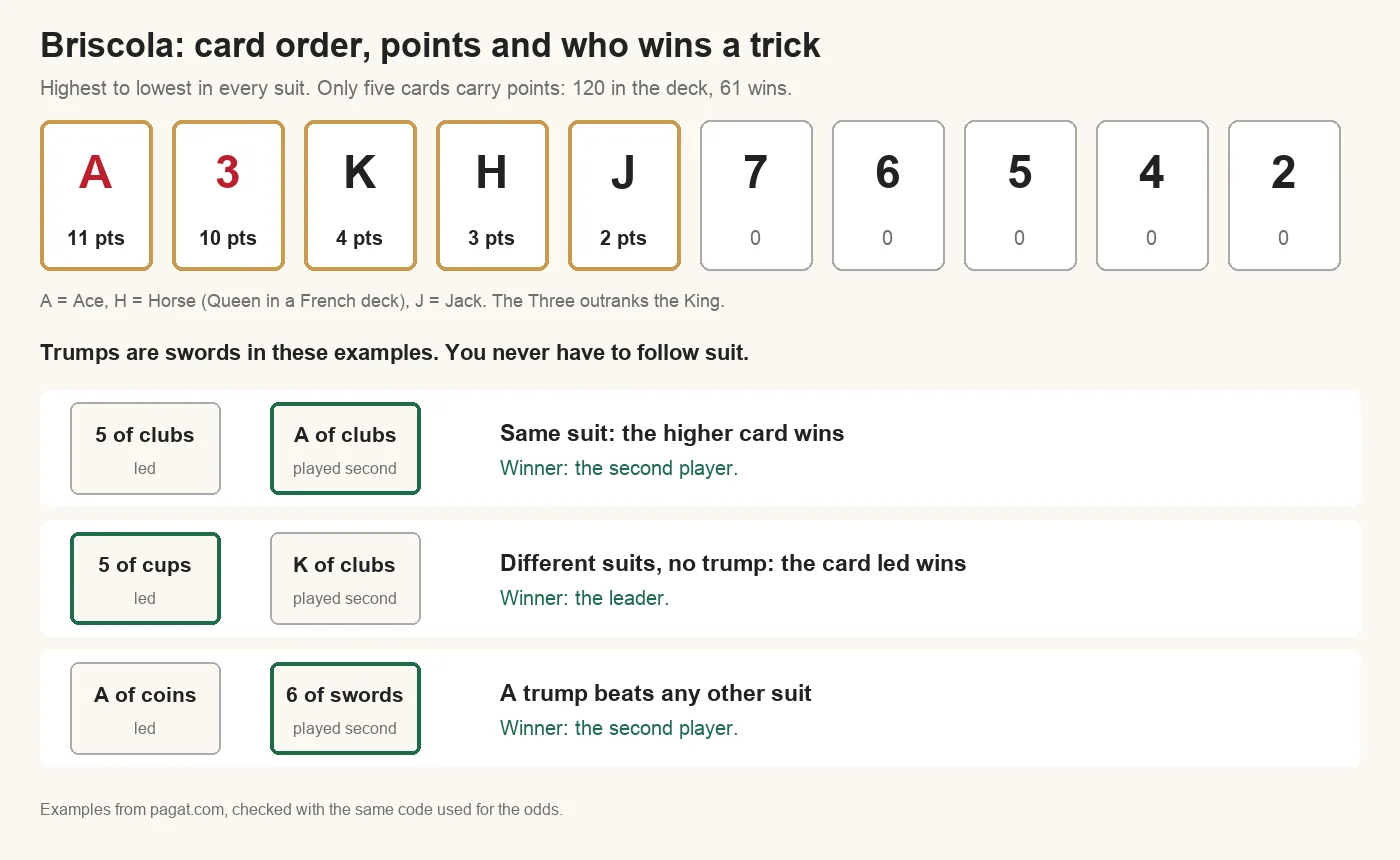
The leader plays any card face up, and each other player then plays one card. You do not have to follow suit. The trick is won like this:
The winner of the trick takes the cards face down, then everyone draws a card from the stock, the winner first. The winner leads to the next trick. When the stock runs out, the last card drawn is the face-up briscola. After that, play continues without drawing until all the cards in hand have been played.
At the end, each player (or team) adds up the points in the tricks they took. With 120 points in the deck, 61 or more wins and 60–60 is a draw. Briscola is usually played as the best of three or five games. Some players instead score game points: one for a win, two for 91 or more, three for taking all 120.
| Players | How it works |
|---|---|
| 3 | Take out one 2 so the 39 cards divide evenly. Each player plays for themselves. |
| 4 | Two teams of two, partners sitting opposite each other. Partners combine their tricks. |
| 5 | Briscola chiamata: all eight cards dealt, players bid to choose trumps, and the winner calls a card to find a secret partner. |
| 6 | Two teams of three, seated alternately. Take out all four 2s to leave 36 cards. |
In the team games, partners are often allowed to signal to each other with agreed faces, for example pursing the lips for the Ace of trumps or winking for the Three of trumps. Around Rome some groups use a little agreed table talk instead, such as asking whether a partner holds high or low trumps.
| Variation | How it differs |
|---|---|
| Exchanging the briscola | In some games, a player holding the 2 of trumps may exchange it for the face-up briscola before the first trick. |
| Briscolone | Two players, usually five cards each and no trumps; often you must follow suit. |
| Briscola a 31 | A short two-player game that ends as soon as a player correctly claims 31 points in their tricks. |
| Seven high | In parts of Piedmont and Sardinia, the Seven replaces the Three as the second-highest card. |
| Black hand (conquista) | Holding the King, Three and Ace of trumps together wins the game outright. |
| Open hands | A two-player version with both hands and the top of the stock face up. |
Briscola and Scopa are two of Italy’s best-known card games and use the same 40-card deck, but they play nothing alike. Briscola is a trick-taking game: cards fight for tricks, a trump suit beats the others, and only Aces, Threes and face cards score. Scopa is a fishing game: you capture cards from a face-up table by matching their value or adding them up, and you score for most cards, most coins, the seven of coins, the primiera and every sweep. Many Italian families play both.
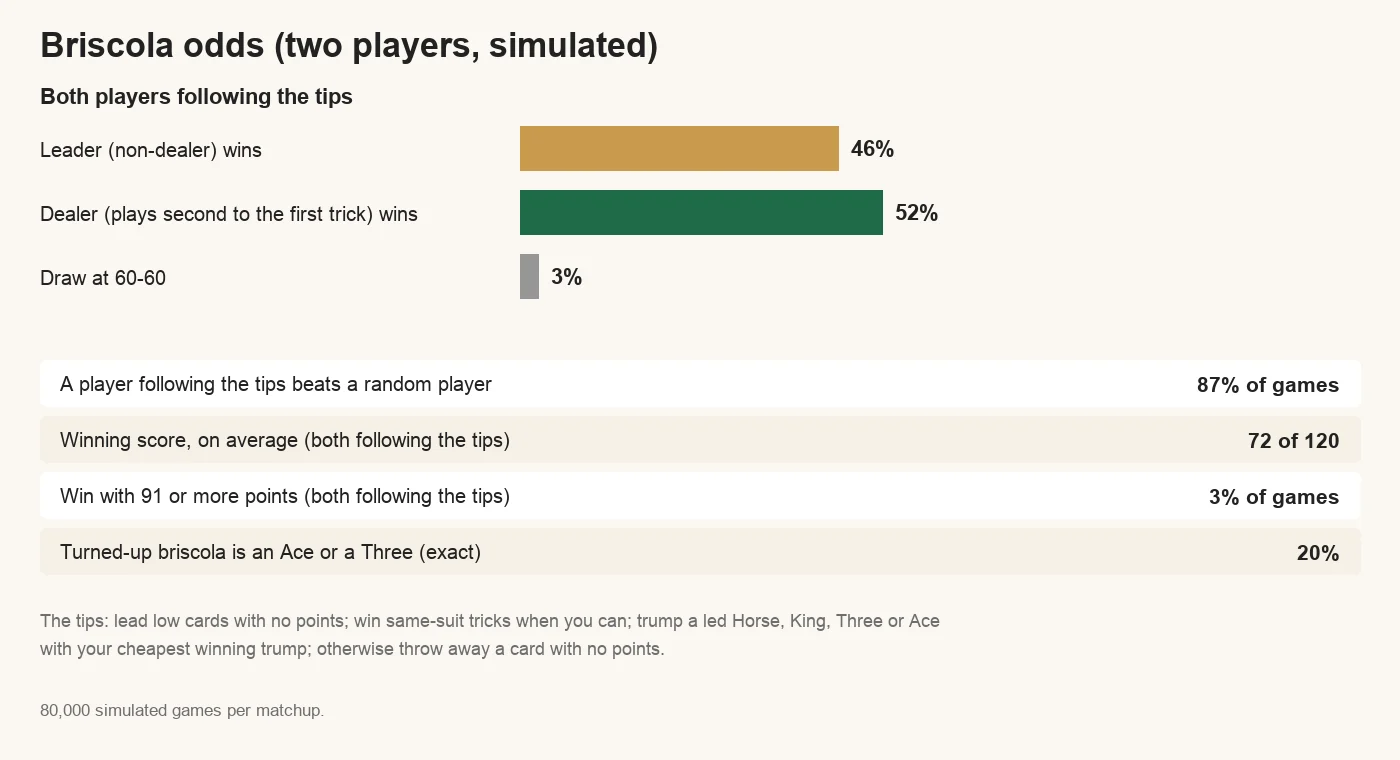
The simulated figures come from 80,000 two-player games for each pairing of strategies.
Briscola is Italian, a little-changed descendant of the French game Brusquembille, which is also the ancestor of bezique. Its Spanish cousin is Brisca, and the same game is played as Briškula on the coasts of Slovenia and Croatia. In English it usually keeps its Italian name; briscola is the word for the trump suit and the trump card.
If you like Briscola, try its Italian partner Scopa, or two more games where Aces and Tens carry the points: Pinochle, which comes from the same French family, and Sheepshead. For another trick-taking classic, see Spades.

After going through several successful experiences with several industry pioneers, Fadi Hayek has managed to excel in the world of content for online gaming by providing unique content for several projects that allowed him to obtain the necessary experience to launch his career. Last but not least, Fadi also holds several certificates, including but not limited to content marketing and iGaming.


