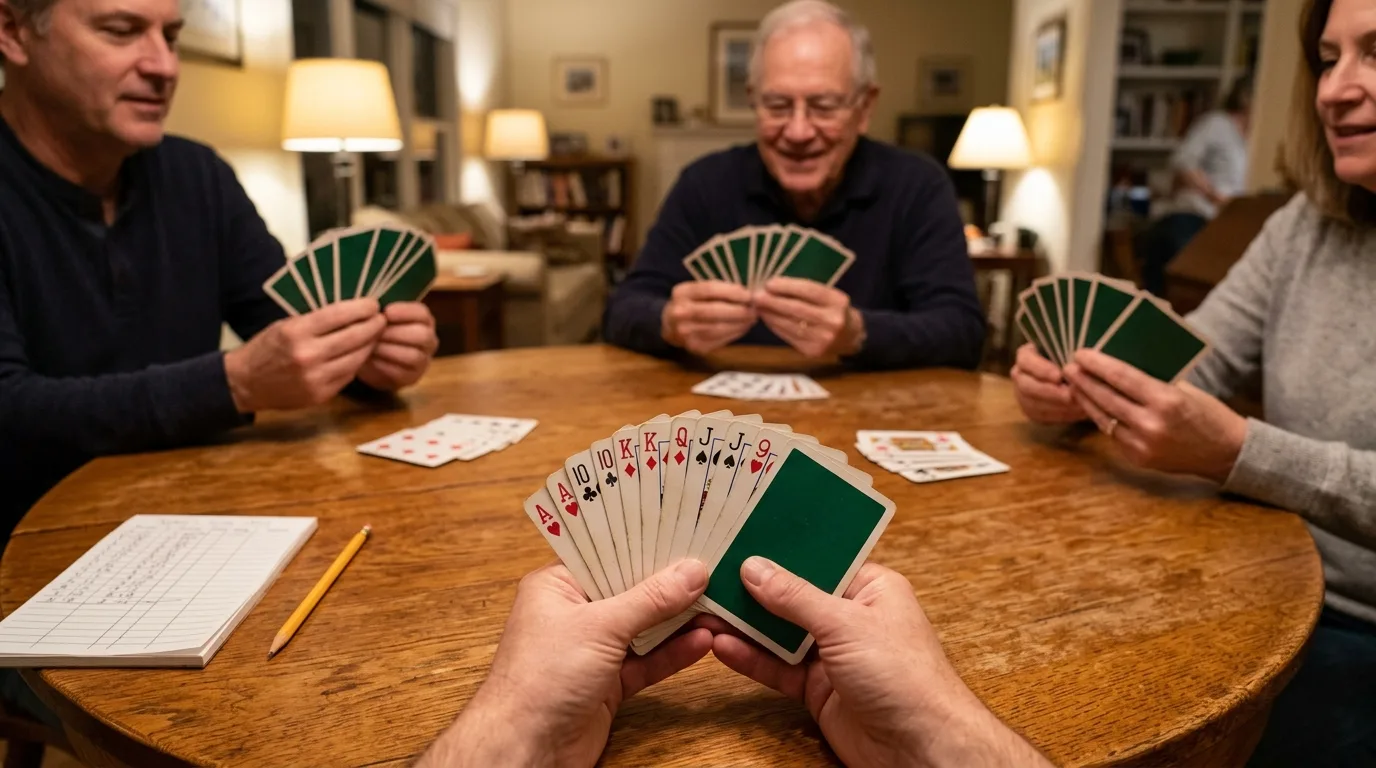
A game of four-handed pinochle at a round wooden table in a living room: three players hold fanned hands of cards with plain green backs, a score pad and pencil sit on the table, and in the foreground a player holds a hand of Aces, Tens, Kings, Queens, Jacks and a Nine
Four-handed pinochle: two teams of two, partners sitting opposite each other.

Pinochle is a trick-taking card game played with a 48-card deck that has two copies of every card from the 9 up to the Ace. Points come from two places: meld, the combinations you show after the bidding, and the counters (Aces, Tens and Kings) you win in tricks. It comes from the French game bezique by way of the German game Binokel, which German immigrants brought to the United States in the late 19th century, where the name turned into “pinochle”. During World War I, Syracuse, New York, banned the game because of its German roots. This guide covers the pinochle rules for the most common game, four-handed partnership pinochle, along with meld scoring, the two-handed and double-deck games, strategy and odds.

Pinochle Rules at a Glance

Four-handed pinochle
PlayersFour, in two teams of two. Partners sit opposite each other.
CardsA 48-card pinochle deck: two each of A, 10, K, Q, J and 9 in all four suits.
Card orderAce (high), 10, King, Queen, Jack, 9 (low). The 10 beats the King.
Deal12 cards each. All 48 cards are dealt.
BiddingAn auction for the right to name trumps, often starting at 250.
ScoringMeld points plus 250 points in the tricks. A team that falls short of its bid loses the amount bid.
GameFirst team to 1,500 points.

The Pinochle Deck

A pinochle deck has 48 cards: twelve in each suit, two each of the Ace, 10, King, Queen, Jack and 9. Within a suit the order is Ace, 10, King, Queen, Jack, 9, so the 10 is the second-highest card. When two identical cards are played to the same trick, the one played first wins. Boxed pinochle decks are easy to find, but you can also make one from two standard packs by taking out every card from 2 to 8. A euchre deck is exactly half a pinochle deck.

How to Play Pinochle

  1. Deal. The dealer deals all 48 cards, 12 to each player, often three at a time.
  2. Bid. Starting to the dealer’s left, each player bids a number of points their team expects to make, or passes. Bids go up in 10s, and once you pass you are out of the auction. In many family games the opening bid is 250, and if everyone else passes the dealer must take it at 250. The player who wins the bid is the declarer.
  3. Name trumps. The declarer names the trump suit.
  4. Pass cards. In the popular “racehorse” version, the declarer’s partner passes four cards face down across the table. The declarer adds them to their hand and passes four cards back.
  5. Show meld. All four players lay their meld face up on the table, and each team adds up its points (see the meld table below). Then everyone picks their cards back up.
  6. Play 12 tricks. The declarer leads to the first trick. Each player plays one card, going left. The highest trump wins the trick, or the highest card of the suit led if no trump was played. The winner of each trick leads to the next.
  7. Count the counters. Each team counts the Aces, 10s and Kings in the tricks it won, then the scores are added up.

Pinochle Meld Table

Meld comes in three types, and a card can be used in more than one meld as long as each one is a different type. A Queen of spades can count in a marriage and in a pinochle at the same time, but not in two marriages.

MeldCardsPoints
Type 1: runs and marriages
RunA, 10, K, Q, J of trumps150
Double runTwo of each: A, 10, K, Q, J of trumps1,500
Royal marriageK and Q of trumps40
MarriageK and Q of any other suit20
Dix (pronounced “deece”)9 of trumps10 each
Type 2: pinochles
PinochleQ of spades and J of diamonds40
Double pinochleBoth Qs of spades and both Js of diamonds300
Type 3: arounds
Aces aroundAn Ace of each suit100 (both of each suit: 1,000)
Kings aroundA King of each suit80 (800)
Queens aroundA Queen of each suit60 (600)
Jacks aroundA Jack of each suit40 (400)

The King and Queen inside a run are already used, so they don’t also score as a royal marriage. If you hold a second King and Queen of trumps, those add a royal marriage: A, 10, K, K, Q, Q, J of trumps is worth 190. Some families pay extra for a single spare King or Queen in a run, so agree on this before you play. Many players also drop the last zero from every score, so a run is 15 and a pinochle is 4.
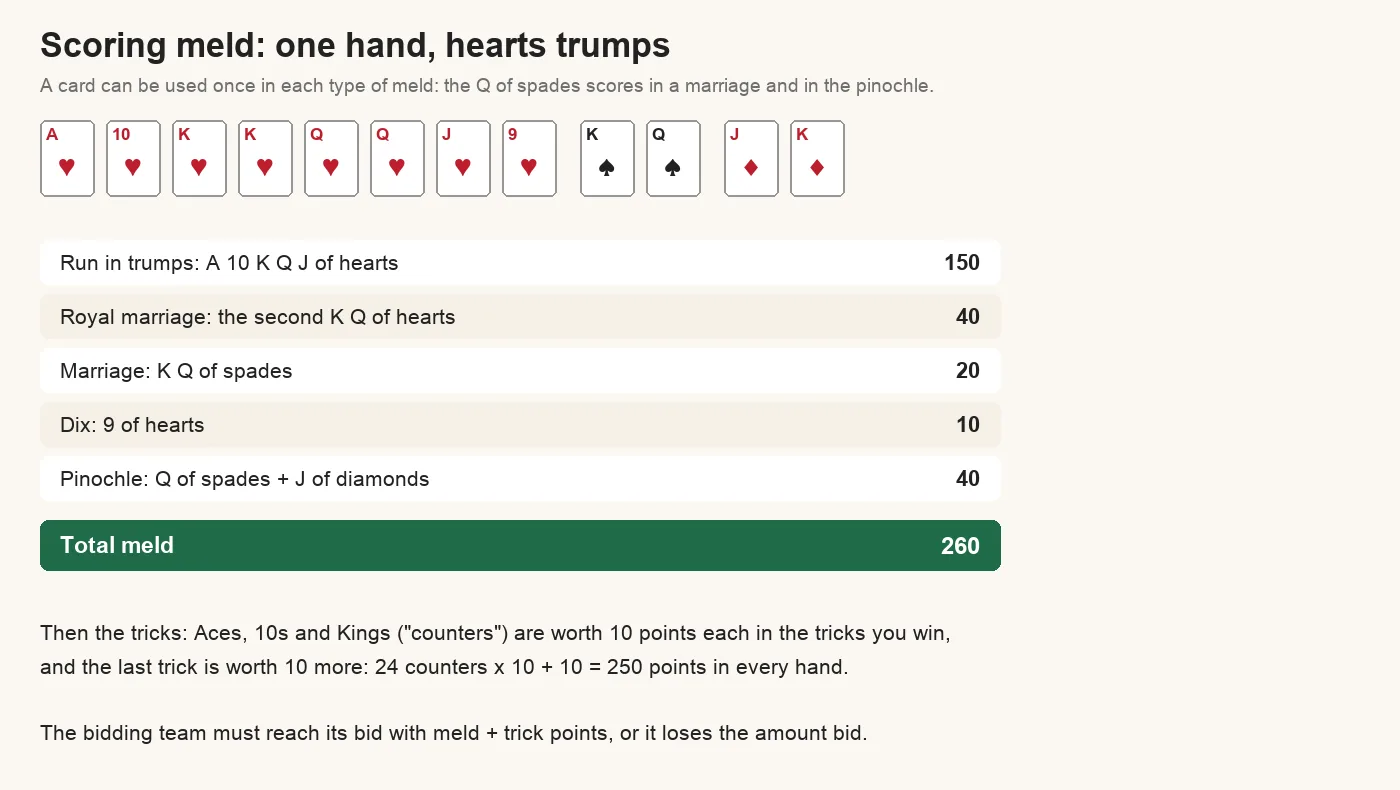
Scoring meld with hearts as trumps: a hand of A, 10, K, K, Q, Q, J and 9 of hearts, K and Q of spades, and J and K of diamonds scores a run 150, a royal marriage 40, a marriage in spades 20, the dix 10 and a pinochle 40, for 260 in meld; the tricks add 250 more points, 10 for every Ace, Ten and King won plus 10 for the last trick
A 12-card hand with hearts as trumps: 260 points in meld before a trick is played.

Rules for Playing the Tricks

Pinochle has strict rules about which card you must play:

  • Follow suit if you can, and play a card that beats the card currently winning the trick if you have one, even if it is your partner’s.
  • Trump if you have no card of the suit led. If the trick already holds a trump, beat it with a higher trump if you can; if you can’t, you must still play a trump.
  • Play any card only when you can neither follow suit nor trump.

Most card game books published since 1945 use a lighter rule: you must try to win the trick only when trumps are led. When another suit is led, you still follow suit or trump, but you don’t have to play higher. Many players still use the older rule, so settle it before the first deal.

Pinochle Scoring

There are 250 points in the tricks in every hand: each of the 24 Aces, 10s and Kings is worth 10, and the last trick is worth 10 more. Some books count the cards differently (Ace 11, 10 10, King 4, Queen 3, Jack 2) but that also comes to 250.

  • Making the bid: if the declarer’s team scores at least its bid with meld and tricks together, it adds everything it made to its score.
  • Going set: if it falls short, it scores nothing for the hand and the amount bid is taken off its score, which can go below zero.
  • Throwing in: if the declaring team’s meld is more than 250 short of its bid, the bid can’t be made. The declarer can throw the hand in without playing; the team loses its bid, and the other team scores its meld.
  • Saving meld: the other team keeps its meld only if it wins at least one counter or the last trick.

The game is usually played to 1,500. If both teams pass 1,500 on the same hand, the declaring team wins.

Two-Handed Pinochle

Two-handed pinochle is the original form of the game. Each player gets 12 cards, the next card is turned face up to set trumps, and the rest form a stock. For the first 12 tricks you don’t have to follow suit. The winner of each trick may show one meld, then both players draw from the stock, winner first. A player who holds the dix can swap it for the face-up trump card. Once the stock runs out, meld goes back into the hand and the last 12 tricks are played under strict rules: follow suit, trump if you can’t, and try to win when trumps are led. In Bicycle’s rules, the cards count Ace 11, 10 10, King 4, Queen 3, Jack 2 and last trick 10, and the game is 1,000 points.

Double Deck Pinochle

Double deck pinochle uses 80 cards: two pinochle decks with the 9s taken out, so there are four of every Ace, 10, King, Queen and Jack. Four players in partnerships get 20 cards each. Scores are kept small: each Ace, 10 and King won is 1 point and the last trick is 2, for 50 points in the tricks. A run is 15, a pinochle 4 and Aces around 10. The opening bid is usually 50, the declarer must hold a marriage in the suit they name as trumps, and the game goes to 500. It is the form played in pinochle associations and tournaments.

Four-handedTwo-handedDouble deck
Cards484880 (no 9s)
Cards per player1212, plus a stock20
TrumpsNamed by the declarerTurned up from the deckNamed by the declarer
Points in tricks25025050
Game1,5001,000500

Pinochle Strategy

  • Bid on meld plus a fair share of the tricks. Add up your meld, then add a realistic share of the 250 in the tricks. Your partner usually brings meld too, but you can’t count on it.
  • Pass trumps and Aces to the declarer. As the declarer’s partner, your four cards should help them win tricks and finish their meld.
  • Lead your Aces early. An Ace can only lose to a trump, and every trick it takes brings in counters.
  • Count the trumps. There are 12 in the deck. Knowing how many are still out tells you when your side cards are safe.
  • Feed counters to your partner. When your partner is winning a trick, play a 10 or King on it if the rules let you.
  • Throw in a hopeless hand. If your bid can’t be made, throwing in stops the other team from scoring in the tricks.
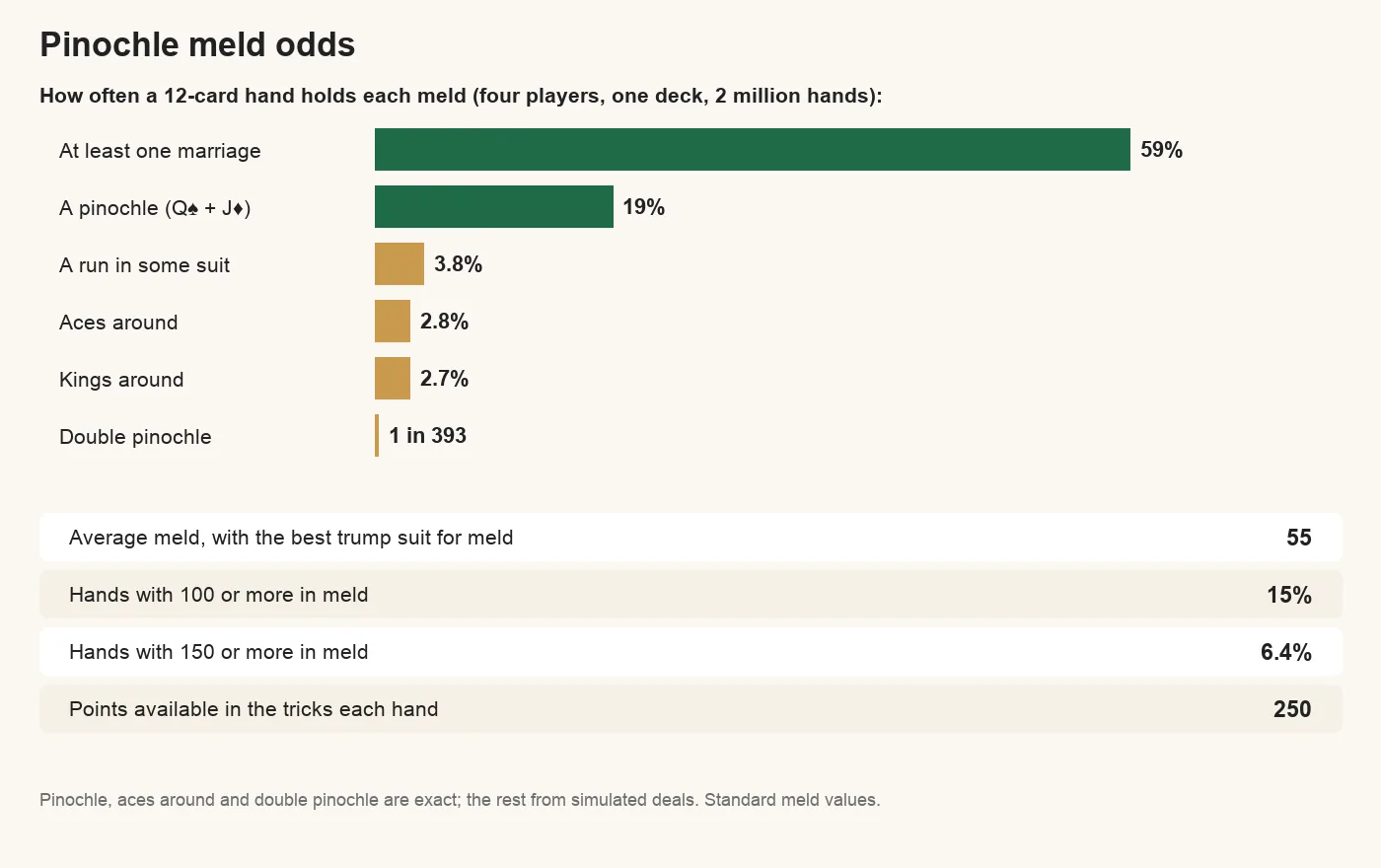
Pinochle meld odds for a 12-card hand in the four-player game: at least one marriage 59%, a pinochle 19%, a run in some suit 3.8%, Aces around 2.8%, Kings around 2.7%, double pinochle 1 in 393; average meld 55 with the best trump suit, 15% of hands meld 100 or more and 6.4% meld 150 or more; 250 points are available in the tricks
Most hands hold a marriage; a run turns up in fewer than 1 hand in 25.

Pinochle Odds

  • Marriages are common: 59% of 12-card hands hold at least one marriage.
  • Pinochle: 19% of hands hold a pinochle, and a double pinochle turns up about once in 393 hands.
  • Runs and arounds: a run in some suit comes in 3.8% of hands, Aces around in 2.8% and Kings around in 2.7%.
  • Meld per hand: with trumps in the suit that gives the most meld, a hand melds 55 points on average. 15% of hands meld 100 or more and 6.4% meld 150 or more.

The pinochle, double pinochle and Aces-around figures are exact. The rest come from 2,000,000 simulated 12-card hands scored with the meld table above.

More Card Games

For another partnership trick-taking game, try Spades. If you’d rather play alone, see Hearts or Oh Hell, where you bid the exact number of tricks you will take.

A Midwestern trick-taking game with card points: Sheepshead, where the picker plays with a hidden partner.

From Italy: Scopa, a quick capturing game played with a 40-card deck, where sweeping the table scores a point.

An Italian cousin: Briscola, a quick ace-ten trick-taking game where the turned-up card sets trumps.

Another American trick-taking classic: Euchre, where the jack of trumps is the highest card.

Pinochle: frequently asked questions

How do you play pinochle?

In the four-handed game, two teams of two each get 12 cards from a 48-card deck. Players bid for the right to name trumps, everyone shows their meld, and then 12 tricks are played. Teams score their meld plus 10 points for every Ace, 10 and King they win, and 10 for the last trick.

What is the order of cards in pinochle?

Ace is high, then 10, King, Queen, Jack and 9. The 10 ranks above the King. If two identical cards are played to the same trick, the one played first wins.

How many cards are in a pinochle deck?

A pinochle deck has 48 cards: two each of the Ace, 10, King, Queen, Jack and 9 in all four suits. Double deck pinochle uses 80 cards with the 9s removed.

How much is a pinochle worth?

A pinochle, the Queen of spades with the Jack of diamonds, is worth 40 points. A double pinochle, both Queens of spades with both Jacks of diamonds, is worth 300.

What is a run in pinochle?

A run is the Ace, 10, King, Queen and Jack of the trump suit, worth 150 points. A double run, two of each, is worth 1,500.

How many points are in a hand of pinochle?

There are 250 points in the tricks: 10 for each of the 24 Aces, 10s and Kings, plus 10 for the last trick. Meld is scored on top of that.

What does it mean to go set in pinochle?

A team goes set when its meld and trick points together come to less than its bid. It scores nothing for the hand and the amount it bid is taken off its score.

Can two people play pinochle?

Yes. In two-handed pinochle each player gets 12 cards and the rest form a stock. Players meld after winning tricks and draw from the stock until it runs out, then play the last 12 tricks under strict rules.

Fadi Hayek
Author & Casino Expert

After going through several successful experiences with several industry pioneers, Fadi Hayek has managed to excel in the world of content for online gaming by providing unique content for several projects that allowed him to obtain the necessary experience to launch his career. Last but not least, Fadi also holds several certificates, including but not limited to content marketing and iGaming.

Latest News

Artificial Intelligence in Gambling – How It Is Changing the Future of the Industry

As online casinos adopt machine learning models and artificial intelligence in gambling becomes the next disruption, you don’t want to be left behind. Read on to learn about the impact AI will have on the future of the gambling industry.

Arabian Football Betting Trends – Stay Current on Betting Preferences in the Middle East!

Keep abreast of the latest Arabian football betting trends with the Arabian sports betting insights below. This guide covers the most popular bet types with Arab bettors and the top bookmakers for Arabian and global football competitions.

Al-Nassr vs PSG | Cristiano Ronaldo vs Lionel Messi

The biggest event in world football is scheduled to take place later this month as Al Nassr vs PSG is on the cards.

Yggdrasil Collaborate with Reflex to Release Dublin Up DoubleMax

Yggdrasil and Reflex are set to launch Dublin Up DoubleMax, an Irish-style video, as one of their latest releases. The slot game is designed by incorporating Yggdrasil’s proprietary Game Engagement Mechanic (GEM) DoubleMax coupled with unique features like free spins bonus and fairy magic.