How to Play Spades
Bid your tricks, trump with spades and watch your bags. The Spades card game rules, step by step.


Bid your tricks, trump with spades and watch your bags. The Spades card game rules, step by step.
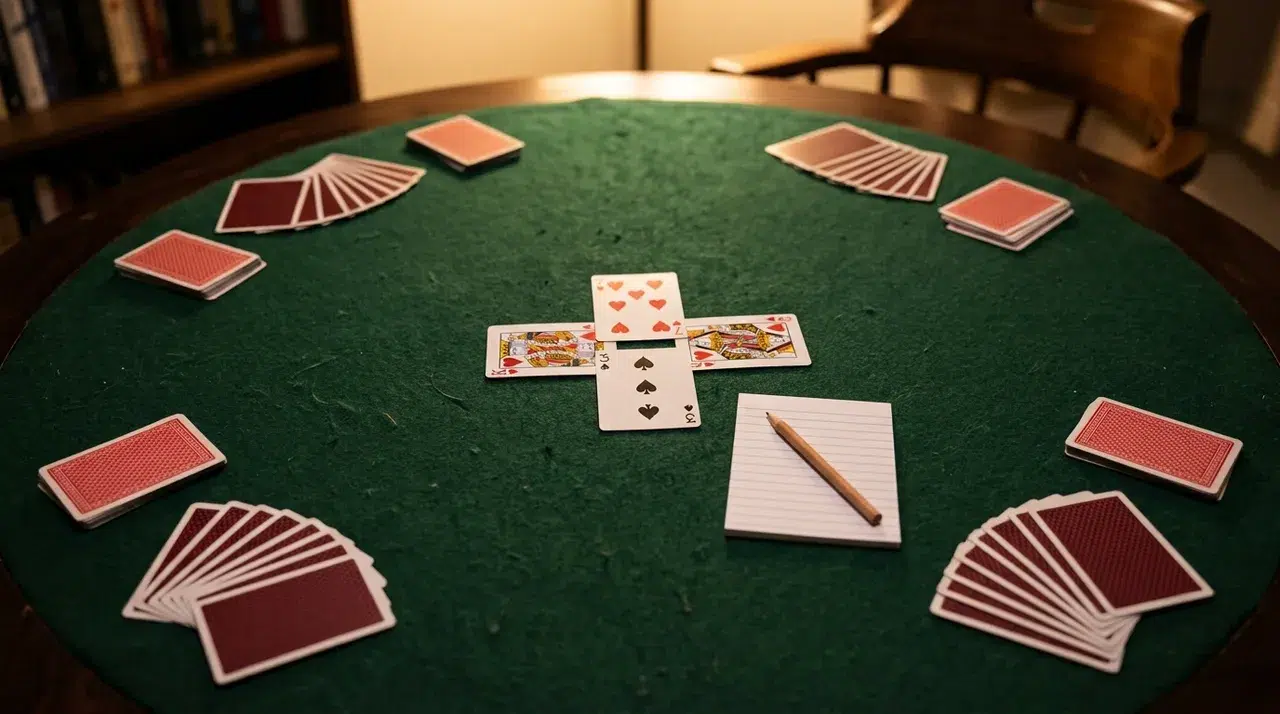
Spades is a trick-taking card game for four players in two partnerships, where the spade suit is always trumps. Each player bids how many tricks they will win, and your team scores if it makes its combined bid. It was invented in the American Midwest in the late 1930s and spread around the world with US soldiers during the Second World War. Since the 1990s, online card rooms have made it popular worldwide. It plays like a simpler cousin of Bridge. This guide covers the Spades rules step by step, bidding and Nil, scoring and bags, versions for two and three players, and how well the usual way of counting your tricks works.
| Spades | |
|---|---|
| Players | Four, in two partnerships; partners sit opposite each other. There are also versions for two, three and six players. |
| Cards | A standard 52-card pack. Cards rank Ace (high), King, Queen, Jack, 10 … 2. |
| Deal | All 52 cards, one at a time, so everyone has 13. |
| Trumps | Spades, always. Any spade beats any card of another suit. |
| Bidding | Each player bids the number of tricks they expect to win; partners’ bids are added together. |
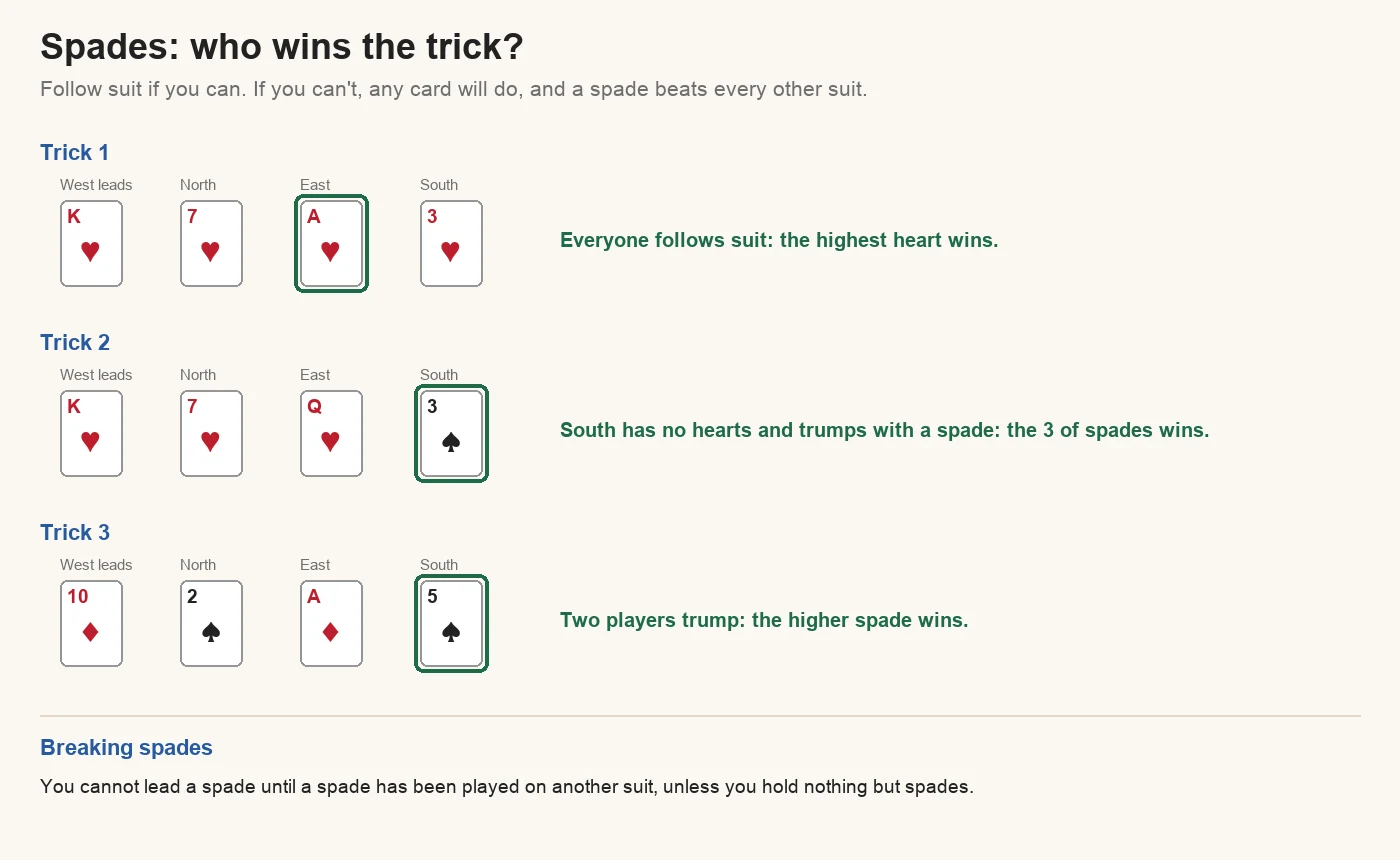
| Play | Follow suit if you can. Spades cannot be led until they have been “broken”. |
| Scoring | 10 points per trick bid if your team makes it, plus 1 per extra trick. Fail, and you lose 10 per trick bid. |
| Winning | The first team to 500 points. |
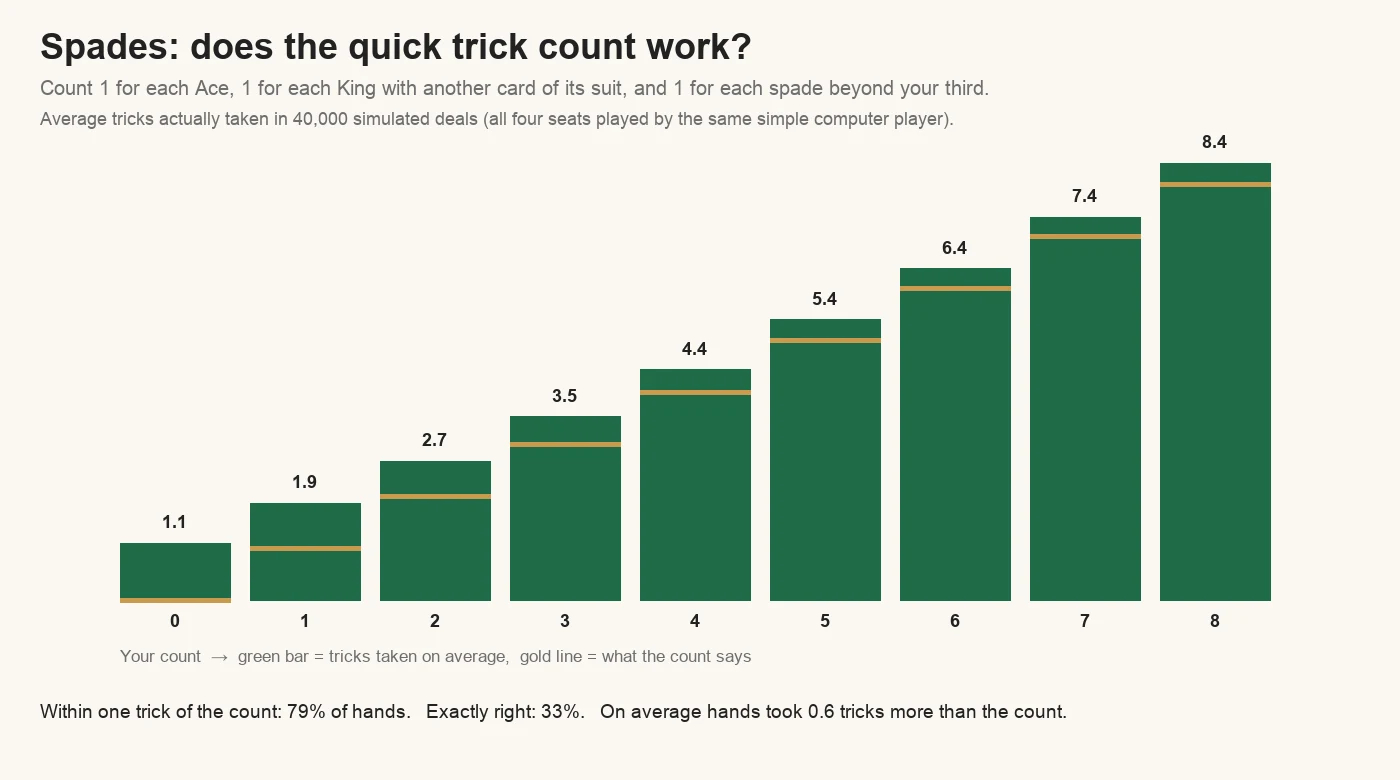
Bidding is the heart of the game. Bid too low and you collect penalty bags; bid too high and your team is “set” and loses points. A common way to start is to count:
Then adjust: a void or a single card in a side suit lets you trump early, and a long run of spades from the top is worth more than the count says.
A bid of 0 is called Nil: you promise to win no tricks at all. It earns your team a 100-point bonus if you succeed and costs 100 if you take even one trick, and your partner’s bid is scored separately as usual. Blind Nil is a Nil bid made before you look at your cards and is worth 200 either way. After the bidding you may swap two cards with your partner. Many tables only allow it when your team is behind by at least 100 points.
| Result | Score |
|---|---|
| Team makes its bid | 10 points for each trick bid |
| Each trick over the bid (a “bag”) | +1 point |
| Every 10 bags collected | −100 points |
| Team fails to make its bid (is “set”) | −10 points for each trick bid |
| Nil made / failed | +100 / −100 |
| Blind Nil made / failed | +200 / −200 |
Worked example: your team has 337 points and bids 5. Take 7 tricks and you score 52, for 389. Take 8 and you score 53, but that is your tenth bag, so you also lose 100 and finish on 290. Because each bag adds 1, the last digit of a positive score always shows how many bags you are carrying. The first team to reach 500 wins; if both teams pass 500 on the same hand, the higher score wins. For a shorter game, play to 200.
Three players play for themselves. Deal 17 cards each and set the last card aside. The player with the 2 of clubs leads it to the first trick. In the basic three-player rules, each extra trick takes 10 off your score: bid 4 and take 5, and you score 30 instead of 40. The game is played to an agreed total, often 300 or 500.
Two players don’t deal. The pack sits face down between you and you take turns drawing. Look at the top card and either keep it and discard the next one face down, or discard it and keep the next one. When the pack runs out you each hold 13 cards. Then bid and play as normal.
The rules above are the standard used in online play. Home games often add their own twists:
| Variation | How it works |
|---|---|
| Jokers | Two Jokers are added as the highest trumps (big Joker, then little Joker) and the 2s of clubs and hearts are taken out. The 2 of spades then usually ranks third, above the Ace. |
| Partnership bidding | Partners discuss and agree one bid for the team, often with a minimum of 4 tricks. |
| Passing cards | Before bidding, partners pass three cards to each other face down. |
| Boston | Taking all 13 tricks. In some groups a team that bids 10 and takes all 13 wins the game outright. |
| Set twice, you lose | In some groups a team that fails its bid on two hands in a row loses the whole game. |
| First hand free | The first hand is played without bidding, at 10 points per trick. |
| Individual Spades | Everyone plays for themselves with a minimum bid of 1, and a failed bid scores 0. |
How good is the simple count? In 40,000 simulated deals where all four seats were played by the same simple computer player, the count was within one trick of the tricks actually taken in 79% of hands and exactly right in 33%. On average a hand took 0.6 tricks more than its count, and a team bidding the two counts added together made its bid 90% of the time.
If you like Spades, try Gin Rummy, Canasta, Crazy Eights, President and Three Card Brag.
Another favourite card game: Golf, where you swap and pair cards to get the lowest score.
The other great American trick-taking game: Hearts, where every trick you avoid is a point saved.
Bid alone, and bid exactly: Oh Hell, where one trick too many costs you the bonus.
Another partnership game with bidding: Pinochle, where your team scores for meld as well as for the tricks it wins.
The classic partnership game: Whist, the classic partnership trick-taking game with no bidding, where trumps are set by the turned-up card.
Another partnership favourite: Euchre, played with 24 cards and the right and left bowers.
Another game for teams: how to play Sequence.

After going through several successful experiences with several industry pioneers, Fadi Hayek has managed to excel in the world of content for online gaming by providing unique content for several projects that allowed him to obtain the necessary experience to launch his career. Last but not least, Fadi also holds several certificates, including but not limited to content marketing and iGaming.


