Scopa Card Game Rules
Capture cards by matching or adding up, sweep the table, and chase the seven of coins: how to play Italy’s classic card game.


Capture cards by matching or adding up, sweep the table, and chase the seven of coins: how to play Italy’s classic card game.
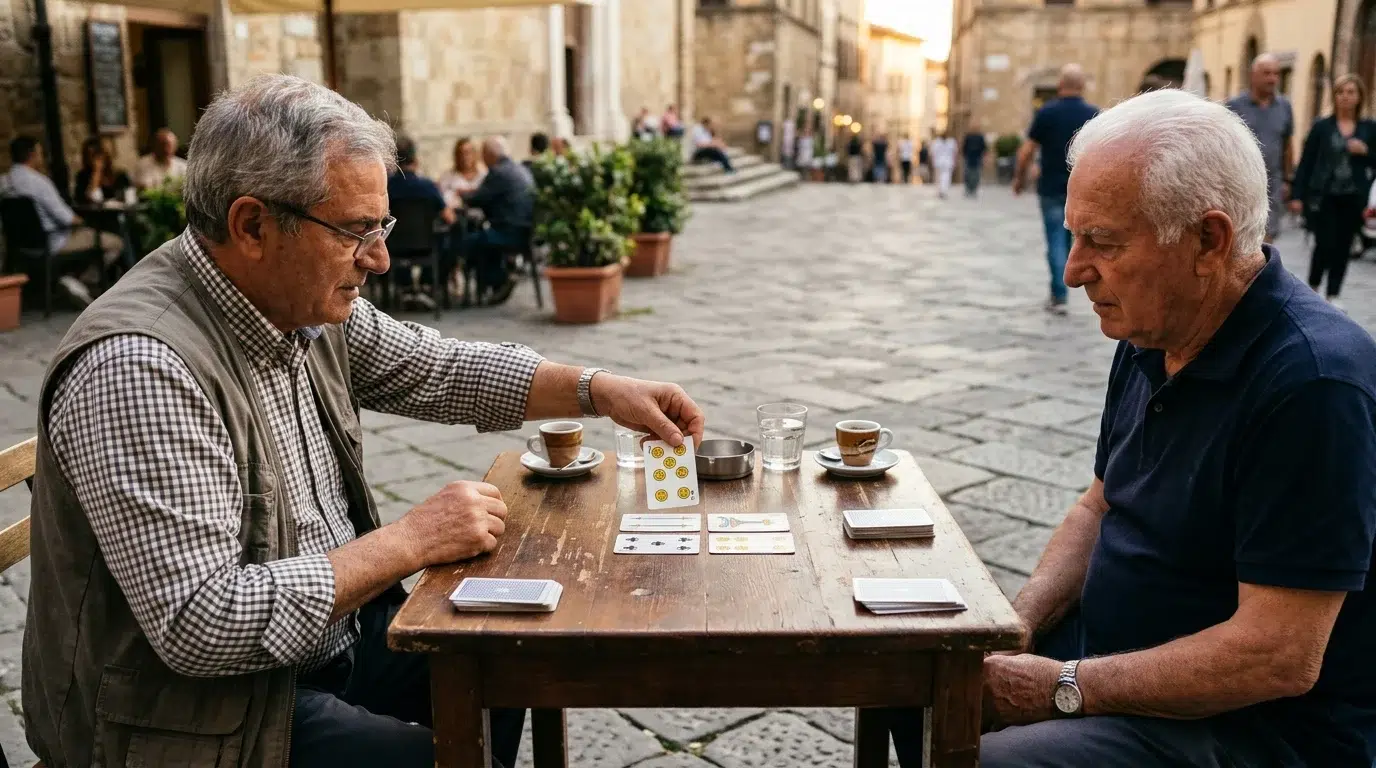
Scopa is one of Italy’s best-known card games, a “fishing” game in which you play a card from your hand to capture cards of the same value from the table. Its name means “broom”: clear every card off the table and you have made a scopa, a sweep, worth a point. Along with Briscola and Tressette it is one of Italy’s three great national card games, and Italian emigrants took it to Argentina, Brazil and beyond. It is usually played by two players, or four in two teams, with a 40-card Italian deck, but an ordinary deck works too. This guide covers the Scopa card game rules: the cards, capturing, scoring, the primiera, variations, tips and odds.
| Scopa | |
|---|---|
| Players | 2, or 4 in two partnerships. It can also be played by 3 or 6. |
| Cards | A 40-card Italian deck: coins, cups, swords and clubs, Ace to 7 plus Jack, Horse and King. Or a regular deck with the 8s, 9s and 10s taken out. |
| Card values | Ace 1, 2 to 7 face value, Jack 8, Horse (or Queen) 9, King 10. |
| Deal | 3 cards each and 4 face up on the table; 3 more each whenever hands run out. |
| Capture | Play a card to take an equal card, or cards that add up to it. |
| Points | Most cards, most coins, the seven of coins, the best primiera, plus 1 for each scopa. |
| Goal | First to 11 points (or 16 or 21 if agreed). |
Scopa uses a 40-card Italian deck with four suits: coins (denari), cups (coppe), swords (spade) and clubs (bastoni). Each suit runs Ace to 7 plus three face cards: the Jack (Fante, worth 8), the Horse (Cavallo, 9; a Queen in northern Italian decks) and the King (Re, 10). Coins are the important suit, and the seven of coins, the settebello or “beautiful seven”, is the most valuable card in the game.
No Italian cards? Use a regular deck. Take out the 8s, 9s and 10s to leave 40 cards. The Jack counts 8, the Queen 9 and the King 10, and diamonds stand in for coins, so the seven of diamonds is the settebello. Some beginners instead take out the face cards and play Ace to 10.
The player beside the dealer starts (the non-dealer in a two-player game), and play goes around the table, traditionally to the right. On your turn you play one card face up from your hand:
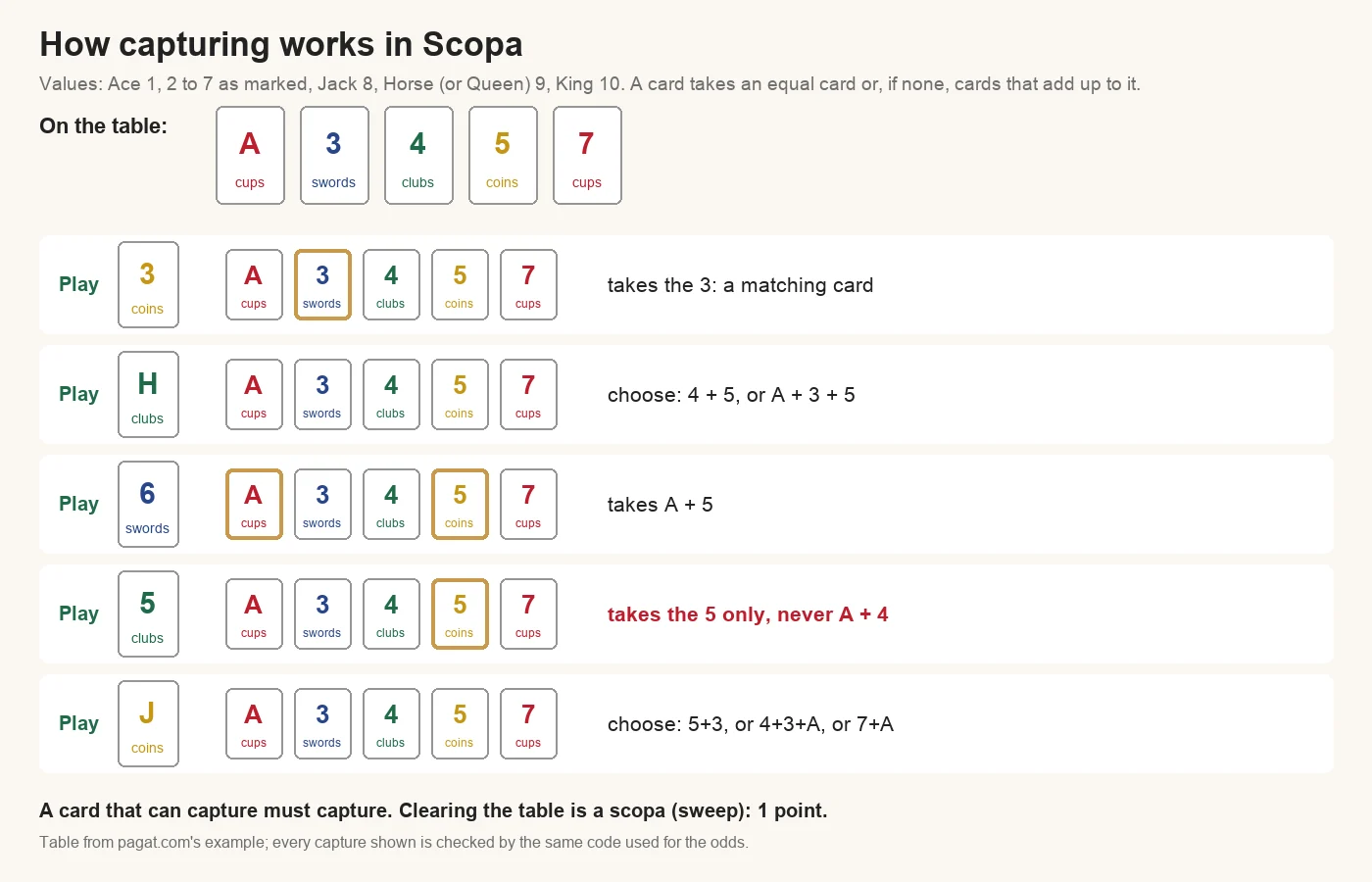
If your capture clears every card from the table, that is a scopa, worth 1 point. Players mark it by leaving the capturing card face up and sideways in their pile. The next player then has nothing to capture and must start a new table. The one exception: taking the last cards with the very last card of the hand never counts as a scopa.
When all the cards have been played, whoever made the last capture takes any cards still on the table. Then the hand is scored.
At the end of each hand, players (or teams) score:
| Point | Who scores it |
|---|---|
| Scope | 1 point for each scopa (sweep). |
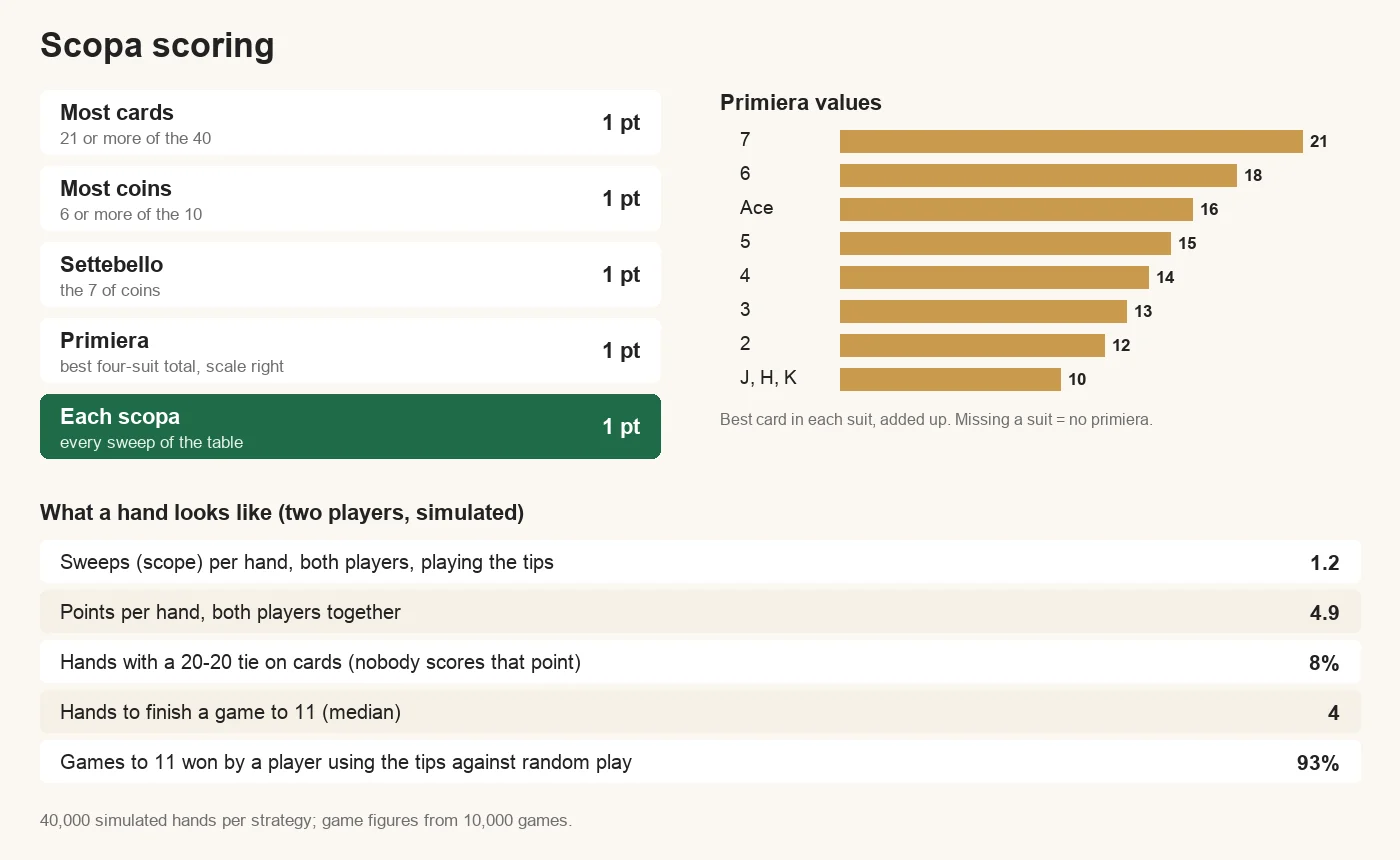
| Cards (carte) | 1 point for capturing the most cards: 21 or more of the 40. |
| Coins (denari) | 1 point for the most coins: 6 or more of the 10. |
| Settebello | 1 point for capturing the seven of coins. |
| Primiera | 1 point for the best primiera (see below). |
Ties score nothing: if both sides take 20 cards, nobody gets the point for cards.
The primiera takes its name from the old gambling game Primiera. Each side picks its best card in each suit and adds up their primiera values: 7 = 21, 6 = 18, Ace = 16, 5 = 15, 4 = 14, 3 = 13, 2 = 12, and face cards 10. The higher total wins the point, and a side missing a suit cannot score it. Sevens matter most, but not alone: three sevens with no card of the fourth suit make only 63, which loses to one seven and three Aces (69).
Hands are dealt in turn until a player or team reaches 11 points with more than anyone else. Points only count at the end of a hand, so taking the settebello at 10–9 does not win on the spot. Many groups play to 16 or 21 instead, and some let a player end the hand early by claiming they have enough to win, at the risk of losing the game if they are wrong.
| Variation | How it differs |
|---|---|
| Scopone | Four players in two teams, each dealt nine cards at once (or ten each, with none on the table, in Scopone a 10 carte). |
| Scopa d’Assi | Playing an Ace sweeps the whole table, but it does not count as a scopa. |
| Scopa a Quindici | You capture cards that add up to 15 together with the card you play. Popular in Argentina and Brazil. |
| Re Bello | The King of coins scores a point too, like the settebello. |
| Napola | Ace, 2 and 3 of coins score extra, plus one for each further coin in sequence; games go to 21. |
| Chkobba | The Tunisian version, played to 21 with a simpler “most sevens” rule in place of the primiera. |
The tips are simple, but they make a big difference: in 10,000 simulated two-player games to 11, a player following them beat a player choosing at random 93% of the time.
The redeal figure is exact. The rest come from 40,000 simulated hands for each kind of play, under the rules above.
Scopa was especially popular in Naples in the 18th century and was already played across Italy. It is thought to descend from Spanish games played in the port of Naples, and the primiera it scores is named after the old gambling game Primiera. Italian emigrants spread it widely, and it is still played in Argentina, Brazil, Libya, Tunisia and Somalia, often under local names.
If you enjoy Scopa, try Sheepshead or Pinochle, two more classic European card games, or Cribbage, another game where you count card values as you play. For a casino card game, see baccarat.
Italy’s other classic: Briscola, a trick-taking game with the same 40-card deck, where Aces and Threes carry the points.
The English cousin: Casino, a fishing game played with a full 52-card deck, where you can also build cards to capture later.

After going through several successful experiences with several industry pioneers, Fadi Hayek has managed to excel in the world of content for online gaming by providing unique content for several projects that allowed him to obtain the necessary experience to launch his career. Last but not least, Fadi also holds several certificates, including but not limited to content marketing and iGaming.


