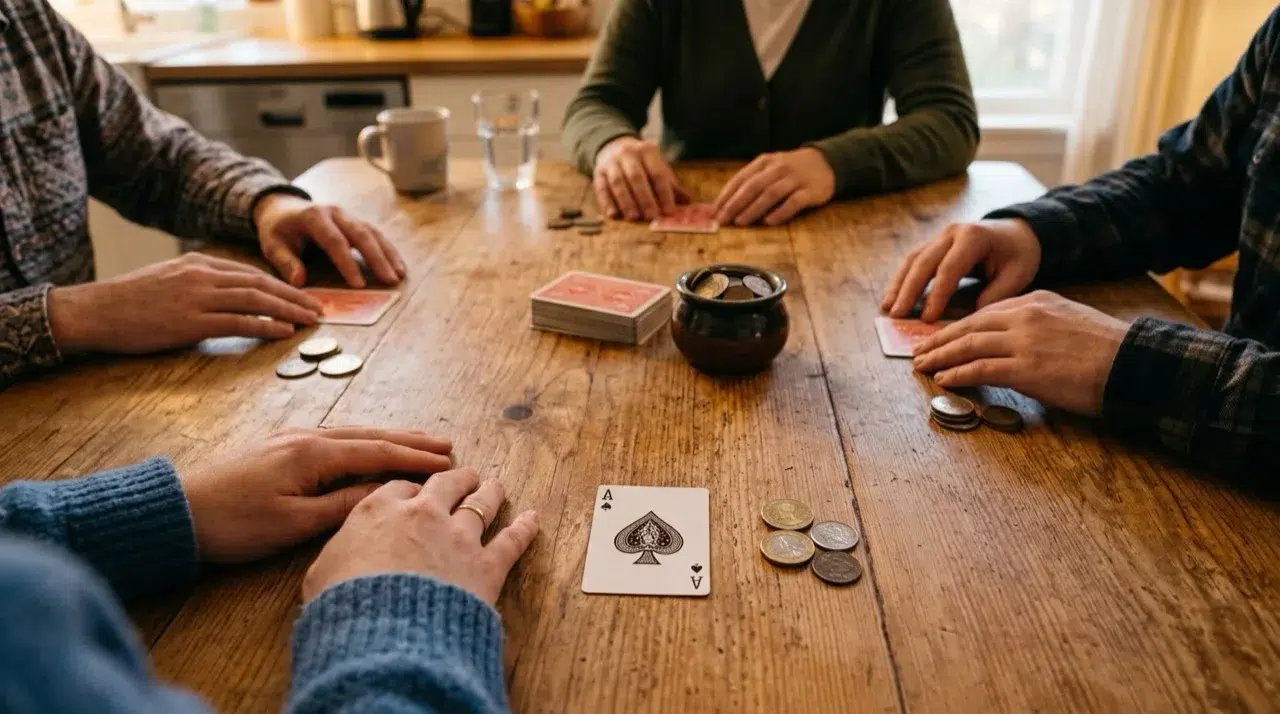
A game of Chase the Ace at a kitchen table: four players each with one face-down card and a few coins as lives, the deck and a pot of coins in the middle, and one player showing the ace of spades

Chase the Ace is a quick British card game for a group: everyone gets one card, you can swap it with the player next to you, and whoever ends up with the lowest card loses a life. It is also known as Cuckoo or Ranter Go Round, and in the US as Screw Your Neighbor. Traditionally each player puts a small stake in a pot, and the last player with a life left takes it. The name is also used for a different, Old Maid-style game, which is explained further down. This guide covers the Chase the Ace rules, the variations, and when to keep or swap your card.

Chase the Ace Rules at a Glance

Chase the Ace
PlayersThree or more; the more the better.
CardsOne standard 52-card pack, no jokers. Suits do not matter.
Card rankingKing (high), Queen, Jack, 10 down to 2, Ace (low).
LivesUsually three each, often kept as coins or counters.
AimDo not be left holding the lowest card.
KingsA King cannot be taken from you: show it and the swap is blocked.
WinnerThe last player with a life left takes the pot.

How to Play Chase the Ace

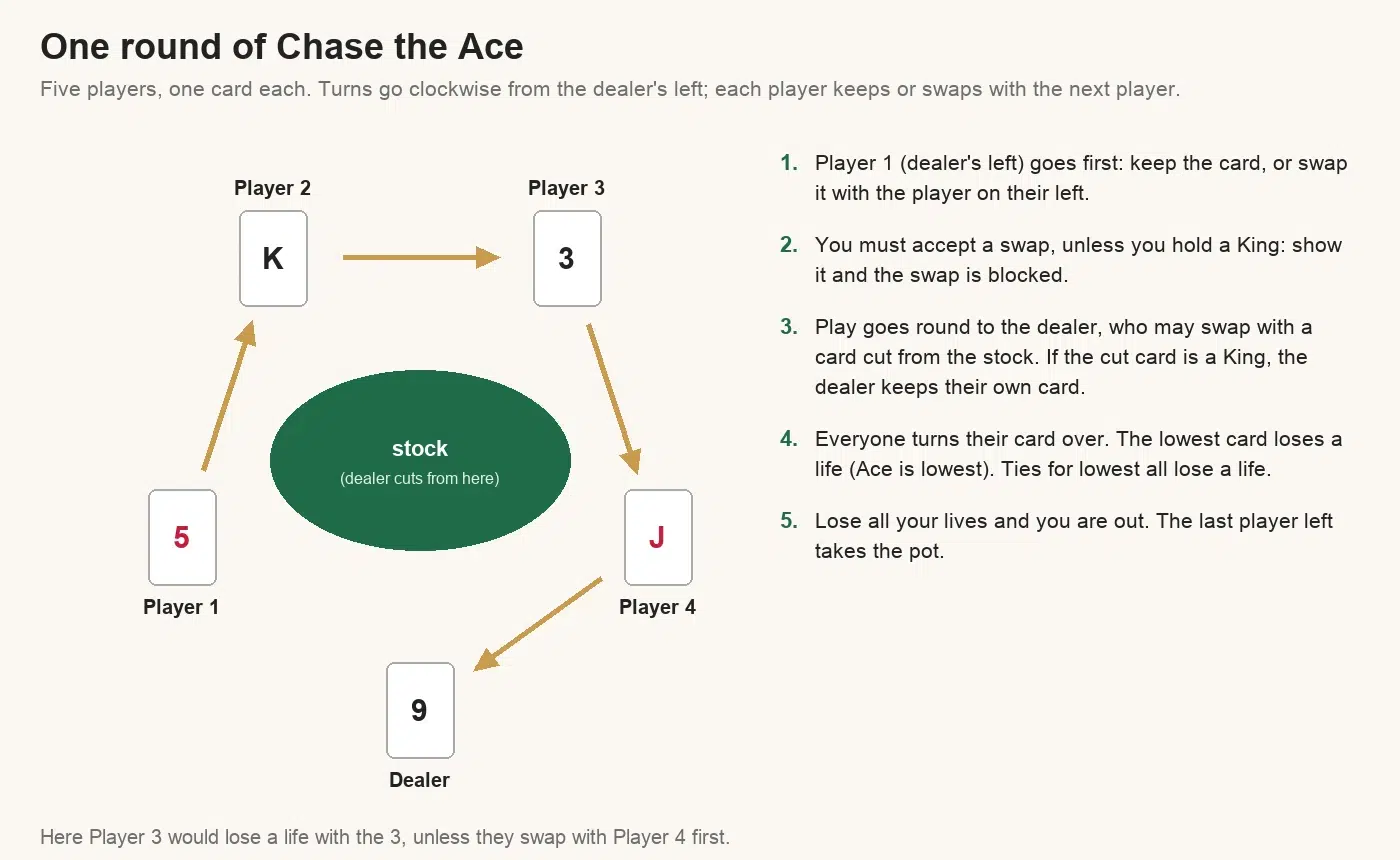
  1. Lives and stakes. Everyone starts with the same number of lives, usually three, and puts an agreed stake in the pot.
  2. Deal one card each. The dealer deals one card face down to every player. Look at your own card but keep it hidden.
  3. Keep or swap. Starting with the player on the dealer’s left and going clockwise, each player either keeps their card or swaps it with the player on their left.
  4. No refusing. You must accept a swap unless you hold a King. If you do, turn it face up and the player trying to swap keeps their own card.
  5. The dealer goes last. The dealer may keep their card or swap it for a card cut from the rest of the pack. If the cut card is a King, the dealer must keep their original card.
  6. Reveal. Everyone turns their card over. The player with the lowest card loses a life; if several players tie for lowest, they all lose one.
  7. Next round. The deal usually passes to the left. A player who loses their last life is out, and the last player left in wins the pot.
Diagram of one round of Chase the Ace with five players: turns go clockwise from the dealer's left, each player can swap with the player on their left, Kings block a swap, and the dealer can swap with a card cut from the stock
Bad cards move one seat to the left with every swap, so they tend to end up near the dealer.

When the last players tie

If every player still in has one life left and they all tie for the lowest card, everyone would be out at once. Groups settle this in different ways, so agree one before you start:
  • the tied players share the pot;
  • they keep their last life and play another round;
  • they cut the pack, and the highest card takes the pot;
  • the game is void and the pot carries over to the next game, with or without new stakes added.

Screw Your Neighbor: Chase the Ace in America

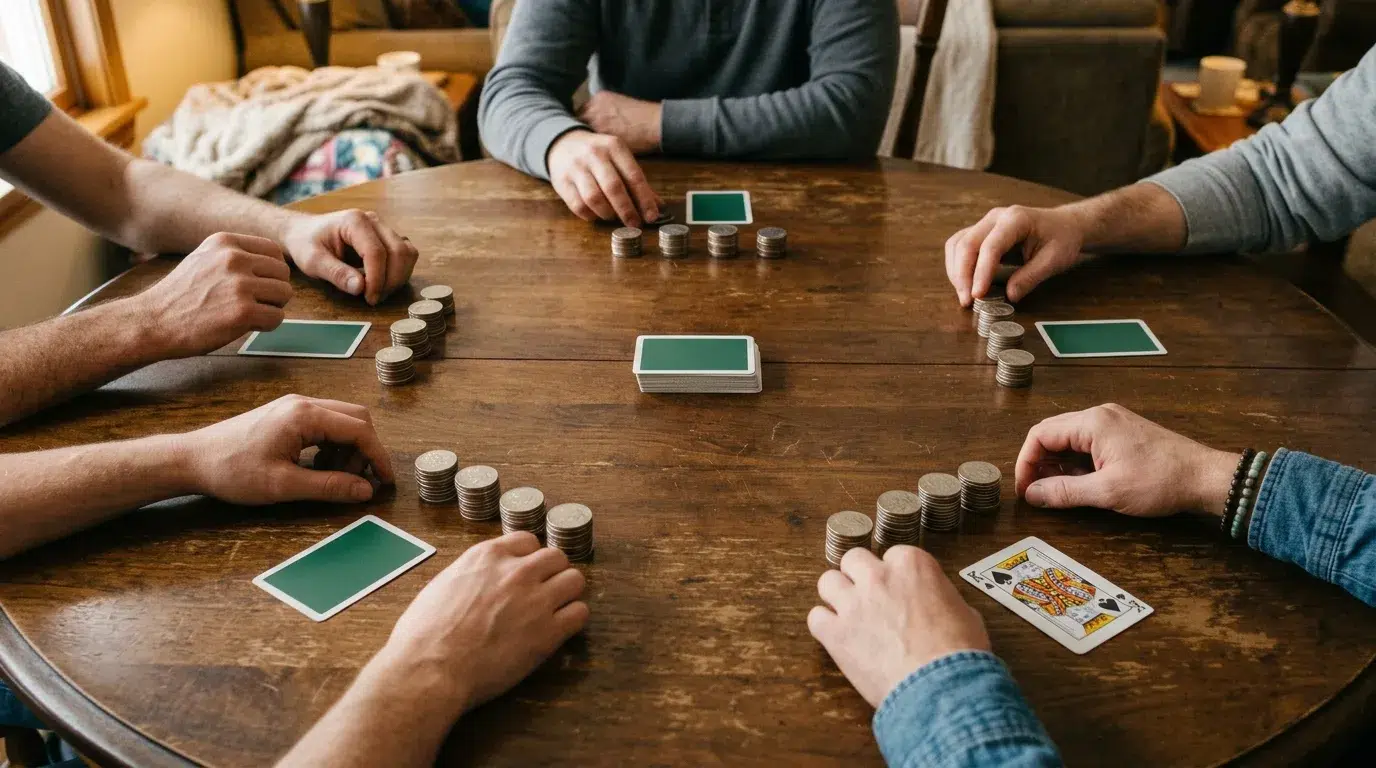
Five players around a round wooden table playing Screw Your Neighbor, each with one face-down card and small stacks of quarters in front of them as lives; one player shows a King of spades and the deck sits in the middle
Lives kept as stacks of coins: two players here have already lost one.

In the US, Chase the Ace is usually called Screw Your Neighbor. It is the same game: one card each, keep it or swap it with the player on your left, a King blocks a swap, and the lowest card loses a life. The name Screw Your Neighbor is also used for several other card games, so check which one your group means; this page covers the one-card swapping game, also known as Cuckoo and Ranter Go Round.

American groups often play it with a few differences:

  • Four lives, played for money. In one American version each player starts with four lives, kept as four equal piles of money in front of them. You give up a pile every time you lose a life, and the last player left in wins all the money.
  • Big groups. That version is played by anywhere from 3 to 26 players.
  • The dealer’s swap. Some groups let the dealer swap with the top card of the deck instead of cutting the pack.
  • Kings. Besides the usual rule that a King blocks a swap, some American groups trade Kings like any other card, and others make anyone dealt a King show it straight away, which stops all trading that round. Queens and Jacks have house rules too; see the variations below.
Chase the AceScrew Your Neighbor
WhereBritainUnited States
LivesUsually threeOften four, kept as piles of money
PlayersThree or moreThree or more; one version allows up to 26
Dealer’s turnCut a card from the packCut a card, or take the top card of the deck
KingsBlock a swapBlock a swap, or a house rule

Chase the Ace Strategy: Keep or Swap?

The only decision in the game is whether to keep your card. A few rules make a real difference:
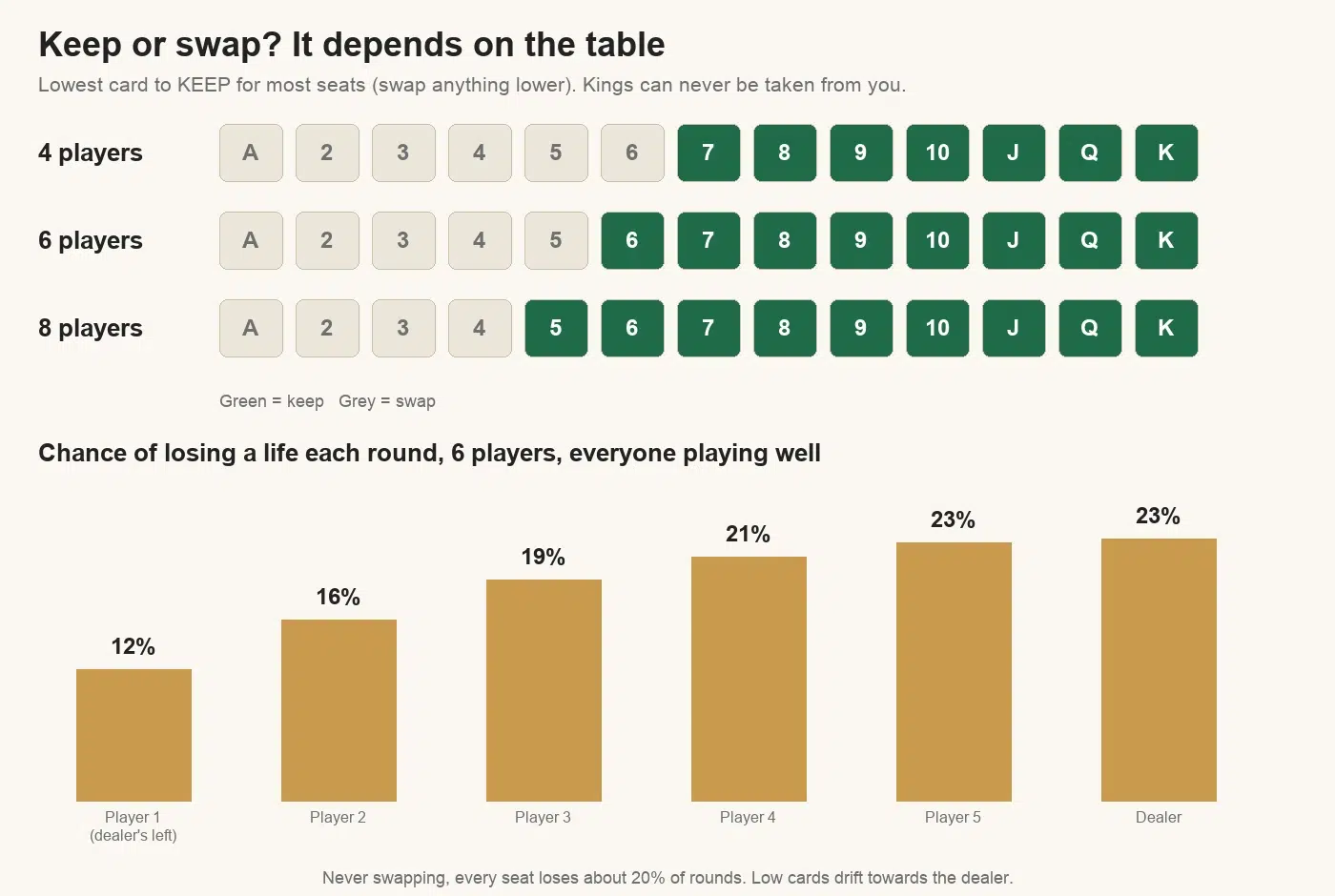
  • Keep a 7 or better at a small table. With four players the best rule for most seats is to keep a 7 or higher and swap anything lower. With six players, keep a 6 or higher; with eight, keep a 5 or higher. The more players there are, the less likely a middle card is to be the lowest.
  • Always keep a King. Nobody can take it, so you cannot lose a life with it.
  • If someone swaps with you and you get a higher card, keep it. The player on your right now holds your old, lower card and has already had their turn, so you cannot be the lowest.
Chase the Ace keep-or-swap chart: keep 7 or higher with 4 players, 6 or higher with 6 players, 5 or higher with 8 players, and a bar chart showing the chance of losing a life rising from 12% for the player on the dealer's left to 23% for the last seats
Seat matters more than you might think: the player on the dealer’s left loses a life far less often than the dealer.

Why the dealer loses most often

Every swap pushes a low card one seat to the left, so bad cards drift round the table towards the dealer. With six players all following the rules above, the player on the dealer’s left loses a life in about 12% of rounds and the dealer in about 23%, against 20% each if nobody ever swapped. With four players the gap is 20% against 32%. Because the deal passes round the table, everyone takes a turn in the worst seat.

Chase the Ace Variations

VariationThe rule
DirectionSome groups play anticlockwise and swap to the right; agree before you deal.
Kings face upAnyone dealt a King shows it straight away; if a King is showing, nobody may swap that round.
Kings as normal cardsKings can be swapped like any other card.
QueensIf you try to swap with someone holding a Queen, you must swap with the player on your right instead.
JacksA Jack also blocks a swap: show it to the player who asked, and play moves on.
Pairs are safePlayers holding cards of the same rank are safe; the lowest unique card loses.
Four livesIn some American versions, players start with four lives, kept as four piles of money.

The Other Chase the Ace

Some families use the name for a different game, close to Old Maid:

  1. Remove the jokers and three of the four aces, leaving one ace in the pack.
  2. Deal out all the cards. Everyone puts down any pairs they hold.
  3. In turn, take a card from the hand of the player next to you. If it makes a pair, put the pair down.
  4. Keep going until all the pairs are down. The player left holding the ace loses.

It is a good first card game for young children.

Chase the Ace the lottery

Chase the Ace is also a fundraising lottery that took off in Canada in 2013 and is now a common pub promotion in Australia. Each week a ticket is drawn, and the winner picks a card from the deck: if it is the ace of spades they win the jackpot; if not, that card is removed and the jackpot rolls over to the next draw.

More Simple Card Games

If you like games decided by the higher card, Casino War is the casino version. For more British pub and family classics, see Three Card Brag, Pontoon and the dice game Shut the Box.

If you play for money, keep the stakes small and agree them before you start. Free, confidential support is available at BeGambleAware.org. 18+ only.

More party card games: Switch (also called Black Jack), the race to empty your hand.

More family card games: Go Fish – how to play, the variations and the odds behind every ask.

Like card-passing games? Try Old Maid (Scabby Queen in Britain), where nobody wants the last Queen.

Chase the Ace: frequently asked questions

How do you play Chase the Ace?

Everyone gets one card. Starting on the dealer’s left, each player keeps their card or swaps it with the player on their left; the dealer can swap with a card cut from the pack. Everyone then shows their card, and the lowest card loses a life. The last player with a life left wins.

Is the Ace high or low in Chase the Ace?

Low. The Ace is the lowest card and the King the highest, so the Ace is the card nobody wants to end up with.

What happens if you have a King in Chase the Ace?

Nobody can take it. If someone tries to swap with you, turn the King face up and the swap is blocked. If the dealer cuts a King from the pack, they must keep their original card.

How many lives do you get in Chase the Ace?

Usually three each, often kept as coins or counters. Some American versions use four.

What happens if two players tie for the lowest card?

They both lose a life. If the last players left all tie and would all be knocked out, agree in advance whether they share the pot, play another round, or cut cards for it.

When should you swap in Chase the Ace?

Keep a 7 or higher with four players, a 6 or higher with six, and a 5 or higher with eight, and swap anything lower. Always keep a King, and keep a higher card that someone has just swapped to you.

What is Chase the Ace also called?

Cuckoo and Ranter Go Round in Britain, and Screw Your Neighbor in the US.

Is there another game called Chase the Ace?

Yes. Some families use the name for an Old Maid-style game played with a single ace, and it is also the name of a fundraising lottery in which the jackpot is won by drawing the ace of spades.

Is Screw Your Neighbor the same as Chase the Ace?

Yes. Screw Your Neighbor is the usual American name for Chase the Ace, which is also called Cuckoo or Ranter Go Round: one card each, keep it or swap with the player on your left, and the lowest card loses a life. The name Screw Your Neighbor is also used for a few other card games.

How do you play Screw Your Neighbor with money?

In one common American version, each player starts with four equal piles of money, one for each life. Every time you are left holding the lowest card you give up a pile, and the last player still in the game wins all the money.

Fadi Hayek
Author & Casino Expert

After going through several successful experiences with several industry pioneers, Fadi Hayek has managed to excel in the world of content for online gaming by providing unique content for several projects that allowed him to obtain the necessary experience to launch his career. Last but not least, Fadi also holds several certificates, including but not limited to content marketing and iGaming.

Latest News

Artificial Intelligence in Gambling – How It Is Changing the Future of the Industry

As online casinos adopt machine learning models and artificial intelligence in gambling becomes the next disruption, you don’t want to be left behind. Read on to learn about the impact AI will have on the future of the gambling industry.

Arabian Football Betting Trends – Stay Current on Betting Preferences in the Middle East!

Keep abreast of the latest Arabian football betting trends with the Arabian sports betting insights below. This guide covers the most popular bet types with Arab bettors and the top bookmakers for Arabian and global football competitions.

Al-Nassr vs PSG | Cristiano Ronaldo vs Lionel Messi

The biggest event in world football is scheduled to take place later this month as Al Nassr vs PSG is on the cards.

Yggdrasil Collaborate with Reflex to Release Dublin Up DoubleMax

Yggdrasil and Reflex are set to launch Dublin Up DoubleMax, an Irish-style video, as one of their latest releases. The slot game is designed by incorporating Yggdrasil’s proprietary Game Engagement Mechanic (GEM) DoubleMax coupled with unique features like free spins bonus and fairy magic.