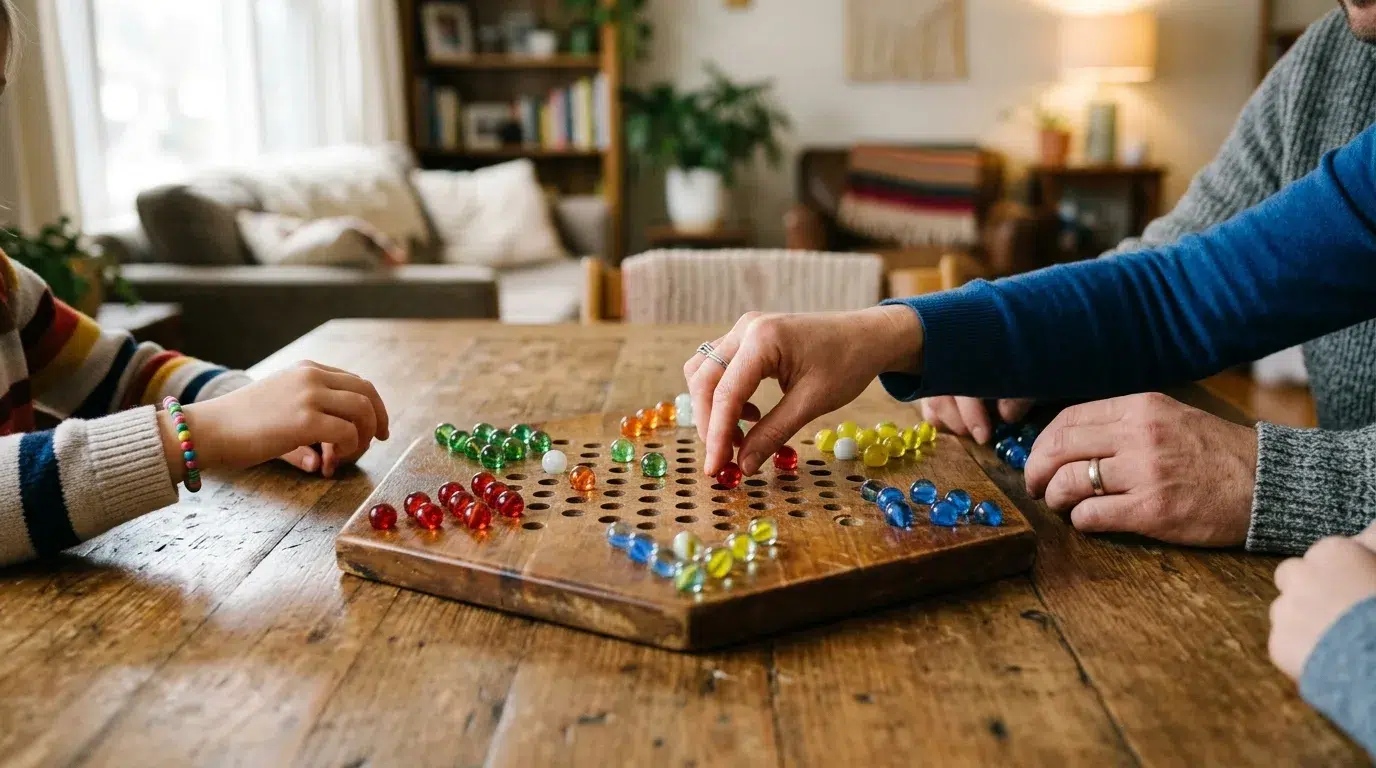
A family playing Chinese checkers on a wooden board, with red, green, yellow and blue marbles in the points of the star and one hand placing a marble
Up to six players, ten marbles each, and a race to the far side of the star.

Chinese checkers (Chinese chequers in the UK) is a race game for two to six players on a star-shaped board. Each player starts with ten marbles in one point of the star and tries to be first to move them all into the point directly opposite, by stepping to the next hole or hopping over other marbles. Nothing is captured, so the game is all about building long chains of hops for yourself and blocking the ones your opponents need. Despite the name, it is neither Chinese nor a form of checkers: it was invented in Germany in 1892. This guide covers how to play Chinese checkers, the set-up for every number of players, the variations, and the strategy that wins the race.

Chinese Checkers Rules at a Glance

Chinese checkers
PlayersTwo, three, four or six.
BoardA six-pointed star with 121 holes; each point holds 10.
Pieces10 marbles or pegs per player (15 in some two-player games).
GoalBe first to move all your marbles into the point opposite your start, called your home.
MovesEither one step to an adjacent empty hole, or one or more hops over single marbles into the empty hole beyond.
CapturesNone. Marbles that are hopped over stay on the board.
Turn orderClockwise around the board.

How to Set Up the Board

PlayersSet-up
TwoStart on opposite points, so each of you races into the other’s start. Some players use 15 marbles each, or two or three sets each.
ThreeUse three alternate points, so everyone races into an empty point. Or play two sets each, on opposite points.
FourUse two pairs of opposite points and leave the remaining two points empty.
SixEvery point is used. Play every player for themselves, or in three teams of two with partners on opposite points.

How to Play Chinese Checkers

  1. Decide who starts, for example with a coin toss, and play clockwise from there.
  2. Move one marble per turn. Either step it to any adjacent empty hole, in any of the six directions, or hop it.
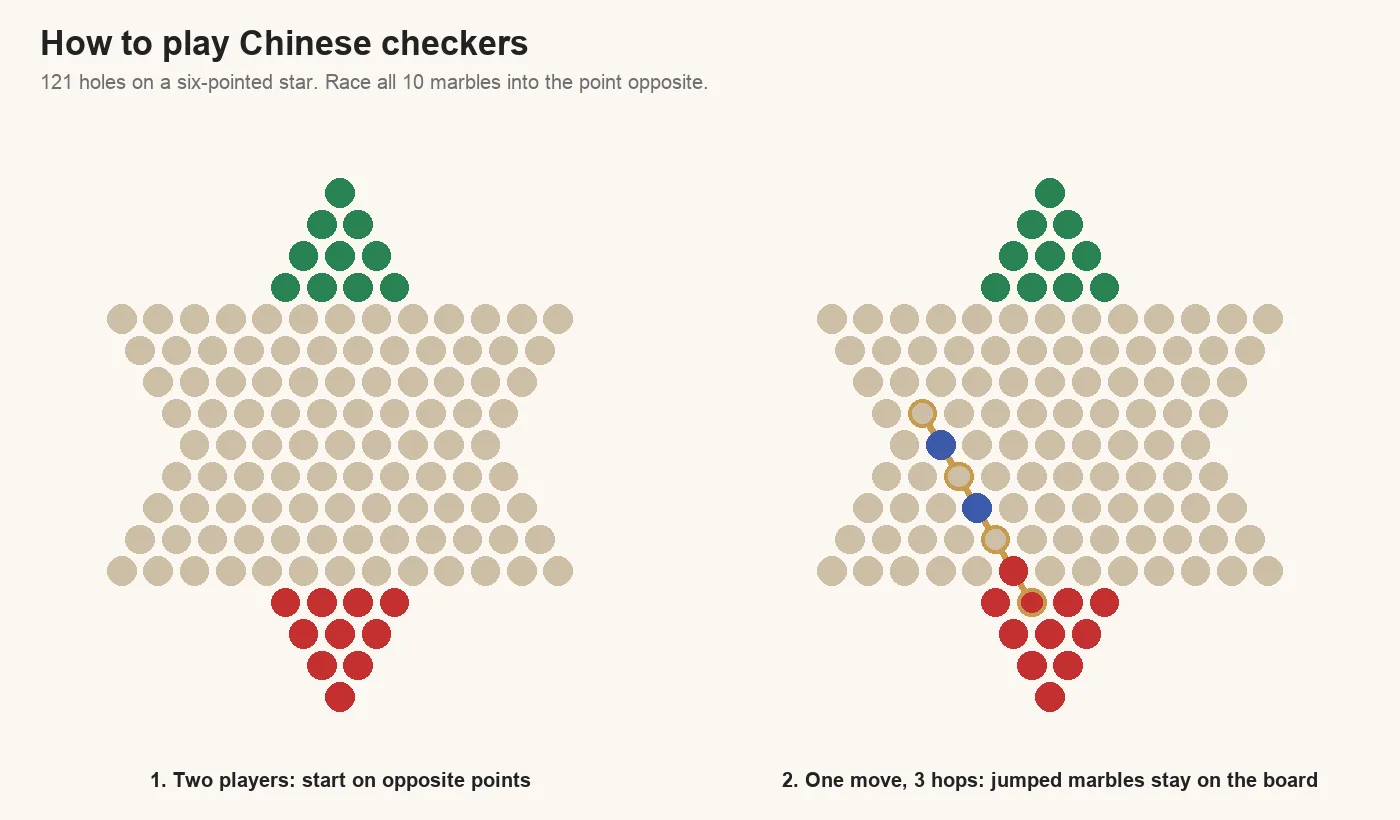
  3. Hop. If the next hole along a line holds a marble, of any colour, and the hole straight beyond it is empty, you can jump over it into that empty hole.
  4. Chain your hops. After a hop you may keep hopping with the same marble, changing direction as you like, for as long as there are marbles to jump. You can stop whenever you choose.
  5. Don’t mix the two. A turn is either a single step or a series of hops, never a step followed by a hop.
  6. Win. The first player to fill their home point with all their marbles wins. The others can carry on to decide second, third and last place.
Chinese checkers rules diagram: the 121-hole star board with red and green marbles on opposite points for two players, and a red marble hopping three marbles in one move
One marble, three hops, one move: any colour can be jumped, and nothing is captured.

Rules Players Often Ask About

  • Can you jump your own marbles? Yes. You can hop over any marble, yours or an opponent’s.
  • Are you forced to hop? No. Hopping is never compulsory, and you can stop a chain part-way.
  • Can a marble go backwards? Yes. Steps and hops can go in any of the six directions, and moving a marble back can set up a long chain later.
  • Can you jump two marbles in a row? Not in the standard rules: each hop goes over exactly one marble into an empty hole. Some fast variants allow it.
  • What if someone won’t leave their start? A player who keeps marbles in their own point can stop an opponent from finishing. Players have proposed various extra rules to stop this, so agree on one before you start.

Chinese Checkers Variations

VariationHow it differs
Fast-paced (Super Chinese checkers)Popular in France: you can hop over a marble that is not next to you, landing the same distance beyond it. Only one marble may be in the way.
CaptureAll 60 marbles start in the central hexagon. Players hop any marble over any other and keep the ones they jump; only hops are allowed, and the most captured marbles wins.
Diamond gamePlayed in Japan and South Korea, usually on a smaller 73-hole board with 10 pieces, or 15 on the full board; each side usually has one king piece, which ordinary pieces cannot jump over.
Order out of chaosMarbles start mixed up in the centre, and players race them out to their home points.
HalmaThe 1880s original: a 16×16 square board, 19 pieces each for two players or 13 for four, and moves in all eight directions.

Chinese Checkers Strategy

  • Build ladders. A line of marbles with gaps between them lets one marble hop the whole way across in one turn. The longest chain that ends nearest your home is usually the best move.
  • Don’t build them for others. Any ladder can be used by any player. Before you move, check whether you are creating a long hop for the player next to you.
  • Move the back marbles. A single marble left behind can cost you several turns at the end. Bring up your stragglers early and keep your group together.
  • Fill your home from the far end. Put the first arrivals into the deepest holes of your home point, so the late marbles still have room to hop in.
  • Clear your start in time. Your opponent needs your starting point as their home. Leaving it too slowly invites the same blocking tactics against you.
  • Block when it pays. Stopping a hop chain part-way, or leaving a marble where it breaks an opponent’s ladder, is legal and often decisive.
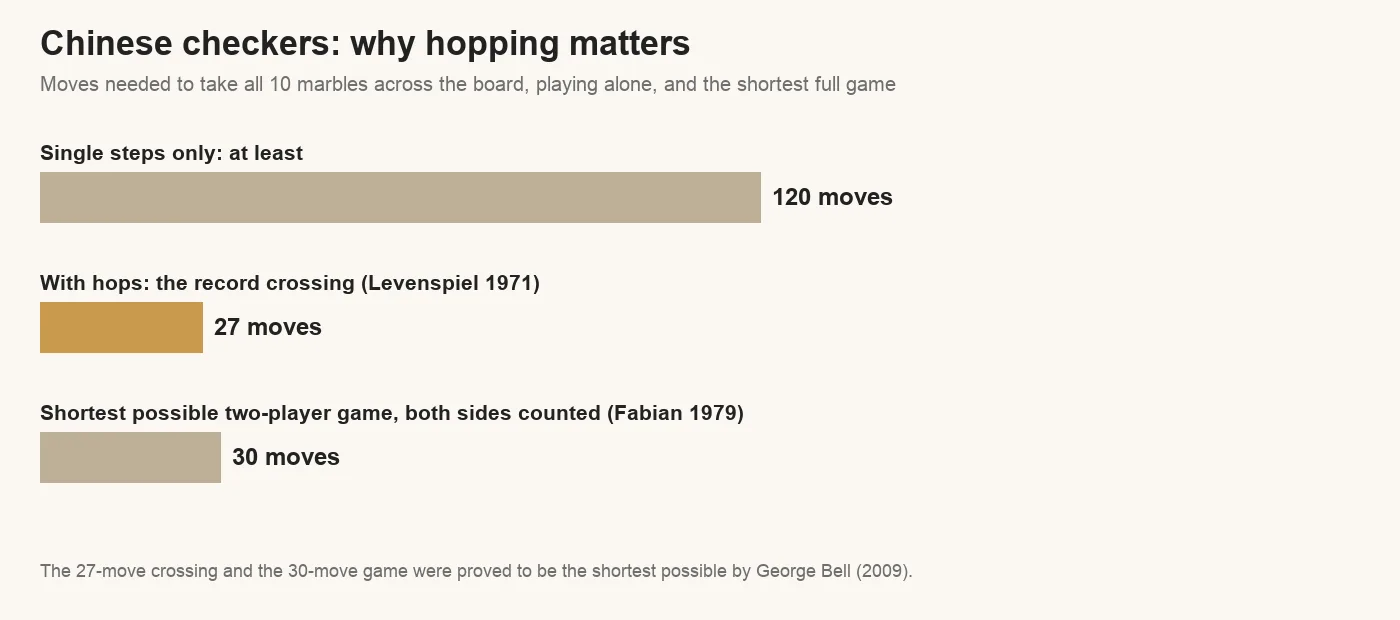
Chart: crossing the Chinese checkers board with single steps takes at least 120 moves, the record crossing with hops is 27 moves, and the shortest possible two-player game is 30 moves
Hops are what make the game fast: 27 moves instead of 120.

Chinese Checkers in Numbers

From the starting position of a two-player game, there are exactly 14 possible first moves. With single steps alone, taking ten marbles across the board needs at least 120 moves, because the marbles together have to cover that many holes. With hops, the record is far lower: Octave Levenspiel found a way to move all ten marbles across an empty board in 27 moves in 1971, and in 2009 George Bell used computer search to prove that no faster crossing exists.

The shortest possible complete game is 30 moves, 15 by each player, first found by David Fabian in 1979 and also proved optimal by Bell. It only works if both players cooperate to finish as fast as possible, but it shows that a sharp game can be much quicker than the game’s slow reputation suggests.

Where Chinese Checkers Comes From

The game started as Halma, invented in 1883 or 1884 by George Howard Monks, an American surgeon at Harvard Medical School, and played on a 16×16 square board. In 1892 a German version moved it onto a star-shaped board as Stern-Halma (“star Halma”), the name it still has in Germany. The name “Chinese checkers” was a marketing idea of Bill and Jack Pressman in the United States in 1928; their first version was sold as “Hop Ching checkers”. In China the game is now known as tiaoqi, “jump game”.

More Games to Try

For the classic game of jumps and kings on a square board, see checkers. For another strategy game for two, try mancala or backgammon.

Another family race game: Trouble, where you pop a 6 to get out and bump other pegs back home.

Chinese checkers: frequently asked questions

How do you play Chinese checkers?

Each player puts 10 marbles in one point of the star. Taking turns clockwise, you move one marble either one step to an adjacent empty hole or by hopping over a single marble into the empty hole beyond, as many hops in a row as you like. Nothing is captured. The first player to move all their marbles into the point opposite their start wins.

How many marbles do you need for Chinese checkers?

Ten per player, so 60 for a full six-player game. In a two-player game some people use 15 marbles each.

How do you set up Chinese checkers for 2 players?

Put each set of 10 marbles in opposite points of the star, so each player races into the other’s starting point. You can also play with two or three sets each.

Can you play Chinese checkers with 3 or 5 players?

Three players use three alternate points, each racing into an empty point opposite. The standard game is for two, three, four or six players; with five, the set-up can’t be made even for everyone.

Can you jump your own marbles in Chinese checkers?

Yes. You can hop over any marble, your own or an opponent’s, and the marble you jump stays where it is.

Do you have to jump in Chinese checkers?

No. Hopping is never compulsory, and you can stop a chain of hops whenever you want.

What is the best strategy in Chinese checkers?

Build and use long chains of hops (ladders) towards your home, avoid creating ladders your opponents can use, bring your back marbles forward early, and fill your home from the far end so the last marbles can still get in.

Is Chinese checkers actually Chinese?

No. It was invented in Germany in 1892 as Stern-Halma, a star-board version of the American game Halma, and was renamed Chinese checkers in the United States in 1928.

Fadi Hayek
Author & Casino Expert

After going through several successful experiences with several industry pioneers, Fadi Hayek has managed to excel in the world of content for online gaming by providing unique content for several projects that allowed him to obtain the necessary experience to launch his career. Last but not least, Fadi also holds several certificates, including but not limited to content marketing and iGaming.

Latest News

Artificial Intelligence in Gambling – How It Is Changing the Future of the Industry

As online casinos adopt machine learning models and artificial intelligence in gambling becomes the next disruption, you don’t want to be left behind. Read on to learn about the impact AI will have on the future of the gambling industry.

Arabian Football Betting Trends – Stay Current on Betting Preferences in the Middle East!

Keep abreast of the latest Arabian football betting trends with the Arabian sports betting insights below. This guide covers the most popular bet types with Arab bettors and the top bookmakers for Arabian and global football competitions.

Al-Nassr vs PSG | Cristiano Ronaldo vs Lionel Messi

The biggest event in world football is scheduled to take place later this month as Al Nassr vs PSG is on the cards.

Yggdrasil Collaborate with Reflex to Release Dublin Up DoubleMax

Yggdrasil and Reflex are set to launch Dublin Up DoubleMax, an Irish-style video, as one of their latest releases. The slot game is designed by incorporating Yggdrasil’s proprietary Game Engagement Mechanic (GEM) DoubleMax coupled with unique features like free spins bonus and fairy magic.