Trouble Board Game Rules
Pop a 6 to get out, race four pegs round the board and bump everyone else back home: the full rules of Trouble, plus strategy and odds.


Pop a 6 to get out, race four pegs round the board and bump everyone else back home: the full rules of Trouble, plus strategy and odds.
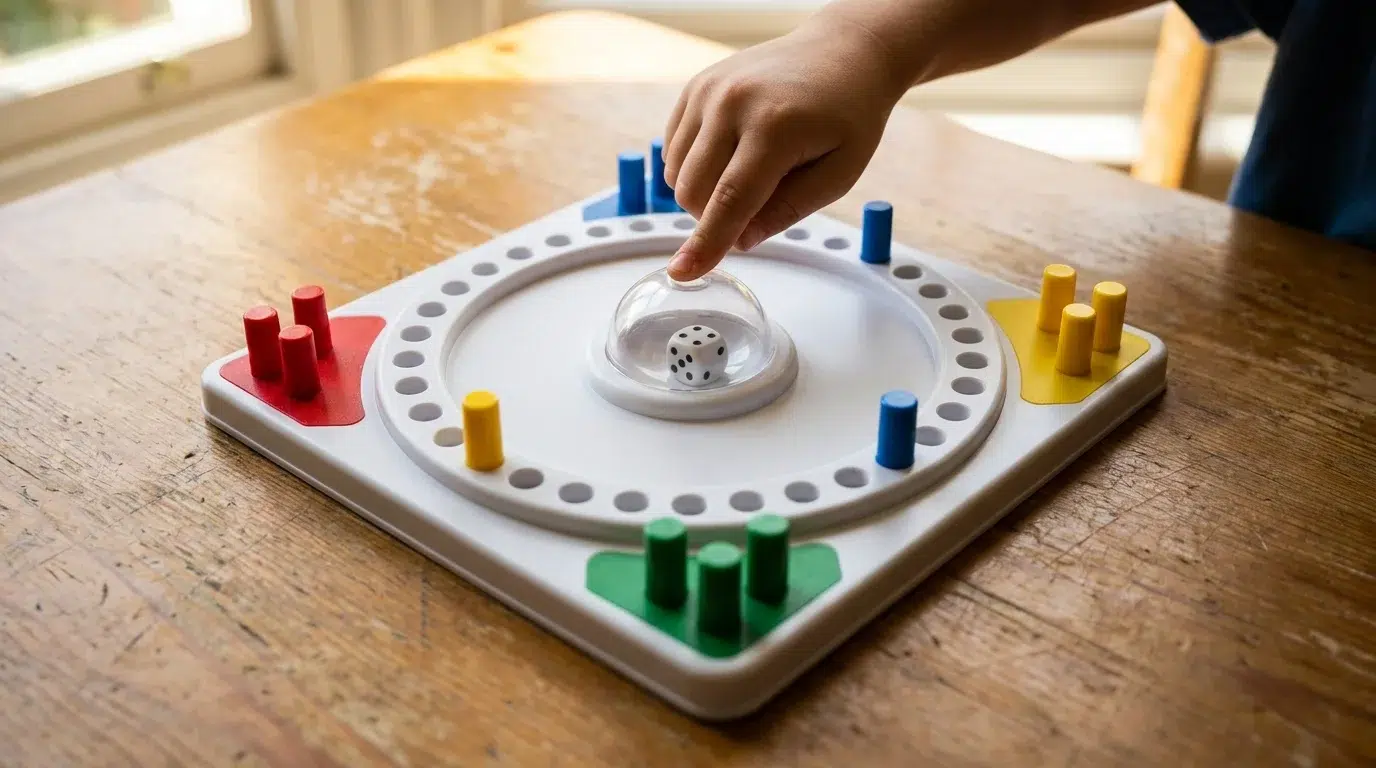
Trouble is the race-and-chase board game with the die sealed inside a clear plastic bubble, the Pop-O-Matic. Two to four players each try to move four pegs once around the board and into their FINISH line, and anyone who lands on another player’s peg sends it back HOME to start again. The rules fit on one page and a game takes about half an hour, which is why it has been a family favourite since 1965. In the UK the same game is sold as Frustration, and in Finland as Kimble.
| Trouble | |
|---|---|
| Players | 2 to 4. With two players, each can play two colours if they like. |
| Equipment | The board with the Pop-O-Matic die roller built in, and 16 pegs: 4 each in red, blue, yellow and green. |
| Board | A 28-hole track with a START hole every 7 holes, plus a HOME and a 4-hole FINISH line for each colour. |
| Goal | Be the first to move all 4 of your pegs once around the board and into your FINISH line. |
| Getting out | You need to pop a 6 to move a peg from HOME to START. |
| Bumping | Land on another colour’s peg and it goes back to its HOME. |
| Playing time | About 30 minutes. |
A turn is one pop of the die and one move, if you can make one. Pop a 6 and you get another pop and move straight away.
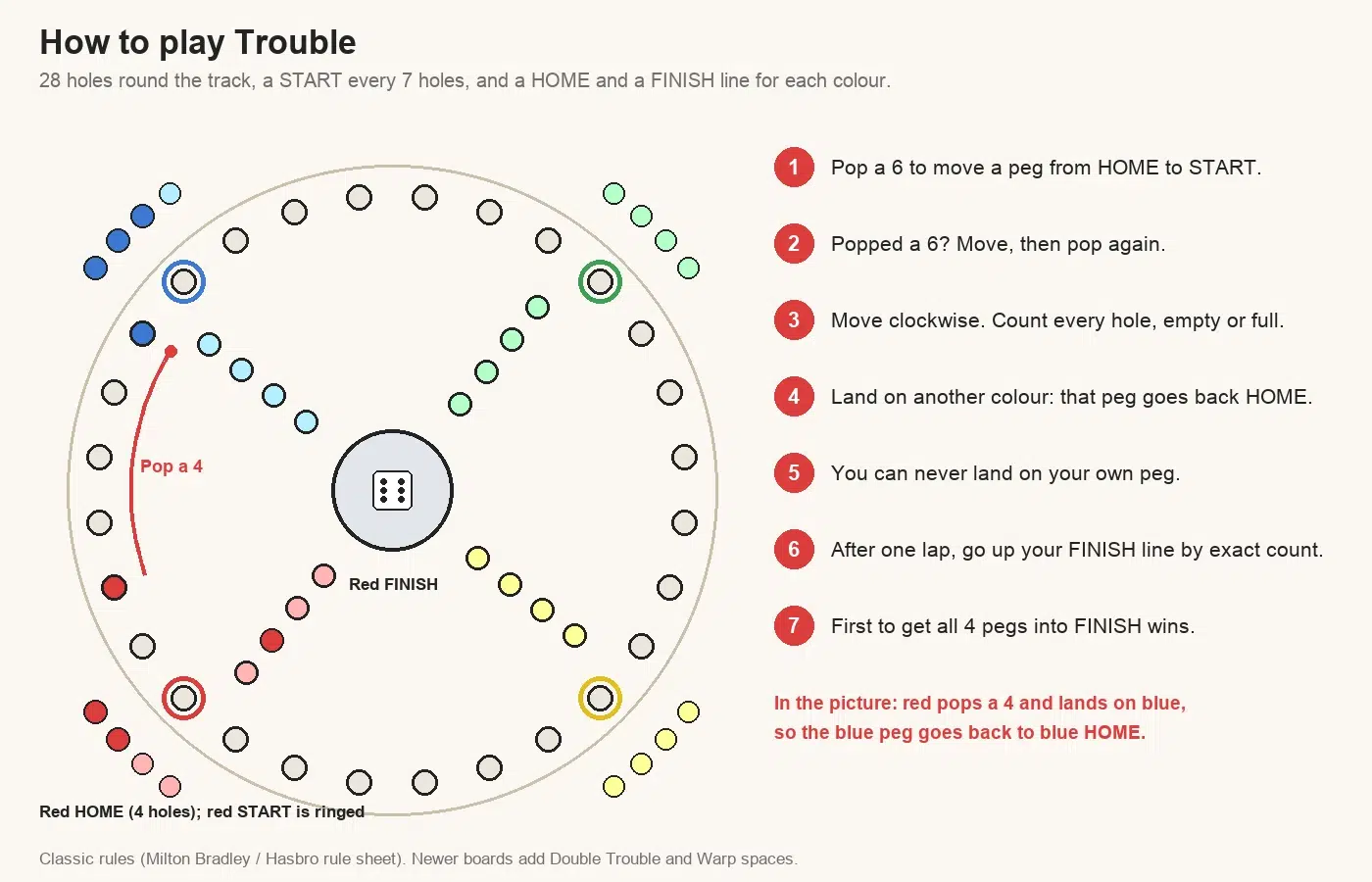
Each colour’s FINISH line is four holes leading in towards the Pop-O-Matic. Pegs in FINISH are safe, because nobody can move into another colour’s FINISH line. A peg can only enter it with the exact number needed to reach one of the FINISH holes, and once inside it can move further in only in the direction of the arrows and by exact count. If no peg can use the number you popped, you simply miss that move.
| Situation | What happens |
|---|---|
| You pop a 6 but have no peg you can move | Your turn doesn’t end: you still get your extra pop. |
| You pop a 6 and your own peg is on START | You can’t bring a new peg out. Use the 6 on a peg already on the track. |
| Another colour is on your START when you pop a 6 | Bring your peg out anyway. Theirs goes back to its HOME. |
| Your move would end on your own peg | Not allowed. Move a different peg, or miss the move. |
| There are pegs between you and your target | Jump them: every hole counts, empty or full. Only the hole you finish on matters. |
| You pop a 1 | On the classic rule sheet a 1 is an ordinary move of one hole. On some newer rule sheets, and in many homes, a 1 lets every other player move a peg from HOME to START instead. |
| The die doesn’t settle flat | Tap the bubble lightly until it does. Don’t pop it again. |
Newer Hasbro boards add two kinds of special hole to the track:
Older boards have neither. If yours has no XX or Warp markings, ignore both rules.
| Variation | How it differs |
|---|---|
| Easy finish | Many families drop the exact-count rule, so a peg that overshoots simply goes into the deepest empty FINISH hole. |
| Bonus for bumping | Send someone home and take another turn. |
| Two colours each | In a two-player game, each player runs two colours, eight pegs in all. |
| Double Trouble (1987) | A Milton Bradley spin-off played with two Pop-O-Matic dice rollers. |
| Travel Trouble | A smaller board with a cover to keep the pegs in, and a die with dots instead of numbers. |
| Headache | A Milton Bradley cousin with cone-shaped pawns and a different track. |
| Frustration and Kimble | The same game under its UK and Finnish names. |
Trouble comes from the same family as Ludo, which in turn comes from the Indian game pachisi, so the three feel alike. The main differences:
| Trouble | Ludo | Parcheesi | |
|---|---|---|---|
| Dice | One, inside the Pop-O-Matic | One | Two |
| Pieces each | 4 | 4 | 4 |
| To bring a piece out | A 6 | Usually a 6 | A 5 on one die, or the two dice adding up to 5 |
| Blocking | Not possible: you can jump any peg | Varies with the rule set | Two pawns on one space form a blockade no one can pass |
| Safe places | Your FINISH line | Your home column, plus marked safe squares in many versions | Your home path and the marked safety spaces |
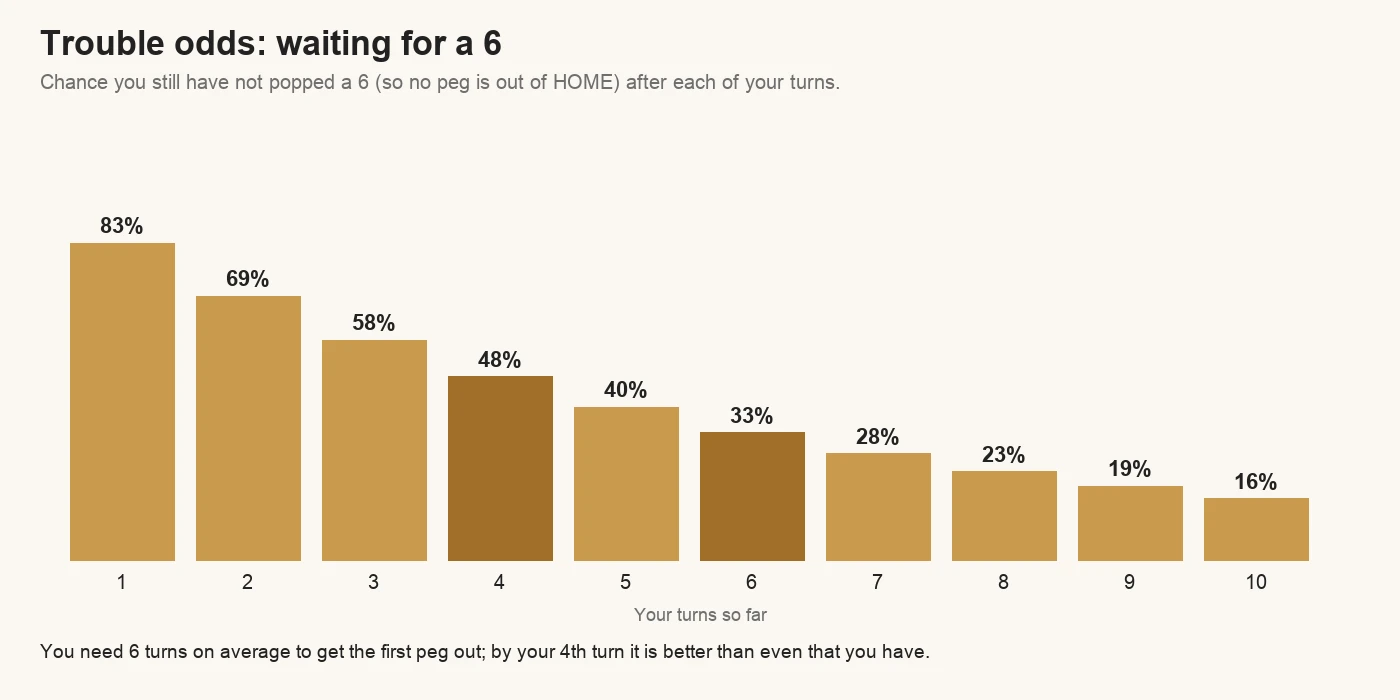
The die gives exact chances for the first few moves. The game-length figures come from 40,000 simulated games of each kind under the classic rules, with every player following the strategy above:
| Question | Answer |
|---|---|
| Chance of popping a 6 | 1 in 6 (17%) on every pop |
| Still no peg out after 3 turns | 58% |
| Still no peg out after 6 turns | 33% |
| Average turns to get your first peg out | 6 |
| An opponent 1–6 holes behind you hits you on their next turn | 1 in 6, if they choose to |
| An opponent 7–12 holes behind you | 1 in 36: they need a 6 first |
| Length of a four-player game | About 54 turns each |
| Bumps in a four-player game | About 16 |
| Length of a two-player game | About 45 turns each |
| Going first in a four-player game | Wins 26% of games, against a fair share of 25% |
| The strategy above against three players moving at random | Wins 38% |
Bumping is what makes the game long. With nobody ever sent home, the same four-player game takes about 20 fewer turns each. Dropping the exact-count rule for FINISH saves about 3 turns each.
Trouble was developed by the Kohner Brothers and first made by Irwin Toy, then by Milton Bradley, now part of Hasbro. It was launched in America in 1965, and Winning Moves Games USA sells a classic edition. The game is based on a traditional race game called Frustration, played with marbles on a wooden board, and its track and rules come from Ludo, the British game descended from pachisi. Its big idea was the Pop-O-Matic: a clear dome over a springy base that rolls the die when you press it, so the die never gets lost and turns go round quickly. The die is printed with numbers rather than dots.
For more board games with simple rules, see checkers, Chinese checkers and mancala. If you like dice, try Farkle, Shut the Box or Left Right Center.
The card-driven cousin: Sorry!, where a deck of cards replaces the die and a Sorry! card sends a rival straight back to Start.
An older cousin: Parcheesi, the American version of pachisi, played with two dice.
A close relative: Aggravation, the marble race game for up to six players.

After going through several successful experiences with several industry pioneers, Fadi Hayek has managed to excel in the world of content for online gaming by providing unique content for several projects that allowed him to obtain the necessary experience to launch his career. Last but not least, Fadi also holds several certificates, including but not limited to content marketing and iGaming.


