Build out from the sevens and be first to empty your hand. How to play Sevens, also called Fan Tan or Parliament.
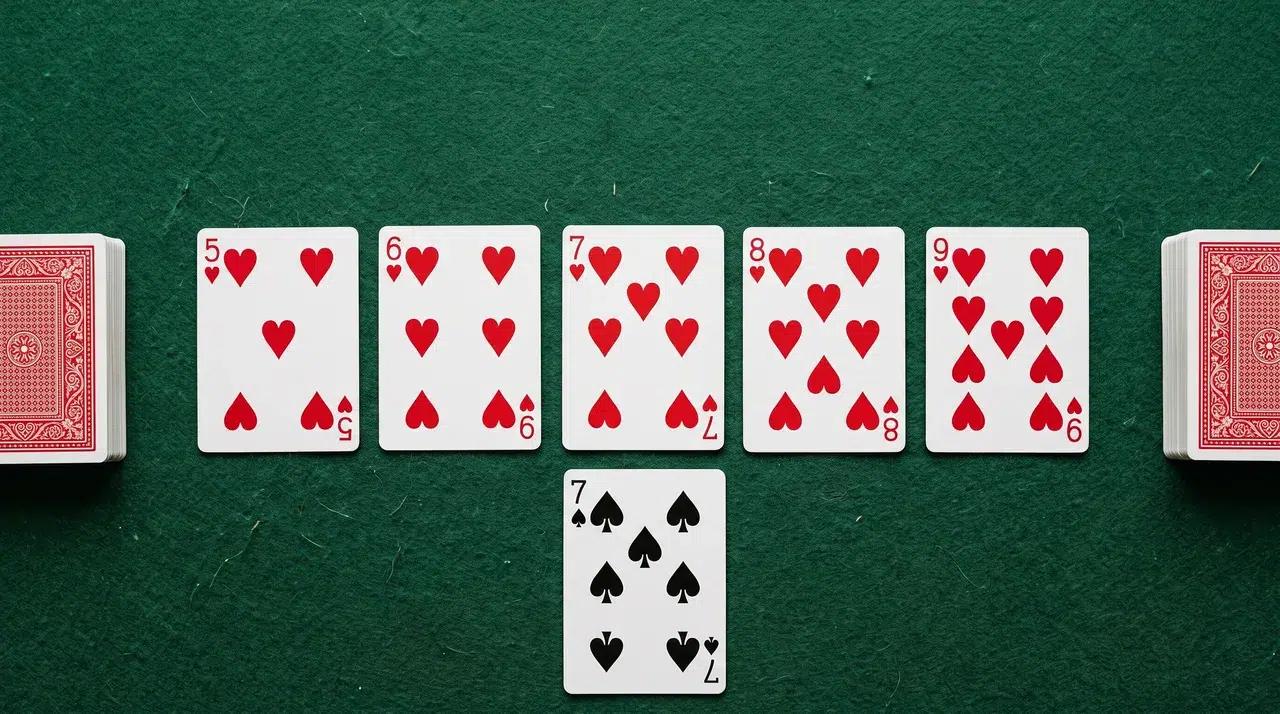
The hearts have been built out from the 7 to the 5 and the 9; the 7 of spades has opened a new row.
Sevens is a simple card game in which players race to get rid of their cards by building four rows, one for each suit, outwards from the sevens. It is also known as Fan Tan, Parliament, Card Dominoes or Domino, and is played around the world under local names – in India it is Badaam Saat or Satti Centre, in Japan Shichi Narabe. It takes a minute to learn and works for three to eight players, yet there is real skill in choosing which card to play. This guide covers the Sevens card game rules, scoring and staking, the main variations, and what a simple blocking strategy is worth.
Sevens Rules at a Glance
Sevens
Players
Three to about eight; four to six is best.
Cards
A standard 52-card pack. In each suit the cards run 2, 3 … 10, Jack, Queen, King, Ace (Ace high).
Deal
All the cards, one at a time. Some players may have one card more than others.
Start
The player holding the 7 of hearts plays it.
On your turn
Play one card: any 7, or the next card up or down in a suit whose 7 is already on the table.
Can’t play
Pass. You may only pass if none of your cards can be played.
Winner
The first player to play all their cards.
How to Play Sevens
Deal everything. Shuffle and deal the whole pack one card at a time, clockwise from the dealer’s left. It does not matter if some players get an extra card.
Open with the 7 of hearts. Whoever holds the 7 of hearts plays it face up in the middle of the table. Play then passes clockwise.
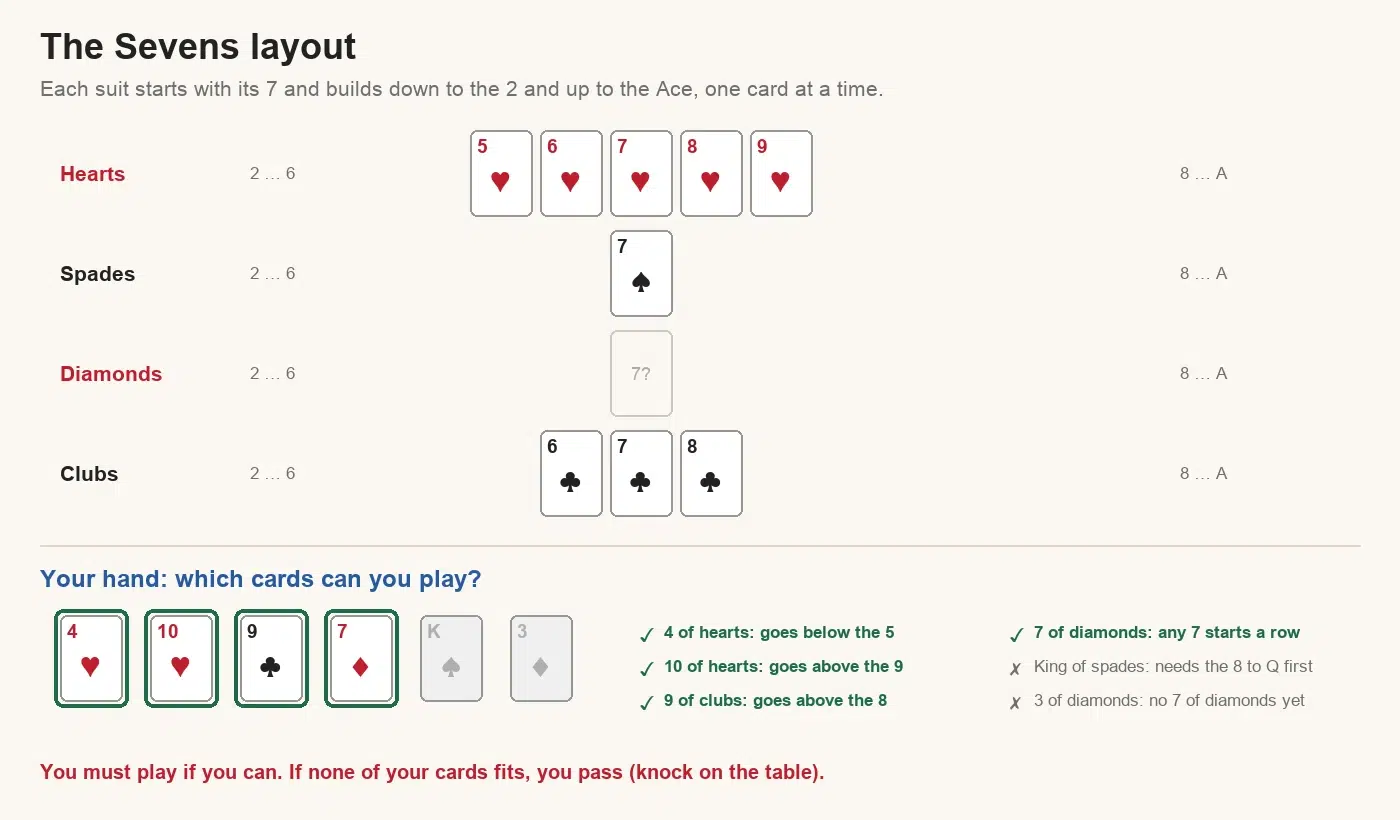
Play one card per turn. On your turn you may play either any 7, which starts a new row for its suit, or a card that is next in sequence to a card already in a row: the 6 or 8 of that suit, then the 5 or 9, and so on.
Build both ways. Each row grows down from the 7 to the 2 on one side and up from the 7 to the Ace on the other. To save space, many players pile the low cards on the 6 and the high cards on the 8.
Play if you can. If you hold a card that can be played, you must play one – but you choose which. If you cannot play, you pass, sometimes by knocking on the table.
Go out. The first player to get rid of all their cards wins. Many groups play on to decide second and third place.
Any 7, or the next card up or down in a row already on the table.
Scoring and Staking
For a quick game, the first player out simply wins. For a longer session, use one of these:
Points. When someone goes out, every other player scores one point per card left in their hand. Play until someone reaches 100; the lowest total wins. Some groups count card values instead – number cards at face value, picture cards 10 and Aces 15 – so that being caught with high cards costs more.
Counters (Fan Tan). Everyone puts one counter in a pool before the deal, and a player with fewer cards adds one more. Every time you pass, you add a counter. When someone goes out, the others pay one counter per card left, and the winner takes the pool.
Penalties. In the Fan Tan rules, a player who passes when they could have played pays three counters, plus five more to the holders of the 6 and 8 if they held back a 7.
Sevens Around the World
The same layout game is played almost everywhere, with small local twists:
Country
Name
What’s different
UK
Sevens, Parliament
Often starts with the 7 of hearts; some groups use the 7 of diamonds.
USA
Fan Tan, Play or Pay
Played with a pool of counters and penalties for passing.
India
Badaam Saat, Satti Centre
Starts with the 7 of hearts; more than one pack may be used. The others score the value of the cards left in their hands (Jack 11, King 13), and the player with most points after a set of games loses.
Japan
Shichi Narabe
All four 7s are laid out before play starts, and each player may choose to pass up to three times a game.
Sweden
Sjuan
Starts with the 7 of hearts. A player who cannot play is handed a card by the previous player.
Finland
Ristiseiska
Starts with the 7 of clubs; the 8 and the 6 of a suit must both be down before the row can grow further.
Spain
Cinquillo
Played with the 40-card Spanish pack, building from the fives.
Russia
Deviatka
Starts with the 9 of diamonds, with 36 or 52 cards.
France
Domino
The first player chooses the starting rank, and every row must start with that rank.
Other house rules
Who starts: some groups let the player on the dealer’s left start with any 7, or start with the 7 of diamonds.
Aces low: the Ace sits below the 2 instead of above the King.
Equal hands: deal everyone the same number of cards and turn the leftovers face up for anyone to use.
Eight before six: in each suit the 8 must be played before the 6.
Sevens Strategy
You must play if you can, but you choose which card – and that choice decides most games. The idea is simple: play cards that open the way for your own cards, and hold back cards that would only help your opponents.
Sit on 7s, 6s and 8s you don’t need. If you hold the 7 of clubs but no other clubs, playing it only lets everyone else unload their clubs. Keep it until you have nothing else to play.
Open your long suits. If you hold the 8, 10 and Queen of hearts, playing the 8 starts a path you will use yourself.
Get rid of end cards when you can. Low 2s and 3s and high Kings and Aces can only go down late, so play them as soon as they become legal.
Watch who passes. A player who knocks is stuck in the suits that are open; keep those gaps closed if you can.
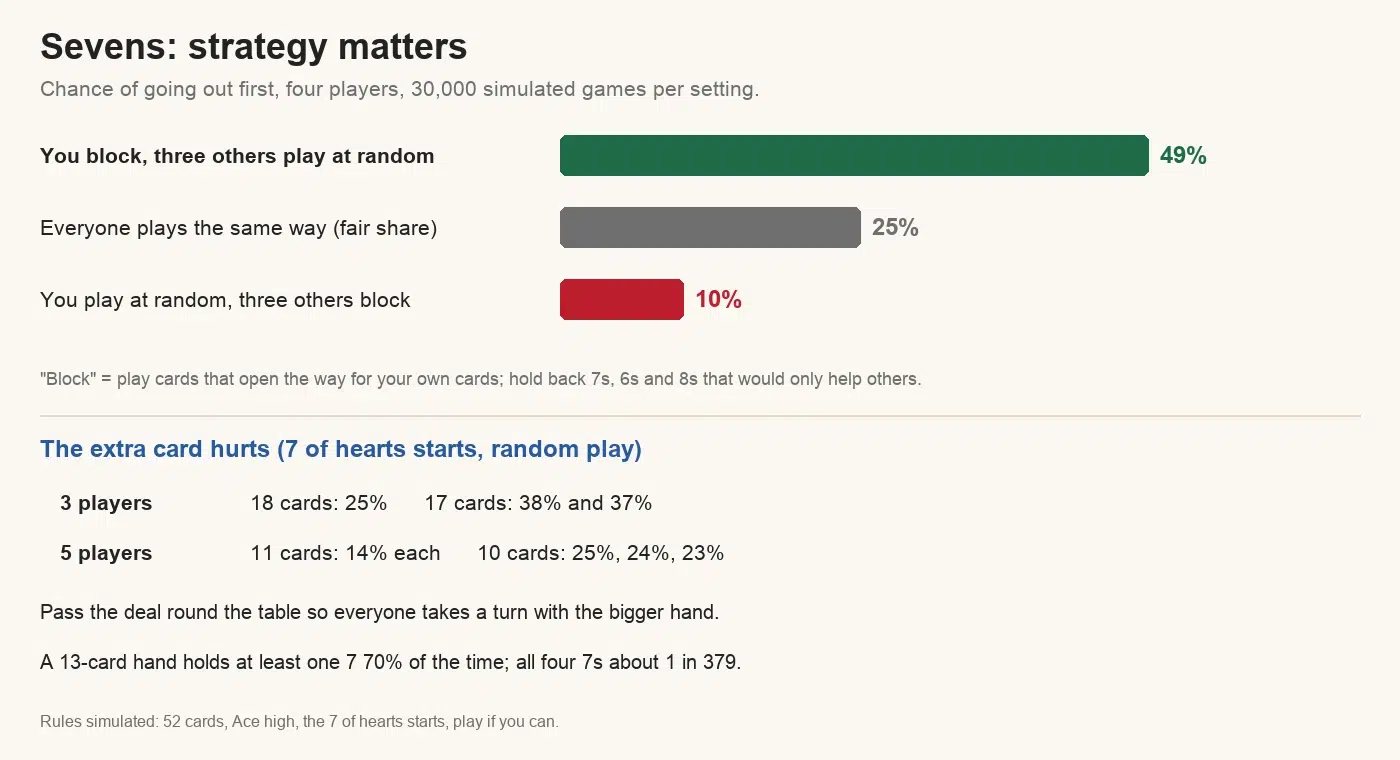
The effect is large. In 30,000 simulated four-player games, a player using this blocking approach against three players choosing their card at random went out first 49% of the time – nearly double the fair share of 25%. Turn it round, and a random player against three blockers won only 10%.
Choosing the right card nearly doubles your chance of winning.
Sevens Odds
The extra card is a handicap. When the 7 of hearts starts, being dealt one card more than the others costs you. With three players and random play, the 18-card hand went out first 25% of the time against 38% and 37% for the 17-card hands; with five players, each 11-card hand won 14% against 23–25% for the 10-card hands. Passing the deal round the table evens this out over a session.
Sevens in your hand. With four players (13 cards each), you hold at least one 7 70% of the time; all four 7s about once in 379 deals.
Passing. In random four-player games, each player passes about 1.4 times a game; against blockers, a random player passes 2.6 times.
Another easy shedding game:Crazy Eights, where you match suit or rank and the eights are wild.
Prefer real dominoes? Try Mexican Train, where every player builds a train out from the centre.
Sevens card game: frequently asked questions
How do you play Sevens?
Deal all 52 cards. The player with the 7 of hearts plays it, then play goes clockwise. On your turn play any 7 to start a new row, or the next card up or down in a suit whose 7 is on the table. If you cannot play, you pass. The first player to get rid of all their cards wins.
Can you pass in Sevens if you can play?
No. In the standard rules you must play a card if you have one that fits; you only choose which one. In the Fan Tan version, passing when you could have played costs a penalty.
How many cards do you get in Sevens?
All the cards are dealt out, so it depends on the number of players: 13 each with four players, 17 or 18 with three, and 10 or 11 with five.
Can you play Sevens with two players?
Yes, although most rules suggest three to eight players. With two, each player is dealt 26 cards.
Who starts in Sevens?
Usually the player holding the 7 of hearts. Some groups start with the 7 of diamonds, or let the player on the dealer’s left play any 7.
Is Sevens the same as Fan Tan?
Yes. Sevens, Fan Tan, Parliament, Card Dominoes and Domino are names for the same layout game. The Fan Tan rules usually add a pool of counters and penalties for passing.
What is the best strategy in Sevens?
Play cards that open the way for your own cards and hold back 7s, 6s and 8s in suits where you have nothing further, since they only help other players. In simulated four-player games this nearly doubled a player’s chance of going out first, from 25% to 49% against random play.
What is Badaam Saat?
Badaam Saat, also called Satti Centre, is the Indian name for Sevens. It starts with the 7 of hearts, may use more than one pack, and players score the value of the cards left in their hands.
Fadi Hayek
Author & Casino Expert
After going through several successful experiences with several industry pioneers, Fadi Hayek has managed to excel in the world of content for online gaming by providing unique content for several projects that allowed him to obtain the necessary experience to launch his career. Last but not least, Fadi also holds several certificates, including but not limited to content marketing and iGaming.
As online casinos adopt machine learning models and artificial intelligence in gambling becomes the next disruption, you don’t want to be left behind. Read on to learn about the impact AI will have on the future of the gambling industry.
Keep abreast of the latest Arabian football betting trends with the Arabian sports betting insights below. This guide covers the most popular bet types with Arab bettors and the top bookmakers for Arabian and global football competitions.
Yggdrasil and Reflex are set to launch Dublin Up DoubleMax, an Irish-style video, as one of their latest releases. The slot game is designed by incorporating Yggdrasil’s proprietary Game Engagement Mechanic (GEM) DoubleMax coupled with unique features like free spins bonus and fairy magic.