How to Play Bunco
Roll three dice, match the round number and shout Bunco: the rules of the party dice game, with a printable score card.


Roll three dice, match the round number and shout Bunco: the rules of the party dice game, with a printable score card.

Bunco is a fast, noisy dice game played in teams, usually by 12 people at three tables of four. Players take turns rolling three dice and score points for every die that matches the round number. Three of the round number is a Bunco, worth 21 points. There are six rounds, partners change every round, and there is no skill involved at all, which is exactly why it has become one of the most popular party and club games in the United States. This guide explains how to play Bunco: what you need, setting up, the rules and scoring, moving between tables, a printable score card, popular variations and the odds.
| Bunco | |
|---|---|
| Players | Usually 12, at three tables of four. Any multiple of four works. |
| Teams | Two teams of two at each table; partners sit opposite each other. |
| Equipment | Three dice per table, a bell for the head table, score cards and pencils. |
| Rounds | Six rounds, numbered 1 to 6. A night is usually several games of six rounds. |
| Scoring | 1 point for each die showing the round number, 5 for three of a kind of another number, 21 for a Bunco. |
| Your turn | Keep rolling as long as you score; pass the dice to your left when you don’t. |
| End of a round | When a team at the head table reaches 21 points and rings the bell. |
| Winning | Count your round wins, losses and Buncos at the end of the night. |
Number the tables. Table 1 is the head table (also called the high table) and gets the bell; with three tables, the others are the middle and low tables. Seat four players at each table. Players sitting opposite each other are partners for the round. At each table, one player volunteers as scorekeeper and keeps the table tally.
| You roll… (example: round 4) | Points |
|---|---|
| One die showing the round number (4, 2, 6) | 1 |
| Two dice showing the round number (4, 4, 1) | 2 |
| No dice showing the round number (5, 2, 1) | 0, and your turn ends |
| Three of a kind of another number (6, 6, 6): a mini Bunco | 5 |
| Three of the round number (4, 4, 4): a Bunco | 21, and call out “Bunco!” |
A Bunco at the head table ends the round, because 21 points is enough on its own (the player still finishes their turn). At the other tables, a Bunco simply adds 21 to the team’s score. Every player keeps a tally of their own Buncos on their score card; the partner doesn’t.
It is round 1, so 1s score. Anna, the scorekeeper, rolls 1, 1, 3 for 2 points and rolls again: 4, 2, 1 adds 1 more. Then 6, 6, 2 scores nothing, so her turn ends with 3 points. Beth rolls 2, 1, 6 (1 point), then 5, 4, 1 (1 point), then 3, 4, 5: 2 points for her team. Carla, Anna’s partner, rolls 3, 3, 3. That is three of a kind but not 1s, so a mini Bunco: 5 points. Her next roll scores nothing. Dana rolls 1, 1, 1: a Bunco, 21 points. At the head table she rings the bell, then finishes her turn: 4, 3, 3 scores nothing. Beth and Dana win the round 23 to 8.
After every round, players move so that partners keep changing. With three tables, the usual pattern is:
| Table | Winners | Losers |
|---|---|---|
| Head table (1) | Stay; one player moves a seat to change partner | Move down to table 2 |
| Middle table (2) | Move up to the head table | Move down to table 3 |
| Low table (3) | Move up to table 2 | Stay; one player moves a seat to change partner |
With more tables the same idea applies: winners move up a table, losers move down, and the teams that stay split up so everyone gets a new partner. Hosts often put a sign on each table showing where winners and losers go.
Each player needs a score card with a box for every round, where they write W for a win or L for a loss, and a place to tally their Buncos. The scorekeeper at each table also keeps a tally of the two teams’ points. Open the score card below in a new tab and print one for each player.
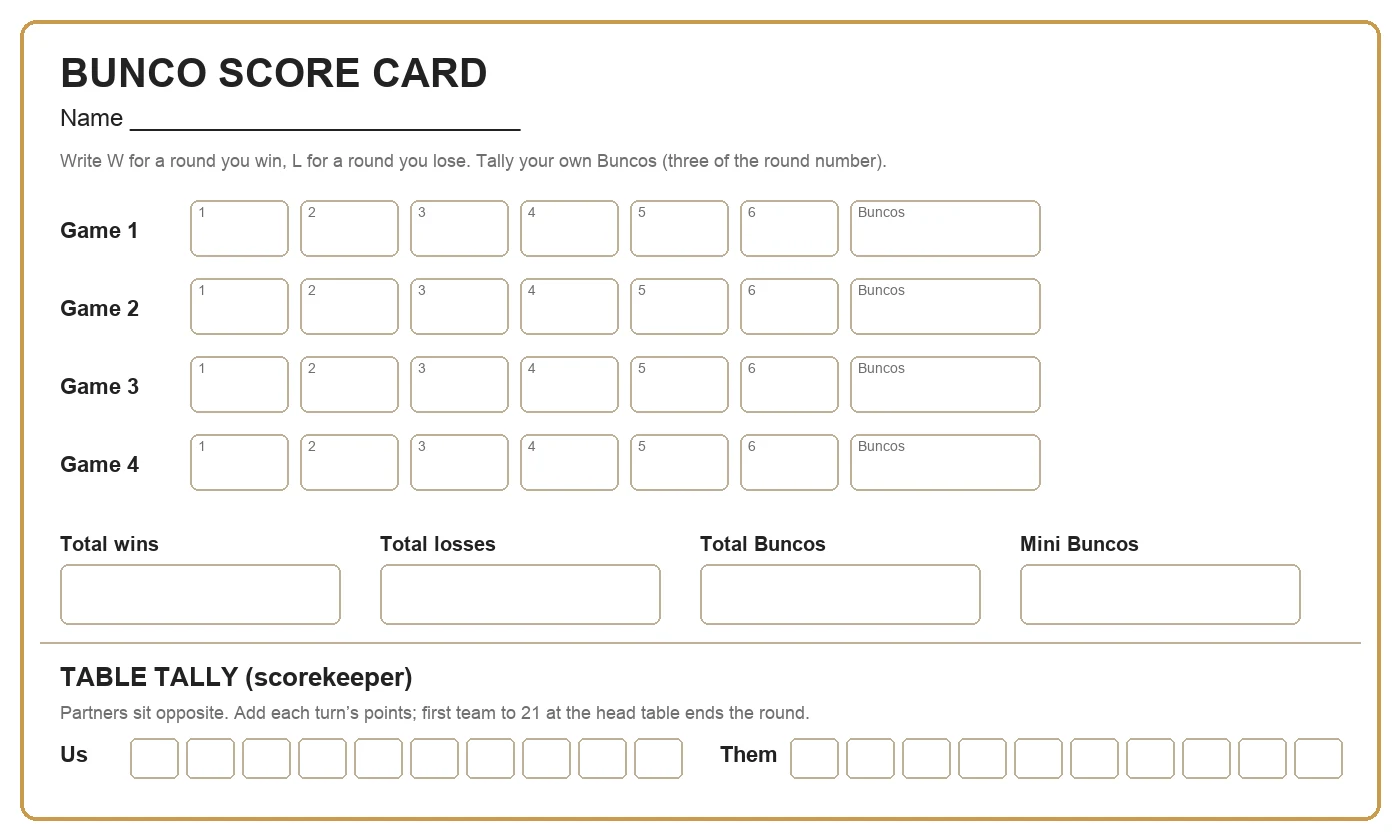
A night of Bunco usually runs to several games of six rounds. At the end, everyone totals their wins, losses and Buncos. Groups often give small prizes in categories such as:
| Variation | What changes |
|---|---|
| Tie roll-off | If a table is tied at the end of a round, each player takes one more turn, starting with the scorekeeper, until one team leads. |
| Stop at the bell | Everyone stops rolling the moment the bell rings, instead of finishing their turn. |
| Traveling | A soft die or bean bag goes to anyone who rolls an agreed combination, such as three 2s in any round. Whoever holds it at the end wins a prize. |
| Ghost players | Groups that don’t divide by four can fill a seat with a “ghost” player. |
| Fewer games | Some groups play two or three games of six rounds; others play five or six. |
Bunco began in 19th-century England as a dice game called “eight dice cloth”. It reached San Francisco around 1855 as a gambling game, where crooked “bunco parlors” gave the word its meaning of a swindle. After the Civil War it became a parlor game, returned to speakeasies during Prohibition (the police units that raided them were called “bunco squads”), and came back as a family and club game from the 1980s.
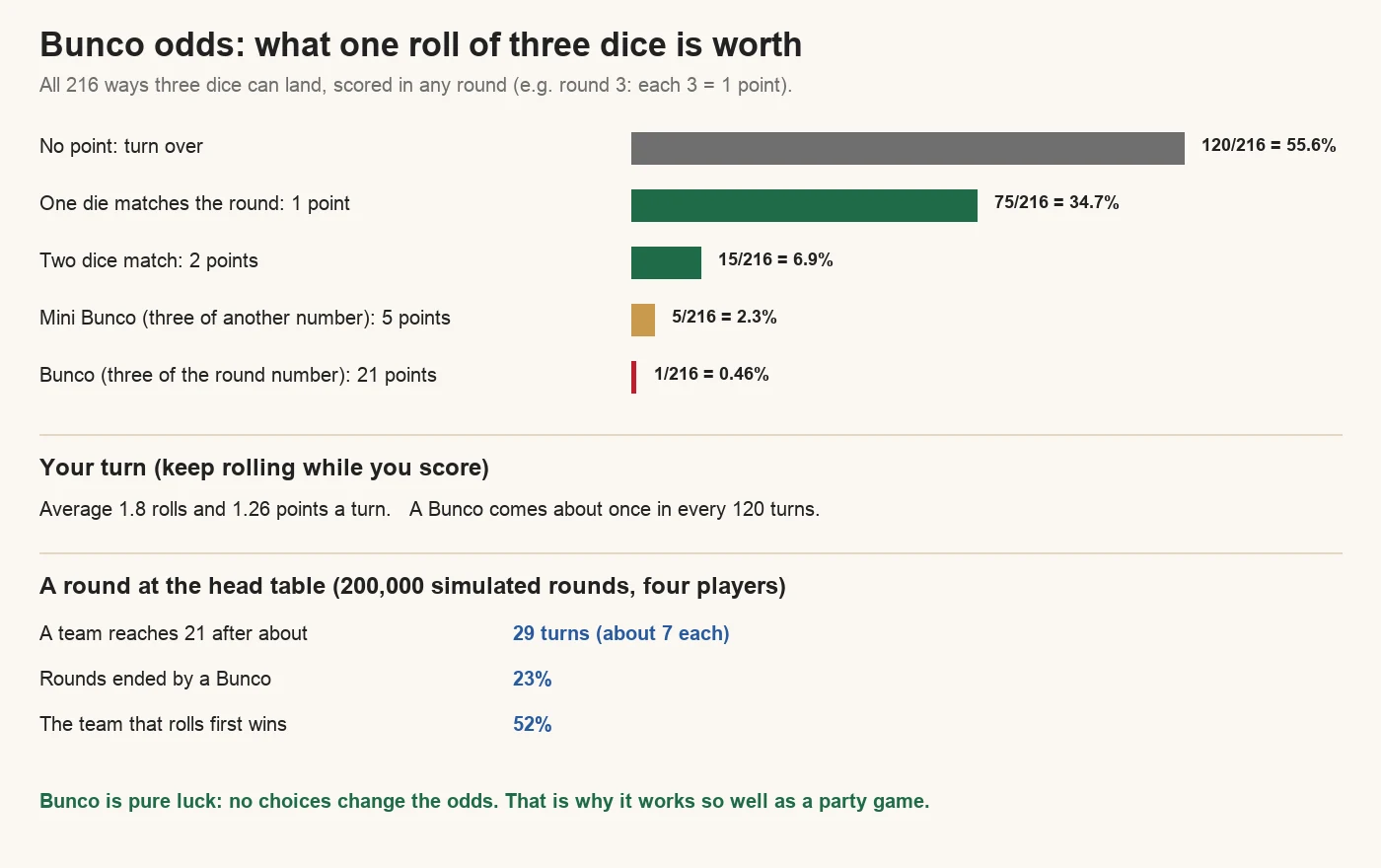
Three dice can land 216 ways, and in any round the scores work out the same:
Across 200,000 simulated rounds at a head table of four, a team reached 21 after about 29 turns (about 7 each), 23% of rounds ended with a Bunco, and the team that rolled first won 52%. Bunco is pure luck: there are no decisions that change the odds, so anyone can win.
If you enjoy Bunco, try Farkle, Liar’s Dice and Shut the Box, or the casino dice games Craps and Sic Bo.
Another game for a big group: Mexican Train dominoes, for up to eight players.
Another dice game for a big group: Left Right Center (LCR), where three dice decide who keeps their chips.

After going through several successful experiences with several industry pioneers, Fadi Hayek has managed to excel in the world of content for online gaming by providing unique content for several projects that allowed him to obtain the necessary experience to launch his career. Last but not least, Fadi also holds several certificates, including but not limited to content marketing and iGaming.


